
Gerhard Mercator
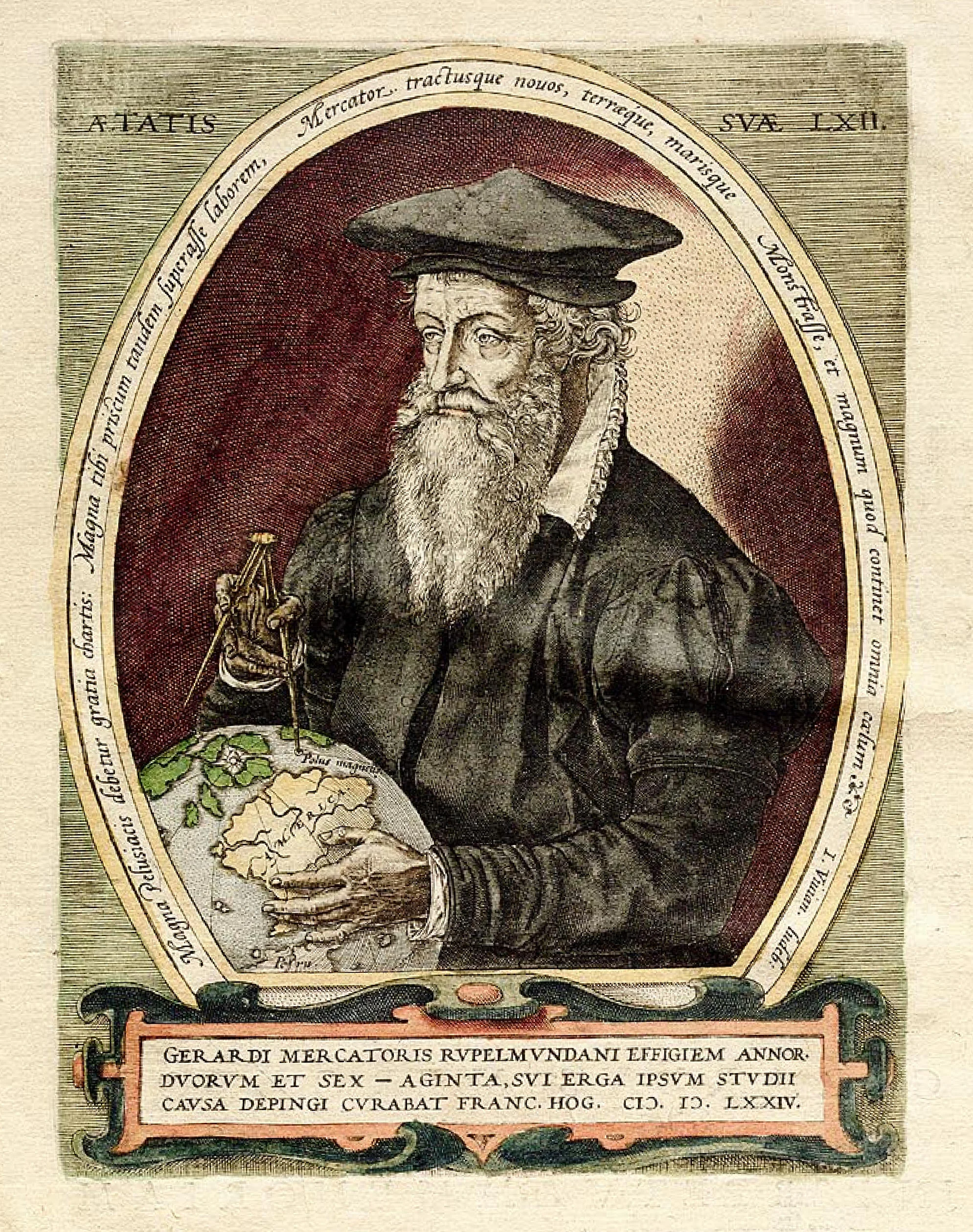
Image from Wikipedia
Image from Wikipedia
Gerhard Mercator – The Cartographer Who Reordered the World
A Humanist Between Science, Workshop, and Worldview
Gerhard Mercator, born Gheert Cremer in Rupelmonde and later Latinized to Gerardus Mercator, is one of the most influential scholars of the 16th century. He was born in 1512 and died in 1594 in Duisburg; even during his lifetime, he was regarded as one of the great cartographers of his time. His work combined technical precision, scientific curiosity, and humanistic education into an intellectual signature that continues to resonate today. ([britannica.com](https://www.britannica.com/biography/Gerardus-Mercator?utm_source=openai))
Biography: From Flanders to Duisburg
Mercator studied from 1530 in Leuven and early on developed into an exceptionally talented engraver, calligrapher, and instrument maker. During this educational phase, he worked in the circle of Gemma Frisius and was involved in the production of globes, which significantly influenced his later cartographic language. Already at the age of 24, Britannica described him as a highly qualified engraver, lettering artist, and manufacturer of scientific instruments. ([britannica.com](https://www.britannica.com/biography/Gerardus-Mercator?utm_source=openai))
The move to Duisburg in 1552 marked a new, productive phase of his life. In the Kleve city, numerous wall maps were created, and from 1559 he taught mathematics, cosmology, and cartography there two days a week at the Academic Gymnasium. The combination of teaching, research, and workshop work made Duisburg a center of his artistic-scientific practice. ([de.wikipedia.org](https://de.wikipedia.org/wiki/Gerhard_Mercator?utm_source=openai))
The Breakthrough: The World Map of 1569
The actual turning point in Mercator's career came in 1569 with the world map that later became famous as the basis for the Mercator projection. This projection represented meridians and parallels in such a way that navigation courses could be plotted as straight lines, revolutionizing seafaring. For maritime practice, this was a milestone of historical significance, as constant bearings became directly readable on a map for the first time. ([britannica.com](https://www.britannica.com/science/Mercator-projection?utm_source=openai))
With this, Mercator solved not only a geometric problem but also shifted the relationship between space, representation, and orientation. His map was optimized for navigational purposes, while also serving as an intellectual statement: science could not only describe the world but transform it into a more precise model of order. This is precisely where the lasting fascination with his work lies. ([britannica.com](https://www.britannica.com/science/Mercator-projection?utm_source=openai))
The Great Work: Atlas, Chronologia, and Cartographic School
In Mercator's later works, alongside cartography, cosmographic and religious literature increasingly emerged. The Chronologia is considered his first major written work, and shortly before his death, he completed the creation story as an introduction to his main work. The planned collection of maps was published posthumously by his sons and grandsons, giving a whole genre its name: the Atlas. ([de.wikipedia.org](https://de.wikipedia.org/wiki/Chronologia_%28Gerhard_Mercator%29?utm_source=openai))
The development of the atlas shows Mercator as an author with a long-term vision. Not only were the maps themselves crucial to him, but also the ordering of the world, its structure, and its readable format. His work combined geography, history, theology, and philological precision into an encyclopedic idea that remained deeply rooted in European knowledge culture. ([britannica.com](https://www.britannica.com/science/geography/The-emergence-of-geography-exploration-and-mapping?utm_source=openai))
Musical Metaphor? No – A Cartographic Discography of Masterpieces
Gerhard Mercator naturally does not have a classical discography; his oeuvre consists of maps, globes, and scientific writings. His important cartographic works include the map of the Holy Land from 1537, the world map from 1538, the Flanders map from 1540, the Europe map from 1554, and the British Isles from 1564. These works mark a development from early, large-format maps to a mature, systematic understanding of cartography. ([spektrum.de](https://www.spektrum.de/lexikon/geographie/mercator-gerardus/5013?utm_source=openai))
Particularly significant remained the Mercator Atlas, which was published posthumously in 1595 and appeared in expanded editions later. In this collection, his entire thinking was condensed: regional accuracy, universal claims, and a visual language that is still associated with cartographic authority today. When speaking of a “catalog” in relation to Mercator, one does not mean songs, but rather key works in the history of European knowledge. ([britannica.com](https://www.britannica.com/biography/Gerardus-Mercator?utm_source=openai))
Style and Method: Precision, Geometry, and Humanistic Openness
Mercator's style was characterized by an extraordinary combination of mathematical rigor and aesthetic clarity. His maps were marked by technical accuracy, clean linework, and a readability that fused scientific orientation with visual elegance. At the same time, he was not merely a technician, but a humanist who integrated geography, theology, philosophy, and natural observation. ([britannica.com](https://www.britannica.com/biography/Gerardus-Mercator?utm_source=openai))
The famous Mercator projection particularly impressively illustrates this way of thinking. It provided a solution for navigation but consciously accepted distortions that remain visible on world maps to this day. It is this tension between utility and distortion that makes Mercator's work a classic example of scientific innovation that continues to inspire debate. ([britannica.com](https://www.britannica.com/science/Mercator-projection?utm_source=openai))
Cultural Influence: The Name Mercator as a Concept
Mercator's influence extends far beyond cartography. His name today represents technical precision, scientific openness, and a form of tolerance derived from the humanistic Europe of the 16th century. Numerous institutions, projects, and places carry his name, and his iconic image with beard, cap, globe, and compass has become a cultural motif in its own right. ([de.wikipedia.org](https://de.wikipedia.org/wiki/Gerhard_Mercator?utm_source=openai))
Even in Duisburg, Mercator remains present today: The Cultural and City Historical Museum houses a significant Mercator collection, and the city views him as a key figure in its history. This local grounding meets with international impact, as the Mercator projection remained influential in navigation and map understanding for centuries. Thus, a scholar became a lasting cultural reference. ([stadtmuseum-duisburg.de](https://www.stadtmuseum-duisburg.de/schatzkammer/?utm_source=openai))
Current Reception and Today's Relevance
Current "projects" in the sense of a musical presence are naturally absent with Mercator; his presence emerges through research, exhibitions, and museum mediation. The Duisburg City Museum, the Mercator Society, and municipal initiatives keep his work present in public consciousness and emphasize his role as a world scholar. Thus, Mercator remains a historical name with a modern echo. ([mercator-gesellschaft.de](https://www.mercator-gesellschaft.de/?utm_source=openai))
Especially in a time when maps, data, and global orientation are ubiquitous, Mercator's thinking appears remarkably contemporary. His work shows how closely scientific accuracy, cultural order, and visual representation are intertwined. To look at Mercator is not merely to look at a cartographer but to see an architect of the European worldview. ([britannica.com](https://www.britannica.com/science/world-map?utm_source=openai))
Conclusion: A Work of Rare Extent
Gerhard Mercator fascinates because he not only created maps but also ways of thinking. His projection, his atlas, and his scientific stance changed how Europe read, measured, and ordered the world. Those who follow his biography encounter a scholar who unified precision, curiosity, and cultural breadth at the highest level. ([britannica.com](https://www.britannica.com/biography/Gerardus-Mercator?utm_source=openai))
For this reason, it is worthwhile to rediscover Mercator today: in museums, in historical cartographic works, and in the history of European knowledge. His work is not a concert in the usual sense, but a monumental cultural performance that continues to resonate today. Those who enter his world experience the origin of modern orientation. ([stadtmuseum-duisburg.de](https://www.stadtmuseum-duisburg.de/schatzkammer/?utm_source=openai))
Official Channels of Gerhard Mercator:
- Instagram: No official profile found
- Facebook: No official profile found
- YouTube: No official profile found
- Spotify: No official profile found
- TikTok: No official profile found
Sources:
- Britannica – Gerardus Mercator
- Britannica – Mercator projection
- Britannica – Atlas
- Deutsche Biographie – Mercator, Gerhard
- Cultural and City Historical Museum Duisburg – Mercator Treasure Chamber
- City Portal Duisburg – Gerhard Mercator
- Mercator Society Duisburg – Homepage
- Wikipedia – Gerhard Mercator
Upcoming Events
The Mercator Couple Tells