
Wasserburg am Inn-Weikertsham
Weikertsham, 83512 Wasserburg am Inn, Germany
Wasserburg am Inn | Old Town & History
Wasserburg am Inn is a place that captures attention at first glance, as it lies almost like an island in the river while still being a vibrant, developed city center. The city describes its old town as almost surrounded by the Inn, with steep banks, short paths, arcades, alleys, and a cityscape that bundles an astonishing amount of history in a small space. This unique mix makes Wasserburg so special: here, medieval urban logic meets an open, lively atmosphere with cafés, shops, museums, and a landscape that can be rediscovered anew with every stroll. For visitors, this is ideal, as classic sights, quiet riverside views, good vantage points, and practical paths can be easily combined. Therefore, those visiting Wasserburg for the first time not only experience a charming old town but also a place with a clear identity, historical depth, and a location that is rarely found in Upper Bavaria. Even the official pages of the city emphasize the unique island effect, the flair of a peninsula almost completely surrounded by the Inn, and the historical radiance of this cityscape. ([wasserburg.de](https://www.wasserburg.de/en/sightseeing/impressions/))
Old Town, Marienplatz, and the Main Attractions
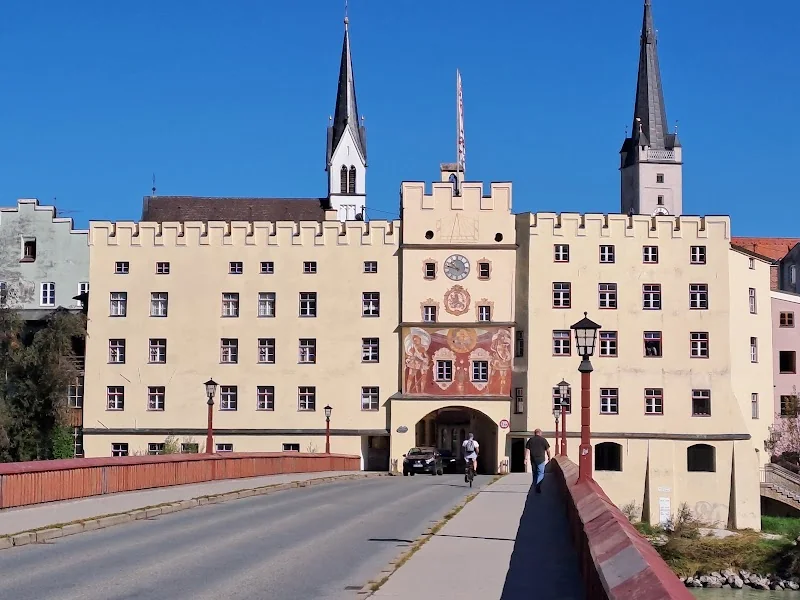
To discover the Wasserburg old town meaningfully, it is best to start right in the center, at Marienplatz. Right there are the town hall and tourist information, and from here, the main stations can be reached in short distances. The city itself suggests for a day visit, among other things, the Beautiful View overlooking the Inn loop, the Inn Bridge with a view of the building front and the Brucktor, the Frauenkirche at Marienplatz, the town hall with its halls, the core house with its Rococo façade, and the path via Herrengasse to the parish church of St. Jakob with the Zürn pulpit. This is ideal for an old town visit because one can see a lot in a single day without long journeys or complicated paths. The sequence of squares, bridges, churches, museums, and small alleys adds to the charm. Wasserburg is not a city that can only be read from a car; it wants to be discovered slowly, on foot, with a view upwards at façades and towers and downwards at cobblestones, passages, and square edges. Particularly impressive is the interplay of Brucktor, Inn Bridge, and the old town core, as the medieval city edge is still clearly perceptible here. The Wasserburg Museum and Herrengasse are also among the addresses that culturally round off the historical core, not just touristically. ([wasserburg.de](https://www.wasserburg.de/ein-tag-in-wasserburg))
The city also presents a virtual and a classic old town tour, making access to the sights even easier. Those who prefer to travel with a plan can download a city map that lists the main stations of the old town in numbered order. On-site, small information boards on the buildings point out the most important dates. This is particularly helpful because Wasserburg consists not only of large, widely visible buildings but also of many details that could easily be overlooked: an old gate, a historical façade structure, a hidden passage, or a building with a special construction history. It is precisely in this combination of orientation and discovery that the strength of the old town lies. Visitors can get a brief overview while still leaving enough room for their own detours. The city tours are also well organized in Wasserburg: according to the official site, there are open tours without prior registration from Easter Monday to the end of October on Mondays and Fridays, showcasing the large and small, often hidden attractions of the almost entirely preserved medieval city. This makes Wasserburg am Inn interesting not only for cultural travelers but also for guests looking for a relaxed yet content-rich city tour. ([wasserburg.de](https://www.wasserburg.de/de/tourismus-freizeit/aktiv-natur/wander-und-spazierwege/altstadtrundgang))
History of the Wasserburg Old Town on the Inn
The history of Wasserburg is closely tied to its location, trade, and rule. On the official sightseeing page of the city, the old castle is already mentioned for 1085, then as Wazzerburch; since the mid-12th century, it was expanded as the seat of the Wasserburg Hallgrafen. The complex was protected on several sides by moats and natural slopes, later it was further fortified and reinforced again in 1415 under Ludwig the Bearded, making it nearly impregnable. Between 1531 and 1537, Duke Wilhelm IV had the castle converted into a ducal residence. These layers of history are important because they show that Wasserburg does not simply have a pretty old town but a center that has been politically and economically significant for centuries. The city describes itself as one of the most historical towns in Old Bavaria, older than Munich and comparable to larger cities up until the 16th century. The salt trade also played a crucial role: Wasserburg was located at the intersection of land and water routes and became an important trading center. This explains the urban density that is still perceptible in the street scene today. The historical growth is not abstract but visible, as the old town has gradually spread out on the peninsula. ([wasserburg.de](https://www.wasserburg.de/en/sightseeing/sights/))
This long history also includes the distinctive buildings that shape the current cityscape. The Brucktor has been documented as the main bridge entrance since 1374 and has been renewed several times over the centuries; on the river side, wall paintings from 1568 are preserved. The Holy Spirit Hospital was built before 1338 and was rebuilt after a fire around 1341, later renewed again. The parish church of St. Jakob was rebuilt after 1410 on the same site as the first town church from 1255 and completed in 1478; after surviving the plague of 1634, it was renewed in lush Renaissance form. The old city wall with the Red Tower, the still visible remnant of the fortification, and the Max Emanuel Chapel also tell of defense, piety, and urban self-confidence. Even the city layout reveals much about the past: the old town is located on a peninsula of just under half a square kilometer, which is surrounded by the Inn on seven-eighths and measures only 240 meters at its narrowest point. Thus, Wasserburg is not only rich in history but also topographically unique. Walking through the alleys is like walking through visible city history. ([wasserburg.de](https://www.wasserburg.de/en/sightseeing/sights/))
Access and Parking in Wasserburg am Inn
For traveling to Wasserburg am Inn, it is helpful to take the official traffic guidance seriously, as the old town is located on a peninsula with limited access points. The city provides two parking garages and two parking lots in close proximity. From the direction of Wasserburg West, that is, from the B 304 from Munich or from the B 15 from Rosenheim and Landshut, the parking garage Überfuhrstraße and the parking lot Unter der Rampe are recommended. From the direction of Wasserburg East as well as from Prien am Chiemsee and Griesstätt, the parking garage Kellerstraße and the parking lot Am Gries are the right choice. This division is very practical for visitors because one already knows where to go before entering. The parking garage Kellerstraße offers 565 parking spaces, four hours of free parking, a day ticket, disabled parking spaces, motorcycle parking spaces, women’s parking spaces, a charging station, a toilet facility with disabled WC, an elevator, and a maximum entrance height of 2.20 meters. This makes it a particularly convenient option for many day guests. The city also points out that parking fees may vary in the old town and at the parking lot Am Gries and that due to the complex traffic guidance, parking garages are recommended for outsiders. ([wasserburg.de](https://www.wasserburg.de/parken))
It is particularly important to note that every point in the old town is accessible from the central parking options within a maximum walking distance of 600 meters, according to the city. This alleviates much uncertainty for visitors because although the old town is old and winding, it has been very well developed for tourist use. Those arriving in a larger vehicle should also pay attention to the height restriction: due to the Brucktor, the Inn Bridge old town has a maximum vehicle height of 3.4 meters, and the peninsula is therefore only directly accessible for tall vehicles from the west. For coaches, the city recommends parking spaces on Landwehrstraße directly in front of the parking lot Am Gries; from there, it is about 200 meters to Marienplatz, and there is also a toilet facility available. There are also several designated parking spaces for people with disabilities in the old town, and for electric vehicles, there are regulations for free parking within the maximum parking duration on the official areas. In summary, this shows: Wasserburg is not a city for spontaneous access attempts but for a short, clear orientation. Those who adhere to the official parking instructions can enter the old town stress-free and start their visit without searching for a parking space. ([wasserburg.de](https://www.wasserburg.de/de/wirtschaft-verkehr/anfahrt-parken/parken-reisebusse/))
Old Town Tour, Beautiful View, and Walking Paths
Wasserburg am Inn is made for walks because the city itself offers several official paths and viewpoints that make the tour easy. The old town tour of the city presents the main attractions in a sequence and is accompanied by a small city map that can be downloaded and printed. On-site, information boards on the buildings help to place the most important dates. Those who prefer to start with a view can take the Beautiful View, from which the old town in the Inn loop becomes particularly impressive. The accompanying information board not only explains the location but also names 27 points that are recognizable in the city view. These include, among others, Kapuzinerinsel, Brucktor, Holy Spirit Hospital, Inn Bridge, Frauenkirche, Museum, Town Hall, Core House, Red Tower, Salt Barn, and the flood dam with the sculpture path. Thus, a glance at the city becomes a real framework for orientation for the entire visit. Particularly exciting is that the peninsula has not only grown beautifully but also geologically and urbanistically. The city describes it as largely formed from alluvial land, grown over the centuries, and discernible in the street and building layouts in the north and northeast. This makes the walk through Wasserburg a kind of walkable history map. ([wasserburg.de](https://www.wasserburg.de/de/tourismus-freizeit/aktiv-natur/wander-und-spazierwege/altstadtrundgang))
The construction style itself also contributes to the experience. The city refers to the Inn-Salzach construction style, where several houses form a closed ensemble through false façades in front of the actual roofs. Some roofs are designed as trench roofs with rain gutters in the middle of the house, which served as fire protection in the past. Additionally, there is the special effect of the urban space: the old town is close enough to feel intimate but large enough to offer a multifaceted route of squares, alleys, and river edges. The official video and the city’s notes also recommend the sculpture path, which begins at the Brucktor and leads along the picturesque Inn bank around the old town. So, if you want to not only see Wasserburg but truly feel it, you should take your time, stand by the river, stroll through arcades, take a look at the river curve, and consciously perceive the transition from narrow alleys to open views. Here lies the strength of the place: the paths are short, but the impressions are diverse. This is ideal for guests looking for a relaxed city stroll with a clear content structure without wanting to miss out on the atmosphere. ([wasserburg.de](https://www.wasserburg.de/schoene-aussicht))
Events, Markets, and Cultural Highlights
Wasserburg thrives not only on its history but also on an astonishingly dense event culture. On the official page about the event highlights, the city emphasizes that especially in the summer months, hardly a weekend goes by without a major event. The traditional markets are particularly prominent, with dates dating back to a fair regulation from 1803. This regulation still governs five classic markets today: Mid-Fasting Market, Georgi Market, Benno, Michael, and Kathrein Market. The markets are among the best moments to experience the old town in motion, as numerous vendors are on the streets, and many shops open additionally. This is interesting for visitors because the old town then functions not only as a monument but as a vibrant urban space. Additionally, cultural formats such as the Wasserburg Folk Music Days, which have existed since 1972 and traditionally take place in the week before Palm Sunday, are included. This mix already shows that Wasserburg is a city where tradition does not seem museum-like but remains embedded in everyday life. Markets, music, and city strolls intertwine here. ([wasserburg.de](https://www.wasserburg.de/veranstaltungshoehepunkte))
Among the special highlights are the Inndamm Festival, where visitors discover culinary stations on the flood dam around the old town, originally celebrated for the flood exposure of the old town, as well as Wasserburg lights up, where buildings are illuminated with light effects, laser beams span streets, and open-air cinema and live bands create a lively atmosphere. Another fixed point is the Day of Open Monuments, where numerous historical Wasserburg buildings and monuments open their doors and often allow free entry. This is complemented by formats such as the Wasserburg Old Town Jump, where top athletes compete in pole vaulting right in the historical old town. This mix is very important for the perception of the city because it shows how versatile the place is used: as a marketplace, as a cultural backdrop, as a sports arena, and as a space for remembrance. Therefore, if you connect your trip with an event date, you will experience Wasserburg particularly intensely. Even a short visit gains more depth because the old town not only looks beautiful but regularly becomes a stage for encounters, music, trade, and urban life. ([wasserburg.de](https://www.wasserburg.de/veranstaltungshoehepunkte))
Classic Car Visit, Day Trip, and Practical Tips
Wasserburg am Inn is excellent for a day trip because the city is compact, historically rich, and well organized. The official site describes the first walk into the old town as a path to Marienplatz in the center, from where tourist information, town hall, and the main destinations are quickly reachable. Those who enjoy a leisurely pace can combine the visit with a coffee break under the arcades, a walk along the Inn, or a museum visit. The Wasserburg Museum is located in Herrengasse opposite the back of the town hall and presents the city’s history in a very vivid way. For visitors arriving by classic car, the clear traffic guidance is especially important: the old town is not designed for confusing access but for a visit via the official parking garages and parking lots. This is why Wasserburg is also attractive for classic vehicles, as one can focus on arriving and not on long parking searches. The historical backdrop fits excellently with this, as old vehicles and medieval alleys create a strong visual contrast that works well in many travel photos. However, it remains crucial to observe the practical rules and use the official access routes. ([wasserburg.de](https://www.wasserburg.de/ein-tag-in-wasserburg))
Even though Wasserburg is not a city that can be reduced to a single motif, the combination of history, riverside location, and urban scale is ideal for a relaxed short trip. The city is older than Munich, has been a trading center for centuries, and is still compact enough to get a very good picture within a few hours without missing anything essential. Those who orient themselves a bit in advance will have more from the day: first Marienplatz, then Brucktor and Inn Bridge, perhaps later St. Jakob, the Beautiful View, and the sculpture path, and later still a visit to the museum or a stop in the old town. For families, culture enthusiasts, photographers, and also classic car fans, this is a coherent mix because everything is close together, and the city itself prepares the visit pleasantly. Particularly practical are the parking garages with four hours of free parking and the official recommendation to choose the appropriate side of the old town depending on the approach. This turns a city stroll into a truly relaxed trip. Wasserburg is thus a place where history, mobility, and leisure do not disturb each other but complement each other very well. ([wasserburg.de](https://www.wasserburg.de/en/sightseeing/impressions/))
Sources:
- City of Wasserburg am Inn - Impressions
- City of Wasserburg am Inn - Sights
- City of Wasserburg am Inn - Beautiful View
- City of Wasserburg am Inn - Parking Old Town
- City of Wasserburg am Inn - Old Town Tour
- City of Wasserburg am Inn - A Day in Wasserburg
- City of Wasserburg am Inn - Event Highlights
- Wasserburg Museum - Events
- City of Wasserburg am Inn - Parking Buses
Show moreShow less
Wasserburg am Inn | Old Town & History
Wasserburg am Inn is a place that captures attention at first glance, as it lies almost like an island in the river while still being a vibrant, developed city center. The city describes its old town as almost surrounded by the Inn, with steep banks, short paths, arcades, alleys, and a cityscape that bundles an astonishing amount of history in a small space. This unique mix makes Wasserburg so special: here, medieval urban logic meets an open, lively atmosphere with cafés, shops, museums, and a landscape that can be rediscovered anew with every stroll. For visitors, this is ideal, as classic sights, quiet riverside views, good vantage points, and practical paths can be easily combined. Therefore, those visiting Wasserburg for the first time not only experience a charming old town but also a place with a clear identity, historical depth, and a location that is rarely found in Upper Bavaria. Even the official pages of the city emphasize the unique island effect, the flair of a peninsula almost completely surrounded by the Inn, and the historical radiance of this cityscape. ([wasserburg.de](https://www.wasserburg.de/en/sightseeing/impressions/))
Old Town, Marienplatz, and the Main Attractions
To discover the Wasserburg old town meaningfully, it is best to start right in the center, at Marienplatz. Right there are the town hall and tourist information, and from here, the main stations can be reached in short distances. The city itself suggests for a day visit, among other things, the Beautiful View overlooking the Inn loop, the Inn Bridge with a view of the building front and the Brucktor, the Frauenkirche at Marienplatz, the town hall with its halls, the core house with its Rococo façade, and the path via Herrengasse to the parish church of St. Jakob with the Zürn pulpit. This is ideal for an old town visit because one can see a lot in a single day without long journeys or complicated paths. The sequence of squares, bridges, churches, museums, and small alleys adds to the charm. Wasserburg is not a city that can only be read from a car; it wants to be discovered slowly, on foot, with a view upwards at façades and towers and downwards at cobblestones, passages, and square edges. Particularly impressive is the interplay of Brucktor, Inn Bridge, and the old town core, as the medieval city edge is still clearly perceptible here. The Wasserburg Museum and Herrengasse are also among the addresses that culturally round off the historical core, not just touristically. ([wasserburg.de](https://www.wasserburg.de/ein-tag-in-wasserburg))
The city also presents a virtual and a classic old town tour, making access to the sights even easier. Those who prefer to travel with a plan can download a city map that lists the main stations of the old town in numbered order. On-site, small information boards on the buildings point out the most important dates. This is particularly helpful because Wasserburg consists not only of large, widely visible buildings but also of many details that could easily be overlooked: an old gate, a historical façade structure, a hidden passage, or a building with a special construction history. It is precisely in this combination of orientation and discovery that the strength of the old town lies. Visitors can get a brief overview while still leaving enough room for their own detours. The city tours are also well organized in Wasserburg: according to the official site, there are open tours without prior registration from Easter Monday to the end of October on Mondays and Fridays, showcasing the large and small, often hidden attractions of the almost entirely preserved medieval city. This makes Wasserburg am Inn interesting not only for cultural travelers but also for guests looking for a relaxed yet content-rich city tour. ([wasserburg.de](https://www.wasserburg.de/de/tourismus-freizeit/aktiv-natur/wander-und-spazierwege/altstadtrundgang))
History of the Wasserburg Old Town on the Inn
The history of Wasserburg is closely tied to its location, trade, and rule. On the official sightseeing page of the city, the old castle is already mentioned for 1085, then as Wazzerburch; since the mid-12th century, it was expanded as the seat of the Wasserburg Hallgrafen. The complex was protected on several sides by moats and natural slopes, later it was further fortified and reinforced again in 1415 under Ludwig the Bearded, making it nearly impregnable. Between 1531 and 1537, Duke Wilhelm IV had the castle converted into a ducal residence. These layers of history are important because they show that Wasserburg does not simply have a pretty old town but a center that has been politically and economically significant for centuries. The city describes itself as one of the most historical towns in Old Bavaria, older than Munich and comparable to larger cities up until the 16th century. The salt trade also played a crucial role: Wasserburg was located at the intersection of land and water routes and became an important trading center. This explains the urban density that is still perceptible in the street scene today. The historical growth is not abstract but visible, as the old town has gradually spread out on the peninsula. ([wasserburg.de](https://www.wasserburg.de/en/sightseeing/sights/))
This long history also includes the distinctive buildings that shape the current cityscape. The Brucktor has been documented as the main bridge entrance since 1374 and has been renewed several times over the centuries; on the river side, wall paintings from 1568 are preserved. The Holy Spirit Hospital was built before 1338 and was rebuilt after a fire around 1341, later renewed again. The parish church of St. Jakob was rebuilt after 1410 on the same site as the first town church from 1255 and completed in 1478; after surviving the plague of 1634, it was renewed in lush Renaissance form. The old city wall with the Red Tower, the still visible remnant of the fortification, and the Max Emanuel Chapel also tell of defense, piety, and urban self-confidence. Even the city layout reveals much about the past: the old town is located on a peninsula of just under half a square kilometer, which is surrounded by the Inn on seven-eighths and measures only 240 meters at its narrowest point. Thus, Wasserburg is not only rich in history but also topographically unique. Walking through the alleys is like walking through visible city history. ([wasserburg.de](https://www.wasserburg.de/en/sightseeing/sights/))
Access and Parking in Wasserburg am Inn
For traveling to Wasserburg am Inn, it is helpful to take the official traffic guidance seriously, as the old town is located on a peninsula with limited access points. The city provides two parking garages and two parking lots in close proximity. From the direction of Wasserburg West, that is, from the B 304 from Munich or from the B 15 from Rosenheim and Landshut, the parking garage Überfuhrstraße and the parking lot Unter der Rampe are recommended. From the direction of Wasserburg East as well as from Prien am Chiemsee and Griesstätt, the parking garage Kellerstraße and the parking lot Am Gries are the right choice. This division is very practical for visitors because one already knows where to go before entering. The parking garage Kellerstraße offers 565 parking spaces, four hours of free parking, a day ticket, disabled parking spaces, motorcycle parking spaces, women’s parking spaces, a charging station, a toilet facility with disabled WC, an elevator, and a maximum entrance height of 2.20 meters. This makes it a particularly convenient option for many day guests. The city also points out that parking fees may vary in the old town and at the parking lot Am Gries and that due to the complex traffic guidance, parking garages are recommended for outsiders. ([wasserburg.de](https://www.wasserburg.de/parken))
It is particularly important to note that every point in the old town is accessible from the central parking options within a maximum walking distance of 600 meters, according to the city. This alleviates much uncertainty for visitors because although the old town is old and winding, it has been very well developed for tourist use. Those arriving in a larger vehicle should also pay attention to the height restriction: due to the Brucktor, the Inn Bridge old town has a maximum vehicle height of 3.4 meters, and the peninsula is therefore only directly accessible for tall vehicles from the west. For coaches, the city recommends parking spaces on Landwehrstraße directly in front of the parking lot Am Gries; from there, it is about 200 meters to Marienplatz, and there is also a toilet facility available. There are also several designated parking spaces for people with disabilities in the old town, and for electric vehicles, there are regulations for free parking within the maximum parking duration on the official areas. In summary, this shows: Wasserburg is not a city for spontaneous access attempts but for a short, clear orientation. Those who adhere to the official parking instructions can enter the old town stress-free and start their visit without searching for a parking space. ([wasserburg.de](https://www.wasserburg.de/de/wirtschaft-verkehr/anfahrt-parken/parken-reisebusse/))
Old Town Tour, Beautiful View, and Walking Paths
Wasserburg am Inn is made for walks because the city itself offers several official paths and viewpoints that make the tour easy. The old town tour of the city presents the main attractions in a sequence and is accompanied by a small city map that can be downloaded and printed. On-site, information boards on the buildings help to place the most important dates. Those who prefer to start with a view can take the Beautiful View, from which the old town in the Inn loop becomes particularly impressive. The accompanying information board not only explains the location but also names 27 points that are recognizable in the city view. These include, among others, Kapuzinerinsel, Brucktor, Holy Spirit Hospital, Inn Bridge, Frauenkirche, Museum, Town Hall, Core House, Red Tower, Salt Barn, and the flood dam with the sculpture path. Thus, a glance at the city becomes a real framework for orientation for the entire visit. Particularly exciting is that the peninsula has not only grown beautifully but also geologically and urbanistically. The city describes it as largely formed from alluvial land, grown over the centuries, and discernible in the street and building layouts in the north and northeast. This makes the walk through Wasserburg a kind of walkable history map. ([wasserburg.de](https://www.wasserburg.de/de/tourismus-freizeit/aktiv-natur/wander-und-spazierwege/altstadtrundgang))
The construction style itself also contributes to the experience. The city refers to the Inn-Salzach construction style, where several houses form a closed ensemble through false façades in front of the actual roofs. Some roofs are designed as trench roofs with rain gutters in the middle of the house, which served as fire protection in the past. Additionally, there is the special effect of the urban space: the old town is close enough to feel intimate but large enough to offer a multifaceted route of squares, alleys, and river edges. The official video and the city’s notes also recommend the sculpture path, which begins at the Brucktor and leads along the picturesque Inn bank around the old town. So, if you want to not only see Wasserburg but truly feel it, you should take your time, stand by the river, stroll through arcades, take a look at the river curve, and consciously perceive the transition from narrow alleys to open views. Here lies the strength of the place: the paths are short, but the impressions are diverse. This is ideal for guests looking for a relaxed city stroll with a clear content structure without wanting to miss out on the atmosphere. ([wasserburg.de](https://www.wasserburg.de/schoene-aussicht))
Events, Markets, and Cultural Highlights
Wasserburg thrives not only on its history but also on an astonishingly dense event culture. On the official page about the event highlights, the city emphasizes that especially in the summer months, hardly a weekend goes by without a major event. The traditional markets are particularly prominent, with dates dating back to a fair regulation from 1803. This regulation still governs five classic markets today: Mid-Fasting Market, Georgi Market, Benno, Michael, and Kathrein Market. The markets are among the best moments to experience the old town in motion, as numerous vendors are on the streets, and many shops open additionally. This is interesting for visitors because the old town then functions not only as a monument but as a vibrant urban space. Additionally, cultural formats such as the Wasserburg Folk Music Days, which have existed since 1972 and traditionally take place in the week before Palm Sunday, are included. This mix already shows that Wasserburg is a city where tradition does not seem museum-like but remains embedded in everyday life. Markets, music, and city strolls intertwine here. ([wasserburg.de](https://www.wasserburg.de/veranstaltungshoehepunkte))
Among the special highlights are the Inndamm Festival, where visitors discover culinary stations on the flood dam around the old town, originally celebrated for the flood exposure of the old town, as well as Wasserburg lights up, where buildings are illuminated with light effects, laser beams span streets, and open-air cinema and live bands create a lively atmosphere. Another fixed point is the Day of Open Monuments, where numerous historical Wasserburg buildings and monuments open their doors and often allow free entry. This is complemented by formats such as the Wasserburg Old Town Jump, where top athletes compete in pole vaulting right in the historical old town. This mix is very important for the perception of the city because it shows how versatile the place is used: as a marketplace, as a cultural backdrop, as a sports arena, and as a space for remembrance. Therefore, if you connect your trip with an event date, you will experience Wasserburg particularly intensely. Even a short visit gains more depth because the old town not only looks beautiful but regularly becomes a stage for encounters, music, trade, and urban life. ([wasserburg.de](https://www.wasserburg.de/veranstaltungshoehepunkte))
Classic Car Visit, Day Trip, and Practical Tips
Wasserburg am Inn is excellent for a day trip because the city is compact, historically rich, and well organized. The official site describes the first walk into the old town as a path to Marienplatz in the center, from where tourist information, town hall, and the main destinations are quickly reachable. Those who enjoy a leisurely pace can combine the visit with a coffee break under the arcades, a walk along the Inn, or a museum visit. The Wasserburg Museum is located in Herrengasse opposite the back of the town hall and presents the city’s history in a very vivid way. For visitors arriving by classic car, the clear traffic guidance is especially important: the old town is not designed for confusing access but for a visit via the official parking garages and parking lots. This is why Wasserburg is also attractive for classic vehicles, as one can focus on arriving and not on long parking searches. The historical backdrop fits excellently with this, as old vehicles and medieval alleys create a strong visual contrast that works well in many travel photos. However, it remains crucial to observe the practical rules and use the official access routes. ([wasserburg.de](https://www.wasserburg.de/ein-tag-in-wasserburg))
Even though Wasserburg is not a city that can be reduced to a single motif, the combination of history, riverside location, and urban scale is ideal for a relaxed short trip. The city is older than Munich, has been a trading center for centuries, and is still compact enough to get a very good picture within a few hours without missing anything essential. Those who orient themselves a bit in advance will have more from the day: first Marienplatz, then Brucktor and Inn Bridge, perhaps later St. Jakob, the Beautiful View, and the sculpture path, and later still a visit to the museum or a stop in the old town. For families, culture enthusiasts, photographers, and also classic car fans, this is a coherent mix because everything is close together, and the city itself prepares the visit pleasantly. Particularly practical are the parking garages with four hours of free parking and the official recommendation to choose the appropriate side of the old town depending on the approach. This turns a city stroll into a truly relaxed trip. Wasserburg is thus a place where history, mobility, and leisure do not disturb each other but complement each other very well. ([wasserburg.de](https://www.wasserburg.de/en/sightseeing/impressions/))
Sources:
- City of Wasserburg am Inn - Impressions
- City of Wasserburg am Inn - Sights
- City of Wasserburg am Inn - Beautiful View
- City of Wasserburg am Inn - Parking Old Town
- City of Wasserburg am Inn - Old Town Tour
- City of Wasserburg am Inn - A Day in Wasserburg
- City of Wasserburg am Inn - Event Highlights
- Wasserburg Museum - Events
- City of Wasserburg am Inn - Parking Buses
Wasserburg am Inn | Old Town & History
Wasserburg am Inn is a place that captures attention at first glance, as it lies almost like an island in the river while still being a vibrant, developed city center. The city describes its old town as almost surrounded by the Inn, with steep banks, short paths, arcades, alleys, and a cityscape that bundles an astonishing amount of history in a small space. This unique mix makes Wasserburg so special: here, medieval urban logic meets an open, lively atmosphere with cafés, shops, museums, and a landscape that can be rediscovered anew with every stroll. For visitors, this is ideal, as classic sights, quiet riverside views, good vantage points, and practical paths can be easily combined. Therefore, those visiting Wasserburg for the first time not only experience a charming old town but also a place with a clear identity, historical depth, and a location that is rarely found in Upper Bavaria. Even the official pages of the city emphasize the unique island effect, the flair of a peninsula almost completely surrounded by the Inn, and the historical radiance of this cityscape. ([wasserburg.de](https://www.wasserburg.de/en/sightseeing/impressions/))
Old Town, Marienplatz, and the Main Attractions
To discover the Wasserburg old town meaningfully, it is best to start right in the center, at Marienplatz. Right there are the town hall and tourist information, and from here, the main stations can be reached in short distances. The city itself suggests for a day visit, among other things, the Beautiful View overlooking the Inn loop, the Inn Bridge with a view of the building front and the Brucktor, the Frauenkirche at Marienplatz, the town hall with its halls, the core house with its Rococo façade, and the path via Herrengasse to the parish church of St. Jakob with the Zürn pulpit. This is ideal for an old town visit because one can see a lot in a single day without long journeys or complicated paths. The sequence of squares, bridges, churches, museums, and small alleys adds to the charm. Wasserburg is not a city that can only be read from a car; it wants to be discovered slowly, on foot, with a view upwards at façades and towers and downwards at cobblestones, passages, and square edges. Particularly impressive is the interplay of Brucktor, Inn Bridge, and the old town core, as the medieval city edge is still clearly perceptible here. The Wasserburg Museum and Herrengasse are also among the addresses that culturally round off the historical core, not just touristically. ([wasserburg.de](https://www.wasserburg.de/ein-tag-in-wasserburg))
The city also presents a virtual and a classic old town tour, making access to the sights even easier. Those who prefer to travel with a plan can download a city map that lists the main stations of the old town in numbered order. On-site, small information boards on the buildings point out the most important dates. This is particularly helpful because Wasserburg consists not only of large, widely visible buildings but also of many details that could easily be overlooked: an old gate, a historical façade structure, a hidden passage, or a building with a special construction history. It is precisely in this combination of orientation and discovery that the strength of the old town lies. Visitors can get a brief overview while still leaving enough room for their own detours. The city tours are also well organized in Wasserburg: according to the official site, there are open tours without prior registration from Easter Monday to the end of October on Mondays and Fridays, showcasing the large and small, often hidden attractions of the almost entirely preserved medieval city. This makes Wasserburg am Inn interesting not only for cultural travelers but also for guests looking for a relaxed yet content-rich city tour. ([wasserburg.de](https://www.wasserburg.de/de/tourismus-freizeit/aktiv-natur/wander-und-spazierwege/altstadtrundgang))
History of the Wasserburg Old Town on the Inn
The history of Wasserburg is closely tied to its location, trade, and rule. On the official sightseeing page of the city, the old castle is already mentioned for 1085, then as Wazzerburch; since the mid-12th century, it was expanded as the seat of the Wasserburg Hallgrafen. The complex was protected on several sides by moats and natural slopes, later it was further fortified and reinforced again in 1415 under Ludwig the Bearded, making it nearly impregnable. Between 1531 and 1537, Duke Wilhelm IV had the castle converted into a ducal residence. These layers of history are important because they show that Wasserburg does not simply have a pretty old town but a center that has been politically and economically significant for centuries. The city describes itself as one of the most historical towns in Old Bavaria, older than Munich and comparable to larger cities up until the 16th century. The salt trade also played a crucial role: Wasserburg was located at the intersection of land and water routes and became an important trading center. This explains the urban density that is still perceptible in the street scene today. The historical growth is not abstract but visible, as the old town has gradually spread out on the peninsula. ([wasserburg.de](https://www.wasserburg.de/en/sightseeing/sights/))
This long history also includes the distinctive buildings that shape the current cityscape. The Brucktor has been documented as the main bridge entrance since 1374 and has been renewed several times over the centuries; on the river side, wall paintings from 1568 are preserved. The Holy Spirit Hospital was built before 1338 and was rebuilt after a fire around 1341, later renewed again. The parish church of St. Jakob was rebuilt after 1410 on the same site as the first town church from 1255 and completed in 1478; after surviving the plague of 1634, it was renewed in lush Renaissance form. The old city wall with the Red Tower, the still visible remnant of the fortification, and the Max Emanuel Chapel also tell of defense, piety, and urban self-confidence. Even the city layout reveals much about the past: the old town is located on a peninsula of just under half a square kilometer, which is surrounded by the Inn on seven-eighths and measures only 240 meters at its narrowest point. Thus, Wasserburg is not only rich in history but also topographically unique. Walking through the alleys is like walking through visible city history. ([wasserburg.de](https://www.wasserburg.de/en/sightseeing/sights/))
Access and Parking in Wasserburg am Inn
For traveling to Wasserburg am Inn, it is helpful to take the official traffic guidance seriously, as the old town is located on a peninsula with limited access points. The city provides two parking garages and two parking lots in close proximity. From the direction of Wasserburg West, that is, from the B 304 from Munich or from the B 15 from Rosenheim and Landshut, the parking garage Überfuhrstraße and the parking lot Unter der Rampe are recommended. From the direction of Wasserburg East as well as from Prien am Chiemsee and Griesstätt, the parking garage Kellerstraße and the parking lot Am Gries are the right choice. This division is very practical for visitors because one already knows where to go before entering. The parking garage Kellerstraße offers 565 parking spaces, four hours of free parking, a day ticket, disabled parking spaces, motorcycle parking spaces, women’s parking spaces, a charging station, a toilet facility with disabled WC, an elevator, and a maximum entrance height of 2.20 meters. This makes it a particularly convenient option for many day guests. The city also points out that parking fees may vary in the old town and at the parking lot Am Gries and that due to the complex traffic guidance, parking garages are recommended for outsiders. ([wasserburg.de](https://www.wasserburg.de/parken))
It is particularly important to note that every point in the old town is accessible from the central parking options within a maximum walking distance of 600 meters, according to the city. This alleviates much uncertainty for visitors because although the old town is old and winding, it has been very well developed for tourist use. Those arriving in a larger vehicle should also pay attention to the height restriction: due to the Brucktor, the Inn Bridge old town has a maximum vehicle height of 3.4 meters, and the peninsula is therefore only directly accessible for tall vehicles from the west. For coaches, the city recommends parking spaces on Landwehrstraße directly in front of the parking lot Am Gries; from there, it is about 200 meters to Marienplatz, and there is also a toilet facility available. There are also several designated parking spaces for people with disabilities in the old town, and for electric vehicles, there are regulations for free parking within the maximum parking duration on the official areas. In summary, this shows: Wasserburg is not a city for spontaneous access attempts but for a short, clear orientation. Those who adhere to the official parking instructions can enter the old town stress-free and start their visit without searching for a parking space. ([wasserburg.de](https://www.wasserburg.de/de/wirtschaft-verkehr/anfahrt-parken/parken-reisebusse/))
Old Town Tour, Beautiful View, and Walking Paths
Wasserburg am Inn is made for walks because the city itself offers several official paths and viewpoints that make the tour easy. The old town tour of the city presents the main attractions in a sequence and is accompanied by a small city map that can be downloaded and printed. On-site, information boards on the buildings help to place the most important dates. Those who prefer to start with a view can take the Beautiful View, from which the old town in the Inn loop becomes particularly impressive. The accompanying information board not only explains the location but also names 27 points that are recognizable in the city view. These include, among others, Kapuzinerinsel, Brucktor, Holy Spirit Hospital, Inn Bridge, Frauenkirche, Museum, Town Hall, Core House, Red Tower, Salt Barn, and the flood dam with the sculpture path. Thus, a glance at the city becomes a real framework for orientation for the entire visit. Particularly exciting is that the peninsula has not only grown beautifully but also geologically and urbanistically. The city describes it as largely formed from alluvial land, grown over the centuries, and discernible in the street and building layouts in the north and northeast. This makes the walk through Wasserburg a kind of walkable history map. ([wasserburg.de](https://www.wasserburg.de/de/tourismus-freizeit/aktiv-natur/wander-und-spazierwege/altstadtrundgang))
The construction style itself also contributes to the experience. The city refers to the Inn-Salzach construction style, where several houses form a closed ensemble through false façades in front of the actual roofs. Some roofs are designed as trench roofs with rain gutters in the middle of the house, which served as fire protection in the past. Additionally, there is the special effect of the urban space: the old town is close enough to feel intimate but large enough to offer a multifaceted route of squares, alleys, and river edges. The official video and the city’s notes also recommend the sculpture path, which begins at the Brucktor and leads along the picturesque Inn bank around the old town. So, if you want to not only see Wasserburg but truly feel it, you should take your time, stand by the river, stroll through arcades, take a look at the river curve, and consciously perceive the transition from narrow alleys to open views. Here lies the strength of the place: the paths are short, but the impressions are diverse. This is ideal for guests looking for a relaxed city stroll with a clear content structure without wanting to miss out on the atmosphere. ([wasserburg.de](https://www.wasserburg.de/schoene-aussicht))
Events, Markets, and Cultural Highlights
Wasserburg thrives not only on its history but also on an astonishingly dense event culture. On the official page about the event highlights, the city emphasizes that especially in the summer months, hardly a weekend goes by without a major event. The traditional markets are particularly prominent, with dates dating back to a fair regulation from 1803. This regulation still governs five classic markets today: Mid-Fasting Market, Georgi Market, Benno, Michael, and Kathrein Market. The markets are among the best moments to experience the old town in motion, as numerous vendors are on the streets, and many shops open additionally. This is interesting for visitors because the old town then functions not only as a monument but as a vibrant urban space. Additionally, cultural formats such as the Wasserburg Folk Music Days, which have existed since 1972 and traditionally take place in the week before Palm Sunday, are included. This mix already shows that Wasserburg is a city where tradition does not seem museum-like but remains embedded in everyday life. Markets, music, and city strolls intertwine here. ([wasserburg.de](https://www.wasserburg.de/veranstaltungshoehepunkte))
Among the special highlights are the Inndamm Festival, where visitors discover culinary stations on the flood dam around the old town, originally celebrated for the flood exposure of the old town, as well as Wasserburg lights up, where buildings are illuminated with light effects, laser beams span streets, and open-air cinema and live bands create a lively atmosphere. Another fixed point is the Day of Open Monuments, where numerous historical Wasserburg buildings and monuments open their doors and often allow free entry. This is complemented by formats such as the Wasserburg Old Town Jump, where top athletes compete in pole vaulting right in the historical old town. This mix is very important for the perception of the city because it shows how versatile the place is used: as a marketplace, as a cultural backdrop, as a sports arena, and as a space for remembrance. Therefore, if you connect your trip with an event date, you will experience Wasserburg particularly intensely. Even a short visit gains more depth because the old town not only looks beautiful but regularly becomes a stage for encounters, music, trade, and urban life. ([wasserburg.de](https://www.wasserburg.de/veranstaltungshoehepunkte))
Classic Car Visit, Day Trip, and Practical Tips
Wasserburg am Inn is excellent for a day trip because the city is compact, historically rich, and well organized. The official site describes the first walk into the old town as a path to Marienplatz in the center, from where tourist information, town hall, and the main destinations are quickly reachable. Those who enjoy a leisurely pace can combine the visit with a coffee break under the arcades, a walk along the Inn, or a museum visit. The Wasserburg Museum is located in Herrengasse opposite the back of the town hall and presents the city’s history in a very vivid way. For visitors arriving by classic car, the clear traffic guidance is especially important: the old town is not designed for confusing access but for a visit via the official parking garages and parking lots. This is why Wasserburg is also attractive for classic vehicles, as one can focus on arriving and not on long parking searches. The historical backdrop fits excellently with this, as old vehicles and medieval alleys create a strong visual contrast that works well in many travel photos. However, it remains crucial to observe the practical rules and use the official access routes. ([wasserburg.de](https://www.wasserburg.de/ein-tag-in-wasserburg))
Even though Wasserburg is not a city that can be reduced to a single motif, the combination of history, riverside location, and urban scale is ideal for a relaxed short trip. The city is older than Munich, has been a trading center for centuries, and is still compact enough to get a very good picture within a few hours without missing anything essential. Those who orient themselves a bit in advance will have more from the day: first Marienplatz, then Brucktor and Inn Bridge, perhaps later St. Jakob, the Beautiful View, and the sculpture path, and later still a visit to the museum or a stop in the old town. For families, culture enthusiasts, photographers, and also classic car fans, this is a coherent mix because everything is close together, and the city itself prepares the visit pleasantly. Particularly practical are the parking garages with four hours of free parking and the official recommendation to choose the appropriate side of the old town depending on the approach. This turns a city stroll into a truly relaxed trip. Wasserburg is thus a place where history, mobility, and leisure do not disturb each other but complement each other very well. ([wasserburg.de](https://www.wasserburg.de/en/sightseeing/impressions/))
Sources:
- City of Wasserburg am Inn - Impressions
- City of Wasserburg am Inn - Sights
- City of Wasserburg am Inn - Beautiful View
- City of Wasserburg am Inn - Parking Old Town
- City of Wasserburg am Inn - Old Town Tour
- City of Wasserburg am Inn - A Day in Wasserburg
- City of Wasserburg am Inn - Event Highlights
- Wasserburg Museum - Events
- City of Wasserburg am Inn - Parking Buses
Upcoming Events
No events found
Frequently Asked Questions
Reviews
uarora
7. January 2023
Beautiful town to walk around. Perfect for a small day trip from Munich. You can also sit by the riverfront on a sunny day.
Judith Supp (JudeS)
30. July 2023
Lovely town with great sights. Picturesque narrow streets, historic town hall. There are also lots of attractive shops.
Micki Maus
30. October 2022
Nice place for a walk, a coffee, or to eat.
Evgenii V.
3. December 2024
Take the bus 431 from the train station Wasserburg to get to the center of the city. It’ll only take you 15 mins to get there. One of the most beautiful towns in Bayern.
Saso Arsic
9. January 2024
Nice town.