
Brannenburg
83098 Brannenburg, Deutschland
Pilgrimage Church Schwarzlack | Stations of the Cross & Parking
The Pilgrimage Church Schwarzlack in Brannenburg is a place where pilgrimage tradition, forest tranquility, and art history connect in a short distance. According to the municipality and tourism association, the site dates back to a hermitage from 1659 and the hermit Georg Tanner; the current church was built as a stone new building in the mid-18th century and was consecrated in 1767. Today, the Pilgrimage Church is located on a hill in the forest at Sulzberg and is only accessible on foot via a roughly 30-minute Stations of the Cross. Right next door, the mountain inn Schwarzlack invites visitors to linger. This combination of spiritual destination, hiking spot, and excursion destination makes Schwarzlack particularly special for visitors to Brannenburg. In this text, you will find the most important facts about history, access, Stations of the Cross, facilities, services, and photographic motifs. ([brannenburg.de](https://www.brannenburg.de/orte/kirchen/wallfahrtskirche-heilige-maria/))
History of the Pilgrimage Church Schwarzlack
The history of its origin begins in the second half of the 17th century, a time when private piety and regional pilgrimage took on new forms in many places in Upper Bavaria. In 1659, the hermit Georg Tanner settled at Schwarzlack and set up a Maria-Hilf image in his hermitage, which soon attracted pilgrims from the surrounding area. From this original hermitage, a wooden chapel was initially developed, which was built in 1687. Even before the current church was built, there was already a small stone predecessor building in 1716. The current site began with the laying of the foundation stone for the new building in 1750 and was consecrated in 1767. This sequence of hermitage, wooden chapel, stone predecessor church, and baroque new building vividly illustrates how a personal devotion became a permanent pilgrimage site. ([chiemsee-alpenland.de](https://www.chiemsee-alpenland.de/entdecken/alle-sehenswuerdigkeiten/wallfahrtskirche-mariahilf-und-st.-johann-nepomuk-auf-schwarzlack-577bc2fe80))
This development is important for visitors because it explains the special atmosphere of Schwarzlack. The church is not just any historical house of worship, but a religiously grown destination with a long continuity. The tourism association describes it as a late baroque pilgrimage church; the furnishings are characterized as fine, uniform Rococo decor that has hardly changed since the consecration. This is exactly what distinguishes Schwarzlack from many other excursion destinations: Here, the historical layer is not only visible in the architecture but also in the lived usage. The site tells of hermitic piety, pilgrimage movements, building history, folk piety, and a landscape that still retains its character as a quiet power place today. Therefore, those who visit Schwarzlack do not enter an open-air museum but a place where history and present come together in close proximity. This connection of origin, permanence, and sacred quality continues to shape perception today. ([brannenburg.de](https://www.brannenburg.de/orte/kirchen/wallfahrtskirche-heilige-maria/))
Access, Parking, and Footpath to Schwarzlack
The most important practical information up front: The Pilgrimage Church Schwarzlack is only accessible on foot. The municipality mentions a roughly 30-minute Stations of the Cross that begins on a hill in the forest at Sulzberg and leads up to the church. The area behind the Gasthof-Hotel Schlosswirt is mentioned as the starting point for the hike. Additionally, the municipality points out parking options in the district of Brannenburg near the Wendelsteinhalle as well as at the hiking parking lot at the shooting range, which can be accessed via Holzhausener Straße. Therefore, those planning their arrival can expect a classic footpath, not a direct access to the church. This is precisely what makes the place attractive for many visitors, as the journey itself is already part of the experience. ([brannenburg.de](https://www.brannenburg.de/orte/kirchen/wallfahrtskirche-heilige-maria/))
The official hiking suggestion from the region also supports this orientation. The Schwarzlack Round BR5 is described as an easy circular tour, 4.3 kilometers long, with about 178 meters of elevation gain and a duration of about 1:30 hours. The Kirchplatz or Wendelsteinhalle is mentioned as the starting point; by train, one can reach the Brannenburg station and walk from there to the Kirchplatz and Gasthof Schlosswirt in about ten minutes. For those arriving by car, the A93 exit Brannenburg is recommended, followed by driving towards the town and further to Bahnhofstraße. The tour mentions parking options at the Kirchplatz or the designated parking spaces at the Wendelsteinhalle. Thus, Schwarzlack is well connected, even though the church itself is intentionally located off the beaten path. The footpath is part of the character: The approach remains practical, but the last section leads into the tranquility of the forest and creates a clear separation between the edge of the village and the pilgrimage site. ([chiemsee-alpenland.de](https://www.chiemsee-alpenland.de/entdecken/tourenportal/wandern-von-brannenburg-aus-auf-die-schwarzlack-und-kogl-bdf93142c5))
Camino de Santiago, Stations of the Cross, and Hike to Schwarzlack
The special status of the Pilgrimage Church is that the well-known Camino de Santiago passes by it. The tourism association explicitly points out that the pilgrimage path runs along the church, connecting the site with a regional hiking and pilgrimage tradition. At the same time, the access itself follows a Stations of the Cross, transforming the journey into a religious and scenic experience. Along the way, there are Stations of the Cross and several resting benches; the path is well developed and initially leads through the forest, later over a forest road. For many visitors, this combination of path, devotion, and nature is what makes it special: One does not just walk to a destination but through a sequence of impressions. The destination is located in a clearing, making it feel even more concentrated and serene. ([chiemsee-alpenland.de](https://www.chiemsee-alpenland.de/entdecken/alle-sehenswuerdigkeiten/wallfahrtskirche-mariahilf-und-st.-johann-nepomuk-auf-schwarzlack-577bc2fe80))
The tour BR5 also makes this quality tangible in a sporting sense. It is considered easy and family-friendly, but at the same time offers scenic views and is culturally and historically interesting. The return route leads back to Brannenburg via Aich or Lechen; along the way, views open up towards the Inntal and the pre-Alps, especially during the further ascent towards Kogl. For hikers, this is an ideal half-day excursion, as history, nature, and refreshment can be combined. At the same time, the route is not suitable for strollers and is closed to cyclists, emphasizing the character of the path as a footpath. Therefore, those traveling here should not only think of the church but understand the path itself as part of the experience. Schwarzlack is thus more than a single building: The place is a destination in a network of pilgrimage paths, forest trails, viewpoints, and regional hiking culture. ([chiemsee-alpenland.de](https://www.chiemsee-alpenland.de/entdecken/tourenportal/wandern-von-brannenburg-aus-auf-die-schwarzlack-und-kogl-bdf93142c5))
Rococo Furnishings, Altar, and Votive Tablets
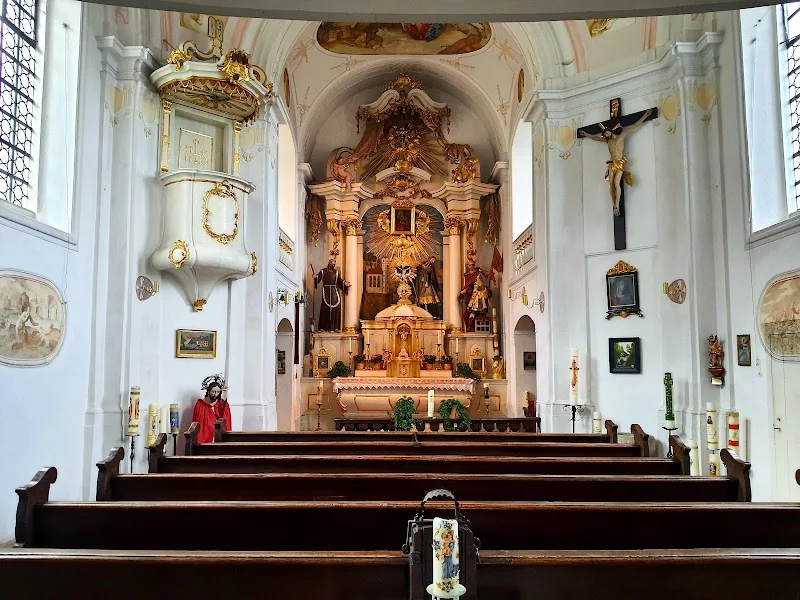
Inside the church, it becomes immediately clear why Schwarzlack has such a high art historical significance. The tourism association describes the Rococo altar in white and gold as dominating the space. It was created by Joseph Götsch and was made in 1767. At the center is the Maria-Hilf image, referred to as a copy of the famous Cranach image from Innsbruck. The altar is not only a decorative element but the visual and spiritual focal point of the church space. Surrounding the miraculous image are angels, clouds, and rays; the composition is complemented by the saintly figures of Johannes Nepomuk, Florian, and Franz von Paula. This creates a typical late baroque overall picture in which architecture, painting, and sculpture are harmoniously coordinated. Upon entering the space, one does not experience stark simplicity but a deliberately staged world of faith that places the miraculous image at the center. ([chiemsee-alpenland.de](https://www.chiemsee-alpenland.de/entdecken/alle-sehenswuerdigkeiten/wallfahrtskirche-mariahilf-und-st.-johann-nepomuk-auf-schwarzlack-577bc2fe80))
Additionally, there are the frescoes by Sebastian Rechenauer the Elder, who was born in the immediate vicinity of the church. He created the frescoes in the choir and nave as well as the grisaille of the four plagues of humanity. This imagery alludes to suffering, threat, and hope, making it clear why pilgrimage sites were places of comfort for many people in earlier centuries. Particularly significant are also the numerous votive tablets in the church. According to the tourism association, they testify to distress, despair, comfort, gratitude, and trust in God. For today's visitor, they are not just historical accessories but immediate testimonies of lived religiosity. The church can be partially visited; the anteroom is separated by a grate, protecting the space while still allowing visitors to experience the interior at least in parts. Schwarzlack is thus a place where liturgical use and art historical perception meaningfully complement each other. ([chiemsee-alpenland.de](https://www.chiemsee-alpenland.de/entdecken/alle-sehenswuerdigkeiten/wallfahrtskirche-mariahilf-und-st.-johann-nepomuk-auf-schwarzlack-577bc2fe80))
Services, Pilgrimage, and Lived Tradition
Even today, the Pilgrimage Church is not just a monument but a living ecclesiastical place. According to Chiemsee-Alpenland, a service takes place every Friday at 7:00 PM during the summer months from Easter until mid-October. The municipality of Brannenburg adds that regular church events and Catholic services take place and refers to the parish's website for current dates. This keeps Schwarzlack interesting not only for hikers but also for people seeking a spiritual place with regular liturgical use. The interplay of services, pilgrimage, and excursions makes the place temporally flexible: In summer, it is an evening place of devotion, during the week a hiking destination, and during events a regional meeting point. ([chiemsee-alpenland.de](https://www.chiemsee-alpenland.de/entdecken/alle-sehenswuerdigkeiten/wallfahrtskirche-mariahilf-und-st.-johann-nepomuk-auf-schwarzlack-577bc2fe80))
The tradition is also evident in the pilgrimages of the region. The mountain inn Schwarzlack points to the annual Gautrachten pilgrimage to the Pilgrimage Church in August, and media reports from the region document that traditional costume wearers and pilgrims continue to visit the site regularly. Such events make it clear that Schwarzlack is not only a historically significant name but is also carried forward in the present. The place thus stands for a form of tradition that is expressed not in a museum cabinet but in the annual cycle of an active community and its associations. For visitors, this means: Those who come at the right time experience not only architecture and nature but also lived tradition. The pilgrimage gives the church its original meaning back and shows that historical sacred places have the strongest impact when they continue to be used and filled with life. ([chiemsee-alpenland.de](https://www.chiemsee-alpenland.de/entdecken/essen-trinken/gastronomie/berggasthaus-schwarzlack-cbc85037bb?utm_source=openai))
Photos, Views, and Refreshments at Schwarzlack
Those looking for photos of the Pilgrimage Church Schwarzlack will find strong moods instead of grand scenery. The church is located on a forest clearing above Brannenburg, and the path there leads through a quiet Stations of the Cross with trees, benches, and changing light. This combination already creates motifs that are worth photographing: the ascent through the forest, the moment of arrival at the clearing, the exterior view of the church, and its calm embedding in the landscape. In the surrounding area, the view opens towards the Inntal and the pre-Alps. For atmospheric shots, not only the building itself but also the path leading there, the seasons, and the lighting conditions are crucial. Especially in the morning or late afternoon, such paths often create a special depth that captures the character of the place well. Inside, the Rococo altar, the votive tablets, and the colors of the space also provide impressive photographic motifs. ([brannenburg.de](https://www.brannenburg.de/orte/kirchen/wallfahrtskirche-heilige-maria/))
For a photo break, the refreshment directly next door is perfect. The mountain inn Schwarzlack is located, according to Chiemsee-Alpenland, right next to the church, at about 600 meters above sea level at the foot of Sulzberg. It offers Bavarian cuisine, game and seasonal dishes, as well as homemade cakes and Schmalznudeln. The establishment is open year-round from 10 AM, with Tuesday being a day off. The municipality describes the family-run inn as a quiet place to linger with cozy guest rooms and a beer garden with a view. Thus, Schwarzlack also becomes a rounded excursion destination in culinary terms: First the path through the forest, then the church as a historical and spiritual center, followed by the refreshment with regional cuisine. For many visitors, this sequence is precisely why Schwarzlack remains memorable. It is a place where one does not just pass by but consciously pauses. ([chiemsee-alpenland.de](https://www.chiemsee-alpenland.de/entdecken/essen-trinken/gastronomie/berggasthaus-schwarzlack-cbc85037bb?utm_source=openai))
Sources:
- Pilgrimage Church Holy Mary - Brannenburg
- Chiemsee-Alpenland - Pilgrimage Church Mariahilf and St. Johann Nepomuk at Schwarzlack
- Chiemsee-Alpenland - Schwarzlack Round BR5
- Chiemsee-Alpenland - Mountain Inn Schwarzlack
- Inn Schwarzlack - Access
- OVB Online - Inngau Trachten Association Pilgrimages to the Pilgrimage Church Schwarzlack
Show moreShow less
Pilgrimage Church Schwarzlack | Stations of the Cross & Parking
The Pilgrimage Church Schwarzlack in Brannenburg is a place where pilgrimage tradition, forest tranquility, and art history connect in a short distance. According to the municipality and tourism association, the site dates back to a hermitage from 1659 and the hermit Georg Tanner; the current church was built as a stone new building in the mid-18th century and was consecrated in 1767. Today, the Pilgrimage Church is located on a hill in the forest at Sulzberg and is only accessible on foot via a roughly 30-minute Stations of the Cross. Right next door, the mountain inn Schwarzlack invites visitors to linger. This combination of spiritual destination, hiking spot, and excursion destination makes Schwarzlack particularly special for visitors to Brannenburg. In this text, you will find the most important facts about history, access, Stations of the Cross, facilities, services, and photographic motifs. ([brannenburg.de](https://www.brannenburg.de/orte/kirchen/wallfahrtskirche-heilige-maria/))
History of the Pilgrimage Church Schwarzlack
The history of its origin begins in the second half of the 17th century, a time when private piety and regional pilgrimage took on new forms in many places in Upper Bavaria. In 1659, the hermit Georg Tanner settled at Schwarzlack and set up a Maria-Hilf image in his hermitage, which soon attracted pilgrims from the surrounding area. From this original hermitage, a wooden chapel was initially developed, which was built in 1687. Even before the current church was built, there was already a small stone predecessor building in 1716. The current site began with the laying of the foundation stone for the new building in 1750 and was consecrated in 1767. This sequence of hermitage, wooden chapel, stone predecessor church, and baroque new building vividly illustrates how a personal devotion became a permanent pilgrimage site. ([chiemsee-alpenland.de](https://www.chiemsee-alpenland.de/entdecken/alle-sehenswuerdigkeiten/wallfahrtskirche-mariahilf-und-st.-johann-nepomuk-auf-schwarzlack-577bc2fe80))
This development is important for visitors because it explains the special atmosphere of Schwarzlack. The church is not just any historical house of worship, but a religiously grown destination with a long continuity. The tourism association describes it as a late baroque pilgrimage church; the furnishings are characterized as fine, uniform Rococo decor that has hardly changed since the consecration. This is exactly what distinguishes Schwarzlack from many other excursion destinations: Here, the historical layer is not only visible in the architecture but also in the lived usage. The site tells of hermitic piety, pilgrimage movements, building history, folk piety, and a landscape that still retains its character as a quiet power place today. Therefore, those who visit Schwarzlack do not enter an open-air museum but a place where history and present come together in close proximity. This connection of origin, permanence, and sacred quality continues to shape perception today. ([brannenburg.de](https://www.brannenburg.de/orte/kirchen/wallfahrtskirche-heilige-maria/))
Access, Parking, and Footpath to Schwarzlack
The most important practical information up front: The Pilgrimage Church Schwarzlack is only accessible on foot. The municipality mentions a roughly 30-minute Stations of the Cross that begins on a hill in the forest at Sulzberg and leads up to the church. The area behind the Gasthof-Hotel Schlosswirt is mentioned as the starting point for the hike. Additionally, the municipality points out parking options in the district of Brannenburg near the Wendelsteinhalle as well as at the hiking parking lot at the shooting range, which can be accessed via Holzhausener Straße. Therefore, those planning their arrival can expect a classic footpath, not a direct access to the church. This is precisely what makes the place attractive for many visitors, as the journey itself is already part of the experience. ([brannenburg.de](https://www.brannenburg.de/orte/kirchen/wallfahrtskirche-heilige-maria/))
The official hiking suggestion from the region also supports this orientation. The Schwarzlack Round BR5 is described as an easy circular tour, 4.3 kilometers long, with about 178 meters of elevation gain and a duration of about 1:30 hours. The Kirchplatz or Wendelsteinhalle is mentioned as the starting point; by train, one can reach the Brannenburg station and walk from there to the Kirchplatz and Gasthof Schlosswirt in about ten minutes. For those arriving by car, the A93 exit Brannenburg is recommended, followed by driving towards the town and further to Bahnhofstraße. The tour mentions parking options at the Kirchplatz or the designated parking spaces at the Wendelsteinhalle. Thus, Schwarzlack is well connected, even though the church itself is intentionally located off the beaten path. The footpath is part of the character: The approach remains practical, but the last section leads into the tranquility of the forest and creates a clear separation between the edge of the village and the pilgrimage site. ([chiemsee-alpenland.de](https://www.chiemsee-alpenland.de/entdecken/tourenportal/wandern-von-brannenburg-aus-auf-die-schwarzlack-und-kogl-bdf93142c5))
Camino de Santiago, Stations of the Cross, and Hike to Schwarzlack
The special status of the Pilgrimage Church is that the well-known Camino de Santiago passes by it. The tourism association explicitly points out that the pilgrimage path runs along the church, connecting the site with a regional hiking and pilgrimage tradition. At the same time, the access itself follows a Stations of the Cross, transforming the journey into a religious and scenic experience. Along the way, there are Stations of the Cross and several resting benches; the path is well developed and initially leads through the forest, later over a forest road. For many visitors, this combination of path, devotion, and nature is what makes it special: One does not just walk to a destination but through a sequence of impressions. The destination is located in a clearing, making it feel even more concentrated and serene. ([chiemsee-alpenland.de](https://www.chiemsee-alpenland.de/entdecken/alle-sehenswuerdigkeiten/wallfahrtskirche-mariahilf-und-st.-johann-nepomuk-auf-schwarzlack-577bc2fe80))
The tour BR5 also makes this quality tangible in a sporting sense. It is considered easy and family-friendly, but at the same time offers scenic views and is culturally and historically interesting. The return route leads back to Brannenburg via Aich or Lechen; along the way, views open up towards the Inntal and the pre-Alps, especially during the further ascent towards Kogl. For hikers, this is an ideal half-day excursion, as history, nature, and refreshment can be combined. At the same time, the route is not suitable for strollers and is closed to cyclists, emphasizing the character of the path as a footpath. Therefore, those traveling here should not only think of the church but understand the path itself as part of the experience. Schwarzlack is thus more than a single building: The place is a destination in a network of pilgrimage paths, forest trails, viewpoints, and regional hiking culture. ([chiemsee-alpenland.de](https://www.chiemsee-alpenland.de/entdecken/tourenportal/wandern-von-brannenburg-aus-auf-die-schwarzlack-und-kogl-bdf93142c5))
Rococo Furnishings, Altar, and Votive Tablets
Inside the church, it becomes immediately clear why Schwarzlack has such a high art historical significance. The tourism association describes the Rococo altar in white and gold as dominating the space. It was created by Joseph Götsch and was made in 1767. At the center is the Maria-Hilf image, referred to as a copy of the famous Cranach image from Innsbruck. The altar is not only a decorative element but the visual and spiritual focal point of the church space. Surrounding the miraculous image are angels, clouds, and rays; the composition is complemented by the saintly figures of Johannes Nepomuk, Florian, and Franz von Paula. This creates a typical late baroque overall picture in which architecture, painting, and sculpture are harmoniously coordinated. Upon entering the space, one does not experience stark simplicity but a deliberately staged world of faith that places the miraculous image at the center. ([chiemsee-alpenland.de](https://www.chiemsee-alpenland.de/entdecken/alle-sehenswuerdigkeiten/wallfahrtskirche-mariahilf-und-st.-johann-nepomuk-auf-schwarzlack-577bc2fe80))
Additionally, there are the frescoes by Sebastian Rechenauer the Elder, who was born in the immediate vicinity of the church. He created the frescoes in the choir and nave as well as the grisaille of the four plagues of humanity. This imagery alludes to suffering, threat, and hope, making it clear why pilgrimage sites were places of comfort for many people in earlier centuries. Particularly significant are also the numerous votive tablets in the church. According to the tourism association, they testify to distress, despair, comfort, gratitude, and trust in God. For today's visitor, they are not just historical accessories but immediate testimonies of lived religiosity. The church can be partially visited; the anteroom is separated by a grate, protecting the space while still allowing visitors to experience the interior at least in parts. Schwarzlack is thus a place where liturgical use and art historical perception meaningfully complement each other. ([chiemsee-alpenland.de](https://www.chiemsee-alpenland.de/entdecken/alle-sehenswuerdigkeiten/wallfahrtskirche-mariahilf-und-st.-johann-nepomuk-auf-schwarzlack-577bc2fe80))
Services, Pilgrimage, and Lived Tradition
Even today, the Pilgrimage Church is not just a monument but a living ecclesiastical place. According to Chiemsee-Alpenland, a service takes place every Friday at 7:00 PM during the summer months from Easter until mid-October. The municipality of Brannenburg adds that regular church events and Catholic services take place and refers to the parish's website for current dates. This keeps Schwarzlack interesting not only for hikers but also for people seeking a spiritual place with regular liturgical use. The interplay of services, pilgrimage, and excursions makes the place temporally flexible: In summer, it is an evening place of devotion, during the week a hiking destination, and during events a regional meeting point. ([chiemsee-alpenland.de](https://www.chiemsee-alpenland.de/entdecken/alle-sehenswuerdigkeiten/wallfahrtskirche-mariahilf-und-st.-johann-nepomuk-auf-schwarzlack-577bc2fe80))
The tradition is also evident in the pilgrimages of the region. The mountain inn Schwarzlack points to the annual Gautrachten pilgrimage to the Pilgrimage Church in August, and media reports from the region document that traditional costume wearers and pilgrims continue to visit the site regularly. Such events make it clear that Schwarzlack is not only a historically significant name but is also carried forward in the present. The place thus stands for a form of tradition that is expressed not in a museum cabinet but in the annual cycle of an active community and its associations. For visitors, this means: Those who come at the right time experience not only architecture and nature but also lived tradition. The pilgrimage gives the church its original meaning back and shows that historical sacred places have the strongest impact when they continue to be used and filled with life. ([chiemsee-alpenland.de](https://www.chiemsee-alpenland.de/entdecken/essen-trinken/gastronomie/berggasthaus-schwarzlack-cbc85037bb?utm_source=openai))
Photos, Views, and Refreshments at Schwarzlack
Those looking for photos of the Pilgrimage Church Schwarzlack will find strong moods instead of grand scenery. The church is located on a forest clearing above Brannenburg, and the path there leads through a quiet Stations of the Cross with trees, benches, and changing light. This combination already creates motifs that are worth photographing: the ascent through the forest, the moment of arrival at the clearing, the exterior view of the church, and its calm embedding in the landscape. In the surrounding area, the view opens towards the Inntal and the pre-Alps. For atmospheric shots, not only the building itself but also the path leading there, the seasons, and the lighting conditions are crucial. Especially in the morning or late afternoon, such paths often create a special depth that captures the character of the place well. Inside, the Rococo altar, the votive tablets, and the colors of the space also provide impressive photographic motifs. ([brannenburg.de](https://www.brannenburg.de/orte/kirchen/wallfahrtskirche-heilige-maria/))
For a photo break, the refreshment directly next door is perfect. The mountain inn Schwarzlack is located, according to Chiemsee-Alpenland, right next to the church, at about 600 meters above sea level at the foot of Sulzberg. It offers Bavarian cuisine, game and seasonal dishes, as well as homemade cakes and Schmalznudeln. The establishment is open year-round from 10 AM, with Tuesday being a day off. The municipality describes the family-run inn as a quiet place to linger with cozy guest rooms and a beer garden with a view. Thus, Schwarzlack also becomes a rounded excursion destination in culinary terms: First the path through the forest, then the church as a historical and spiritual center, followed by the refreshment with regional cuisine. For many visitors, this sequence is precisely why Schwarzlack remains memorable. It is a place where one does not just pass by but consciously pauses. ([chiemsee-alpenland.de](https://www.chiemsee-alpenland.de/entdecken/essen-trinken/gastronomie/berggasthaus-schwarzlack-cbc85037bb?utm_source=openai))
Sources:
- Pilgrimage Church Holy Mary - Brannenburg
- Chiemsee-Alpenland - Pilgrimage Church Mariahilf and St. Johann Nepomuk at Schwarzlack
- Chiemsee-Alpenland - Schwarzlack Round BR5
- Chiemsee-Alpenland - Mountain Inn Schwarzlack
- Inn Schwarzlack - Access
- OVB Online - Inngau Trachten Association Pilgrimages to the Pilgrimage Church Schwarzlack
Pilgrimage Church Schwarzlack | Stations of the Cross & Parking
The Pilgrimage Church Schwarzlack in Brannenburg is a place where pilgrimage tradition, forest tranquility, and art history connect in a short distance. According to the municipality and tourism association, the site dates back to a hermitage from 1659 and the hermit Georg Tanner; the current church was built as a stone new building in the mid-18th century and was consecrated in 1767. Today, the Pilgrimage Church is located on a hill in the forest at Sulzberg and is only accessible on foot via a roughly 30-minute Stations of the Cross. Right next door, the mountain inn Schwarzlack invites visitors to linger. This combination of spiritual destination, hiking spot, and excursion destination makes Schwarzlack particularly special for visitors to Brannenburg. In this text, you will find the most important facts about history, access, Stations of the Cross, facilities, services, and photographic motifs. ([brannenburg.de](https://www.brannenburg.de/orte/kirchen/wallfahrtskirche-heilige-maria/))
History of the Pilgrimage Church Schwarzlack
The history of its origin begins in the second half of the 17th century, a time when private piety and regional pilgrimage took on new forms in many places in Upper Bavaria. In 1659, the hermit Georg Tanner settled at Schwarzlack and set up a Maria-Hilf image in his hermitage, which soon attracted pilgrims from the surrounding area. From this original hermitage, a wooden chapel was initially developed, which was built in 1687. Even before the current church was built, there was already a small stone predecessor building in 1716. The current site began with the laying of the foundation stone for the new building in 1750 and was consecrated in 1767. This sequence of hermitage, wooden chapel, stone predecessor church, and baroque new building vividly illustrates how a personal devotion became a permanent pilgrimage site. ([chiemsee-alpenland.de](https://www.chiemsee-alpenland.de/entdecken/alle-sehenswuerdigkeiten/wallfahrtskirche-mariahilf-und-st.-johann-nepomuk-auf-schwarzlack-577bc2fe80))
This development is important for visitors because it explains the special atmosphere of Schwarzlack. The church is not just any historical house of worship, but a religiously grown destination with a long continuity. The tourism association describes it as a late baroque pilgrimage church; the furnishings are characterized as fine, uniform Rococo decor that has hardly changed since the consecration. This is exactly what distinguishes Schwarzlack from many other excursion destinations: Here, the historical layer is not only visible in the architecture but also in the lived usage. The site tells of hermitic piety, pilgrimage movements, building history, folk piety, and a landscape that still retains its character as a quiet power place today. Therefore, those who visit Schwarzlack do not enter an open-air museum but a place where history and present come together in close proximity. This connection of origin, permanence, and sacred quality continues to shape perception today. ([brannenburg.de](https://www.brannenburg.de/orte/kirchen/wallfahrtskirche-heilige-maria/))
Access, Parking, and Footpath to Schwarzlack
The most important practical information up front: The Pilgrimage Church Schwarzlack is only accessible on foot. The municipality mentions a roughly 30-minute Stations of the Cross that begins on a hill in the forest at Sulzberg and leads up to the church. The area behind the Gasthof-Hotel Schlosswirt is mentioned as the starting point for the hike. Additionally, the municipality points out parking options in the district of Brannenburg near the Wendelsteinhalle as well as at the hiking parking lot at the shooting range, which can be accessed via Holzhausener Straße. Therefore, those planning their arrival can expect a classic footpath, not a direct access to the church. This is precisely what makes the place attractive for many visitors, as the journey itself is already part of the experience. ([brannenburg.de](https://www.brannenburg.de/orte/kirchen/wallfahrtskirche-heilige-maria/))
The official hiking suggestion from the region also supports this orientation. The Schwarzlack Round BR5 is described as an easy circular tour, 4.3 kilometers long, with about 178 meters of elevation gain and a duration of about 1:30 hours. The Kirchplatz or Wendelsteinhalle is mentioned as the starting point; by train, one can reach the Brannenburg station and walk from there to the Kirchplatz and Gasthof Schlosswirt in about ten minutes. For those arriving by car, the A93 exit Brannenburg is recommended, followed by driving towards the town and further to Bahnhofstraße. The tour mentions parking options at the Kirchplatz or the designated parking spaces at the Wendelsteinhalle. Thus, Schwarzlack is well connected, even though the church itself is intentionally located off the beaten path. The footpath is part of the character: The approach remains practical, but the last section leads into the tranquility of the forest and creates a clear separation between the edge of the village and the pilgrimage site. ([chiemsee-alpenland.de](https://www.chiemsee-alpenland.de/entdecken/tourenportal/wandern-von-brannenburg-aus-auf-die-schwarzlack-und-kogl-bdf93142c5))
Camino de Santiago, Stations of the Cross, and Hike to Schwarzlack
The special status of the Pilgrimage Church is that the well-known Camino de Santiago passes by it. The tourism association explicitly points out that the pilgrimage path runs along the church, connecting the site with a regional hiking and pilgrimage tradition. At the same time, the access itself follows a Stations of the Cross, transforming the journey into a religious and scenic experience. Along the way, there are Stations of the Cross and several resting benches; the path is well developed and initially leads through the forest, later over a forest road. For many visitors, this combination of path, devotion, and nature is what makes it special: One does not just walk to a destination but through a sequence of impressions. The destination is located in a clearing, making it feel even more concentrated and serene. ([chiemsee-alpenland.de](https://www.chiemsee-alpenland.de/entdecken/alle-sehenswuerdigkeiten/wallfahrtskirche-mariahilf-und-st.-johann-nepomuk-auf-schwarzlack-577bc2fe80))
The tour BR5 also makes this quality tangible in a sporting sense. It is considered easy and family-friendly, but at the same time offers scenic views and is culturally and historically interesting. The return route leads back to Brannenburg via Aich or Lechen; along the way, views open up towards the Inntal and the pre-Alps, especially during the further ascent towards Kogl. For hikers, this is an ideal half-day excursion, as history, nature, and refreshment can be combined. At the same time, the route is not suitable for strollers and is closed to cyclists, emphasizing the character of the path as a footpath. Therefore, those traveling here should not only think of the church but understand the path itself as part of the experience. Schwarzlack is thus more than a single building: The place is a destination in a network of pilgrimage paths, forest trails, viewpoints, and regional hiking culture. ([chiemsee-alpenland.de](https://www.chiemsee-alpenland.de/entdecken/tourenportal/wandern-von-brannenburg-aus-auf-die-schwarzlack-und-kogl-bdf93142c5))
Rococo Furnishings, Altar, and Votive Tablets
Inside the church, it becomes immediately clear why Schwarzlack has such a high art historical significance. The tourism association describes the Rococo altar in white and gold as dominating the space. It was created by Joseph Götsch and was made in 1767. At the center is the Maria-Hilf image, referred to as a copy of the famous Cranach image from Innsbruck. The altar is not only a decorative element but the visual and spiritual focal point of the church space. Surrounding the miraculous image are angels, clouds, and rays; the composition is complemented by the saintly figures of Johannes Nepomuk, Florian, and Franz von Paula. This creates a typical late baroque overall picture in which architecture, painting, and sculpture are harmoniously coordinated. Upon entering the space, one does not experience stark simplicity but a deliberately staged world of faith that places the miraculous image at the center. ([chiemsee-alpenland.de](https://www.chiemsee-alpenland.de/entdecken/alle-sehenswuerdigkeiten/wallfahrtskirche-mariahilf-und-st.-johann-nepomuk-auf-schwarzlack-577bc2fe80))
Additionally, there are the frescoes by Sebastian Rechenauer the Elder, who was born in the immediate vicinity of the church. He created the frescoes in the choir and nave as well as the grisaille of the four plagues of humanity. This imagery alludes to suffering, threat, and hope, making it clear why pilgrimage sites were places of comfort for many people in earlier centuries. Particularly significant are also the numerous votive tablets in the church. According to the tourism association, they testify to distress, despair, comfort, gratitude, and trust in God. For today's visitor, they are not just historical accessories but immediate testimonies of lived religiosity. The church can be partially visited; the anteroom is separated by a grate, protecting the space while still allowing visitors to experience the interior at least in parts. Schwarzlack is thus a place where liturgical use and art historical perception meaningfully complement each other. ([chiemsee-alpenland.de](https://www.chiemsee-alpenland.de/entdecken/alle-sehenswuerdigkeiten/wallfahrtskirche-mariahilf-und-st.-johann-nepomuk-auf-schwarzlack-577bc2fe80))
Services, Pilgrimage, and Lived Tradition
Even today, the Pilgrimage Church is not just a monument but a living ecclesiastical place. According to Chiemsee-Alpenland, a service takes place every Friday at 7:00 PM during the summer months from Easter until mid-October. The municipality of Brannenburg adds that regular church events and Catholic services take place and refers to the parish's website for current dates. This keeps Schwarzlack interesting not only for hikers but also for people seeking a spiritual place with regular liturgical use. The interplay of services, pilgrimage, and excursions makes the place temporally flexible: In summer, it is an evening place of devotion, during the week a hiking destination, and during events a regional meeting point. ([chiemsee-alpenland.de](https://www.chiemsee-alpenland.de/entdecken/alle-sehenswuerdigkeiten/wallfahrtskirche-mariahilf-und-st.-johann-nepomuk-auf-schwarzlack-577bc2fe80))
The tradition is also evident in the pilgrimages of the region. The mountain inn Schwarzlack points to the annual Gautrachten pilgrimage to the Pilgrimage Church in August, and media reports from the region document that traditional costume wearers and pilgrims continue to visit the site regularly. Such events make it clear that Schwarzlack is not only a historically significant name but is also carried forward in the present. The place thus stands for a form of tradition that is expressed not in a museum cabinet but in the annual cycle of an active community and its associations. For visitors, this means: Those who come at the right time experience not only architecture and nature but also lived tradition. The pilgrimage gives the church its original meaning back and shows that historical sacred places have the strongest impact when they continue to be used and filled with life. ([chiemsee-alpenland.de](https://www.chiemsee-alpenland.de/entdecken/essen-trinken/gastronomie/berggasthaus-schwarzlack-cbc85037bb?utm_source=openai))
Photos, Views, and Refreshments at Schwarzlack
Those looking for photos of the Pilgrimage Church Schwarzlack will find strong moods instead of grand scenery. The church is located on a forest clearing above Brannenburg, and the path there leads through a quiet Stations of the Cross with trees, benches, and changing light. This combination already creates motifs that are worth photographing: the ascent through the forest, the moment of arrival at the clearing, the exterior view of the church, and its calm embedding in the landscape. In the surrounding area, the view opens towards the Inntal and the pre-Alps. For atmospheric shots, not only the building itself but also the path leading there, the seasons, and the lighting conditions are crucial. Especially in the morning or late afternoon, such paths often create a special depth that captures the character of the place well. Inside, the Rococo altar, the votive tablets, and the colors of the space also provide impressive photographic motifs. ([brannenburg.de](https://www.brannenburg.de/orte/kirchen/wallfahrtskirche-heilige-maria/))
For a photo break, the refreshment directly next door is perfect. The mountain inn Schwarzlack is located, according to Chiemsee-Alpenland, right next to the church, at about 600 meters above sea level at the foot of Sulzberg. It offers Bavarian cuisine, game and seasonal dishes, as well as homemade cakes and Schmalznudeln. The establishment is open year-round from 10 AM, with Tuesday being a day off. The municipality describes the family-run inn as a quiet place to linger with cozy guest rooms and a beer garden with a view. Thus, Schwarzlack also becomes a rounded excursion destination in culinary terms: First the path through the forest, then the church as a historical and spiritual center, followed by the refreshment with regional cuisine. For many visitors, this sequence is precisely why Schwarzlack remains memorable. It is a place where one does not just pass by but consciously pauses. ([chiemsee-alpenland.de](https://www.chiemsee-alpenland.de/entdecken/essen-trinken/gastronomie/berggasthaus-schwarzlack-cbc85037bb?utm_source=openai))
Sources:
- Pilgrimage Church Holy Mary - Brannenburg
- Chiemsee-Alpenland - Pilgrimage Church Mariahilf and St. Johann Nepomuk at Schwarzlack
- Chiemsee-Alpenland - Schwarzlack Round BR5
- Chiemsee-Alpenland - Mountain Inn Schwarzlack
- Inn Schwarzlack - Access
- OVB Online - Inngau Trachten Association Pilgrimages to the Pilgrimage Church Schwarzlack
Frequently Asked Questions
Reviews
No reviews found