
Kiefersfelden
Feldweg 8a, 83088 Kiefersfelden, Deutschland
Wachtl-Bahn | Timetable & Access
The Wachtl-Bahn in Kiefersfelden is one of those addresses that at first glance may seem like a niche term, but upon closer inspection tells a piece of vibrant regional and industrial history. As an electrically operated narrow-gauge railway with a gauge of 900 millimeters, it connected the cement factory in Kiefersfelden with the Wachtl quarry in the municipality of Thiersee in Tyrol for decades. Today, it appears for many seekers primarily as a museum railway, club project, and excursion destination. That is precisely why the railway is equally relevant for the search terms timetable, access, photos, and club: Those searching for Wachtl-Bahn want to know not only where it is located, but also what still happens there today, how to get there, and why this place is so special for railway enthusiasts. The official club website lists visiting hours on Saturdays and refers to ongoing restoration projects; at the same time, expert sources describe that tourist train operations have been suspended since 2017. This mix of historical railway, club work, and border location creates the charm of the site. ([josefmoser1.wixsite.com](https://josefmoser1.wixsite.com/wachtl-bahn))
Wachtl-Bahn Timetable and Visiting Hours
Those searching for the timetable of the Wachtl-Bahn often expect a classic museum railway with clear departure times, ticket sales, and summer season. This is where a closer look is worthwhile: The official website of the club states visiting hours on Saturdays from 10:00 to 12:00 and 14:00 to 18:00. However, the events page states 10:00 to 12:00 and 14:00 to 16:00 on Saturdays. This discrepancy shows one thing: The page is important for visitors, but should be checked again before a planned trip. For SEO, the keyword timetable is therefore obvious, but in terms of content, it is more appropriate to speak of visiting hours, club openings, and historical tourist trips at the Wachtl-Bahn today rather than a dense scheduled service. ([josefmoser1.wixsite.com](https://josefmoser1.wixsite.com/wachtl-bahn))
Historically, the railway certainly had a real tourist timetable. Wikipedia describes that passenger traffic was offered from 1991 and that in the 2016 timetable, several train pairs operated on certain weekends. At the same time, expert sources note that tourist operations were suspended in 2017 due to infrastructure problems, and a resumption remained unclear for a long time. For seekers, this means: The term timetable is more of an entry point into the history and visit planning at the Wachtl-Bahn than into current scheduled traffic. Therefore, those who want to experience the railway should not only rely on online search results but also use the club's website and contact options directly. The club's address at Feldweg 8a, as well as the phone number and email address for inquiries, can also be found there. ([de.wikipedia.org](https://de.wikipedia.org/wiki/Wachtlbahn))
Especially for regional excursions, this distinction is important because the Wachtl-Bahn does not operate like a regular city tour. Rather, it is a historical railway system whose current operation depends heavily on club life, projects, and events. This makes the railway interesting for people who not only want to ride but also want to understand the background: How did a freight railway become a museum project? Why are opening hours more important than a fixed schedule? And why do so many users search for terms like Wachtlbahn timetable or Wachtlbahn opening hours? The answer is simple: The railway lives from its history, but also from its current state as a voluntarily maintained technical monument. ([josefmoser1.wixsite.com](https://josefmoser1.wixsite.com/wachtl-bahn))
Access to the Wachtl-Bahn in Kiefersfelden and Parking
Access to the Wachtl-Bahn is relatively uncomplicated for visitors because Kiefersfelden itself is very well connected to the regional transport network. The tourist information describes the location as situated at the foot of the Kaiser Mountains and names the A93 motorway as the main access; additionally, the Kiefersfelden train station is on the Munich–Rosenheim–Innsbruck line with hourly service. For the Wachtl-Bahn, it is also important that its premises are located at Feldweg 8a and are accessible from the train station. An expert source describes the route from Kiefersfelden station to the site as well-signposted and taking about 20 minutes on foot. Therefore, those arriving without a car can generally reach the museum station on foot. ([tourismus-kiefersfelden.de](https://www.tourismus-kiefersfelden.de/lage-und-anfahrt/))
When it comes to parking, it is worth looking at previous club and press notices, as they show how visitor flows were organized there. A community newsletter expressly mentioned parking spaces at Feldweg 8a and on the railway premises; in another report on the event at the Wachtl museum railway, the town hall square was mentioned as a parking lot. In practice, this means: Those attending an event at the site should not only know the address Feldweg 8a but also pay attention to current notices from the club, as parking and access solutions may vary depending on the occasion. Especially for smaller events, it is advisable to arrive early and pay attention to the signage on site. ([kiefersfelden.de](https://kiefersfelden.de/wp-content/uploads/2023/09/kieferer-nachrichten-maerz-2016.pdf?utm_source=openai))
The location is more than just a logistical point. Kiefersfelden, as a border town between Bavaria and Tyrol, is a place where railways, roads, and hiking come together. This makes the Wachtl-Bahn particularly attractive for people who want to combine a museum railway with a day outdoors. The route of the former tourist traffic led through a scenic area with stations and hiking connections towards Hechtsee, Gießenbachklamm, and the Tyrolean lake district. Therefore, access is often not only understood as a technical question but as part of the overall experience. Thus, those visiting the site do not just experience a club location but a historical transport hub at a border that has long become a connecting space in everyday life. ([museen.de](https://museen.de/wachtl-express-kiefersfelden.html?utm_source=openai))
History and Technology of the Wachtl-Bahn
The history of the Wachtl-Bahn dates back a long way. Wikipedia describes the railway as having been put into operation around 1880; initially, it served freight transport, especially the transport of limestone from the quarry in Wachtl to the cement factory in Kiefersfelden. Other expert sources also emphasize this origin as an industrial railway in the border area between Bavaria and Tyrol. From this sober works railway, a tourist and museum project later developed. In 1990, the Wachtl Museum Railway Community was founded, and on July 6, 1991, passenger traffic was offered for the first time. In 1994, the Wachtl Express was spun off from HeidelbergCement AG as an independent railway company with the help of several sponsors. This development is a core point of any serious SEO description because it explains why the railway is interesting both industrially and culturally historically today. ([de.wikipedia.org](https://de.wikipedia.org/wiki/Wachtlbahn))
Technically, the railway is unusual and therefore remarkable. The line is described as an electrically operated narrow-gauge railway with a gauge of 900 millimeters; the power system is named as 1200 volts direct current. In the literature, there are varying lengths of the line, ranging from about five to 6.1 kilometers, depending on the counting method. This is not an error but shows that different values circulate depending on whether the end of the operation or the line is counted. For seekers, it is important: Along the way, there are and were notable points such as Siedlerweg, Kohlstatt, Hechtsee-Schöffau, Breitenau, Gießenbachklamm, and Wachtl. Thus, the railway is not only a technical object but a geographical narrative space that makes visible the path from the factory up into the border and lake landscape. ([de.wikipedia.org](https://de.wikipedia.org/wiki/Wachtlbahn))
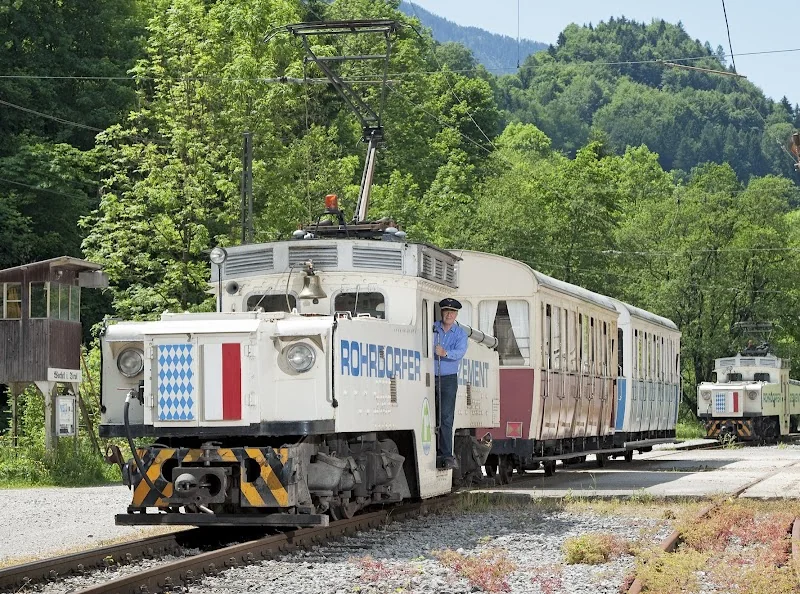
The rolling stock also contributes to the fascination. Wikipedia names the two electric locomotives 4 and 5 of the Crocodile type, built in 1927 and 1928 by Brown, Boveri & Cie., as well as the Gmeinder diesel locomotive number 6 from 1947 for the former operation. Additionally, there are passenger cars that came from the Wendelsteinbahn; on the historical railway, even old Wendelstein cars were converted and partially used as bar cars. The official club website lists the restoration of the steam locomotive and the cars as current projects. This mixture of vehicle history, restoration, and voluntary maintenance makes the Wachtl-Bahn a living archive rather than just a museum object. ([de.wikipedia.org](https://de.wikipedia.org/wiki/Wachtlbahn))
Photos, Atmosphere, and Special Experiences at the Wachtl-Bahn
Those searching for Wachtlbahn photos often expect not only railway images but also atmosphere, landscape, and details from club life. The railway is excellently suited for this, as the official website offers dedicated sections for images and videos. This is very important for the search intent, as it allows for a quick visual impression of the facility, vehicles, and grounds. Additionally, there is a dedicated Wachtlbahn collection on Wikimedia Commons, where historical and current image documents are compiled. Therefore, seekers find not only text information but also material that makes the mix of industrial railway atmosphere, border location, and nostalgic railway charm visually tangible. ([josefmoser1.wixsite.com](https://josefmoser1.wixsite.com/wachtl-bahn/bilder))
The atmosphere is unusually diverse. Expert reports describe that the former tourist route ran along Kieferbach, Klausenbach, and Thierseer Ache, thereby opening up a hiking and recreational area that extends from the Oberaudorf pastures and the Gießenbachklamm to the Tyrolean lake district between Hechtsee and Thiersee. This is precisely what distinguishes the Wachtl-Bahn from many other museum railways: It was never just a leisure transport medium but always also part of a landscape and work history. Those taking photos or interested in images therefore receive not only trains against a backdrop but a railway that is anchored in a very specific environment of forests, border areas, old factory roads, and hiking trails. ([museen.de](https://museen.de/wachtl-express-kiefersfelden.html?utm_source=openai))
Particularly charming are the historical details that appear in the available photographic documentation: the old Crocodile locomotives, the cars of the Wendelsteinbahn, the shunting operations at the endpoints, and the impression of a railway that has functioned industrially and touristically for a long time. The terms Wachtl Express or Kieferer Grenz-Bahn also appear repeatedly in image and report material, telling that the railway was more than just a pure transport offer. For people seeking image material for inspiration, research, or railway nostalgia, this mix is particularly attractive. The photo experience at the Wachtl-Bahn is therefore never just technical but always also emotional and historical. ([dokumentationszentrum-eisenbahnforschung.org](https://www.dokumentationszentrum-eisenbahnforschung.org/wachtlexpress))
Wachtl-Bahn e.V., Events, and Practical Information
The Wachtl-Bahn is today primarily a club project. The Wachtl Museum Railway Community is located at Feldweg 8a, lists contact options on its website, and describes current projects such as the restoration of the steam locomotive and the cars on the info page. This is crucial for the external perception, as the railway can thus be seen not only as historical infrastructure but as an active volunteer project. Those searching for Wachtlbahn eV mean exactly this sponsoring association. For search intent, it is therefore important that the railway is not viewed in isolation but as a community achievement by people who maintain vehicles, care for the facility, and welcome visitors to the site. ([josefmoser1.wixsite.com](https://josefmoser1.wixsite.com/wachtl-bahn))
Events also show how versatile the site is used. In recent years, there have been a large LGB garden railway exhibition and musical open-air formats at the Wachtl station. Such events make the railway interesting for visitors who are not primarily railway experts but want to experience culture, family, and technology together. Local announcements also mentioned that during anniversaries, guided tours, catering, and exhibitions were possible on the site. This makes it clear: The Wachtl-Bahn is not just a rail object but a place where club life, event culture, and technical maintenance come together. For SEO planning, this is valuable because it organically connects the themes of events, history, images, and the club. ([sitemap.hey-grafing.de](https://sitemap.hey-grafing.de/events/572804?utm_source=openai))
For readers primarily searching for reviews, the Wachtl-Bahn is a special case. The impression on site heavily depends on expectations: Those looking for a fully regular museum railway with a dense timetable will evaluate its current situation differently than someone interested in a historical club site, border history, and restoration. This is precisely why clear information on visiting hours, access, and current status is so important. In summary, the Wachtl-Bahn is particularly suitable for people who want to not only read about railway history but see it on site; who appreciate the natural and border location; and who want to follow the work of a club that preserves an unusual piece of technical history with great passion. ([josefmoser1.wixsite.com](https://josefmoser1.wixsite.com/wachtl-bahn))
Sources:
Show moreShow less
Wachtl-Bahn | Timetable & Access
The Wachtl-Bahn in Kiefersfelden is one of those addresses that at first glance may seem like a niche term, but upon closer inspection tells a piece of vibrant regional and industrial history. As an electrically operated narrow-gauge railway with a gauge of 900 millimeters, it connected the cement factory in Kiefersfelden with the Wachtl quarry in the municipality of Thiersee in Tyrol for decades. Today, it appears for many seekers primarily as a museum railway, club project, and excursion destination. That is precisely why the railway is equally relevant for the search terms timetable, access, photos, and club: Those searching for Wachtl-Bahn want to know not only where it is located, but also what still happens there today, how to get there, and why this place is so special for railway enthusiasts. The official club website lists visiting hours on Saturdays and refers to ongoing restoration projects; at the same time, expert sources describe that tourist train operations have been suspended since 2017. This mix of historical railway, club work, and border location creates the charm of the site. ([josefmoser1.wixsite.com](https://josefmoser1.wixsite.com/wachtl-bahn))
Wachtl-Bahn Timetable and Visiting Hours
Those searching for the timetable of the Wachtl-Bahn often expect a classic museum railway with clear departure times, ticket sales, and summer season. This is where a closer look is worthwhile: The official website of the club states visiting hours on Saturdays from 10:00 to 12:00 and 14:00 to 18:00. However, the events page states 10:00 to 12:00 and 14:00 to 16:00 on Saturdays. This discrepancy shows one thing: The page is important for visitors, but should be checked again before a planned trip. For SEO, the keyword timetable is therefore obvious, but in terms of content, it is more appropriate to speak of visiting hours, club openings, and historical tourist trips at the Wachtl-Bahn today rather than a dense scheduled service. ([josefmoser1.wixsite.com](https://josefmoser1.wixsite.com/wachtl-bahn))
Historically, the railway certainly had a real tourist timetable. Wikipedia describes that passenger traffic was offered from 1991 and that in the 2016 timetable, several train pairs operated on certain weekends. At the same time, expert sources note that tourist operations were suspended in 2017 due to infrastructure problems, and a resumption remained unclear for a long time. For seekers, this means: The term timetable is more of an entry point into the history and visit planning at the Wachtl-Bahn than into current scheduled traffic. Therefore, those who want to experience the railway should not only rely on online search results but also use the club's website and contact options directly. The club's address at Feldweg 8a, as well as the phone number and email address for inquiries, can also be found there. ([de.wikipedia.org](https://de.wikipedia.org/wiki/Wachtlbahn))
Especially for regional excursions, this distinction is important because the Wachtl-Bahn does not operate like a regular city tour. Rather, it is a historical railway system whose current operation depends heavily on club life, projects, and events. This makes the railway interesting for people who not only want to ride but also want to understand the background: How did a freight railway become a museum project? Why are opening hours more important than a fixed schedule? And why do so many users search for terms like Wachtlbahn timetable or Wachtlbahn opening hours? The answer is simple: The railway lives from its history, but also from its current state as a voluntarily maintained technical monument. ([josefmoser1.wixsite.com](https://josefmoser1.wixsite.com/wachtl-bahn))
Access to the Wachtl-Bahn in Kiefersfelden and Parking
Access to the Wachtl-Bahn is relatively uncomplicated for visitors because Kiefersfelden itself is very well connected to the regional transport network. The tourist information describes the location as situated at the foot of the Kaiser Mountains and names the A93 motorway as the main access; additionally, the Kiefersfelden train station is on the Munich–Rosenheim–Innsbruck line with hourly service. For the Wachtl-Bahn, it is also important that its premises are located at Feldweg 8a and are accessible from the train station. An expert source describes the route from Kiefersfelden station to the site as well-signposted and taking about 20 minutes on foot. Therefore, those arriving without a car can generally reach the museum station on foot. ([tourismus-kiefersfelden.de](https://www.tourismus-kiefersfelden.de/lage-und-anfahrt/))
When it comes to parking, it is worth looking at previous club and press notices, as they show how visitor flows were organized there. A community newsletter expressly mentioned parking spaces at Feldweg 8a and on the railway premises; in another report on the event at the Wachtl museum railway, the town hall square was mentioned as a parking lot. In practice, this means: Those attending an event at the site should not only know the address Feldweg 8a but also pay attention to current notices from the club, as parking and access solutions may vary depending on the occasion. Especially for smaller events, it is advisable to arrive early and pay attention to the signage on site. ([kiefersfelden.de](https://kiefersfelden.de/wp-content/uploads/2023/09/kieferer-nachrichten-maerz-2016.pdf?utm_source=openai))
The location is more than just a logistical point. Kiefersfelden, as a border town between Bavaria and Tyrol, is a place where railways, roads, and hiking come together. This makes the Wachtl-Bahn particularly attractive for people who want to combine a museum railway with a day outdoors. The route of the former tourist traffic led through a scenic area with stations and hiking connections towards Hechtsee, Gießenbachklamm, and the Tyrolean lake district. Therefore, access is often not only understood as a technical question but as part of the overall experience. Thus, those visiting the site do not just experience a club location but a historical transport hub at a border that has long become a connecting space in everyday life. ([museen.de](https://museen.de/wachtl-express-kiefersfelden.html?utm_source=openai))
History and Technology of the Wachtl-Bahn
The history of the Wachtl-Bahn dates back a long way. Wikipedia describes the railway as having been put into operation around 1880; initially, it served freight transport, especially the transport of limestone from the quarry in Wachtl to the cement factory in Kiefersfelden. Other expert sources also emphasize this origin as an industrial railway in the border area between Bavaria and Tyrol. From this sober works railway, a tourist and museum project later developed. In 1990, the Wachtl Museum Railway Community was founded, and on July 6, 1991, passenger traffic was offered for the first time. In 1994, the Wachtl Express was spun off from HeidelbergCement AG as an independent railway company with the help of several sponsors. This development is a core point of any serious SEO description because it explains why the railway is interesting both industrially and culturally historically today. ([de.wikipedia.org](https://de.wikipedia.org/wiki/Wachtlbahn))
Technically, the railway is unusual and therefore remarkable. The line is described as an electrically operated narrow-gauge railway with a gauge of 900 millimeters; the power system is named as 1200 volts direct current. In the literature, there are varying lengths of the line, ranging from about five to 6.1 kilometers, depending on the counting method. This is not an error but shows that different values circulate depending on whether the end of the operation or the line is counted. For seekers, it is important: Along the way, there are and were notable points such as Siedlerweg, Kohlstatt, Hechtsee-Schöffau, Breitenau, Gießenbachklamm, and Wachtl. Thus, the railway is not only a technical object but a geographical narrative space that makes visible the path from the factory up into the border and lake landscape. ([de.wikipedia.org](https://de.wikipedia.org/wiki/Wachtlbahn))
The rolling stock also contributes to the fascination. Wikipedia names the two electric locomotives 4 and 5 of the Crocodile type, built in 1927 and 1928 by Brown, Boveri & Cie., as well as the Gmeinder diesel locomotive number 6 from 1947 for the former operation. Additionally, there are passenger cars that came from the Wendelsteinbahn; on the historical railway, even old Wendelstein cars were converted and partially used as bar cars. The official club website lists the restoration of the steam locomotive and the cars as current projects. This mixture of vehicle history, restoration, and voluntary maintenance makes the Wachtl-Bahn a living archive rather than just a museum object. ([de.wikipedia.org](https://de.wikipedia.org/wiki/Wachtlbahn))
Photos, Atmosphere, and Special Experiences at the Wachtl-Bahn
Those searching for Wachtlbahn photos often expect not only railway images but also atmosphere, landscape, and details from club life. The railway is excellently suited for this, as the official website offers dedicated sections for images and videos. This is very important for the search intent, as it allows for a quick visual impression of the facility, vehicles, and grounds. Additionally, there is a dedicated Wachtlbahn collection on Wikimedia Commons, where historical and current image documents are compiled. Therefore, seekers find not only text information but also material that makes the mix of industrial railway atmosphere, border location, and nostalgic railway charm visually tangible. ([josefmoser1.wixsite.com](https://josefmoser1.wixsite.com/wachtl-bahn/bilder))
The atmosphere is unusually diverse. Expert reports describe that the former tourist route ran along Kieferbach, Klausenbach, and Thierseer Ache, thereby opening up a hiking and recreational area that extends from the Oberaudorf pastures and the Gießenbachklamm to the Tyrolean lake district between Hechtsee and Thiersee. This is precisely what distinguishes the Wachtl-Bahn from many other museum railways: It was never just a leisure transport medium but always also part of a landscape and work history. Those taking photos or interested in images therefore receive not only trains against a backdrop but a railway that is anchored in a very specific environment of forests, border areas, old factory roads, and hiking trails. ([museen.de](https://museen.de/wachtl-express-kiefersfelden.html?utm_source=openai))
Particularly charming are the historical details that appear in the available photographic documentation: the old Crocodile locomotives, the cars of the Wendelsteinbahn, the shunting operations at the endpoints, and the impression of a railway that has functioned industrially and touristically for a long time. The terms Wachtl Express or Kieferer Grenz-Bahn also appear repeatedly in image and report material, telling that the railway was more than just a pure transport offer. For people seeking image material for inspiration, research, or railway nostalgia, this mix is particularly attractive. The photo experience at the Wachtl-Bahn is therefore never just technical but always also emotional and historical. ([dokumentationszentrum-eisenbahnforschung.org](https://www.dokumentationszentrum-eisenbahnforschung.org/wachtlexpress))
Wachtl-Bahn e.V., Events, and Practical Information
The Wachtl-Bahn is today primarily a club project. The Wachtl Museum Railway Community is located at Feldweg 8a, lists contact options on its website, and describes current projects such as the restoration of the steam locomotive and the cars on the info page. This is crucial for the external perception, as the railway can thus be seen not only as historical infrastructure but as an active volunteer project. Those searching for Wachtlbahn eV mean exactly this sponsoring association. For search intent, it is therefore important that the railway is not viewed in isolation but as a community achievement by people who maintain vehicles, care for the facility, and welcome visitors to the site. ([josefmoser1.wixsite.com](https://josefmoser1.wixsite.com/wachtl-bahn))
Events also show how versatile the site is used. In recent years, there have been a large LGB garden railway exhibition and musical open-air formats at the Wachtl station. Such events make the railway interesting for visitors who are not primarily railway experts but want to experience culture, family, and technology together. Local announcements also mentioned that during anniversaries, guided tours, catering, and exhibitions were possible on the site. This makes it clear: The Wachtl-Bahn is not just a rail object but a place where club life, event culture, and technical maintenance come together. For SEO planning, this is valuable because it organically connects the themes of events, history, images, and the club. ([sitemap.hey-grafing.de](https://sitemap.hey-grafing.de/events/572804?utm_source=openai))
For readers primarily searching for reviews, the Wachtl-Bahn is a special case. The impression on site heavily depends on expectations: Those looking for a fully regular museum railway with a dense timetable will evaluate its current situation differently than someone interested in a historical club site, border history, and restoration. This is precisely why clear information on visiting hours, access, and current status is so important. In summary, the Wachtl-Bahn is particularly suitable for people who want to not only read about railway history but see it on site; who appreciate the natural and border location; and who want to follow the work of a club that preserves an unusual piece of technical history with great passion. ([josefmoser1.wixsite.com](https://josefmoser1.wixsite.com/wachtl-bahn))
Sources:
Wachtl-Bahn | Timetable & Access
The Wachtl-Bahn in Kiefersfelden is one of those addresses that at first glance may seem like a niche term, but upon closer inspection tells a piece of vibrant regional and industrial history. As an electrically operated narrow-gauge railway with a gauge of 900 millimeters, it connected the cement factory in Kiefersfelden with the Wachtl quarry in the municipality of Thiersee in Tyrol for decades. Today, it appears for many seekers primarily as a museum railway, club project, and excursion destination. That is precisely why the railway is equally relevant for the search terms timetable, access, photos, and club: Those searching for Wachtl-Bahn want to know not only where it is located, but also what still happens there today, how to get there, and why this place is so special for railway enthusiasts. The official club website lists visiting hours on Saturdays and refers to ongoing restoration projects; at the same time, expert sources describe that tourist train operations have been suspended since 2017. This mix of historical railway, club work, and border location creates the charm of the site. ([josefmoser1.wixsite.com](https://josefmoser1.wixsite.com/wachtl-bahn))
Wachtl-Bahn Timetable and Visiting Hours
Those searching for the timetable of the Wachtl-Bahn often expect a classic museum railway with clear departure times, ticket sales, and summer season. This is where a closer look is worthwhile: The official website of the club states visiting hours on Saturdays from 10:00 to 12:00 and 14:00 to 18:00. However, the events page states 10:00 to 12:00 and 14:00 to 16:00 on Saturdays. This discrepancy shows one thing: The page is important for visitors, but should be checked again before a planned trip. For SEO, the keyword timetable is therefore obvious, but in terms of content, it is more appropriate to speak of visiting hours, club openings, and historical tourist trips at the Wachtl-Bahn today rather than a dense scheduled service. ([josefmoser1.wixsite.com](https://josefmoser1.wixsite.com/wachtl-bahn))
Historically, the railway certainly had a real tourist timetable. Wikipedia describes that passenger traffic was offered from 1991 and that in the 2016 timetable, several train pairs operated on certain weekends. At the same time, expert sources note that tourist operations were suspended in 2017 due to infrastructure problems, and a resumption remained unclear for a long time. For seekers, this means: The term timetable is more of an entry point into the history and visit planning at the Wachtl-Bahn than into current scheduled traffic. Therefore, those who want to experience the railway should not only rely on online search results but also use the club's website and contact options directly. The club's address at Feldweg 8a, as well as the phone number and email address for inquiries, can also be found there. ([de.wikipedia.org](https://de.wikipedia.org/wiki/Wachtlbahn))
Especially for regional excursions, this distinction is important because the Wachtl-Bahn does not operate like a regular city tour. Rather, it is a historical railway system whose current operation depends heavily on club life, projects, and events. This makes the railway interesting for people who not only want to ride but also want to understand the background: How did a freight railway become a museum project? Why are opening hours more important than a fixed schedule? And why do so many users search for terms like Wachtlbahn timetable or Wachtlbahn opening hours? The answer is simple: The railway lives from its history, but also from its current state as a voluntarily maintained technical monument. ([josefmoser1.wixsite.com](https://josefmoser1.wixsite.com/wachtl-bahn))
Access to the Wachtl-Bahn in Kiefersfelden and Parking
Access to the Wachtl-Bahn is relatively uncomplicated for visitors because Kiefersfelden itself is very well connected to the regional transport network. The tourist information describes the location as situated at the foot of the Kaiser Mountains and names the A93 motorway as the main access; additionally, the Kiefersfelden train station is on the Munich–Rosenheim–Innsbruck line with hourly service. For the Wachtl-Bahn, it is also important that its premises are located at Feldweg 8a and are accessible from the train station. An expert source describes the route from Kiefersfelden station to the site as well-signposted and taking about 20 minutes on foot. Therefore, those arriving without a car can generally reach the museum station on foot. ([tourismus-kiefersfelden.de](https://www.tourismus-kiefersfelden.de/lage-und-anfahrt/))
When it comes to parking, it is worth looking at previous club and press notices, as they show how visitor flows were organized there. A community newsletter expressly mentioned parking spaces at Feldweg 8a and on the railway premises; in another report on the event at the Wachtl museum railway, the town hall square was mentioned as a parking lot. In practice, this means: Those attending an event at the site should not only know the address Feldweg 8a but also pay attention to current notices from the club, as parking and access solutions may vary depending on the occasion. Especially for smaller events, it is advisable to arrive early and pay attention to the signage on site. ([kiefersfelden.de](https://kiefersfelden.de/wp-content/uploads/2023/09/kieferer-nachrichten-maerz-2016.pdf?utm_source=openai))
The location is more than just a logistical point. Kiefersfelden, as a border town between Bavaria and Tyrol, is a place where railways, roads, and hiking come together. This makes the Wachtl-Bahn particularly attractive for people who want to combine a museum railway with a day outdoors. The route of the former tourist traffic led through a scenic area with stations and hiking connections towards Hechtsee, Gießenbachklamm, and the Tyrolean lake district. Therefore, access is often not only understood as a technical question but as part of the overall experience. Thus, those visiting the site do not just experience a club location but a historical transport hub at a border that has long become a connecting space in everyday life. ([museen.de](https://museen.de/wachtl-express-kiefersfelden.html?utm_source=openai))
History and Technology of the Wachtl-Bahn
The history of the Wachtl-Bahn dates back a long way. Wikipedia describes the railway as having been put into operation around 1880; initially, it served freight transport, especially the transport of limestone from the quarry in Wachtl to the cement factory in Kiefersfelden. Other expert sources also emphasize this origin as an industrial railway in the border area between Bavaria and Tyrol. From this sober works railway, a tourist and museum project later developed. In 1990, the Wachtl Museum Railway Community was founded, and on July 6, 1991, passenger traffic was offered for the first time. In 1994, the Wachtl Express was spun off from HeidelbergCement AG as an independent railway company with the help of several sponsors. This development is a core point of any serious SEO description because it explains why the railway is interesting both industrially and culturally historically today. ([de.wikipedia.org](https://de.wikipedia.org/wiki/Wachtlbahn))
Technically, the railway is unusual and therefore remarkable. The line is described as an electrically operated narrow-gauge railway with a gauge of 900 millimeters; the power system is named as 1200 volts direct current. In the literature, there are varying lengths of the line, ranging from about five to 6.1 kilometers, depending on the counting method. This is not an error but shows that different values circulate depending on whether the end of the operation or the line is counted. For seekers, it is important: Along the way, there are and were notable points such as Siedlerweg, Kohlstatt, Hechtsee-Schöffau, Breitenau, Gießenbachklamm, and Wachtl. Thus, the railway is not only a technical object but a geographical narrative space that makes visible the path from the factory up into the border and lake landscape. ([de.wikipedia.org](https://de.wikipedia.org/wiki/Wachtlbahn))
The rolling stock also contributes to the fascination. Wikipedia names the two electric locomotives 4 and 5 of the Crocodile type, built in 1927 and 1928 by Brown, Boveri & Cie., as well as the Gmeinder diesel locomotive number 6 from 1947 for the former operation. Additionally, there are passenger cars that came from the Wendelsteinbahn; on the historical railway, even old Wendelstein cars were converted and partially used as bar cars. The official club website lists the restoration of the steam locomotive and the cars as current projects. This mixture of vehicle history, restoration, and voluntary maintenance makes the Wachtl-Bahn a living archive rather than just a museum object. ([de.wikipedia.org](https://de.wikipedia.org/wiki/Wachtlbahn))
Photos, Atmosphere, and Special Experiences at the Wachtl-Bahn
Those searching for Wachtlbahn photos often expect not only railway images but also atmosphere, landscape, and details from club life. The railway is excellently suited for this, as the official website offers dedicated sections for images and videos. This is very important for the search intent, as it allows for a quick visual impression of the facility, vehicles, and grounds. Additionally, there is a dedicated Wachtlbahn collection on Wikimedia Commons, where historical and current image documents are compiled. Therefore, seekers find not only text information but also material that makes the mix of industrial railway atmosphere, border location, and nostalgic railway charm visually tangible. ([josefmoser1.wixsite.com](https://josefmoser1.wixsite.com/wachtl-bahn/bilder))
The atmosphere is unusually diverse. Expert reports describe that the former tourist route ran along Kieferbach, Klausenbach, and Thierseer Ache, thereby opening up a hiking and recreational area that extends from the Oberaudorf pastures and the Gießenbachklamm to the Tyrolean lake district between Hechtsee and Thiersee. This is precisely what distinguishes the Wachtl-Bahn from many other museum railways: It was never just a leisure transport medium but always also part of a landscape and work history. Those taking photos or interested in images therefore receive not only trains against a backdrop but a railway that is anchored in a very specific environment of forests, border areas, old factory roads, and hiking trails. ([museen.de](https://museen.de/wachtl-express-kiefersfelden.html?utm_source=openai))
Particularly charming are the historical details that appear in the available photographic documentation: the old Crocodile locomotives, the cars of the Wendelsteinbahn, the shunting operations at the endpoints, and the impression of a railway that has functioned industrially and touristically for a long time. The terms Wachtl Express or Kieferer Grenz-Bahn also appear repeatedly in image and report material, telling that the railway was more than just a pure transport offer. For people seeking image material for inspiration, research, or railway nostalgia, this mix is particularly attractive. The photo experience at the Wachtl-Bahn is therefore never just technical but always also emotional and historical. ([dokumentationszentrum-eisenbahnforschung.org](https://www.dokumentationszentrum-eisenbahnforschung.org/wachtlexpress))
Wachtl-Bahn e.V., Events, and Practical Information
The Wachtl-Bahn is today primarily a club project. The Wachtl Museum Railway Community is located at Feldweg 8a, lists contact options on its website, and describes current projects such as the restoration of the steam locomotive and the cars on the info page. This is crucial for the external perception, as the railway can thus be seen not only as historical infrastructure but as an active volunteer project. Those searching for Wachtlbahn eV mean exactly this sponsoring association. For search intent, it is therefore important that the railway is not viewed in isolation but as a community achievement by people who maintain vehicles, care for the facility, and welcome visitors to the site. ([josefmoser1.wixsite.com](https://josefmoser1.wixsite.com/wachtl-bahn))
Events also show how versatile the site is used. In recent years, there have been a large LGB garden railway exhibition and musical open-air formats at the Wachtl station. Such events make the railway interesting for visitors who are not primarily railway experts but want to experience culture, family, and technology together. Local announcements also mentioned that during anniversaries, guided tours, catering, and exhibitions were possible on the site. This makes it clear: The Wachtl-Bahn is not just a rail object but a place where club life, event culture, and technical maintenance come together. For SEO planning, this is valuable because it organically connects the themes of events, history, images, and the club. ([sitemap.hey-grafing.de](https://sitemap.hey-grafing.de/events/572804?utm_source=openai))
For readers primarily searching for reviews, the Wachtl-Bahn is a special case. The impression on site heavily depends on expectations: Those looking for a fully regular museum railway with a dense timetable will evaluate its current situation differently than someone interested in a historical club site, border history, and restoration. This is precisely why clear information on visiting hours, access, and current status is so important. In summary, the Wachtl-Bahn is particularly suitable for people who want to not only read about railway history but see it on site; who appreciate the natural and border location; and who want to follow the work of a club that preserves an unusual piece of technical history with great passion. ([josefmoser1.wixsite.com](https://josefmoser1.wixsite.com/wachtl-bahn))
Sources:
Frequently Asked Questions
Reviews
No reviews found