
Flintsbach am Inn
Theaterweg 2, 83126 Flintsbach am Inn, Deutschland
Volkstheater Flintsbach | Program & Tickets 2026
The Volkstheater Flintsbach in Flintsbach am Inn is an extraordinary piece of Bavarian theater culture: documented since 1675, performed in its own theater barn since 1823, and today known as a historic house with a special aura. Those who come here do not experience an anonymous event hall, but a grown folk theater with tradition, a craft-maintained stage, and an audience that consciously uses the summer months for theater evenings in the Inn Valley. The address Theaterweg 2, 83126 Flintsbach am Inn, the long tradition of performances, and the integration into the European Route of Historic Theaters make the place interesting for visitors from the region and for cultural travelers alike. The official website and the municipality also refer to the annual season from June to August, the historic character of the house, and the special status of the theater as one of the oldest in Germany. ([volkstheater-flintsbach.de](https://www.volkstheater-flintsbach.de/?utm_source=openai))
Performance Schedule and Dates 2026 at Volkstheater Flintsbach
Those looking for the current program will find a clear pattern at Volkstheater Flintsbach: The house focuses on a compact summer season and thus opens a consciously limited period for visitors each year. According to the official website, the season runs annually from mid-June to mid-August, and the municipality of Flintsbach also names the period from early May for ticket pre-sales. For 2026, the reservation page announces the play “Einen Jux will er sich machen” by Johann Nestroy, which shows that the theater is also relying on a well-known and audience-friendly classic in the current season. This combination is important, especially for users searching for the terms program, schedule, or dates: The Volkstheater Flintsbach does not operate year-round but works with a precisely timed season that makes summer the actual theater time. This fits the identity of the house, which has been perceived as a summer theater with a strong local connection for generations in the region. The “Performed Plays” page also shows that the repertoire has been very diverse in recent years: In 2025, “Madam Bäurin” was performed, in 2024 “Die Teufelsbraut,” and in 2023 “Der Geisterbräu.” This makes it clear that the theater relies on classic folk plays while regularly presenting different authors and play forms. Therefore, those planning the program for 2026 should not only be interested in the title of the new play but also in the time frame, as the limited season is part of the character of the folk theater, just like the special performance tradition in the historic theater house. ([volkstheater-flintsbach.de](https://www.volkstheater-flintsbach.de/?utm_source=openai))
Reserve Tickets and Seating Plan in the Historic Komödienstadl
For many visitors, the question of tickets and seating plan is just as important as the play itself, and here too, Volkstheater Flintsbach provides clear information. The official reservation page states that tickets can be reserved online starting Friday, May 1. Additionally, the box office will be reachable by phone at 08034/8333 from May 28, Monday to Friday between 11 AM and 1 PM; on performance days, the box office is staffed from 7 PM. These times are very helpful for planning, as they show that the pre-sale is consciously organized with a service orientation and does not rely solely on spontaneous box office sales. The seating plan is particularly important: The reservation page offers a download for the seating plan, which is a real advantage for a historic house with a balcony and parterre. The auditorium has 286 seats, of which 191 are in the parterre and 95 in the balcony. Thus, Volkstheater Flintsbach is large enough for a substantial audience response but remains small enough to maintain an intimate and immediate theater atmosphere. This mix is what makes it appealing: You are not sitting in an anonymous multipurpose hall but in a historically grown auditorium where every seat choice has a noticeable impact on the experience. Those searching for the keyword seating plan often also want to know where the best view is. The official structure with parterre and balcony at least shows the basic orientation for seat selection. For visitors, this means: Reserving early is worthwhile, especially during the peak of the summer season when demand increases and the house is visited by many guests from the region. Especially in a theater with a limited number of seats, pre-sales are a crucial part of the experience. ([volkstheater-flintsbach.de](https://www.volkstheater-flintsbach.de/karten-reservierung/?utm_source=openai))
1675 to Present: History and Special Status of the Volkstheater
The historical depth of the Volkstheater Flintsbach is one of the strongest reasons why this place receives attention far beyond the municipality. The official history cites an excerpt from the church accounting book of 1675 as the first secured evidence of a village theater culture. At the same time, it is explained that theater playing in Flintsbach has already developed from older religious and liturgical performance traditions that date back to the 15th century. Since 1823, performances have been held in its own theater barn because the hall of the Gasthof Falkenstein had become too small as a performance venue. This detail is important because it marks the transition from a loose performance tradition to a fixed, architecturally anchored theater house. In the 200 years of the historic theater house, it also becomes clear how persistently the people of Flintsbach have maintained, expanded, and adapted their building to new requirements over generations. The house is thus not only a theater but also a monument of local cultural history. Particularly impressive is also the recognition by third parties: The Volkstheater Flintsbach is a member of the Bavarian State Association for Local Heritage Preservation, the Association of Bavarian Amateur Theaters, and the Federation of German Amateur Theaters. The government of Upper Bavaria certifies that the association fulfills the same cultural tasks as theaters run by the federal and state governments. Additionally, awards such as the sponsorship prize in the competition “Amateur Theaters Compete,” the medal for exemplary local heritage preservation, the large cultural prize of the Rosenheim district, and the Euregio-Inntal Prize 2018 have been received. In 2025, a 116-page chronicle was also published for the 350th anniversary. All these points show: The Volkstheater Flintsbach is not just a local stage but a living traditional house with regional, cultural, and historical significance. ([volkstheater-flintsbach.de](https://www.volkstheater-flintsbach.de/historie/?utm_source=openai))
Stage, Curtain, and Equipment: Why the House is So Special
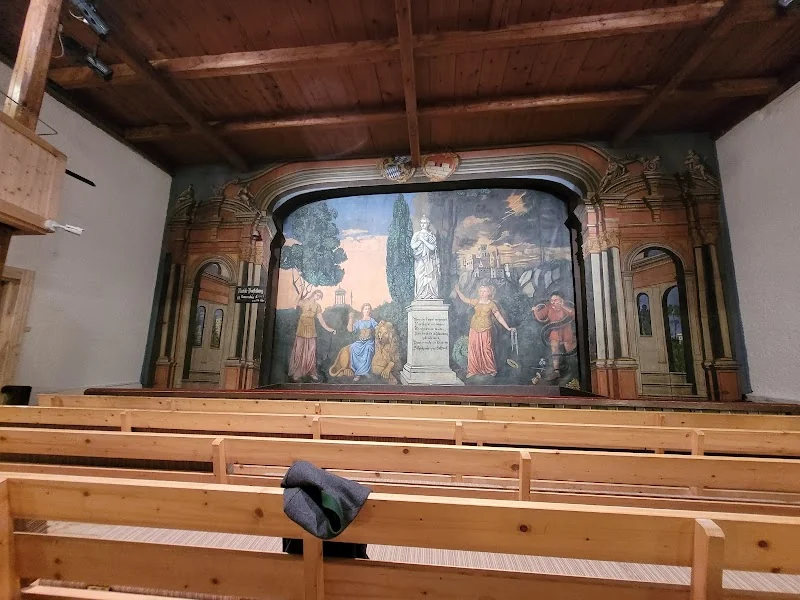
The technical and structural equipment of the Volkstheater Flintsbach is remarkable for a historic folk theater and explains why the house is often described as special. On the technical side, the succession scenery stage is deemed crucial for the theater. This traditional stage form consists of six pairs of slanted wing flats, several intermediate curtains, and a proscenium but does not have a sliding proscenium. The oldest preserved stage of this type is the one built in Flintsbach in 1823. Additionally, the main curtain from 1844 is described on the stage views page as the theater's most valuable possession. It is also explained there that the curtain was restored in 1985 and depicts Thalia, the muse of comedy, as well as figures from knightly history. For visitors, this means: Just the view of the curtain is a small journey into theater and art history. The spatial data is also remarkable. The stage is 7 meters wide and 12.50 meters deep, thus larger than the auditorium, and in 1987, a necessary revolving stage was installed in the back part of the stage. This allows for the creation of up to 30 stage settings and more in a short time with the existing box stage, revolving and wing flats, the fly system, and the revolving stage. An electrically controlled lighting system, a loudspeaker system, and the well-maintained furnishings with rustic and stylish furniture complete the overall picture. Additionally, around 7,000 spectators visit the theater each year, according to official representations. Therefore, those searching for photos or stage views do not just find beautiful images here but a genuine insight into a technically and historically exceptionally preserved theater building. This mix of craftsmanship, tradition, and performance practice is what makes the charm of the house and clearly sets it apart from many other amateur and folk theaters. ([volkstheater-flintsbach.de](https://www.volkstheater-flintsbach.de/technik/?utm_source=openai))
Directions, Address, and Practical Tips for Your Visit
For practical planning, the basic data of the Volkstheater Flintsbach is very clear: The official address is Theaterweg 2, 83126 Flintsbach am Inn, Germany. The association can be reached by phone at 08034/8333, and fax and email are also mentioned in the imprint and on the contact page. For visitors, it is especially important that the official website focuses on address, ticket service, and season. A separate parking page is not listed on the verified official pages, so it makes sense to plan local parking options around Theaterweg before your visit. This is not a limitation but rather a hint at the structure of the house: The Volkstheater is a historic performance venue and not a modern exhibition center, thus the cultural experience is at the center. Those who prepare their visit well should ideally combine timely ticket reservation, early arrival, and a brief look at the seating plan. The season from mid-June to mid-August is compact, the box office has fixed hours, and official communication runs clearly through the website and phone. The municipality of Flintsbach also refers to the season, the address, and ticket pre-sales starting in early May at the Volkstheater. For visitors from the Rosenheim region, from the Inn Valley, or from further away, the house is thus easily accessible if one considers the seasonal logic. Especially because the theater attracts many guests each year, a realistic time buffer for arrival, orientation on-site, and the way into the historic building is worthwhile. This way, the journey becomes not a stress point but a calm start to a theater evening that is characterized by tradition and atmosphere from the very beginning. ([volkstheater-flintsbach.de](https://www.volkstheater-flintsbach.de/?p=6655&utm_source=openai))
Photos and Performed Plays in the Image Archive
Those looking for photos, archival material, or the keyword “Der Geisterbräu” will quickly find themselves in a comprehensive image archive at Volkstheater Flintsbach. The “Performed Plays” page is explicitly set up as an image archive and allows selection by year. Among other things, 2025 features “Madam Bäurin,” 2024 “Die Teufelsbraut,” and 2023 “Der Geisterbräu.” Earlier years are also visible, such as 2022 “Die drei Dorfheiligen,” 2021 “Die Brautschau & Die Dachserin,” and in the older years, numerous other titles from the folk-friendly and literary repertoire. For users who are not only looking for a current ticket but are also interested in the development of the stage, this archive is particularly valuable. It shows how consistently the theater works and how strongly the selection of plays remains connected to Bavarian and alpine folk theater. Additionally, the stage views provide further image sources, as the main curtain, intermediate curtains, and the historical impact of the stage space are described in detail. Together, this creates a very complete picture: photos from performances, documented productions, and the visual uniqueness of the house interconnect. This is why Volkstheater Flintsbach is so interesting online for visitors who want to be inspired in advance. You do not just see an event poster but a living archive with real continuity. This is crucial for search queries related to photos and past plays, as the theater offers not only pre-sales and dates but also a comprehensible view of its own history in images. Those who prepare in this way will understand much better during their later theater visit why this house in Flintsbach am Inn is considered a cultural focal point. ([volkstheater-flintsbach.de](https://www.volkstheater-flintsbach.de/gespielte-stuecke/?utm_source=openai))
Sources:
- Volkstheater Flintsbach - Official Website
- Volkstheater Flintsbach - Ticket Reservation and Seating Plan
- Volkstheater Flintsbach - History
- Volkstheater Flintsbach - Technology and Stage Forms
- Volkstheater Flintsbach - Performed Plays and Image Archive
- Volkstheater Flintsbach - Stage Views
- Municipality of Flintsbach am Inn - Volkstheater
Show moreShow less
Volkstheater Flintsbach | Program & Tickets 2026
The Volkstheater Flintsbach in Flintsbach am Inn is an extraordinary piece of Bavarian theater culture: documented since 1675, performed in its own theater barn since 1823, and today known as a historic house with a special aura. Those who come here do not experience an anonymous event hall, but a grown folk theater with tradition, a craft-maintained stage, and an audience that consciously uses the summer months for theater evenings in the Inn Valley. The address Theaterweg 2, 83126 Flintsbach am Inn, the long tradition of performances, and the integration into the European Route of Historic Theaters make the place interesting for visitors from the region and for cultural travelers alike. The official website and the municipality also refer to the annual season from June to August, the historic character of the house, and the special status of the theater as one of the oldest in Germany. ([volkstheater-flintsbach.de](https://www.volkstheater-flintsbach.de/?utm_source=openai))
Performance Schedule and Dates 2026 at Volkstheater Flintsbach
Those looking for the current program will find a clear pattern at Volkstheater Flintsbach: The house focuses on a compact summer season and thus opens a consciously limited period for visitors each year. According to the official website, the season runs annually from mid-June to mid-August, and the municipality of Flintsbach also names the period from early May for ticket pre-sales. For 2026, the reservation page announces the play “Einen Jux will er sich machen” by Johann Nestroy, which shows that the theater is also relying on a well-known and audience-friendly classic in the current season. This combination is important, especially for users searching for the terms program, schedule, or dates: The Volkstheater Flintsbach does not operate year-round but works with a precisely timed season that makes summer the actual theater time. This fits the identity of the house, which has been perceived as a summer theater with a strong local connection for generations in the region. The “Performed Plays” page also shows that the repertoire has been very diverse in recent years: In 2025, “Madam Bäurin” was performed, in 2024 “Die Teufelsbraut,” and in 2023 “Der Geisterbräu.” This makes it clear that the theater relies on classic folk plays while regularly presenting different authors and play forms. Therefore, those planning the program for 2026 should not only be interested in the title of the new play but also in the time frame, as the limited season is part of the character of the folk theater, just like the special performance tradition in the historic theater house. ([volkstheater-flintsbach.de](https://www.volkstheater-flintsbach.de/?utm_source=openai))
Reserve Tickets and Seating Plan in the Historic Komödienstadl
For many visitors, the question of tickets and seating plan is just as important as the play itself, and here too, Volkstheater Flintsbach provides clear information. The official reservation page states that tickets can be reserved online starting Friday, May 1. Additionally, the box office will be reachable by phone at 08034/8333 from May 28, Monday to Friday between 11 AM and 1 PM; on performance days, the box office is staffed from 7 PM. These times are very helpful for planning, as they show that the pre-sale is consciously organized with a service orientation and does not rely solely on spontaneous box office sales. The seating plan is particularly important: The reservation page offers a download for the seating plan, which is a real advantage for a historic house with a balcony and parterre. The auditorium has 286 seats, of which 191 are in the parterre and 95 in the balcony. Thus, Volkstheater Flintsbach is large enough for a substantial audience response but remains small enough to maintain an intimate and immediate theater atmosphere. This mix is what makes it appealing: You are not sitting in an anonymous multipurpose hall but in a historically grown auditorium where every seat choice has a noticeable impact on the experience. Those searching for the keyword seating plan often also want to know where the best view is. The official structure with parterre and balcony at least shows the basic orientation for seat selection. For visitors, this means: Reserving early is worthwhile, especially during the peak of the summer season when demand increases and the house is visited by many guests from the region. Especially in a theater with a limited number of seats, pre-sales are a crucial part of the experience. ([volkstheater-flintsbach.de](https://www.volkstheater-flintsbach.de/karten-reservierung/?utm_source=openai))
1675 to Present: History and Special Status of the Volkstheater
The historical depth of the Volkstheater Flintsbach is one of the strongest reasons why this place receives attention far beyond the municipality. The official history cites an excerpt from the church accounting book of 1675 as the first secured evidence of a village theater culture. At the same time, it is explained that theater playing in Flintsbach has already developed from older religious and liturgical performance traditions that date back to the 15th century. Since 1823, performances have been held in its own theater barn because the hall of the Gasthof Falkenstein had become too small as a performance venue. This detail is important because it marks the transition from a loose performance tradition to a fixed, architecturally anchored theater house. In the 200 years of the historic theater house, it also becomes clear how persistently the people of Flintsbach have maintained, expanded, and adapted their building to new requirements over generations. The house is thus not only a theater but also a monument of local cultural history. Particularly impressive is also the recognition by third parties: The Volkstheater Flintsbach is a member of the Bavarian State Association for Local Heritage Preservation, the Association of Bavarian Amateur Theaters, and the Federation of German Amateur Theaters. The government of Upper Bavaria certifies that the association fulfills the same cultural tasks as theaters run by the federal and state governments. Additionally, awards such as the sponsorship prize in the competition “Amateur Theaters Compete,” the medal for exemplary local heritage preservation, the large cultural prize of the Rosenheim district, and the Euregio-Inntal Prize 2018 have been received. In 2025, a 116-page chronicle was also published for the 350th anniversary. All these points show: The Volkstheater Flintsbach is not just a local stage but a living traditional house with regional, cultural, and historical significance. ([volkstheater-flintsbach.de](https://www.volkstheater-flintsbach.de/historie/?utm_source=openai))
Stage, Curtain, and Equipment: Why the House is So Special
The technical and structural equipment of the Volkstheater Flintsbach is remarkable for a historic folk theater and explains why the house is often described as special. On the technical side, the succession scenery stage is deemed crucial for the theater. This traditional stage form consists of six pairs of slanted wing flats, several intermediate curtains, and a proscenium but does not have a sliding proscenium. The oldest preserved stage of this type is the one built in Flintsbach in 1823. Additionally, the main curtain from 1844 is described on the stage views page as the theater's most valuable possession. It is also explained there that the curtain was restored in 1985 and depicts Thalia, the muse of comedy, as well as figures from knightly history. For visitors, this means: Just the view of the curtain is a small journey into theater and art history. The spatial data is also remarkable. The stage is 7 meters wide and 12.50 meters deep, thus larger than the auditorium, and in 1987, a necessary revolving stage was installed in the back part of the stage. This allows for the creation of up to 30 stage settings and more in a short time with the existing box stage, revolving and wing flats, the fly system, and the revolving stage. An electrically controlled lighting system, a loudspeaker system, and the well-maintained furnishings with rustic and stylish furniture complete the overall picture. Additionally, around 7,000 spectators visit the theater each year, according to official representations. Therefore, those searching for photos or stage views do not just find beautiful images here but a genuine insight into a technically and historically exceptionally preserved theater building. This mix of craftsmanship, tradition, and performance practice is what makes the charm of the house and clearly sets it apart from many other amateur and folk theaters. ([volkstheater-flintsbach.de](https://www.volkstheater-flintsbach.de/technik/?utm_source=openai))
Directions, Address, and Practical Tips for Your Visit
For practical planning, the basic data of the Volkstheater Flintsbach is very clear: The official address is Theaterweg 2, 83126 Flintsbach am Inn, Germany. The association can be reached by phone at 08034/8333, and fax and email are also mentioned in the imprint and on the contact page. For visitors, it is especially important that the official website focuses on address, ticket service, and season. A separate parking page is not listed on the verified official pages, so it makes sense to plan local parking options around Theaterweg before your visit. This is not a limitation but rather a hint at the structure of the house: The Volkstheater is a historic performance venue and not a modern exhibition center, thus the cultural experience is at the center. Those who prepare their visit well should ideally combine timely ticket reservation, early arrival, and a brief look at the seating plan. The season from mid-June to mid-August is compact, the box office has fixed hours, and official communication runs clearly through the website and phone. The municipality of Flintsbach also refers to the season, the address, and ticket pre-sales starting in early May at the Volkstheater. For visitors from the Rosenheim region, from the Inn Valley, or from further away, the house is thus easily accessible if one considers the seasonal logic. Especially because the theater attracts many guests each year, a realistic time buffer for arrival, orientation on-site, and the way into the historic building is worthwhile. This way, the journey becomes not a stress point but a calm start to a theater evening that is characterized by tradition and atmosphere from the very beginning. ([volkstheater-flintsbach.de](https://www.volkstheater-flintsbach.de/?p=6655&utm_source=openai))
Photos and Performed Plays in the Image Archive
Those looking for photos, archival material, or the keyword “Der Geisterbräu” will quickly find themselves in a comprehensive image archive at Volkstheater Flintsbach. The “Performed Plays” page is explicitly set up as an image archive and allows selection by year. Among other things, 2025 features “Madam Bäurin,” 2024 “Die Teufelsbraut,” and 2023 “Der Geisterbräu.” Earlier years are also visible, such as 2022 “Die drei Dorfheiligen,” 2021 “Die Brautschau & Die Dachserin,” and in the older years, numerous other titles from the folk-friendly and literary repertoire. For users who are not only looking for a current ticket but are also interested in the development of the stage, this archive is particularly valuable. It shows how consistently the theater works and how strongly the selection of plays remains connected to Bavarian and alpine folk theater. Additionally, the stage views provide further image sources, as the main curtain, intermediate curtains, and the historical impact of the stage space are described in detail. Together, this creates a very complete picture: photos from performances, documented productions, and the visual uniqueness of the house interconnect. This is why Volkstheater Flintsbach is so interesting online for visitors who want to be inspired in advance. You do not just see an event poster but a living archive with real continuity. This is crucial for search queries related to photos and past plays, as the theater offers not only pre-sales and dates but also a comprehensible view of its own history in images. Those who prepare in this way will understand much better during their later theater visit why this house in Flintsbach am Inn is considered a cultural focal point. ([volkstheater-flintsbach.de](https://www.volkstheater-flintsbach.de/gespielte-stuecke/?utm_source=openai))
Sources:
- Volkstheater Flintsbach - Official Website
- Volkstheater Flintsbach - Ticket Reservation and Seating Plan
- Volkstheater Flintsbach - History
- Volkstheater Flintsbach - Technology and Stage Forms
- Volkstheater Flintsbach - Performed Plays and Image Archive
- Volkstheater Flintsbach - Stage Views
- Municipality of Flintsbach am Inn - Volkstheater
Volkstheater Flintsbach | Program & Tickets 2026
The Volkstheater Flintsbach in Flintsbach am Inn is an extraordinary piece of Bavarian theater culture: documented since 1675, performed in its own theater barn since 1823, and today known as a historic house with a special aura. Those who come here do not experience an anonymous event hall, but a grown folk theater with tradition, a craft-maintained stage, and an audience that consciously uses the summer months for theater evenings in the Inn Valley. The address Theaterweg 2, 83126 Flintsbach am Inn, the long tradition of performances, and the integration into the European Route of Historic Theaters make the place interesting for visitors from the region and for cultural travelers alike. The official website and the municipality also refer to the annual season from June to August, the historic character of the house, and the special status of the theater as one of the oldest in Germany. ([volkstheater-flintsbach.de](https://www.volkstheater-flintsbach.de/?utm_source=openai))
Performance Schedule and Dates 2026 at Volkstheater Flintsbach
Those looking for the current program will find a clear pattern at Volkstheater Flintsbach: The house focuses on a compact summer season and thus opens a consciously limited period for visitors each year. According to the official website, the season runs annually from mid-June to mid-August, and the municipality of Flintsbach also names the period from early May for ticket pre-sales. For 2026, the reservation page announces the play “Einen Jux will er sich machen” by Johann Nestroy, which shows that the theater is also relying on a well-known and audience-friendly classic in the current season. This combination is important, especially for users searching for the terms program, schedule, or dates: The Volkstheater Flintsbach does not operate year-round but works with a precisely timed season that makes summer the actual theater time. This fits the identity of the house, which has been perceived as a summer theater with a strong local connection for generations in the region. The “Performed Plays” page also shows that the repertoire has been very diverse in recent years: In 2025, “Madam Bäurin” was performed, in 2024 “Die Teufelsbraut,” and in 2023 “Der Geisterbräu.” This makes it clear that the theater relies on classic folk plays while regularly presenting different authors and play forms. Therefore, those planning the program for 2026 should not only be interested in the title of the new play but also in the time frame, as the limited season is part of the character of the folk theater, just like the special performance tradition in the historic theater house. ([volkstheater-flintsbach.de](https://www.volkstheater-flintsbach.de/?utm_source=openai))
Reserve Tickets and Seating Plan in the Historic Komödienstadl
For many visitors, the question of tickets and seating plan is just as important as the play itself, and here too, Volkstheater Flintsbach provides clear information. The official reservation page states that tickets can be reserved online starting Friday, May 1. Additionally, the box office will be reachable by phone at 08034/8333 from May 28, Monday to Friday between 11 AM and 1 PM; on performance days, the box office is staffed from 7 PM. These times are very helpful for planning, as they show that the pre-sale is consciously organized with a service orientation and does not rely solely on spontaneous box office sales. The seating plan is particularly important: The reservation page offers a download for the seating plan, which is a real advantage for a historic house with a balcony and parterre. The auditorium has 286 seats, of which 191 are in the parterre and 95 in the balcony. Thus, Volkstheater Flintsbach is large enough for a substantial audience response but remains small enough to maintain an intimate and immediate theater atmosphere. This mix is what makes it appealing: You are not sitting in an anonymous multipurpose hall but in a historically grown auditorium where every seat choice has a noticeable impact on the experience. Those searching for the keyword seating plan often also want to know where the best view is. The official structure with parterre and balcony at least shows the basic orientation for seat selection. For visitors, this means: Reserving early is worthwhile, especially during the peak of the summer season when demand increases and the house is visited by many guests from the region. Especially in a theater with a limited number of seats, pre-sales are a crucial part of the experience. ([volkstheater-flintsbach.de](https://www.volkstheater-flintsbach.de/karten-reservierung/?utm_source=openai))
1675 to Present: History and Special Status of the Volkstheater
The historical depth of the Volkstheater Flintsbach is one of the strongest reasons why this place receives attention far beyond the municipality. The official history cites an excerpt from the church accounting book of 1675 as the first secured evidence of a village theater culture. At the same time, it is explained that theater playing in Flintsbach has already developed from older religious and liturgical performance traditions that date back to the 15th century. Since 1823, performances have been held in its own theater barn because the hall of the Gasthof Falkenstein had become too small as a performance venue. This detail is important because it marks the transition from a loose performance tradition to a fixed, architecturally anchored theater house. In the 200 years of the historic theater house, it also becomes clear how persistently the people of Flintsbach have maintained, expanded, and adapted their building to new requirements over generations. The house is thus not only a theater but also a monument of local cultural history. Particularly impressive is also the recognition by third parties: The Volkstheater Flintsbach is a member of the Bavarian State Association for Local Heritage Preservation, the Association of Bavarian Amateur Theaters, and the Federation of German Amateur Theaters. The government of Upper Bavaria certifies that the association fulfills the same cultural tasks as theaters run by the federal and state governments. Additionally, awards such as the sponsorship prize in the competition “Amateur Theaters Compete,” the medal for exemplary local heritage preservation, the large cultural prize of the Rosenheim district, and the Euregio-Inntal Prize 2018 have been received. In 2025, a 116-page chronicle was also published for the 350th anniversary. All these points show: The Volkstheater Flintsbach is not just a local stage but a living traditional house with regional, cultural, and historical significance. ([volkstheater-flintsbach.de](https://www.volkstheater-flintsbach.de/historie/?utm_source=openai))
Stage, Curtain, and Equipment: Why the House is So Special
The technical and structural equipment of the Volkstheater Flintsbach is remarkable for a historic folk theater and explains why the house is often described as special. On the technical side, the succession scenery stage is deemed crucial for the theater. This traditional stage form consists of six pairs of slanted wing flats, several intermediate curtains, and a proscenium but does not have a sliding proscenium. The oldest preserved stage of this type is the one built in Flintsbach in 1823. Additionally, the main curtain from 1844 is described on the stage views page as the theater's most valuable possession. It is also explained there that the curtain was restored in 1985 and depicts Thalia, the muse of comedy, as well as figures from knightly history. For visitors, this means: Just the view of the curtain is a small journey into theater and art history. The spatial data is also remarkable. The stage is 7 meters wide and 12.50 meters deep, thus larger than the auditorium, and in 1987, a necessary revolving stage was installed in the back part of the stage. This allows for the creation of up to 30 stage settings and more in a short time with the existing box stage, revolving and wing flats, the fly system, and the revolving stage. An electrically controlled lighting system, a loudspeaker system, and the well-maintained furnishings with rustic and stylish furniture complete the overall picture. Additionally, around 7,000 spectators visit the theater each year, according to official representations. Therefore, those searching for photos or stage views do not just find beautiful images here but a genuine insight into a technically and historically exceptionally preserved theater building. This mix of craftsmanship, tradition, and performance practice is what makes the charm of the house and clearly sets it apart from many other amateur and folk theaters. ([volkstheater-flintsbach.de](https://www.volkstheater-flintsbach.de/technik/?utm_source=openai))
Directions, Address, and Practical Tips for Your Visit
For practical planning, the basic data of the Volkstheater Flintsbach is very clear: The official address is Theaterweg 2, 83126 Flintsbach am Inn, Germany. The association can be reached by phone at 08034/8333, and fax and email are also mentioned in the imprint and on the contact page. For visitors, it is especially important that the official website focuses on address, ticket service, and season. A separate parking page is not listed on the verified official pages, so it makes sense to plan local parking options around Theaterweg before your visit. This is not a limitation but rather a hint at the structure of the house: The Volkstheater is a historic performance venue and not a modern exhibition center, thus the cultural experience is at the center. Those who prepare their visit well should ideally combine timely ticket reservation, early arrival, and a brief look at the seating plan. The season from mid-June to mid-August is compact, the box office has fixed hours, and official communication runs clearly through the website and phone. The municipality of Flintsbach also refers to the season, the address, and ticket pre-sales starting in early May at the Volkstheater. For visitors from the Rosenheim region, from the Inn Valley, or from further away, the house is thus easily accessible if one considers the seasonal logic. Especially because the theater attracts many guests each year, a realistic time buffer for arrival, orientation on-site, and the way into the historic building is worthwhile. This way, the journey becomes not a stress point but a calm start to a theater evening that is characterized by tradition and atmosphere from the very beginning. ([volkstheater-flintsbach.de](https://www.volkstheater-flintsbach.de/?p=6655&utm_source=openai))
Photos and Performed Plays in the Image Archive
Those looking for photos, archival material, or the keyword “Der Geisterbräu” will quickly find themselves in a comprehensive image archive at Volkstheater Flintsbach. The “Performed Plays” page is explicitly set up as an image archive and allows selection by year. Among other things, 2025 features “Madam Bäurin,” 2024 “Die Teufelsbraut,” and 2023 “Der Geisterbräu.” Earlier years are also visible, such as 2022 “Die drei Dorfheiligen,” 2021 “Die Brautschau & Die Dachserin,” and in the older years, numerous other titles from the folk-friendly and literary repertoire. For users who are not only looking for a current ticket but are also interested in the development of the stage, this archive is particularly valuable. It shows how consistently the theater works and how strongly the selection of plays remains connected to Bavarian and alpine folk theater. Additionally, the stage views provide further image sources, as the main curtain, intermediate curtains, and the historical impact of the stage space are described in detail. Together, this creates a very complete picture: photos from performances, documented productions, and the visual uniqueness of the house interconnect. This is why Volkstheater Flintsbach is so interesting online for visitors who want to be inspired in advance. You do not just see an event poster but a living archive with real continuity. This is crucial for search queries related to photos and past plays, as the theater offers not only pre-sales and dates but also a comprehensible view of its own history in images. Those who prepare in this way will understand much better during their later theater visit why this house in Flintsbach am Inn is considered a cultural focal point. ([volkstheater-flintsbach.de](https://www.volkstheater-flintsbach.de/gespielte-stuecke/?utm_source=openai))
Sources:
- Volkstheater Flintsbach - Official Website
- Volkstheater Flintsbach - Ticket Reservation and Seating Plan
- Volkstheater Flintsbach - History
- Volkstheater Flintsbach - Technology and Stage Forms
- Volkstheater Flintsbach - Performed Plays and Image Archive
- Volkstheater Flintsbach - Stage Views
- Municipality of Flintsbach am Inn - Volkstheater
Upcoming Events
Theater premiere at Flintsbach Folk Theater
Visit the exciting premiere at Flintsbach Folk Theater and experience a special evening full of theatrical flair.
Theater premiere with "He Wants to Have a Fun" by Johann Nestroy
A Nestroy evening full of wit and pace in the historical theater house Flintsbach. On 13.06.2026 at 20:00 you can expect great comedic art. #Theater
Frequently Asked Questions
Reviews
No reviews found