
Bad Aibling
Hofberg 2, 83043 Bad Aibling, Deutschland
City Parish Church of the Assumption of Mary Bad Aibling | Photos & Access
The City Parish Church of the Assumption of Mary in Bad Aibling is much more than a sacred building: it is the distinctive landmark on the Hofberg, high above the rooftops of the city, and has shaped the first impression of Bad Aibling for centuries. The current structure dates back primarily to the first half of the 15th century; in the 18th century, it was extensively remodeled and influenced by Baroque and Rococo styles. Visitors to the church therefore experience not an anonymous functional building, but a vibrant interplay of history, art, liturgy, and urban landscape. The access is as characteristic as it is impressive: steps lead up from the city center, and there are also paths over the Hofberg. For many visitors, the visit begins with this small ascent, as the view over the city opens up at the top, and the church presents itself as a calm counterpoint to everyday life. The church is open daily, and the parish's service times are also well-planned. ([bad-aibling.de](https://www.bad-aibling.de/poi/stadtpfarrkirche-mariae-himmelfahrt))
Photos and Landmarks on the Hofberg
Those searching for photos of the City Parish Church of the Assumption of Mary Bad Aibling will primarily find the classic combination of elevation, stone steps, tower, and city panorama. This location makes the church so photogenic: it is not hidden in a side alley but visibly stands above the historical core of Bad Aibling. The tourism information explicitly describes the building as a widely visible landmark that lies high above the rooftops of the city. The ascent from the city center is particularly appealing for pictures, as the stairs, the gentle slope, and the transition to the church automatically create perspectives that one would not have with a ground-level location. For those who enjoy photographing details, the exterior also reveals traces of different construction phases: late Gothic substance, later Baroque forms, and the characteristic tower dome that shapes the cityscape. The connection to the parish courtyard and the surrounding area on the Hofberg ensures that the church does not appear isolated but as part of a developed ensemble. ([chiemsee-alpenland.de](https://www.chiemsee-alpenland.de/entdecken/alle-sehenswuerdigkeiten/stadtpfarrkirche-mariae-himmelfahrt-bad-aibling-82bb16a3ca))
For the visual impression, it is also important that the church impresses not only from the outside but also functions as a landmark due to its location. The City Parish Church stands on a hill, and the path from below to above gives the visit an almost pilgrim-like movement within the city. This is precisely why it is popular among travelers who engage with photos and reviews beforehand: One wants to know how the view looks, what the ascent looks like, and how much the church actually dominates the cityscape. The official tourism site and the information from the archdiocese show that the church is perceived today as a landmark, parish church, and historical site simultaneously. This makes it interesting for photography not only as a motif but also as a substantive image for Bad Aibling itself. Anyone who captures the City Parish Church also photographs a piece of the city's identity. ([bad-aibling.de](https://www.bad-aibling.de/poi/stadtpfarrkirche-mariae-himmelfahrt))
Additionally, there is a special interaction between the city, church building, and sightline. From below, the church appears as a calm counterpoint to the paths, squares, and houses of the city center; from above, the view opens back into the city. This back-and-forth between proximity and distance makes the site so attractive for visitors. The tourist description emphasizes the spacious hall structure and the baptismal font made of red marble, while the ecclesiastical representation highlights the monumental staircase, the elevation, and the historical depth. For photo searches, this is ideal, as there is not just a single motif but several levels: the path to the church, the facade, the tower, the interior, and the surroundings. Therefore, anyone visiting Bad Aibling should not just quickly take a picture but take a few minutes to capture the perspective from various points. ([chiemsee-alpenland.de](https://www.chiemsee-alpenland.de/entdecken/alle-sehenswuerdigkeiten/stadtpfarrkirche-mariae-himmelfahrt-bad-aibling-82bb16a3ca))
History from Late Gothic to Rococo
The history of the City Parish Church of the Assumption of Mary goes back a long way. On the parish side of the archdiocese, it is described that the current church mostly dates from the first half of the 15th century. A document from 1431 already records a penance for the church building in Aibling, underscoring the early significance of the place. For a long time, the parish seat remained in Ellmosen; only in 1482, after a donation on the Hofberg, was the parish courtyard established directly next to the church, and the seat was moved to Aibling. This development shows that the church is not just a building but the center of a gradually densifying parish history. The location on the Hofberg has also historically grown and was not created by chance. The combination of elevation, church, and parish courtyard has shaped the place for centuries and made it a spiritual center of the city. ([www2.erzbistum-muenchen.de](https://www2.erzbistum-muenchen.de/pfarrei/stadtkirche-bad-aibling/cont/61641))
In the 17th century, renovations and alterations followed. The archdiocese's site mentions a renovation in 1663, during which new church pews were installed, among other things. During the same period, further liturgical and artistic elements were added, including altars and later forms of devotion. Particularly important is the Stations of the Cross: After Stations of the Cross were also permitted in other churches in the 18th century, Pastor Dinzenhofer had the still-existing Stations of the Cross created by painter Hans Höttinger in 1734. This connects the church's historical piety with concrete art. The appearance changed even more dramatically in the mid-18th century when the famous Munich city architect Johann Michael Fischer was consulted. His advice led to the church being extended to the west; in 1754 and 1755, the master mason Abraham Millauer from Haustatt implemented this expansion. During this process, the Gothic ribbed vaults were removed, and the interior was dressed in the garb of Rococo. ([www2.erzbistum-muenchen.de](https://www2.erzbistum-muenchen.de/pfarrei/stadtkirche-bad-aibling/cont/61641))
The further history shows how alive the church has remained. The high altar received a new form in 1856, later the then painting was destroyed by fire, and in 1937, the old Madonna figure returned to its place. Also, in 1941 and in later renovation phases, the interior received further additions and care. Particularly important for today's impression is the comprehensive renovation of 2018, which allowed the church to shine anew; the reopening was celebrated in March 2019. The official tourism site points precisely to this last comprehensive renovation, making it clear that this is a carefully maintained place, not a museum-like stasis. The historical core, the Baroque style, the Rococo forms, and the modern care interlock. Thus, anyone visiting the church today sees not just a monument but a well-maintained building with a history that continues into the present. ([chiemsee-alpenland.de](https://www.chiemsee-alpenland.de/entdecken/alle-sehenswuerdigkeiten/stadtpfarrkirche-mariae-himmelfahrt-bad-aibling-82bb16a3ca))
Opening Hours, Services, and Parish Office
For practical planning, the City Parish Church of the Assumption of Mary is pleasantly uncomplicated. The tourism information of the city of Bad Aibling states that the opening hours are daily from 08:00 to 18:00. This is particularly helpful for visitors, as the church is thus accessible not only during set visiting windows but can be visited every day of the year within a reliable timeframe. Therefore, anyone planning a city tour, a short stop at the Hofberg, or a quiet church visit can coordinate their daily schedule accordingly. Additionally, the city information page lists the parish office of the Assumption of Mary with the address Harthauser Str. 2 in Bad Aibling, as well as office hours on Tuesday, Thursday, and Friday from 08:30 to 12:00. This makes organizational concerns easily findable. The combination of visiting hours and parish office hours is practical for all who are not only photographing but also seeking liturgical, cultural, or pastoral information. ([chiemsee-alpenland.de](https://www.chiemsee-alpenland.de/entdecken/alle-sehenswuerdigkeiten/stadtpfarrkirche-mariae-himmelfahrt-bad-aibling-82bb16a3ca?utm_source=openai))
The service schedule is also clearly structured. On the page of the City Church Bad Aibling, regular masses and Eucharistic celebrations are mentioned: Tuesdays at 09:00, Thursdays at 19:00, Fridays at 09:00, Saturdays at 18:00 as the first Eucharistic celebration for Sunday, and Sundays at 10:30. For visitors and believers, this is an important note, as it shows that the church is a lively place of worship and not just a historical sightseeing object. Anyone planning a quiet visit should keep these times in mind, as prayer is, of course, the focus during the liturgy. At the same time, the regular schedule makes it clear that the Assumption of Mary is the center of an active parish life. The church belongs to the City Church of Bad Aibling, which includes several other churches and branch churches. This explains why the parish church should not be viewed in isolation: it is the main place of a larger ecclesiastical network in Bad Aibling. ([www2.erzbistum-muenchen.de](https://www2.erzbistum-muenchen.de/pfarrei/stadtkirche-bad-aibling/cont/61587))
Access and Parking at the City Parish Church
The access to the City Parish Church of the Assumption of Mary is easy to explain but also particularly characteristic due to its location on the Hofberg. The official tourism site describes three ways up to the church: via steps coming from the city center, via a bridge, or over the Hofberg. These paths make the access so memorable because the church visit is associated with a short change of perspective. Those walking experience the ascent as part of the local landscape; those coming from the city center quickly realize that the church is not just located on a street but is deliberately elevated above the city. For targeted planning, this is helpful, as the orientation is clear. The address of the parish office is Hofberg 2, 83043 Bad Aibling, while the parish office is located at Harthauser Str. 2. For visitors, this means: for the church location itself, the Hofberg is the central orientation, while for organizational questions, it is the parish office. ([chiemsee-alpenland.de](https://www.chiemsee-alpenland.de/entdecken/alle-sehenswuerdigkeiten/stadtpfarrkirche-mariae-himmelfahrt-bad-aibling-82bb16a3ca))
When parking, the public parking lot P7 at the Hofberg is the nearby official option. The city of Bad Aibling lists it with 20 parking spaces, free of charge and accessible around the clock. Additionally, the parking information points to barrier-free access, which can be important for a visit to the Hofberg. Therefore, those arriving by car have a concrete and well-documented option in close proximity to the church. This is pleasant for a tourist day visit, as one does not lose time searching for parking before heading to the church. Combined with the elevation, a clear visiting process emerges: arrive, park the car at the Hofberg, walk a few steps to the church, and then enjoy the view over Bad Aibling. The city also generally provides access and parking information that facilitates movement within the area. For the City Parish Church itself, it is especially important that the Hofberg is not only spiritually and historically significant but also practically well-connected. ([bad-aibling.de](https://www.bad-aibling.de/poi/parkplatz-p7-am-hofberg?utm_source=openai))
Those visiting Bad Aibling without a car benefit from the fact that the church is so centrally located in the urban structure that it can be easily integrated into a city tour. The official tourism note about the bridge, the steps, and the Hofberg shows that the access is deliberately designed for pedestrians. This is an advantage for guests, as the church can be easily combined with other destinations in the city center. Those coming from the town center do not need complicated navigation but simply follow the slope upwards. Thus, the City Parish Church is a good destination for short stays as well as for longer visits. The place beautifully demonstrates how historical buildings and modern visitor guidance can fit together: old location, clear paths, known parking options. This mixture makes the access unexciting and practical for everyday use. ([chiemsee-alpenland.de](https://www.chiemsee-alpenland.de/entdecken/alle-sehenswuerdigkeiten/stadtpfarrkirche-mariae-himmelfahrt-bad-aibling-82bb16a3ca))
Interior, Artworks, and Historical Baptismal Font
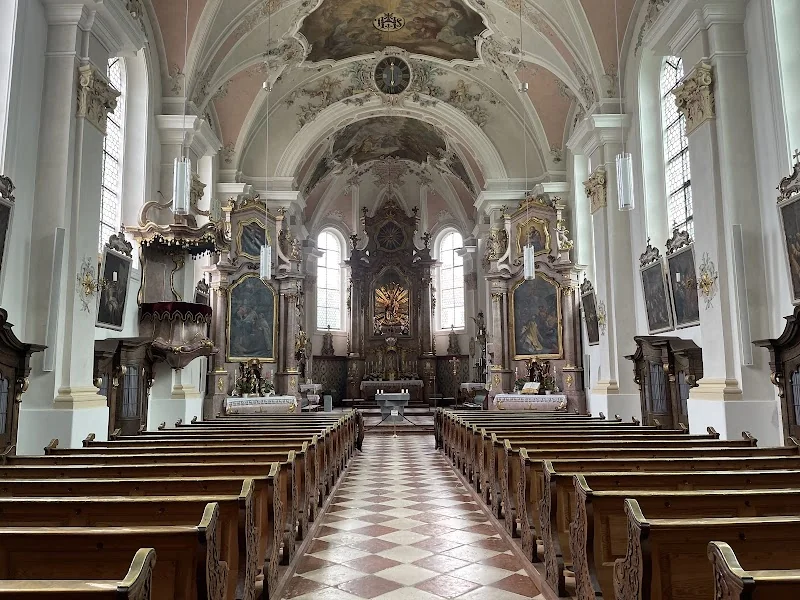
The interior of the City Parish Church of the Assumption of Mary is an important reason why the building is often described as particularly impressive. The tourism site mentions a spacious hall structure with five axes and refers to a baptismal font made of red marble from the late Gothic period. This baptismal font visibly connects the church with its early building history. The parish pages of the archdiocese also describe the space as a spacious hall structure with a short altar area and three-sided closure. This means: the interior is not narrow and dark but open and oriented towards the liturgical center. The Rococo stuccoes by Thomas Schwarzenberger and Fink from Erding, as well as the double west gallery with its floral and rocaille decor, give the space a bright, dynamic atmosphere. Therefore, upon entering the interior, visitors experience not only architecture but a carefully composed connection of space, light, and ornament. For visitors looking for photos, these details are particularly interesting, as the contrast between the late Gothic core and the Baroque design remains clearly visible. ([chiemsee-alpenland.de](https://www.chiemsee-alpenland.de/entdecken/alle-sehenswuerdigkeiten/stadtpfarrkirche-mariae-himmelfahrt-bad-aibling-82bb16a3ca))
Among the artistic highlights are the ceiling paintings by Martin Heigl. On the parish side, they are described as scenes depicting the death of Mary, her Assumption, and her glorification by the peoples of the earth. Thus, the patronage of the church is not only present in the name but also directly in the spatial design. Therefore, when entering the church, one encounters the Marian motif not only at the altar but also in the ceiling and in the overall program of the interior. Additionally, there is the high altar with the reinstalled Madonna figure from the early 16th century and the old baptismal font made of marble, which also dates from this time. This combination makes the church space particularly valuable, as different centuries are preserved and remain readable. This is a strong argument for people searching for Bad Aibling churches, Baroque churches, or Rococo: the City Parish Church is not a single work of art but an ensemble of several layers of religious and art-historical significance. ([www2.erzbistum-muenchen.de](https://www2.erzbistum-muenchen.de/pfarrei/stadtkirche-bad-aibling/cont/61641))
Also, the side altars, tombstones, and outdoor art deserve attention. The archdiocese description mentions two side altars, including a northern altar with the relics of St. Honoratus and a crucifixion group with life-sized figures attributed to Josef Götsch. Outside on the north side, several marble tombstones from the 16th to 18th centuries can be seen, including the tombstone of the Prant family. Additionally, a crucifix of high artistic quality from the early 17th century, originating from Schäftlarn, hangs on the outer wall of the choir. Such details explain why the church functions not only as a parish church but also as a place for art-historically interested visitors. The interplay of interior and exterior creates a rarely dense atmosphere: historical memory, liturgical use, and artistic aspiration stand side by side without displacing each other. ([www2.erzbistum-muenchen.de](https://www2.erzbistum-muenchen.de/pfarrei/stadtkirche-bad-aibling/cont/61641))
Organ, Church Music, and Visiting Tips
The lively use of the City Parish Church also includes the organ. The official site of the archdiocese mentions the consecration of the current organ on March 28, 1982; disposition, organ prospect, and execution are clearly documented. The instrument comes from the Munich organ workshop Wilhelm Stöberl, while the intonation was done by Hildenbrand and Feser. This is interesting for the practical impression, as the church is thus well-equipped not only historically but also musically. The organ shows that the sacred space continues to be maintained, used, and thought of acoustically. Therefore, those who enjoy church music will find not only a beautiful interior here but also an instrument that supports liturgical and musical practice. The church thus remains a place where history can not only be viewed but also heard. Particularly in connection with the regular services, a complete picture of a lively parish center emerges. ([www2.erzbistum-muenchen.de](https://www2.erzbistum-muenchen.de/pfarrei/stadtkirche-bad-aibling/cont/61663))
For the visit itself, a simple but attentive approach is recommended: first, it is worth looking from the outside at the location on the Hofberg, then entering the interior, followed by a brief moment for the artistic details, and finally, if it fits, a walk back down into the city. The daily opening hours from 08:00 to 18:00 provide enough leeway for this. Those who wish to combine their visit with a mass can refer to the current service schedule. The City Parish Church is not only a destination for tourists but a place where faith, art, and city history intertwine. This is exactly what makes its strength: it is not a loud spectacle but a quiet yet very clear address for all who want to experience Bad Aibling authentically. Whether one is looking for photos, opening hours, parking, or history, this church answers several search intentions at once and remains above all else: a defining landmark of the city. ([chiemsee-alpenland.de](https://www.chiemsee-alpenland.de/entdecken/alle-sehenswuerdigkeiten/stadtpfarrkirche-mariae-himmelfahrt-bad-aibling-82bb16a3ca?utm_source=openai))
Sources:
- Bad Aibling - City Parish Church of the Assumption of Mary
- Chiemsee-Alpenland Tourism - City Parish Church of the Assumption of Mary Bad Aibling
- Archdiocese of Munich and Freising - Parish Church of the Assumption of Mary
- Archdiocese of Munich and Freising - Organ of the Assumption of Mary
- Bad Aibling - Parking Lot P7 at the Hofberg
Show moreShow less
City Parish Church of the Assumption of Mary Bad Aibling | Photos & Access
The City Parish Church of the Assumption of Mary in Bad Aibling is much more than a sacred building: it is the distinctive landmark on the Hofberg, high above the rooftops of the city, and has shaped the first impression of Bad Aibling for centuries. The current structure dates back primarily to the first half of the 15th century; in the 18th century, it was extensively remodeled and influenced by Baroque and Rococo styles. Visitors to the church therefore experience not an anonymous functional building, but a vibrant interplay of history, art, liturgy, and urban landscape. The access is as characteristic as it is impressive: steps lead up from the city center, and there are also paths over the Hofberg. For many visitors, the visit begins with this small ascent, as the view over the city opens up at the top, and the church presents itself as a calm counterpoint to everyday life. The church is open daily, and the parish's service times are also well-planned. ([bad-aibling.de](https://www.bad-aibling.de/poi/stadtpfarrkirche-mariae-himmelfahrt))
Photos and Landmarks on the Hofberg
Those searching for photos of the City Parish Church of the Assumption of Mary Bad Aibling will primarily find the classic combination of elevation, stone steps, tower, and city panorama. This location makes the church so photogenic: it is not hidden in a side alley but visibly stands above the historical core of Bad Aibling. The tourism information explicitly describes the building as a widely visible landmark that lies high above the rooftops of the city. The ascent from the city center is particularly appealing for pictures, as the stairs, the gentle slope, and the transition to the church automatically create perspectives that one would not have with a ground-level location. For those who enjoy photographing details, the exterior also reveals traces of different construction phases: late Gothic substance, later Baroque forms, and the characteristic tower dome that shapes the cityscape. The connection to the parish courtyard and the surrounding area on the Hofberg ensures that the church does not appear isolated but as part of a developed ensemble. ([chiemsee-alpenland.de](https://www.chiemsee-alpenland.de/entdecken/alle-sehenswuerdigkeiten/stadtpfarrkirche-mariae-himmelfahrt-bad-aibling-82bb16a3ca))
For the visual impression, it is also important that the church impresses not only from the outside but also functions as a landmark due to its location. The City Parish Church stands on a hill, and the path from below to above gives the visit an almost pilgrim-like movement within the city. This is precisely why it is popular among travelers who engage with photos and reviews beforehand: One wants to know how the view looks, what the ascent looks like, and how much the church actually dominates the cityscape. The official tourism site and the information from the archdiocese show that the church is perceived today as a landmark, parish church, and historical site simultaneously. This makes it interesting for photography not only as a motif but also as a substantive image for Bad Aibling itself. Anyone who captures the City Parish Church also photographs a piece of the city's identity. ([bad-aibling.de](https://www.bad-aibling.de/poi/stadtpfarrkirche-mariae-himmelfahrt))
Additionally, there is a special interaction between the city, church building, and sightline. From below, the church appears as a calm counterpoint to the paths, squares, and houses of the city center; from above, the view opens back into the city. This back-and-forth between proximity and distance makes the site so attractive for visitors. The tourist description emphasizes the spacious hall structure and the baptismal font made of red marble, while the ecclesiastical representation highlights the monumental staircase, the elevation, and the historical depth. For photo searches, this is ideal, as there is not just a single motif but several levels: the path to the church, the facade, the tower, the interior, and the surroundings. Therefore, anyone visiting Bad Aibling should not just quickly take a picture but take a few minutes to capture the perspective from various points. ([chiemsee-alpenland.de](https://www.chiemsee-alpenland.de/entdecken/alle-sehenswuerdigkeiten/stadtpfarrkirche-mariae-himmelfahrt-bad-aibling-82bb16a3ca))
History from Late Gothic to Rococo
The history of the City Parish Church of the Assumption of Mary goes back a long way. On the parish side of the archdiocese, it is described that the current church mostly dates from the first half of the 15th century. A document from 1431 already records a penance for the church building in Aibling, underscoring the early significance of the place. For a long time, the parish seat remained in Ellmosen; only in 1482, after a donation on the Hofberg, was the parish courtyard established directly next to the church, and the seat was moved to Aibling. This development shows that the church is not just a building but the center of a gradually densifying parish history. The location on the Hofberg has also historically grown and was not created by chance. The combination of elevation, church, and parish courtyard has shaped the place for centuries and made it a spiritual center of the city. ([www2.erzbistum-muenchen.de](https://www2.erzbistum-muenchen.de/pfarrei/stadtkirche-bad-aibling/cont/61641))
In the 17th century, renovations and alterations followed. The archdiocese's site mentions a renovation in 1663, during which new church pews were installed, among other things. During the same period, further liturgical and artistic elements were added, including altars and later forms of devotion. Particularly important is the Stations of the Cross: After Stations of the Cross were also permitted in other churches in the 18th century, Pastor Dinzenhofer had the still-existing Stations of the Cross created by painter Hans Höttinger in 1734. This connects the church's historical piety with concrete art. The appearance changed even more dramatically in the mid-18th century when the famous Munich city architect Johann Michael Fischer was consulted. His advice led to the church being extended to the west; in 1754 and 1755, the master mason Abraham Millauer from Haustatt implemented this expansion. During this process, the Gothic ribbed vaults were removed, and the interior was dressed in the garb of Rococo. ([www2.erzbistum-muenchen.de](https://www2.erzbistum-muenchen.de/pfarrei/stadtkirche-bad-aibling/cont/61641))
The further history shows how alive the church has remained. The high altar received a new form in 1856, later the then painting was destroyed by fire, and in 1937, the old Madonna figure returned to its place. Also, in 1941 and in later renovation phases, the interior received further additions and care. Particularly important for today's impression is the comprehensive renovation of 2018, which allowed the church to shine anew; the reopening was celebrated in March 2019. The official tourism site points precisely to this last comprehensive renovation, making it clear that this is a carefully maintained place, not a museum-like stasis. The historical core, the Baroque style, the Rococo forms, and the modern care interlock. Thus, anyone visiting the church today sees not just a monument but a well-maintained building with a history that continues into the present. ([chiemsee-alpenland.de](https://www.chiemsee-alpenland.de/entdecken/alle-sehenswuerdigkeiten/stadtpfarrkirche-mariae-himmelfahrt-bad-aibling-82bb16a3ca))
Opening Hours, Services, and Parish Office
For practical planning, the City Parish Church of the Assumption of Mary is pleasantly uncomplicated. The tourism information of the city of Bad Aibling states that the opening hours are daily from 08:00 to 18:00. This is particularly helpful for visitors, as the church is thus accessible not only during set visiting windows but can be visited every day of the year within a reliable timeframe. Therefore, anyone planning a city tour, a short stop at the Hofberg, or a quiet church visit can coordinate their daily schedule accordingly. Additionally, the city information page lists the parish office of the Assumption of Mary with the address Harthauser Str. 2 in Bad Aibling, as well as office hours on Tuesday, Thursday, and Friday from 08:30 to 12:00. This makes organizational concerns easily findable. The combination of visiting hours and parish office hours is practical for all who are not only photographing but also seeking liturgical, cultural, or pastoral information. ([chiemsee-alpenland.de](https://www.chiemsee-alpenland.de/entdecken/alle-sehenswuerdigkeiten/stadtpfarrkirche-mariae-himmelfahrt-bad-aibling-82bb16a3ca?utm_source=openai))
The service schedule is also clearly structured. On the page of the City Church Bad Aibling, regular masses and Eucharistic celebrations are mentioned: Tuesdays at 09:00, Thursdays at 19:00, Fridays at 09:00, Saturdays at 18:00 as the first Eucharistic celebration for Sunday, and Sundays at 10:30. For visitors and believers, this is an important note, as it shows that the church is a lively place of worship and not just a historical sightseeing object. Anyone planning a quiet visit should keep these times in mind, as prayer is, of course, the focus during the liturgy. At the same time, the regular schedule makes it clear that the Assumption of Mary is the center of an active parish life. The church belongs to the City Church of Bad Aibling, which includes several other churches and branch churches. This explains why the parish church should not be viewed in isolation: it is the main place of a larger ecclesiastical network in Bad Aibling. ([www2.erzbistum-muenchen.de](https://www2.erzbistum-muenchen.de/pfarrei/stadtkirche-bad-aibling/cont/61587))
Access and Parking at the City Parish Church
The access to the City Parish Church of the Assumption of Mary is easy to explain but also particularly characteristic due to its location on the Hofberg. The official tourism site describes three ways up to the church: via steps coming from the city center, via a bridge, or over the Hofberg. These paths make the access so memorable because the church visit is associated with a short change of perspective. Those walking experience the ascent as part of the local landscape; those coming from the city center quickly realize that the church is not just located on a street but is deliberately elevated above the city. For targeted planning, this is helpful, as the orientation is clear. The address of the parish office is Hofberg 2, 83043 Bad Aibling, while the parish office is located at Harthauser Str. 2. For visitors, this means: for the church location itself, the Hofberg is the central orientation, while for organizational questions, it is the parish office. ([chiemsee-alpenland.de](https://www.chiemsee-alpenland.de/entdecken/alle-sehenswuerdigkeiten/stadtpfarrkirche-mariae-himmelfahrt-bad-aibling-82bb16a3ca))
When parking, the public parking lot P7 at the Hofberg is the nearby official option. The city of Bad Aibling lists it with 20 parking spaces, free of charge and accessible around the clock. Additionally, the parking information points to barrier-free access, which can be important for a visit to the Hofberg. Therefore, those arriving by car have a concrete and well-documented option in close proximity to the church. This is pleasant for a tourist day visit, as one does not lose time searching for parking before heading to the church. Combined with the elevation, a clear visiting process emerges: arrive, park the car at the Hofberg, walk a few steps to the church, and then enjoy the view over Bad Aibling. The city also generally provides access and parking information that facilitates movement within the area. For the City Parish Church itself, it is especially important that the Hofberg is not only spiritually and historically significant but also practically well-connected. ([bad-aibling.de](https://www.bad-aibling.de/poi/parkplatz-p7-am-hofberg?utm_source=openai))
Those visiting Bad Aibling without a car benefit from the fact that the church is so centrally located in the urban structure that it can be easily integrated into a city tour. The official tourism note about the bridge, the steps, and the Hofberg shows that the access is deliberately designed for pedestrians. This is an advantage for guests, as the church can be easily combined with other destinations in the city center. Those coming from the town center do not need complicated navigation but simply follow the slope upwards. Thus, the City Parish Church is a good destination for short stays as well as for longer visits. The place beautifully demonstrates how historical buildings and modern visitor guidance can fit together: old location, clear paths, known parking options. This mixture makes the access unexciting and practical for everyday use. ([chiemsee-alpenland.de](https://www.chiemsee-alpenland.de/entdecken/alle-sehenswuerdigkeiten/stadtpfarrkirche-mariae-himmelfahrt-bad-aibling-82bb16a3ca))
Interior, Artworks, and Historical Baptismal Font
The interior of the City Parish Church of the Assumption of Mary is an important reason why the building is often described as particularly impressive. The tourism site mentions a spacious hall structure with five axes and refers to a baptismal font made of red marble from the late Gothic period. This baptismal font visibly connects the church with its early building history. The parish pages of the archdiocese also describe the space as a spacious hall structure with a short altar area and three-sided closure. This means: the interior is not narrow and dark but open and oriented towards the liturgical center. The Rococo stuccoes by Thomas Schwarzenberger and Fink from Erding, as well as the double west gallery with its floral and rocaille decor, give the space a bright, dynamic atmosphere. Therefore, upon entering the interior, visitors experience not only architecture but a carefully composed connection of space, light, and ornament. For visitors looking for photos, these details are particularly interesting, as the contrast between the late Gothic core and the Baroque design remains clearly visible. ([chiemsee-alpenland.de](https://www.chiemsee-alpenland.de/entdecken/alle-sehenswuerdigkeiten/stadtpfarrkirche-mariae-himmelfahrt-bad-aibling-82bb16a3ca))
Among the artistic highlights are the ceiling paintings by Martin Heigl. On the parish side, they are described as scenes depicting the death of Mary, her Assumption, and her glorification by the peoples of the earth. Thus, the patronage of the church is not only present in the name but also directly in the spatial design. Therefore, when entering the church, one encounters the Marian motif not only at the altar but also in the ceiling and in the overall program of the interior. Additionally, there is the high altar with the reinstalled Madonna figure from the early 16th century and the old baptismal font made of marble, which also dates from this time. This combination makes the church space particularly valuable, as different centuries are preserved and remain readable. This is a strong argument for people searching for Bad Aibling churches, Baroque churches, or Rococo: the City Parish Church is not a single work of art but an ensemble of several layers of religious and art-historical significance. ([www2.erzbistum-muenchen.de](https://www2.erzbistum-muenchen.de/pfarrei/stadtkirche-bad-aibling/cont/61641))
Also, the side altars, tombstones, and outdoor art deserve attention. The archdiocese description mentions two side altars, including a northern altar with the relics of St. Honoratus and a crucifixion group with life-sized figures attributed to Josef Götsch. Outside on the north side, several marble tombstones from the 16th to 18th centuries can be seen, including the tombstone of the Prant family. Additionally, a crucifix of high artistic quality from the early 17th century, originating from Schäftlarn, hangs on the outer wall of the choir. Such details explain why the church functions not only as a parish church but also as a place for art-historically interested visitors. The interplay of interior and exterior creates a rarely dense atmosphere: historical memory, liturgical use, and artistic aspiration stand side by side without displacing each other. ([www2.erzbistum-muenchen.de](https://www2.erzbistum-muenchen.de/pfarrei/stadtkirche-bad-aibling/cont/61641))
Organ, Church Music, and Visiting Tips
The lively use of the City Parish Church also includes the organ. The official site of the archdiocese mentions the consecration of the current organ on March 28, 1982; disposition, organ prospect, and execution are clearly documented. The instrument comes from the Munich organ workshop Wilhelm Stöberl, while the intonation was done by Hildenbrand and Feser. This is interesting for the practical impression, as the church is thus well-equipped not only historically but also musically. The organ shows that the sacred space continues to be maintained, used, and thought of acoustically. Therefore, those who enjoy church music will find not only a beautiful interior here but also an instrument that supports liturgical and musical practice. The church thus remains a place where history can not only be viewed but also heard. Particularly in connection with the regular services, a complete picture of a lively parish center emerges. ([www2.erzbistum-muenchen.de](https://www2.erzbistum-muenchen.de/pfarrei/stadtkirche-bad-aibling/cont/61663))
For the visit itself, a simple but attentive approach is recommended: first, it is worth looking from the outside at the location on the Hofberg, then entering the interior, followed by a brief moment for the artistic details, and finally, if it fits, a walk back down into the city. The daily opening hours from 08:00 to 18:00 provide enough leeway for this. Those who wish to combine their visit with a mass can refer to the current service schedule. The City Parish Church is not only a destination for tourists but a place where faith, art, and city history intertwine. This is exactly what makes its strength: it is not a loud spectacle but a quiet yet very clear address for all who want to experience Bad Aibling authentically. Whether one is looking for photos, opening hours, parking, or history, this church answers several search intentions at once and remains above all else: a defining landmark of the city. ([chiemsee-alpenland.de](https://www.chiemsee-alpenland.de/entdecken/alle-sehenswuerdigkeiten/stadtpfarrkirche-mariae-himmelfahrt-bad-aibling-82bb16a3ca?utm_source=openai))
Sources:
- Bad Aibling - City Parish Church of the Assumption of Mary
- Chiemsee-Alpenland Tourism - City Parish Church of the Assumption of Mary Bad Aibling
- Archdiocese of Munich and Freising - Parish Church of the Assumption of Mary
- Archdiocese of Munich and Freising - Organ of the Assumption of Mary
- Bad Aibling - Parking Lot P7 at the Hofberg
City Parish Church of the Assumption of Mary Bad Aibling | Photos & Access
The City Parish Church of the Assumption of Mary in Bad Aibling is much more than a sacred building: it is the distinctive landmark on the Hofberg, high above the rooftops of the city, and has shaped the first impression of Bad Aibling for centuries. The current structure dates back primarily to the first half of the 15th century; in the 18th century, it was extensively remodeled and influenced by Baroque and Rococo styles. Visitors to the church therefore experience not an anonymous functional building, but a vibrant interplay of history, art, liturgy, and urban landscape. The access is as characteristic as it is impressive: steps lead up from the city center, and there are also paths over the Hofberg. For many visitors, the visit begins with this small ascent, as the view over the city opens up at the top, and the church presents itself as a calm counterpoint to everyday life. The church is open daily, and the parish's service times are also well-planned. ([bad-aibling.de](https://www.bad-aibling.de/poi/stadtpfarrkirche-mariae-himmelfahrt))
Photos and Landmarks on the Hofberg
Those searching for photos of the City Parish Church of the Assumption of Mary Bad Aibling will primarily find the classic combination of elevation, stone steps, tower, and city panorama. This location makes the church so photogenic: it is not hidden in a side alley but visibly stands above the historical core of Bad Aibling. The tourism information explicitly describes the building as a widely visible landmark that lies high above the rooftops of the city. The ascent from the city center is particularly appealing for pictures, as the stairs, the gentle slope, and the transition to the church automatically create perspectives that one would not have with a ground-level location. For those who enjoy photographing details, the exterior also reveals traces of different construction phases: late Gothic substance, later Baroque forms, and the characteristic tower dome that shapes the cityscape. The connection to the parish courtyard and the surrounding area on the Hofberg ensures that the church does not appear isolated but as part of a developed ensemble. ([chiemsee-alpenland.de](https://www.chiemsee-alpenland.de/entdecken/alle-sehenswuerdigkeiten/stadtpfarrkirche-mariae-himmelfahrt-bad-aibling-82bb16a3ca))
For the visual impression, it is also important that the church impresses not only from the outside but also functions as a landmark due to its location. The City Parish Church stands on a hill, and the path from below to above gives the visit an almost pilgrim-like movement within the city. This is precisely why it is popular among travelers who engage with photos and reviews beforehand: One wants to know how the view looks, what the ascent looks like, and how much the church actually dominates the cityscape. The official tourism site and the information from the archdiocese show that the church is perceived today as a landmark, parish church, and historical site simultaneously. This makes it interesting for photography not only as a motif but also as a substantive image for Bad Aibling itself. Anyone who captures the City Parish Church also photographs a piece of the city's identity. ([bad-aibling.de](https://www.bad-aibling.de/poi/stadtpfarrkirche-mariae-himmelfahrt))
Additionally, there is a special interaction between the city, church building, and sightline. From below, the church appears as a calm counterpoint to the paths, squares, and houses of the city center; from above, the view opens back into the city. This back-and-forth between proximity and distance makes the site so attractive for visitors. The tourist description emphasizes the spacious hall structure and the baptismal font made of red marble, while the ecclesiastical representation highlights the monumental staircase, the elevation, and the historical depth. For photo searches, this is ideal, as there is not just a single motif but several levels: the path to the church, the facade, the tower, the interior, and the surroundings. Therefore, anyone visiting Bad Aibling should not just quickly take a picture but take a few minutes to capture the perspective from various points. ([chiemsee-alpenland.de](https://www.chiemsee-alpenland.de/entdecken/alle-sehenswuerdigkeiten/stadtpfarrkirche-mariae-himmelfahrt-bad-aibling-82bb16a3ca))
History from Late Gothic to Rococo
The history of the City Parish Church of the Assumption of Mary goes back a long way. On the parish side of the archdiocese, it is described that the current church mostly dates from the first half of the 15th century. A document from 1431 already records a penance for the church building in Aibling, underscoring the early significance of the place. For a long time, the parish seat remained in Ellmosen; only in 1482, after a donation on the Hofberg, was the parish courtyard established directly next to the church, and the seat was moved to Aibling. This development shows that the church is not just a building but the center of a gradually densifying parish history. The location on the Hofberg has also historically grown and was not created by chance. The combination of elevation, church, and parish courtyard has shaped the place for centuries and made it a spiritual center of the city. ([www2.erzbistum-muenchen.de](https://www2.erzbistum-muenchen.de/pfarrei/stadtkirche-bad-aibling/cont/61641))
In the 17th century, renovations and alterations followed. The archdiocese's site mentions a renovation in 1663, during which new church pews were installed, among other things. During the same period, further liturgical and artistic elements were added, including altars and later forms of devotion. Particularly important is the Stations of the Cross: After Stations of the Cross were also permitted in other churches in the 18th century, Pastor Dinzenhofer had the still-existing Stations of the Cross created by painter Hans Höttinger in 1734. This connects the church's historical piety with concrete art. The appearance changed even more dramatically in the mid-18th century when the famous Munich city architect Johann Michael Fischer was consulted. His advice led to the church being extended to the west; in 1754 and 1755, the master mason Abraham Millauer from Haustatt implemented this expansion. During this process, the Gothic ribbed vaults were removed, and the interior was dressed in the garb of Rococo. ([www2.erzbistum-muenchen.de](https://www2.erzbistum-muenchen.de/pfarrei/stadtkirche-bad-aibling/cont/61641))
The further history shows how alive the church has remained. The high altar received a new form in 1856, later the then painting was destroyed by fire, and in 1937, the old Madonna figure returned to its place. Also, in 1941 and in later renovation phases, the interior received further additions and care. Particularly important for today's impression is the comprehensive renovation of 2018, which allowed the church to shine anew; the reopening was celebrated in March 2019. The official tourism site points precisely to this last comprehensive renovation, making it clear that this is a carefully maintained place, not a museum-like stasis. The historical core, the Baroque style, the Rococo forms, and the modern care interlock. Thus, anyone visiting the church today sees not just a monument but a well-maintained building with a history that continues into the present. ([chiemsee-alpenland.de](https://www.chiemsee-alpenland.de/entdecken/alle-sehenswuerdigkeiten/stadtpfarrkirche-mariae-himmelfahrt-bad-aibling-82bb16a3ca))
Opening Hours, Services, and Parish Office
For practical planning, the City Parish Church of the Assumption of Mary is pleasantly uncomplicated. The tourism information of the city of Bad Aibling states that the opening hours are daily from 08:00 to 18:00. This is particularly helpful for visitors, as the church is thus accessible not only during set visiting windows but can be visited every day of the year within a reliable timeframe. Therefore, anyone planning a city tour, a short stop at the Hofberg, or a quiet church visit can coordinate their daily schedule accordingly. Additionally, the city information page lists the parish office of the Assumption of Mary with the address Harthauser Str. 2 in Bad Aibling, as well as office hours on Tuesday, Thursday, and Friday from 08:30 to 12:00. This makes organizational concerns easily findable. The combination of visiting hours and parish office hours is practical for all who are not only photographing but also seeking liturgical, cultural, or pastoral information. ([chiemsee-alpenland.de](https://www.chiemsee-alpenland.de/entdecken/alle-sehenswuerdigkeiten/stadtpfarrkirche-mariae-himmelfahrt-bad-aibling-82bb16a3ca?utm_source=openai))
The service schedule is also clearly structured. On the page of the City Church Bad Aibling, regular masses and Eucharistic celebrations are mentioned: Tuesdays at 09:00, Thursdays at 19:00, Fridays at 09:00, Saturdays at 18:00 as the first Eucharistic celebration for Sunday, and Sundays at 10:30. For visitors and believers, this is an important note, as it shows that the church is a lively place of worship and not just a historical sightseeing object. Anyone planning a quiet visit should keep these times in mind, as prayer is, of course, the focus during the liturgy. At the same time, the regular schedule makes it clear that the Assumption of Mary is the center of an active parish life. The church belongs to the City Church of Bad Aibling, which includes several other churches and branch churches. This explains why the parish church should not be viewed in isolation: it is the main place of a larger ecclesiastical network in Bad Aibling. ([www2.erzbistum-muenchen.de](https://www2.erzbistum-muenchen.de/pfarrei/stadtkirche-bad-aibling/cont/61587))
Access and Parking at the City Parish Church
The access to the City Parish Church of the Assumption of Mary is easy to explain but also particularly characteristic due to its location on the Hofberg. The official tourism site describes three ways up to the church: via steps coming from the city center, via a bridge, or over the Hofberg. These paths make the access so memorable because the church visit is associated with a short change of perspective. Those walking experience the ascent as part of the local landscape; those coming from the city center quickly realize that the church is not just located on a street but is deliberately elevated above the city. For targeted planning, this is helpful, as the orientation is clear. The address of the parish office is Hofberg 2, 83043 Bad Aibling, while the parish office is located at Harthauser Str. 2. For visitors, this means: for the church location itself, the Hofberg is the central orientation, while for organizational questions, it is the parish office. ([chiemsee-alpenland.de](https://www.chiemsee-alpenland.de/entdecken/alle-sehenswuerdigkeiten/stadtpfarrkirche-mariae-himmelfahrt-bad-aibling-82bb16a3ca))
When parking, the public parking lot P7 at the Hofberg is the nearby official option. The city of Bad Aibling lists it with 20 parking spaces, free of charge and accessible around the clock. Additionally, the parking information points to barrier-free access, which can be important for a visit to the Hofberg. Therefore, those arriving by car have a concrete and well-documented option in close proximity to the church. This is pleasant for a tourist day visit, as one does not lose time searching for parking before heading to the church. Combined with the elevation, a clear visiting process emerges: arrive, park the car at the Hofberg, walk a few steps to the church, and then enjoy the view over Bad Aibling. The city also generally provides access and parking information that facilitates movement within the area. For the City Parish Church itself, it is especially important that the Hofberg is not only spiritually and historically significant but also practically well-connected. ([bad-aibling.de](https://www.bad-aibling.de/poi/parkplatz-p7-am-hofberg?utm_source=openai))
Those visiting Bad Aibling without a car benefit from the fact that the church is so centrally located in the urban structure that it can be easily integrated into a city tour. The official tourism note about the bridge, the steps, and the Hofberg shows that the access is deliberately designed for pedestrians. This is an advantage for guests, as the church can be easily combined with other destinations in the city center. Those coming from the town center do not need complicated navigation but simply follow the slope upwards. Thus, the City Parish Church is a good destination for short stays as well as for longer visits. The place beautifully demonstrates how historical buildings and modern visitor guidance can fit together: old location, clear paths, known parking options. This mixture makes the access unexciting and practical for everyday use. ([chiemsee-alpenland.de](https://www.chiemsee-alpenland.de/entdecken/alle-sehenswuerdigkeiten/stadtpfarrkirche-mariae-himmelfahrt-bad-aibling-82bb16a3ca))
Interior, Artworks, and Historical Baptismal Font
The interior of the City Parish Church of the Assumption of Mary is an important reason why the building is often described as particularly impressive. The tourism site mentions a spacious hall structure with five axes and refers to a baptismal font made of red marble from the late Gothic period. This baptismal font visibly connects the church with its early building history. The parish pages of the archdiocese also describe the space as a spacious hall structure with a short altar area and three-sided closure. This means: the interior is not narrow and dark but open and oriented towards the liturgical center. The Rococo stuccoes by Thomas Schwarzenberger and Fink from Erding, as well as the double west gallery with its floral and rocaille decor, give the space a bright, dynamic atmosphere. Therefore, upon entering the interior, visitors experience not only architecture but a carefully composed connection of space, light, and ornament. For visitors looking for photos, these details are particularly interesting, as the contrast between the late Gothic core and the Baroque design remains clearly visible. ([chiemsee-alpenland.de](https://www.chiemsee-alpenland.de/entdecken/alle-sehenswuerdigkeiten/stadtpfarrkirche-mariae-himmelfahrt-bad-aibling-82bb16a3ca))
Among the artistic highlights are the ceiling paintings by Martin Heigl. On the parish side, they are described as scenes depicting the death of Mary, her Assumption, and her glorification by the peoples of the earth. Thus, the patronage of the church is not only present in the name but also directly in the spatial design. Therefore, when entering the church, one encounters the Marian motif not only at the altar but also in the ceiling and in the overall program of the interior. Additionally, there is the high altar with the reinstalled Madonna figure from the early 16th century and the old baptismal font made of marble, which also dates from this time. This combination makes the church space particularly valuable, as different centuries are preserved and remain readable. This is a strong argument for people searching for Bad Aibling churches, Baroque churches, or Rococo: the City Parish Church is not a single work of art but an ensemble of several layers of religious and art-historical significance. ([www2.erzbistum-muenchen.de](https://www2.erzbistum-muenchen.de/pfarrei/stadtkirche-bad-aibling/cont/61641))
Also, the side altars, tombstones, and outdoor art deserve attention. The archdiocese description mentions two side altars, including a northern altar with the relics of St. Honoratus and a crucifixion group with life-sized figures attributed to Josef Götsch. Outside on the north side, several marble tombstones from the 16th to 18th centuries can be seen, including the tombstone of the Prant family. Additionally, a crucifix of high artistic quality from the early 17th century, originating from Schäftlarn, hangs on the outer wall of the choir. Such details explain why the church functions not only as a parish church but also as a place for art-historically interested visitors. The interplay of interior and exterior creates a rarely dense atmosphere: historical memory, liturgical use, and artistic aspiration stand side by side without displacing each other. ([www2.erzbistum-muenchen.de](https://www2.erzbistum-muenchen.de/pfarrei/stadtkirche-bad-aibling/cont/61641))
Organ, Church Music, and Visiting Tips
The lively use of the City Parish Church also includes the organ. The official site of the archdiocese mentions the consecration of the current organ on March 28, 1982; disposition, organ prospect, and execution are clearly documented. The instrument comes from the Munich organ workshop Wilhelm Stöberl, while the intonation was done by Hildenbrand and Feser. This is interesting for the practical impression, as the church is thus well-equipped not only historically but also musically. The organ shows that the sacred space continues to be maintained, used, and thought of acoustically. Therefore, those who enjoy church music will find not only a beautiful interior here but also an instrument that supports liturgical and musical practice. The church thus remains a place where history can not only be viewed but also heard. Particularly in connection with the regular services, a complete picture of a lively parish center emerges. ([www2.erzbistum-muenchen.de](https://www2.erzbistum-muenchen.de/pfarrei/stadtkirche-bad-aibling/cont/61663))
For the visit itself, a simple but attentive approach is recommended: first, it is worth looking from the outside at the location on the Hofberg, then entering the interior, followed by a brief moment for the artistic details, and finally, if it fits, a walk back down into the city. The daily opening hours from 08:00 to 18:00 provide enough leeway for this. Those who wish to combine their visit with a mass can refer to the current service schedule. The City Parish Church is not only a destination for tourists but a place where faith, art, and city history intertwine. This is exactly what makes its strength: it is not a loud spectacle but a quiet yet very clear address for all who want to experience Bad Aibling authentically. Whether one is looking for photos, opening hours, parking, or history, this church answers several search intentions at once and remains above all else: a defining landmark of the city. ([chiemsee-alpenland.de](https://www.chiemsee-alpenland.de/entdecken/alle-sehenswuerdigkeiten/stadtpfarrkirche-mariae-himmelfahrt-bad-aibling-82bb16a3ca?utm_source=openai))
Sources:
- Bad Aibling - City Parish Church of the Assumption of Mary
- Chiemsee-Alpenland Tourism - City Parish Church of the Assumption of Mary Bad Aibling
- Archdiocese of Munich and Freising - Parish Church of the Assumption of Mary
- Archdiocese of Munich and Freising - Organ of the Assumption of Mary
- Bad Aibling - Parking Lot P7 at the Hofberg
Frequently Asked Questions
Reviews
No reviews found