
Chiemsee
83209 Chiemsee, Deutschland
Seekapelle to the Holy Cross | Herreninsel & Photos
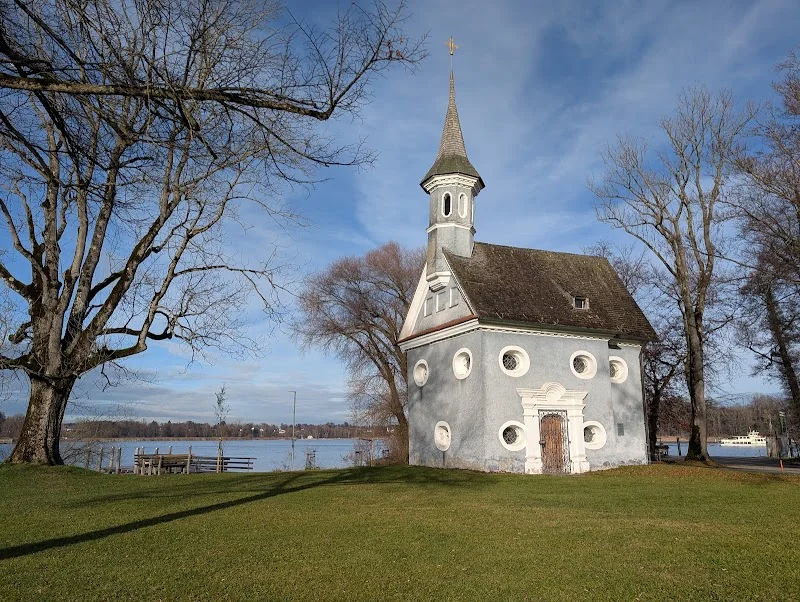
The Seekapelle to the Holy Cross on Herreninsel is one of those buildings that may seem small at first glance yet immediately attracts attention. It stands on the northern island shore in Chiemsee, right where the circular path runs along the water, and is considered a charming destination for all who explore the island on foot. The Bavarian Palace Administration describes it as a chapel from 1697, whose design likely goes back to Giulio Zuccalli; Chiemsee-Alpenland also points out the art-historical furnishings and the beautiful view over the lake. Therefore, those searching for photos of Seekapelle to the Holy Cross Chiemsee find not only a sacred building but also a very photogenic island motif with water, shoreline, and historical context. Today, the chapel is not a regular interior space for visitors but a place that is primarily perceived from the outside and integrated into the island tour. This mix of restraint, history, and view makes it so interesting for many visitors. ([herrenchiemsee.de](https://www.herrenchiemsee.de/deutsch/a_schloss/sakral.htm))
Where is the Seekapelle to the Holy Cross on Herreninsel located?
The Seekapelle to the Holy Cross is located at the northern corner of Herreninsel in Chiemsee. Thus, it does not belong to an urban square or a large church complex with a dense environment but to a very open island location where water and architecture come together directly. This position also explains why the chapel often appears in search queries together with the terms Chiemsee, Herreninsel, and photos: One is not only looking for a sacred object but also for a prominent point on the shore that fits well into a walk around the island. The official tourism description explicitly highlights the view of Chiemsee and refers to the chapel as a gem along the island shore walk. Therefore, those coming from Herreninsel experience the Seekapelle less as a closed interior space but as a striking, almost freestanding building in the landscape. This is part of its impact. The place is small, but the effect is great because the baroque chapel stands against the vastness of the lake and thus appears particularly present. ([de.wikipedia.org](https://de.wikipedia.org/wiki/Seekapelle_zum_Heiligen_Kreuz_%28Herrenchiemsee%29))
Even in the larger context of Herreninsel, the Seekapelle can be well categorized. The island is one of the most well-known destinations in Chiemsee, and the paths connect the landing stage, palace area, park, and various sacred buildings with each other. For visitors, this means: The chapel is usually not approached in isolation but perceived as part of an island visit. Those walking on Herreninsel often see the Seekapelle in the interplay between architecture and nature, between historical sightlines and the open shore. The position at the northern island shore also provides a natural photographic framing, as water surface, sky, and building come together. This is not an artificial staging but the direct result of its location. For SEO and user intent, this point is important because behind a search for Seekapelle to the Holy Cross Chiemsee often lies the desire to understand the exact location and get a first visual impression. The chapel is thus both a landscape and a cultural-historical destination. ([chiemsee-alpenland.de](https://www.chiemsee-alpenland.de/entdecken/alle-sehenswuerdigkeiten/seekapelle-zum-hl.-kreuz-d530f37128))
History of the Seekapelle to the Holy Cross since 1697
The current Seekapelle was built in 1697 on the northern island shore. Giulio Zuccalli is considered a possible designer, a name that also appears in connection with other baroque buildings in the region. The official representation of the Bavarian Palace Administration and the tourist description of Chiemsee-Alpenland also mention a cycle of paintings by Joseph Eder from 1700. This quickly makes it clear that the chapel was not created as a simple utility building but was from the beginning part of an artistic, representative design. Its construction falls into a time when Chiemsee and Herreninsel played a special role as a spiritual and sovereign center. The chapel served the prince-bishop of Chiemsee, who, according to the official description, used it for changing before visiting the cathedral. This note is more than a nice anecdote: It explains the function of the building in the everyday life of the church at that time and clarifies why the place is historically so closely associated with the bishop's seat. The Seekapelle was thus not just any place of worship by the water but part of an ordered liturgical and courtly staging. ([herrenchiemsee.de](https://www.herrenchiemsee.de/deutsch/a_schloss/sakral.htm))
For today's perception, this historical context is important because it enhances the small building. Those who only view the chapel as a pretty photo motif easily overlook that it was embedded in a much larger spiritual system. Herreninsel had sacred buildings for centuries, whose functions changed over time. The Seekapelle exemplifies this development: It preserves the memory of the time when the prince-bishop of Chiemsee needed a place for the walk to the cathedral, and it simultaneously bears the hallmark of a late baroque style that has produced numerous high-ranking examples in Bavaria. Because the building is located by the water and is not surrounded by a densely built environment, this history does not remain at a distance. It is visible when one walks along the shoreline and views the chapel in its marginal location. Thus, historical function and today's perception connect surprisingly directly. The visitor sees not only a chapel but a testament to the bishop's island history. ([herrenchiemsee.de](https://www.herrenchiemsee.de/deutsch/a_schloss/sakral.htm))
Architecture, Frescoes, and the Crucifix on the Exterior Wall
Architecturally, the Seekapelle to the Holy Cross is a baroque stone building with round-oval windows and plaster structuring. On the north side, instead of the former portal, there is a niche with the figure of St. John Nepomuk; additionally, the spire of the roof rider was added after 1819. These details show that despite its small size, the building has a carefully composed appearance. Inside, sources refer to frescoes by Johann Baptist Zimmermann from 1700 and a cycle of paintings by Joseph Eder. A late Gothic crucifix hangs on the outer altar wall, a copy whose original is from the cathedral church. The baroque language of forms is thus intertwined with older sacred reference points. This is exactly what makes the chapel art-historically appealing: It is small but not simple. It combines architecture, painting, sculpture, and memory of earlier church furnishings. For this reason, it regularly appears in image archives and monument contexts, as it is a concentrated example of the building and art history of Herreninsel. ([de.wikipedia.org](https://de.wikipedia.org/wiki/Seekapelle_zum_Heiligen_Kreuz_%28Herrenchiemsee%29))
For users searching for photos of Seekapelle to the Holy Cross Chiemsee, the exterior appearance is particularly important. The combination of a small building, shoreline location, bright wall surfaces, and lake background creates a clear, immediately recognizable silhouette. The official image world of the Chiemsee-Alpenland tourism site even explicitly shows the view from Chiemsee to the Seekapelle Heilig Kreuz on Herreninsel. This suggests that the lake itself is part of the motif and not just a background. Therefore, those photographing should not see the chapel in isolation but as a building at the edge of a natural space. This connection explains the strong visual impact. The motif thrives on the contrast between small architecture and vast water surface, between sacred history and open shoreline landscape. For an SEO text, this is important because the photo search is not just a side aspect but a central part of user intent. Many people want to know before their visit whether the chapel is worth it and what it looks like. The answer is very clearly yes, especially because of its location. ([chiemsee-alpenland.de](https://www.chiemsee-alpenland.de/presse/bildarchiv/seen/seekapelle-heilig-kreuz-herreninsel))
For practical visits, it is also worthwhile to view the Seekapelle not as an isolated destination but as part of a small route. This way, one can walk across the island from the landing stage, plan the exterior view of the chapel, and then continue the tour on Herrenchiemsee. This is also sensible because the chapel is not accessible, and the exterior view thus provides the actual benefit of the visit. Those interested in historical details will also find points at the chapel that are particularly well readable in photos: the baroque form, the shoreline location, the bright wall surface, and the religious symbolism with the crucifix. The interplay of all these elements makes it a compact but very striking photo motif. When one enters the term Seekapelle to the Holy Cross photos into search engines, one is ultimately looking for exactly this mix of information and atmosphere. The image perspective provides the answer faster than long explanations, and that is exactly why the chapel is so searchable: It is small enough for a quick overview but characteristic enough to remain in memory. ([herrenchiemsee.de](https://www.herrenchiemsee.de/deutsch/a_schloss/sakral.htm))
Those who correctly categorize the Seekapelle also better understand the other sacred buildings on Herreninsel. The Bavarian Palace Administration categorizes it within the area of sacred buildings on Herrenchiemsee; the same context includes the island cathedral and the former parish church of St. Mary. For visitors, this is helpful because the small chapel does not exist as an isolated point but as part of a religious and historical topography on the island. This is exactly why the search intent behind Seekapelle to the Holy Cross Chiemsee works so well: Those entering the name usually want to understand the location, history, visual impact, and practical accessibility in a single overview. This connection of orientation and atmosphere is the core of a good location text and also the reason why the Seekapelle, despite its small size, has such a strong digital footprint. ([herrenchiemsee.de](https://www.herrenchiemsee.de/deutsch/a_schloss/sakral.htm))
In the end, the Seekapelle to the Holy Cross remains an example of how a small place can have a great impact. It combines baroque architecture, historical function, art from Zuccalli, Zimmermann, and Eder, as well as an extraordinary location on the lakeshore. This combination answers the most frequent search queries in one go: Where is the chapel? Why is it famous? How do you get there? Can you see it inside? And where can you get good photos? Those who keep these points in mind quickly recognize that the Seekapelle is not just a marginal detail of Herrenchiemsee but one of the most characterful motifs of the island. ([herrenchiemsee.de](https://www.herrenchiemsee.de/deutsch/a_schloss/sakral.htm))
Sources:
- Bavarian Palace Administration - Sacred Buildings on Herrenchiemsee ([herrenchiemsee.de](https://www.herrenchiemsee.de/deutsch/a_schloss/sakral.htm))
- Chiemsee-Alpenland Tourism - Seekapelle to the Holy Cross ([chiemsee-alpenland.de](https://www.chiemsee-alpenland.de/entdecken/alle-sehenswuerdigkeiten/seekapelle-zum-hl.-kreuz-d530f37128))
- Bavarian Palace Administration - How to get there ([herrenchiemsee.de](https://www.herrenchiemsee.de/englisch/tourist/howtoget.htm))
- Chiemsee Shipping - Parking and Toilets ([chiemsee-schifffahrt.de](https://www.chiemsee-schifffahrt.de/de/infos/parkplaetze-toiletten?utm_source=openai))
Show moreShow less
Seekapelle to the Holy Cross | Herreninsel & Photos
The Seekapelle to the Holy Cross on Herreninsel is one of those buildings that may seem small at first glance yet immediately attracts attention. It stands on the northern island shore in Chiemsee, right where the circular path runs along the water, and is considered a charming destination for all who explore the island on foot. The Bavarian Palace Administration describes it as a chapel from 1697, whose design likely goes back to Giulio Zuccalli; Chiemsee-Alpenland also points out the art-historical furnishings and the beautiful view over the lake. Therefore, those searching for photos of Seekapelle to the Holy Cross Chiemsee find not only a sacred building but also a very photogenic island motif with water, shoreline, and historical context. Today, the chapel is not a regular interior space for visitors but a place that is primarily perceived from the outside and integrated into the island tour. This mix of restraint, history, and view makes it so interesting for many visitors. ([herrenchiemsee.de](https://www.herrenchiemsee.de/deutsch/a_schloss/sakral.htm))
Where is the Seekapelle to the Holy Cross on Herreninsel located?
The Seekapelle to the Holy Cross is located at the northern corner of Herreninsel in Chiemsee. Thus, it does not belong to an urban square or a large church complex with a dense environment but to a very open island location where water and architecture come together directly. This position also explains why the chapel often appears in search queries together with the terms Chiemsee, Herreninsel, and photos: One is not only looking for a sacred object but also for a prominent point on the shore that fits well into a walk around the island. The official tourism description explicitly highlights the view of Chiemsee and refers to the chapel as a gem along the island shore walk. Therefore, those coming from Herreninsel experience the Seekapelle less as a closed interior space but as a striking, almost freestanding building in the landscape. This is part of its impact. The place is small, but the effect is great because the baroque chapel stands against the vastness of the lake and thus appears particularly present. ([de.wikipedia.org](https://de.wikipedia.org/wiki/Seekapelle_zum_Heiligen_Kreuz_%28Herrenchiemsee%29))
Even in the larger context of Herreninsel, the Seekapelle can be well categorized. The island is one of the most well-known destinations in Chiemsee, and the paths connect the landing stage, palace area, park, and various sacred buildings with each other. For visitors, this means: The chapel is usually not approached in isolation but perceived as part of an island visit. Those walking on Herreninsel often see the Seekapelle in the interplay between architecture and nature, between historical sightlines and the open shore. The position at the northern island shore also provides a natural photographic framing, as water surface, sky, and building come together. This is not an artificial staging but the direct result of its location. For SEO and user intent, this point is important because behind a search for Seekapelle to the Holy Cross Chiemsee often lies the desire to understand the exact location and get a first visual impression. The chapel is thus both a landscape and a cultural-historical destination. ([chiemsee-alpenland.de](https://www.chiemsee-alpenland.de/entdecken/alle-sehenswuerdigkeiten/seekapelle-zum-hl.-kreuz-d530f37128))
History of the Seekapelle to the Holy Cross since 1697
The current Seekapelle was built in 1697 on the northern island shore. Giulio Zuccalli is considered a possible designer, a name that also appears in connection with other baroque buildings in the region. The official representation of the Bavarian Palace Administration and the tourist description of Chiemsee-Alpenland also mention a cycle of paintings by Joseph Eder from 1700. This quickly makes it clear that the chapel was not created as a simple utility building but was from the beginning part of an artistic, representative design. Its construction falls into a time when Chiemsee and Herreninsel played a special role as a spiritual and sovereign center. The chapel served the prince-bishop of Chiemsee, who, according to the official description, used it for changing before visiting the cathedral. This note is more than a nice anecdote: It explains the function of the building in the everyday life of the church at that time and clarifies why the place is historically so closely associated with the bishop's seat. The Seekapelle was thus not just any place of worship by the water but part of an ordered liturgical and courtly staging. ([herrenchiemsee.de](https://www.herrenchiemsee.de/deutsch/a_schloss/sakral.htm))
For today's perception, this historical context is important because it enhances the small building. Those who only view the chapel as a pretty photo motif easily overlook that it was embedded in a much larger spiritual system. Herreninsel had sacred buildings for centuries, whose functions changed over time. The Seekapelle exemplifies this development: It preserves the memory of the time when the prince-bishop of Chiemsee needed a place for the walk to the cathedral, and it simultaneously bears the hallmark of a late baroque style that has produced numerous high-ranking examples in Bavaria. Because the building is located by the water and is not surrounded by a densely built environment, this history does not remain at a distance. It is visible when one walks along the shoreline and views the chapel in its marginal location. Thus, historical function and today's perception connect surprisingly directly. The visitor sees not only a chapel but a testament to the bishop's island history. ([herrenchiemsee.de](https://www.herrenchiemsee.de/deutsch/a_schloss/sakral.htm))
Architecture, Frescoes, and the Crucifix on the Exterior Wall
Architecturally, the Seekapelle to the Holy Cross is a baroque stone building with round-oval windows and plaster structuring. On the north side, instead of the former portal, there is a niche with the figure of St. John Nepomuk; additionally, the spire of the roof rider was added after 1819. These details show that despite its small size, the building has a carefully composed appearance. Inside, sources refer to frescoes by Johann Baptist Zimmermann from 1700 and a cycle of paintings by Joseph Eder. A late Gothic crucifix hangs on the outer altar wall, a copy whose original is from the cathedral church. The baroque language of forms is thus intertwined with older sacred reference points. This is exactly what makes the chapel art-historically appealing: It is small but not simple. It combines architecture, painting, sculpture, and memory of earlier church furnishings. For this reason, it regularly appears in image archives and monument contexts, as it is a concentrated example of the building and art history of Herreninsel. ([de.wikipedia.org](https://de.wikipedia.org/wiki/Seekapelle_zum_Heiligen_Kreuz_%28Herrenchiemsee%29))
For users searching for photos of Seekapelle to the Holy Cross Chiemsee, the exterior appearance is particularly important. The combination of a small building, shoreline location, bright wall surfaces, and lake background creates a clear, immediately recognizable silhouette. The official image world of the Chiemsee-Alpenland tourism site even explicitly shows the view from Chiemsee to the Seekapelle Heilig Kreuz on Herreninsel. This suggests that the lake itself is part of the motif and not just a background. Therefore, those photographing should not see the chapel in isolation but as a building at the edge of a natural space. This connection explains the strong visual impact. The motif thrives on the contrast between small architecture and vast water surface, between sacred history and open shoreline landscape. For an SEO text, this is important because the photo search is not just a side aspect but a central part of user intent. Many people want to know before their visit whether the chapel is worth it and what it looks like. The answer is very clearly yes, especially because of its location. ([chiemsee-alpenland.de](https://www.chiemsee-alpenland.de/presse/bildarchiv/seen/seekapelle-heilig-kreuz-herreninsel))
For practical visits, it is also worthwhile to view the Seekapelle not as an isolated destination but as part of a small route. This way, one can walk across the island from the landing stage, plan the exterior view of the chapel, and then continue the tour on Herrenchiemsee. This is also sensible because the chapel is not accessible, and the exterior view thus provides the actual benefit of the visit. Those interested in historical details will also find points at the chapel that are particularly well readable in photos: the baroque form, the shoreline location, the bright wall surface, and the religious symbolism with the crucifix. The interplay of all these elements makes it a compact but very striking photo motif. When one enters the term Seekapelle to the Holy Cross photos into search engines, one is ultimately looking for exactly this mix of information and atmosphere. The image perspective provides the answer faster than long explanations, and that is exactly why the chapel is so searchable: It is small enough for a quick overview but characteristic enough to remain in memory. ([herrenchiemsee.de](https://www.herrenchiemsee.de/deutsch/a_schloss/sakral.htm))
Those who correctly categorize the Seekapelle also better understand the other sacred buildings on Herreninsel. The Bavarian Palace Administration categorizes it within the area of sacred buildings on Herrenchiemsee; the same context includes the island cathedral and the former parish church of St. Mary. For visitors, this is helpful because the small chapel does not exist as an isolated point but as part of a religious and historical topography on the island. This is exactly why the search intent behind Seekapelle to the Holy Cross Chiemsee works so well: Those entering the name usually want to understand the location, history, visual impact, and practical accessibility in a single overview. This connection of orientation and atmosphere is the core of a good location text and also the reason why the Seekapelle, despite its small size, has such a strong digital footprint. ([herrenchiemsee.de](https://www.herrenchiemsee.de/deutsch/a_schloss/sakral.htm))
In the end, the Seekapelle to the Holy Cross remains an example of how a small place can have a great impact. It combines baroque architecture, historical function, art from Zuccalli, Zimmermann, and Eder, as well as an extraordinary location on the lakeshore. This combination answers the most frequent search queries in one go: Where is the chapel? Why is it famous? How do you get there? Can you see it inside? And where can you get good photos? Those who keep these points in mind quickly recognize that the Seekapelle is not just a marginal detail of Herrenchiemsee but one of the most characterful motifs of the island. ([herrenchiemsee.de](https://www.herrenchiemsee.de/deutsch/a_schloss/sakral.htm))
Sources:
- Bavarian Palace Administration - Sacred Buildings on Herrenchiemsee ([herrenchiemsee.de](https://www.herrenchiemsee.de/deutsch/a_schloss/sakral.htm))
- Chiemsee-Alpenland Tourism - Seekapelle to the Holy Cross ([chiemsee-alpenland.de](https://www.chiemsee-alpenland.de/entdecken/alle-sehenswuerdigkeiten/seekapelle-zum-hl.-kreuz-d530f37128))
- Bavarian Palace Administration - How to get there ([herrenchiemsee.de](https://www.herrenchiemsee.de/englisch/tourist/howtoget.htm))
- Chiemsee Shipping - Parking and Toilets ([chiemsee-schifffahrt.de](https://www.chiemsee-schifffahrt.de/de/infos/parkplaetze-toiletten?utm_source=openai))
Seekapelle to the Holy Cross | Herreninsel & Photos
The Seekapelle to the Holy Cross on Herreninsel is one of those buildings that may seem small at first glance yet immediately attracts attention. It stands on the northern island shore in Chiemsee, right where the circular path runs along the water, and is considered a charming destination for all who explore the island on foot. The Bavarian Palace Administration describes it as a chapel from 1697, whose design likely goes back to Giulio Zuccalli; Chiemsee-Alpenland also points out the art-historical furnishings and the beautiful view over the lake. Therefore, those searching for photos of Seekapelle to the Holy Cross Chiemsee find not only a sacred building but also a very photogenic island motif with water, shoreline, and historical context. Today, the chapel is not a regular interior space for visitors but a place that is primarily perceived from the outside and integrated into the island tour. This mix of restraint, history, and view makes it so interesting for many visitors. ([herrenchiemsee.de](https://www.herrenchiemsee.de/deutsch/a_schloss/sakral.htm))
Where is the Seekapelle to the Holy Cross on Herreninsel located?
The Seekapelle to the Holy Cross is located at the northern corner of Herreninsel in Chiemsee. Thus, it does not belong to an urban square or a large church complex with a dense environment but to a very open island location where water and architecture come together directly. This position also explains why the chapel often appears in search queries together with the terms Chiemsee, Herreninsel, and photos: One is not only looking for a sacred object but also for a prominent point on the shore that fits well into a walk around the island. The official tourism description explicitly highlights the view of Chiemsee and refers to the chapel as a gem along the island shore walk. Therefore, those coming from Herreninsel experience the Seekapelle less as a closed interior space but as a striking, almost freestanding building in the landscape. This is part of its impact. The place is small, but the effect is great because the baroque chapel stands against the vastness of the lake and thus appears particularly present. ([de.wikipedia.org](https://de.wikipedia.org/wiki/Seekapelle_zum_Heiligen_Kreuz_%28Herrenchiemsee%29))
Even in the larger context of Herreninsel, the Seekapelle can be well categorized. The island is one of the most well-known destinations in Chiemsee, and the paths connect the landing stage, palace area, park, and various sacred buildings with each other. For visitors, this means: The chapel is usually not approached in isolation but perceived as part of an island visit. Those walking on Herreninsel often see the Seekapelle in the interplay between architecture and nature, between historical sightlines and the open shore. The position at the northern island shore also provides a natural photographic framing, as water surface, sky, and building come together. This is not an artificial staging but the direct result of its location. For SEO and user intent, this point is important because behind a search for Seekapelle to the Holy Cross Chiemsee often lies the desire to understand the exact location and get a first visual impression. The chapel is thus both a landscape and a cultural-historical destination. ([chiemsee-alpenland.de](https://www.chiemsee-alpenland.de/entdecken/alle-sehenswuerdigkeiten/seekapelle-zum-hl.-kreuz-d530f37128))
History of the Seekapelle to the Holy Cross since 1697
The current Seekapelle was built in 1697 on the northern island shore. Giulio Zuccalli is considered a possible designer, a name that also appears in connection with other baroque buildings in the region. The official representation of the Bavarian Palace Administration and the tourist description of Chiemsee-Alpenland also mention a cycle of paintings by Joseph Eder from 1700. This quickly makes it clear that the chapel was not created as a simple utility building but was from the beginning part of an artistic, representative design. Its construction falls into a time when Chiemsee and Herreninsel played a special role as a spiritual and sovereign center. The chapel served the prince-bishop of Chiemsee, who, according to the official description, used it for changing before visiting the cathedral. This note is more than a nice anecdote: It explains the function of the building in the everyday life of the church at that time and clarifies why the place is historically so closely associated with the bishop's seat. The Seekapelle was thus not just any place of worship by the water but part of an ordered liturgical and courtly staging. ([herrenchiemsee.de](https://www.herrenchiemsee.de/deutsch/a_schloss/sakral.htm))
For today's perception, this historical context is important because it enhances the small building. Those who only view the chapel as a pretty photo motif easily overlook that it was embedded in a much larger spiritual system. Herreninsel had sacred buildings for centuries, whose functions changed over time. The Seekapelle exemplifies this development: It preserves the memory of the time when the prince-bishop of Chiemsee needed a place for the walk to the cathedral, and it simultaneously bears the hallmark of a late baroque style that has produced numerous high-ranking examples in Bavaria. Because the building is located by the water and is not surrounded by a densely built environment, this history does not remain at a distance. It is visible when one walks along the shoreline and views the chapel in its marginal location. Thus, historical function and today's perception connect surprisingly directly. The visitor sees not only a chapel but a testament to the bishop's island history. ([herrenchiemsee.de](https://www.herrenchiemsee.de/deutsch/a_schloss/sakral.htm))
Architecture, Frescoes, and the Crucifix on the Exterior Wall
Architecturally, the Seekapelle to the Holy Cross is a baroque stone building with round-oval windows and plaster structuring. On the north side, instead of the former portal, there is a niche with the figure of St. John Nepomuk; additionally, the spire of the roof rider was added after 1819. These details show that despite its small size, the building has a carefully composed appearance. Inside, sources refer to frescoes by Johann Baptist Zimmermann from 1700 and a cycle of paintings by Joseph Eder. A late Gothic crucifix hangs on the outer altar wall, a copy whose original is from the cathedral church. The baroque language of forms is thus intertwined with older sacred reference points. This is exactly what makes the chapel art-historically appealing: It is small but not simple. It combines architecture, painting, sculpture, and memory of earlier church furnishings. For this reason, it regularly appears in image archives and monument contexts, as it is a concentrated example of the building and art history of Herreninsel. ([de.wikipedia.org](https://de.wikipedia.org/wiki/Seekapelle_zum_Heiligen_Kreuz_%28Herrenchiemsee%29))
For users searching for photos of Seekapelle to the Holy Cross Chiemsee, the exterior appearance is particularly important. The combination of a small building, shoreline location, bright wall surfaces, and lake background creates a clear, immediately recognizable silhouette. The official image world of the Chiemsee-Alpenland tourism site even explicitly shows the view from Chiemsee to the Seekapelle Heilig Kreuz on Herreninsel. This suggests that the lake itself is part of the motif and not just a background. Therefore, those photographing should not see the chapel in isolation but as a building at the edge of a natural space. This connection explains the strong visual impact. The motif thrives on the contrast between small architecture and vast water surface, between sacred history and open shoreline landscape. For an SEO text, this is important because the photo search is not just a side aspect but a central part of user intent. Many people want to know before their visit whether the chapel is worth it and what it looks like. The answer is very clearly yes, especially because of its location. ([chiemsee-alpenland.de](https://www.chiemsee-alpenland.de/presse/bildarchiv/seen/seekapelle-heilig-kreuz-herreninsel))
For practical visits, it is also worthwhile to view the Seekapelle not as an isolated destination but as part of a small route. This way, one can walk across the island from the landing stage, plan the exterior view of the chapel, and then continue the tour on Herrenchiemsee. This is also sensible because the chapel is not accessible, and the exterior view thus provides the actual benefit of the visit. Those interested in historical details will also find points at the chapel that are particularly well readable in photos: the baroque form, the shoreline location, the bright wall surface, and the religious symbolism with the crucifix. The interplay of all these elements makes it a compact but very striking photo motif. When one enters the term Seekapelle to the Holy Cross photos into search engines, one is ultimately looking for exactly this mix of information and atmosphere. The image perspective provides the answer faster than long explanations, and that is exactly why the chapel is so searchable: It is small enough for a quick overview but characteristic enough to remain in memory. ([herrenchiemsee.de](https://www.herrenchiemsee.de/deutsch/a_schloss/sakral.htm))
Those who correctly categorize the Seekapelle also better understand the other sacred buildings on Herreninsel. The Bavarian Palace Administration categorizes it within the area of sacred buildings on Herrenchiemsee; the same context includes the island cathedral and the former parish church of St. Mary. For visitors, this is helpful because the small chapel does not exist as an isolated point but as part of a religious and historical topography on the island. This is exactly why the search intent behind Seekapelle to the Holy Cross Chiemsee works so well: Those entering the name usually want to understand the location, history, visual impact, and practical accessibility in a single overview. This connection of orientation and atmosphere is the core of a good location text and also the reason why the Seekapelle, despite its small size, has such a strong digital footprint. ([herrenchiemsee.de](https://www.herrenchiemsee.de/deutsch/a_schloss/sakral.htm))
In the end, the Seekapelle to the Holy Cross remains an example of how a small place can have a great impact. It combines baroque architecture, historical function, art from Zuccalli, Zimmermann, and Eder, as well as an extraordinary location on the lakeshore. This combination answers the most frequent search queries in one go: Where is the chapel? Why is it famous? How do you get there? Can you see it inside? And where can you get good photos? Those who keep these points in mind quickly recognize that the Seekapelle is not just a marginal detail of Herrenchiemsee but one of the most characterful motifs of the island. ([herrenchiemsee.de](https://www.herrenchiemsee.de/deutsch/a_schloss/sakral.htm))
Sources:
- Bavarian Palace Administration - Sacred Buildings on Herrenchiemsee ([herrenchiemsee.de](https://www.herrenchiemsee.de/deutsch/a_schloss/sakral.htm))
- Chiemsee-Alpenland Tourism - Seekapelle to the Holy Cross ([chiemsee-alpenland.de](https://www.chiemsee-alpenland.de/entdecken/alle-sehenswuerdigkeiten/seekapelle-zum-hl.-kreuz-d530f37128))
- Bavarian Palace Administration - How to get there ([herrenchiemsee.de](https://www.herrenchiemsee.de/englisch/tourist/howtoget.htm))
- Chiemsee Shipping - Parking and Toilets ([chiemsee-schifffahrt.de](https://www.chiemsee-schifffahrt.de/de/infos/parkplaetze-toiletten?utm_source=openai))
Upcoming Events
No events found
Frequently Asked Questions
Reviews
Vladimir Georgiev
31. July 2020
Very charming chapel, especially when seen from the boat to Herreninsel. And the Fairytale Castle of Ludwig II on the same island.
Piotr Postrach
10. July 2021
Ciimax
Carola B.
7. December 2025
A quieter path leads past this beautiful chapel through the woods to the right around the island to the canal.
Nadine B.
16. August 2020
A very beautiful and especially quiet place, as most tourists go in the other direction from the boat dock. The chapel looks really nice. There's also a small sandy beach behind it where you can wade into the water, lots of greenery, and a public toilet. Definitely worth a visit 👍
Kathleen Handrick
19. September 2025
A very beautiful chapel, both from the water and from the land it looks stunning!