
Herrenchiemsee
83209 Herrenchiemsee, Deutschland
Schlosspark Herrenchiemsee | Photos & Parking
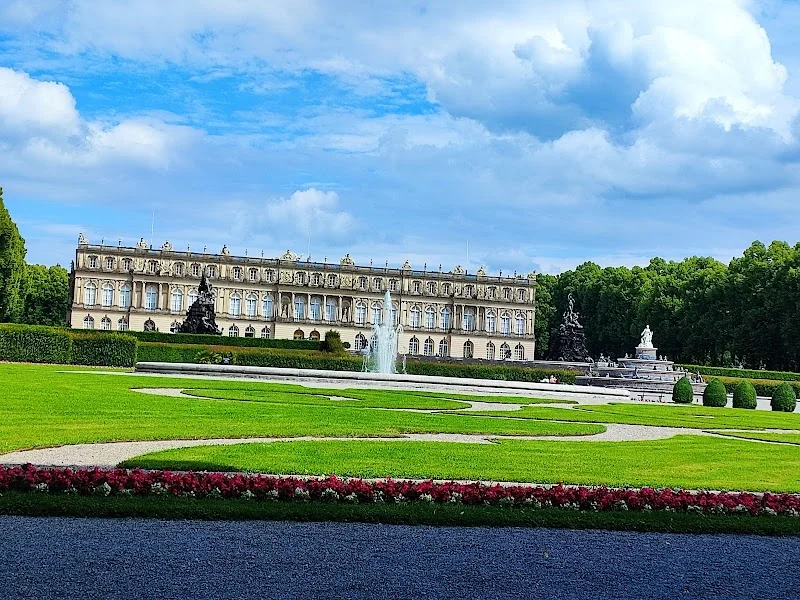
The Schlosspark Herrenchiemsee is one of the most impressive garden facilities in Bavaria, as it combines landscape, architecture, and King Ludwig II's longing for an idealized castle world. On Herreninsel in Chiemsee, a simple park was not created, but rather a carefully staged space that directs the view towards the New Palace, water surfaces, geometrically arranged paths, and the surrounding nature. The official palace administration describes the park as part of Ludwig's dream world and emphasizes that the central garden spaces were planned after the model of Versailles, without simply copying the layout. Since 2025, the ensemble of King Ludwig II's palaces, which includes Herrenchiemsee, has been part of the UNESCO World Heritage. Thus, the Schlosspark today is not only a destination for excursions but also a significant cultural heritage of international standing. ([herrenchiemsee.de](https://www.herrenchiemsee.de/deutsch/park/))
The most beautiful photo motifs in Schlosspark Herrenchiemsee
Those searching for photos of Schlosspark Herrenchiemsee will find one of the clearest and most elegant garden backdrops in Germany here. Particularly striking are the water basins in the western area, designed as Parterre d’eau, which receive a mythological accent with the figures of Fama and Fortuna. Additionally, there is the flower parterre with the Latonabrunnen, the Grand Canal, and the long central axis that divides the park like a stage. These elements do not act in isolation but in a careful spatial sequence that creates strong lines, reflections, and visual connections when photographing. This is exactly what gives the park its special charm: Each shot gains depth, order, and a touch of courtly theatricality. ([herrenchiemsee.de](https://www.herrenchiemsee.de/deutsch/park/))
For photos, the perspectives along the garden's central axis are particularly exciting, as this is where the layout reveals its entire idea. From the side of the palace, the architecture appears strict and monumental, while the canal, the flower beds, and the hedges form an almost graphic structure. To the east, the long driveway, laid out over 900 meters, leads to the area where a ship landing stage was originally planned. At the same time, the island park opens up views over Chiemsee and towards the Alps at many points. This combination of formal garden art and wide natural space makes Herrenchiemsee particularly photogenic: sometimes the reflecting water surface dominates, sometimes the axis, and sometimes the palace as a focal point in the image. ([herrenchiemsee.de](https://www.herrenchiemsee.de/deutsch/park/entsteh.htm))
Access and Parking: How to Reach Herreninsel
The journey to Schlosspark Herrenchiemsee is well organized, but it follows the special character of an island facility. Officially, the route by car leads via the A8 Salzburg-Munich, exit Bernau, continuing to Prien am Chiemsee. At the roundabout before Prien, follow the signs towards Chiemsee or Königsschloss to the paid parking lot. Regular boats run from Prien/Stock to Herreninsel, so the visit is associated from the start with a short boat ride. Traveling by train is also uncomplicated: The Prien am Chiemsee train station is on the route to Munich and is explicitly mentioned in the official visitor information. ([herrenchiemsee.de](https://www.herrenchiemsee.de/deutsch/tourist/anfahrt.htm))
Those planning their visit should not underestimate the paths, as the island is not a short stop but an excursion with several stages. The palace administration recommends planning about an hour for the journey to the New Palace, including the boat ride. During the summer season, the Chiemsee-Bahn additionally runs from Prien station to the Prien/Stock boat landing; walking this path takes about 30 minutes. This is practical for those arriving without a car or wishing to combine their island visit with a leisurely walk. It is important for visitors to note: On the island itself, the car is not the dominant means of transport, but rather the footpath or the carriage. ([herrenchiemsee.de](https://www.herrenchiemsee.de/deutsch/tourist/anfahrt.htm))
How the Dream of Versailles Became the Schlosspark on Herreninsel
The history of the Schlosspark begins with a very personal vision of King Ludwig II. As early as 1868, the king worked on the idea of creating a palace and garden facility inspired by the splendor of Versailles. In 1873, he acquired Herreninsel as a construction site because the plans originally intended for Linderhof could not be implemented there to the desired extent. The island offered exactly what Ludwig was looking for: seclusion, water, a wide backdrop, and the possibility to retreat into a deliberately created dream world. At the same time, Ludwig made it clear that he was not interested in a mechanical copy. He selected parts of the Versailles garden idea that should be visible from the main rooms of the palace and had them translated into his own Bavarian version. ([herrenchiemsee.de](https://www.herrenchiemsee.de/deutsch/park/))
For the design of the gardens, court gardener director Carl von Effner played a central role. Starting in 1875, he developed the garden planning, which oriented itself around the central axis of the park and focused the view on the most important elements. The official representation emphasizes that significant preliminary work was necessary for this layout: forest areas had to be cleared, hills leveled, and depressions filled to create the flat areas needed for the baroque order. In 1878, the foundation stone for the palace was laid, in 1882 the actual garden work could begin, and by 1886 only about a third of the planned facility was completed. After Ludwig II's death, a simplified completion began in 1888 under Jakob Möhl, which gave the facility its recognizable framework to this day. ([herrenchiemsee.de](https://www.herrenchiemsee.de/deutsch/park/entsteh.htm))
Water Parterre, Latonabrunnen, and Grand Canal: The Garden Axes in Detail
The heart of the Schlosspark lies in the western garden axis. There, two large water basins are designed as Parterre d’eau and are mythologically elevated with Fama and Fortuna. Following this is the flower parterre with the Latonabrunnen, and then the Grand Canal, in front of whose reflecting surface the Apollobrunnen was originally supposed to act. This sequence is particularly important for Herrenchiemsee because it does not make the park appear as a loose collection of areas but as a strictly composed space. Each zone has a function: water reflects, flowers organize, axes guide the gaze, and the figures give the layout a narrative level. This combination makes the park so unmistakable and explains why it is still perceived as one of the great works of garden art of the 19th century. ([herrenchiemsee.de](https://www.herrenchiemsee.de/deutsch/park/))
To the east, the second great perspective of the Schlosspark opens up. There, a driveway planned over 900 meters stretches, accompanied by avenues, leading from the shore to the palace complex. The official description also mentions two horseshoe-shaped stable buildings that were supposed to frame this view. It is noteworthy that Ludwig II did not wish for open views of the lake or the rural surroundings in Herrenchiemsee; instead, the garden spaces were meant to appear more as closed, festive backdrops. This explains why the park today appears so different from a natural landscape park: it is focused on staging and directing views. Those standing there experience not just a beautiful garden but a conscious composition of architecture, water, and spatial dramaturgy. ([herrenchiemsee.de](https://www.herrenchiemsee.de/deutsch/park/entsteh.htm))
Island Plan, Paths, and Carriage Rides on Herrenchiemsee
Herreninsel is larger and more versatile than many visitors initially expect. The palace administration explicitly refers to an island plan in the Herrenchiemsee brochure, and this orientation is sensible if one wants to discover the park, the New Palace, and the other areas in one day. The official development history also describes that Ludwig II had various paths laid out, including a carriage path near the shore that almost circles the entire island. Today, one can walk along the other paths through the island, passing orchards, fields, livestock pastures, and forest areas. This creates an exciting contrast: on one hand, the strict garden axis at the palace, and on the other hand, a surprisingly open island space with wide natural references. ([herrenchiemsee.de](https://www.herrenchiemsee.de/deutsch/tourist/plan.htm))
A special part of the visitor experience is the carriage rides. The palace administration states that around 30 horses are in service, bringing visitors from the boat landing to the king's palace. At the same time, it is clearly stated that horse-drawn carriages are the only means of transport for visitors on the island and that the footpath to the New Palace takes about 20 minutes. This information is practical for those traveling with children, elderly companions, or a lot of photographic equipment. It also makes clear that Herrenchiemsee is not a place for hurried traversing. The path is part of the experience, and the slow arrival is part of the atmosphere here. Those who embrace this experience will not only see Herreninsel as a destination but as a landscape and historically charged pathway. ([herrenchiemsee.de](https://www.herrenchiemsee.de/deutsch/tourist/pferde.htm))
Care, Restoration, and Current Importance of Schlosspark Herrenchiemsee
The Schlosspark Herrenchiemsee is not only art historically interesting but also horticulturally demanding. The official park maintenance page states specific dimensions: 3.5 hectares of lawn areas, 6.5 hectares of path areas, 0.1 hectares of flower beds, 2.5 hectares of hedge trimming areas, as well as 4900 running meters of avenue trees and numerous water basins and figures. These numbers show that the park is a complex, permanently maintained facility. Its character lives from precision, symmetry, and well-kept structures. Without continuous care, the sharp contours of the beds, hedges, and paths would quickly disappear. This is exactly why the Schlosspark is not a static monument but a living work of garden art that must be maintained day by day. ([herrenchiemsee.de](https://www.herrenchiemsee.de/deutsch/park/betreu.htm))
However, the history of the park also knows phases of decline. Shortly after Ludwig's death, the water features had to be turned off, parts of the facility further deteriorated, and during the hard times before and during the world wars, flower beds were even used for vegetable cultivation while the canal silted up. It was not until the 1970s that systematic restoration began, initially with the Latonabrunnen and the hunting fountains, later with the gravel ornaments, the Fama and Fortuna fountains, and the Grand Canal. Since these reconstructions, the facility has largely returned to the condition that Ludwig II himself likely experienced. That Herrenchiemsee has also been a UNESCO World Heritage site since 2025 further underscores its historical and cultural significance. ([herrenchiemsee.de](https://www.herrenchiemsee.de/deutsch/park/betreu.htm))
Sources:
- Bavarian Palace Administration - Schloss and Park Herrenchiemsee - Park - Overview
- Bavarian Palace Administration - Schloss and Park Herrenchiemsee - Visitor Information - Access
- Bavarian Palace Administration - Schloss and Park Herrenchiemsee - Visitor Information - Island Plan
- Bavarian Palace Administration - Schloss and Park Herrenchiemsee - Park - Park Maintenance Today
- Bavarian Palace Administration - Schloss and Park Herrenchiemsee - Current Events
- German UNESCO Commission - The Palaces of King Ludwig II of Bavaria: Neuschwanstein, Linderhof, Schachen, and Herrenchiemsee
Show moreShow less
Schlosspark Herrenchiemsee | Photos & Parking
The Schlosspark Herrenchiemsee is one of the most impressive garden facilities in Bavaria, as it combines landscape, architecture, and King Ludwig II's longing for an idealized castle world. On Herreninsel in Chiemsee, a simple park was not created, but rather a carefully staged space that directs the view towards the New Palace, water surfaces, geometrically arranged paths, and the surrounding nature. The official palace administration describes the park as part of Ludwig's dream world and emphasizes that the central garden spaces were planned after the model of Versailles, without simply copying the layout. Since 2025, the ensemble of King Ludwig II's palaces, which includes Herrenchiemsee, has been part of the UNESCO World Heritage. Thus, the Schlosspark today is not only a destination for excursions but also a significant cultural heritage of international standing. ([herrenchiemsee.de](https://www.herrenchiemsee.de/deutsch/park/))
The most beautiful photo motifs in Schlosspark Herrenchiemsee
Those searching for photos of Schlosspark Herrenchiemsee will find one of the clearest and most elegant garden backdrops in Germany here. Particularly striking are the water basins in the western area, designed as Parterre d’eau, which receive a mythological accent with the figures of Fama and Fortuna. Additionally, there is the flower parterre with the Latonabrunnen, the Grand Canal, and the long central axis that divides the park like a stage. These elements do not act in isolation but in a careful spatial sequence that creates strong lines, reflections, and visual connections when photographing. This is exactly what gives the park its special charm: Each shot gains depth, order, and a touch of courtly theatricality. ([herrenchiemsee.de](https://www.herrenchiemsee.de/deutsch/park/))
For photos, the perspectives along the garden's central axis are particularly exciting, as this is where the layout reveals its entire idea. From the side of the palace, the architecture appears strict and monumental, while the canal, the flower beds, and the hedges form an almost graphic structure. To the east, the long driveway, laid out over 900 meters, leads to the area where a ship landing stage was originally planned. At the same time, the island park opens up views over Chiemsee and towards the Alps at many points. This combination of formal garden art and wide natural space makes Herrenchiemsee particularly photogenic: sometimes the reflecting water surface dominates, sometimes the axis, and sometimes the palace as a focal point in the image. ([herrenchiemsee.de](https://www.herrenchiemsee.de/deutsch/park/entsteh.htm))
Access and Parking: How to Reach Herreninsel
The journey to Schlosspark Herrenchiemsee is well organized, but it follows the special character of an island facility. Officially, the route by car leads via the A8 Salzburg-Munich, exit Bernau, continuing to Prien am Chiemsee. At the roundabout before Prien, follow the signs towards Chiemsee or Königsschloss to the paid parking lot. Regular boats run from Prien/Stock to Herreninsel, so the visit is associated from the start with a short boat ride. Traveling by train is also uncomplicated: The Prien am Chiemsee train station is on the route to Munich and is explicitly mentioned in the official visitor information. ([herrenchiemsee.de](https://www.herrenchiemsee.de/deutsch/tourist/anfahrt.htm))
Those planning their visit should not underestimate the paths, as the island is not a short stop but an excursion with several stages. The palace administration recommends planning about an hour for the journey to the New Palace, including the boat ride. During the summer season, the Chiemsee-Bahn additionally runs from Prien station to the Prien/Stock boat landing; walking this path takes about 30 minutes. This is practical for those arriving without a car or wishing to combine their island visit with a leisurely walk. It is important for visitors to note: On the island itself, the car is not the dominant means of transport, but rather the footpath or the carriage. ([herrenchiemsee.de](https://www.herrenchiemsee.de/deutsch/tourist/anfahrt.htm))
How the Dream of Versailles Became the Schlosspark on Herreninsel
The history of the Schlosspark begins with a very personal vision of King Ludwig II. As early as 1868, the king worked on the idea of creating a palace and garden facility inspired by the splendor of Versailles. In 1873, he acquired Herreninsel as a construction site because the plans originally intended for Linderhof could not be implemented there to the desired extent. The island offered exactly what Ludwig was looking for: seclusion, water, a wide backdrop, and the possibility to retreat into a deliberately created dream world. At the same time, Ludwig made it clear that he was not interested in a mechanical copy. He selected parts of the Versailles garden idea that should be visible from the main rooms of the palace and had them translated into his own Bavarian version. ([herrenchiemsee.de](https://www.herrenchiemsee.de/deutsch/park/))
For the design of the gardens, court gardener director Carl von Effner played a central role. Starting in 1875, he developed the garden planning, which oriented itself around the central axis of the park and focused the view on the most important elements. The official representation emphasizes that significant preliminary work was necessary for this layout: forest areas had to be cleared, hills leveled, and depressions filled to create the flat areas needed for the baroque order. In 1878, the foundation stone for the palace was laid, in 1882 the actual garden work could begin, and by 1886 only about a third of the planned facility was completed. After Ludwig II's death, a simplified completion began in 1888 under Jakob Möhl, which gave the facility its recognizable framework to this day. ([herrenchiemsee.de](https://www.herrenchiemsee.de/deutsch/park/entsteh.htm))
Water Parterre, Latonabrunnen, and Grand Canal: The Garden Axes in Detail
The heart of the Schlosspark lies in the western garden axis. There, two large water basins are designed as Parterre d’eau and are mythologically elevated with Fama and Fortuna. Following this is the flower parterre with the Latonabrunnen, and then the Grand Canal, in front of whose reflecting surface the Apollobrunnen was originally supposed to act. This sequence is particularly important for Herrenchiemsee because it does not make the park appear as a loose collection of areas but as a strictly composed space. Each zone has a function: water reflects, flowers organize, axes guide the gaze, and the figures give the layout a narrative level. This combination makes the park so unmistakable and explains why it is still perceived as one of the great works of garden art of the 19th century. ([herrenchiemsee.de](https://www.herrenchiemsee.de/deutsch/park/))
To the east, the second great perspective of the Schlosspark opens up. There, a driveway planned over 900 meters stretches, accompanied by avenues, leading from the shore to the palace complex. The official description also mentions two horseshoe-shaped stable buildings that were supposed to frame this view. It is noteworthy that Ludwig II did not wish for open views of the lake or the rural surroundings in Herrenchiemsee; instead, the garden spaces were meant to appear more as closed, festive backdrops. This explains why the park today appears so different from a natural landscape park: it is focused on staging and directing views. Those standing there experience not just a beautiful garden but a conscious composition of architecture, water, and spatial dramaturgy. ([herrenchiemsee.de](https://www.herrenchiemsee.de/deutsch/park/entsteh.htm))
Island Plan, Paths, and Carriage Rides on Herrenchiemsee
Herreninsel is larger and more versatile than many visitors initially expect. The palace administration explicitly refers to an island plan in the Herrenchiemsee brochure, and this orientation is sensible if one wants to discover the park, the New Palace, and the other areas in one day. The official development history also describes that Ludwig II had various paths laid out, including a carriage path near the shore that almost circles the entire island. Today, one can walk along the other paths through the island, passing orchards, fields, livestock pastures, and forest areas. This creates an exciting contrast: on one hand, the strict garden axis at the palace, and on the other hand, a surprisingly open island space with wide natural references. ([herrenchiemsee.de](https://www.herrenchiemsee.de/deutsch/tourist/plan.htm))
A special part of the visitor experience is the carriage rides. The palace administration states that around 30 horses are in service, bringing visitors from the boat landing to the king's palace. At the same time, it is clearly stated that horse-drawn carriages are the only means of transport for visitors on the island and that the footpath to the New Palace takes about 20 minutes. This information is practical for those traveling with children, elderly companions, or a lot of photographic equipment. It also makes clear that Herrenchiemsee is not a place for hurried traversing. The path is part of the experience, and the slow arrival is part of the atmosphere here. Those who embrace this experience will not only see Herreninsel as a destination but as a landscape and historically charged pathway. ([herrenchiemsee.de](https://www.herrenchiemsee.de/deutsch/tourist/pferde.htm))
Care, Restoration, and Current Importance of Schlosspark Herrenchiemsee
The Schlosspark Herrenchiemsee is not only art historically interesting but also horticulturally demanding. The official park maintenance page states specific dimensions: 3.5 hectares of lawn areas, 6.5 hectares of path areas, 0.1 hectares of flower beds, 2.5 hectares of hedge trimming areas, as well as 4900 running meters of avenue trees and numerous water basins and figures. These numbers show that the park is a complex, permanently maintained facility. Its character lives from precision, symmetry, and well-kept structures. Without continuous care, the sharp contours of the beds, hedges, and paths would quickly disappear. This is exactly why the Schlosspark is not a static monument but a living work of garden art that must be maintained day by day. ([herrenchiemsee.de](https://www.herrenchiemsee.de/deutsch/park/betreu.htm))
However, the history of the park also knows phases of decline. Shortly after Ludwig's death, the water features had to be turned off, parts of the facility further deteriorated, and during the hard times before and during the world wars, flower beds were even used for vegetable cultivation while the canal silted up. It was not until the 1970s that systematic restoration began, initially with the Latonabrunnen and the hunting fountains, later with the gravel ornaments, the Fama and Fortuna fountains, and the Grand Canal. Since these reconstructions, the facility has largely returned to the condition that Ludwig II himself likely experienced. That Herrenchiemsee has also been a UNESCO World Heritage site since 2025 further underscores its historical and cultural significance. ([herrenchiemsee.de](https://www.herrenchiemsee.de/deutsch/park/betreu.htm))
Sources:
- Bavarian Palace Administration - Schloss and Park Herrenchiemsee - Park - Overview
- Bavarian Palace Administration - Schloss and Park Herrenchiemsee - Visitor Information - Access
- Bavarian Palace Administration - Schloss and Park Herrenchiemsee - Visitor Information - Island Plan
- Bavarian Palace Administration - Schloss and Park Herrenchiemsee - Park - Park Maintenance Today
- Bavarian Palace Administration - Schloss and Park Herrenchiemsee - Current Events
- German UNESCO Commission - The Palaces of King Ludwig II of Bavaria: Neuschwanstein, Linderhof, Schachen, and Herrenchiemsee
Schlosspark Herrenchiemsee | Photos & Parking
The Schlosspark Herrenchiemsee is one of the most impressive garden facilities in Bavaria, as it combines landscape, architecture, and King Ludwig II's longing for an idealized castle world. On Herreninsel in Chiemsee, a simple park was not created, but rather a carefully staged space that directs the view towards the New Palace, water surfaces, geometrically arranged paths, and the surrounding nature. The official palace administration describes the park as part of Ludwig's dream world and emphasizes that the central garden spaces were planned after the model of Versailles, without simply copying the layout. Since 2025, the ensemble of King Ludwig II's palaces, which includes Herrenchiemsee, has been part of the UNESCO World Heritage. Thus, the Schlosspark today is not only a destination for excursions but also a significant cultural heritage of international standing. ([herrenchiemsee.de](https://www.herrenchiemsee.de/deutsch/park/))
The most beautiful photo motifs in Schlosspark Herrenchiemsee
Those searching for photos of Schlosspark Herrenchiemsee will find one of the clearest and most elegant garden backdrops in Germany here. Particularly striking are the water basins in the western area, designed as Parterre d’eau, which receive a mythological accent with the figures of Fama and Fortuna. Additionally, there is the flower parterre with the Latonabrunnen, the Grand Canal, and the long central axis that divides the park like a stage. These elements do not act in isolation but in a careful spatial sequence that creates strong lines, reflections, and visual connections when photographing. This is exactly what gives the park its special charm: Each shot gains depth, order, and a touch of courtly theatricality. ([herrenchiemsee.de](https://www.herrenchiemsee.de/deutsch/park/))
For photos, the perspectives along the garden's central axis are particularly exciting, as this is where the layout reveals its entire idea. From the side of the palace, the architecture appears strict and monumental, while the canal, the flower beds, and the hedges form an almost graphic structure. To the east, the long driveway, laid out over 900 meters, leads to the area where a ship landing stage was originally planned. At the same time, the island park opens up views over Chiemsee and towards the Alps at many points. This combination of formal garden art and wide natural space makes Herrenchiemsee particularly photogenic: sometimes the reflecting water surface dominates, sometimes the axis, and sometimes the palace as a focal point in the image. ([herrenchiemsee.de](https://www.herrenchiemsee.de/deutsch/park/entsteh.htm))
Access and Parking: How to Reach Herreninsel
The journey to Schlosspark Herrenchiemsee is well organized, but it follows the special character of an island facility. Officially, the route by car leads via the A8 Salzburg-Munich, exit Bernau, continuing to Prien am Chiemsee. At the roundabout before Prien, follow the signs towards Chiemsee or Königsschloss to the paid parking lot. Regular boats run from Prien/Stock to Herreninsel, so the visit is associated from the start with a short boat ride. Traveling by train is also uncomplicated: The Prien am Chiemsee train station is on the route to Munich and is explicitly mentioned in the official visitor information. ([herrenchiemsee.de](https://www.herrenchiemsee.de/deutsch/tourist/anfahrt.htm))
Those planning their visit should not underestimate the paths, as the island is not a short stop but an excursion with several stages. The palace administration recommends planning about an hour for the journey to the New Palace, including the boat ride. During the summer season, the Chiemsee-Bahn additionally runs from Prien station to the Prien/Stock boat landing; walking this path takes about 30 minutes. This is practical for those arriving without a car or wishing to combine their island visit with a leisurely walk. It is important for visitors to note: On the island itself, the car is not the dominant means of transport, but rather the footpath or the carriage. ([herrenchiemsee.de](https://www.herrenchiemsee.de/deutsch/tourist/anfahrt.htm))
How the Dream of Versailles Became the Schlosspark on Herreninsel
The history of the Schlosspark begins with a very personal vision of King Ludwig II. As early as 1868, the king worked on the idea of creating a palace and garden facility inspired by the splendor of Versailles. In 1873, he acquired Herreninsel as a construction site because the plans originally intended for Linderhof could not be implemented there to the desired extent. The island offered exactly what Ludwig was looking for: seclusion, water, a wide backdrop, and the possibility to retreat into a deliberately created dream world. At the same time, Ludwig made it clear that he was not interested in a mechanical copy. He selected parts of the Versailles garden idea that should be visible from the main rooms of the palace and had them translated into his own Bavarian version. ([herrenchiemsee.de](https://www.herrenchiemsee.de/deutsch/park/))
For the design of the gardens, court gardener director Carl von Effner played a central role. Starting in 1875, he developed the garden planning, which oriented itself around the central axis of the park and focused the view on the most important elements. The official representation emphasizes that significant preliminary work was necessary for this layout: forest areas had to be cleared, hills leveled, and depressions filled to create the flat areas needed for the baroque order. In 1878, the foundation stone for the palace was laid, in 1882 the actual garden work could begin, and by 1886 only about a third of the planned facility was completed. After Ludwig II's death, a simplified completion began in 1888 under Jakob Möhl, which gave the facility its recognizable framework to this day. ([herrenchiemsee.de](https://www.herrenchiemsee.de/deutsch/park/entsteh.htm))
Water Parterre, Latonabrunnen, and Grand Canal: The Garden Axes in Detail
The heart of the Schlosspark lies in the western garden axis. There, two large water basins are designed as Parterre d’eau and are mythologically elevated with Fama and Fortuna. Following this is the flower parterre with the Latonabrunnen, and then the Grand Canal, in front of whose reflecting surface the Apollobrunnen was originally supposed to act. This sequence is particularly important for Herrenchiemsee because it does not make the park appear as a loose collection of areas but as a strictly composed space. Each zone has a function: water reflects, flowers organize, axes guide the gaze, and the figures give the layout a narrative level. This combination makes the park so unmistakable and explains why it is still perceived as one of the great works of garden art of the 19th century. ([herrenchiemsee.de](https://www.herrenchiemsee.de/deutsch/park/))
To the east, the second great perspective of the Schlosspark opens up. There, a driveway planned over 900 meters stretches, accompanied by avenues, leading from the shore to the palace complex. The official description also mentions two horseshoe-shaped stable buildings that were supposed to frame this view. It is noteworthy that Ludwig II did not wish for open views of the lake or the rural surroundings in Herrenchiemsee; instead, the garden spaces were meant to appear more as closed, festive backdrops. This explains why the park today appears so different from a natural landscape park: it is focused on staging and directing views. Those standing there experience not just a beautiful garden but a conscious composition of architecture, water, and spatial dramaturgy. ([herrenchiemsee.de](https://www.herrenchiemsee.de/deutsch/park/entsteh.htm))
Island Plan, Paths, and Carriage Rides on Herrenchiemsee
Herreninsel is larger and more versatile than many visitors initially expect. The palace administration explicitly refers to an island plan in the Herrenchiemsee brochure, and this orientation is sensible if one wants to discover the park, the New Palace, and the other areas in one day. The official development history also describes that Ludwig II had various paths laid out, including a carriage path near the shore that almost circles the entire island. Today, one can walk along the other paths through the island, passing orchards, fields, livestock pastures, and forest areas. This creates an exciting contrast: on one hand, the strict garden axis at the palace, and on the other hand, a surprisingly open island space with wide natural references. ([herrenchiemsee.de](https://www.herrenchiemsee.de/deutsch/tourist/plan.htm))
A special part of the visitor experience is the carriage rides. The palace administration states that around 30 horses are in service, bringing visitors from the boat landing to the king's palace. At the same time, it is clearly stated that horse-drawn carriages are the only means of transport for visitors on the island and that the footpath to the New Palace takes about 20 minutes. This information is practical for those traveling with children, elderly companions, or a lot of photographic equipment. It also makes clear that Herrenchiemsee is not a place for hurried traversing. The path is part of the experience, and the slow arrival is part of the atmosphere here. Those who embrace this experience will not only see Herreninsel as a destination but as a landscape and historically charged pathway. ([herrenchiemsee.de](https://www.herrenchiemsee.de/deutsch/tourist/pferde.htm))
Care, Restoration, and Current Importance of Schlosspark Herrenchiemsee
The Schlosspark Herrenchiemsee is not only art historically interesting but also horticulturally demanding. The official park maintenance page states specific dimensions: 3.5 hectares of lawn areas, 6.5 hectares of path areas, 0.1 hectares of flower beds, 2.5 hectares of hedge trimming areas, as well as 4900 running meters of avenue trees and numerous water basins and figures. These numbers show that the park is a complex, permanently maintained facility. Its character lives from precision, symmetry, and well-kept structures. Without continuous care, the sharp contours of the beds, hedges, and paths would quickly disappear. This is exactly why the Schlosspark is not a static monument but a living work of garden art that must be maintained day by day. ([herrenchiemsee.de](https://www.herrenchiemsee.de/deutsch/park/betreu.htm))
However, the history of the park also knows phases of decline. Shortly after Ludwig's death, the water features had to be turned off, parts of the facility further deteriorated, and during the hard times before and during the world wars, flower beds were even used for vegetable cultivation while the canal silted up. It was not until the 1970s that systematic restoration began, initially with the Latonabrunnen and the hunting fountains, later with the gravel ornaments, the Fama and Fortuna fountains, and the Grand Canal. Since these reconstructions, the facility has largely returned to the condition that Ludwig II himself likely experienced. That Herrenchiemsee has also been a UNESCO World Heritage site since 2025 further underscores its historical and cultural significance. ([herrenchiemsee.de](https://www.herrenchiemsee.de/deutsch/park/betreu.htm))
Sources:
- Bavarian Palace Administration - Schloss and Park Herrenchiemsee - Park - Overview
- Bavarian Palace Administration - Schloss and Park Herrenchiemsee - Visitor Information - Access
- Bavarian Palace Administration - Schloss and Park Herrenchiemsee - Visitor Information - Island Plan
- Bavarian Palace Administration - Schloss and Park Herrenchiemsee - Park - Park Maintenance Today
- Bavarian Palace Administration - Schloss and Park Herrenchiemsee - Current Events
- German UNESCO Commission - The Palaces of King Ludwig II of Bavaria: Neuschwanstein, Linderhof, Schachen, and Herrenchiemsee
Frequently Asked Questions
Reviews
No reviews found