
Übersee
Dorfstraße 30, 83236 Übersee, Deutschland
Parish Church St. Nicholas Übersee | Services & History
The Parish Church St. Nicholas Übersee is much more than a sacred building with a well-known address. It is a defining landmark of the community, a point of orientation in the village landscape, and a place where history, faith, and community life closely intertwine. Official pages of the parish and the community describe it as a neo-Gothic church, which can be seen from afar in the silhouette of the village and is therefore also referred to as the Cathedral of the Achental. Those who come to Übersee encounter not only a house of worship but also a structure that visibly carries the identity of the place. The church is located at Dorfstraße 30, while the parish organizes its administrative tasks through the parish office at Kirchweg 4a. This includes the service schedule, current notices, and further information about parish life. This blend of striking architecture, long history, and vibrant community work makes the Parish Church St. Nicholas equally exciting for visitors, believers, and culture enthusiasts. ([uebersee.com](https://www.uebersee.com/freizeit-tourismus/sehenswuerdigkeiten/kirchen-und-kapellen))
Service Schedule and Current Dates
Those who want to get to know the Parish Church St. Nicholas Übersee from a practical perspective should start with the official service schedule. The parish provides a dedicated page where masses, vespers, devotions, and prayers are continuously published. There, not only individual dates can be found, but also information about changes, additional celebrations, and the option to download service schedules. This is particularly helpful for visitors, as the liturgical everyday life of an active parish cannot be squeezed into a rigid framework. Instead, the website presents a lively community life with regularly maintained information and a clear recommendation to clarify changes directly through the parish office if in doubt. Thus, the church is not only a historical monument but also a place where the Catholic community continues to gather reliably today. The feast day is also firmly anchored: St. Nicholas has his feast day on December 6. This date is an important anchor for the church year of the parish and shows that the church, despite its historical depth, remains strongly anchored in the annual cycle of the community. The official page also makes it clear that digital access to the liturgy is taken seriously. So, those searching for the parish church will find not only architecture but also a functioning, up-to-date information channel for services and community dates. ([erzbistum-muenchen.de](https://www.erzbistum-muenchen.de/pfarrei/st-nikolaus-uebersee/gottesdienst?utm_source=openai))
For inquiries regarding services, service schedules, and current dates, it is also important that the parish of Übersee uses its website as a central information platform. The homepage clearly displays tiles for service schedules, readings and gospels, pastoral team, prayer intentions online, and parish office. This is supplemented by current news from the parish, such as the election of a new parish council, the World Day of Prayer, confirmation preparations, or special liturgical occasions. Such content shows that St. Nicholas is not just a church to look at but a place with a genuine community function. Even though specific dates may change, the structure remains the same for visitors and locals: those looking for mass, devotion, or special celebrations will find the current information on the official parish page. This is especially important because occasions and times can shift depending on the church year and community situation. For SEO logic, this topic should therefore be placed at the top, as many users are not only searching for the building but for immediate access to service times, feast days, and the next practical steps. The Parish Church St. Nicholas Übersee meets this need through clear digital information that connects directly with real community life. ([erzbistum-muenchen.de](https://www.erzbistum-muenchen.de/pfarrei/st-nikolaus-uebersee))
History of the Parish Church St. Nicholas
The history of the Parish Church St. Nicholas Übersee begins long before the building visible today. According to the official records of the Archdiocese, the place Übersee already appears in a Salzburg document from the late 8th century; even then, there was a small church that was probably dedicated to Saint Nicholas. Ecclesiastically, the place initially belonged to Grassau and thus to the Archdiocese of Salzburg. It was only with the founding of the Diocese of Chiemsee in 1216 that the ecclesiastical structures changed. A significant turning point came in 1485 when a All Souls Brotherhood was established in Übersee, which allowed for a clergyman to be employed on site. This meant that the place was better provided for pastorally, especially since it was often cut off from its mother parish due to frequent flooding. These early dates show that the location of the current church has emerged from a long religious tradition. Even then, the care of the population, the distance to the parish base, and the question of a viable church were at the forefront. The history of the parish church is therefore not just a building history but also a local history. It tells how a village gradually developed into an independent parish between water, agriculture, ecclesiastical administration, and a growing self-understanding. For this reason, the church is still more than just a beautiful building today: it stands for centuries-old continuity that extends to the present in Übersee. ([erzbistum-muenchen.de](https://www.erzbistum-muenchen.de/pfarrei/st-nikolaus-uebersee/pfarreiinfos))
In the 18th century, the predecessor church was replaced by a baroque church with an onion dome. According to official texts, Pastor Wolfgang Pauliel was responsible for Übersee between 1715 and 1745 and is considered the builder of this second historically verifiable church. The house of worship remained known to many Überseers through images for a long time before it had to make way for the new building in 1902. Another important step was marked in 1818: Übersee was separated from Grassau and elevated to an independent parish. This completed the development towards an independent ecclesiastical structure, even though the old parish house was later replaced and restored in 2002. From 1866, especially under Pastor Joseph Probst, the question of a new building became more pressing. The old baroque church had become dilapidated, and various new building ideas, including Romanesque or Renaissance designs, could not prevail. It was not until 1902 that the decision for the current new building was implemented. The construction of the current church was therefore not a spontaneous modernization but the result of long planning, debates, and the financial willingness of the population to sacrifice. This patient development makes the current Parish Church St. Nicholas Übersee historically so interesting: it connects early medieval roots, baroque predecessor buildings, the independence of the parish, and the architectural decision of the early 20th century into a coherent local history. ([erzbistum-muenchen.de](https://www.erzbistum-muenchen.de/pfarrei/st-nikolaus-uebersee/pfarreiinfos))
Neo-Gothic Architecture, Altars, and Interior
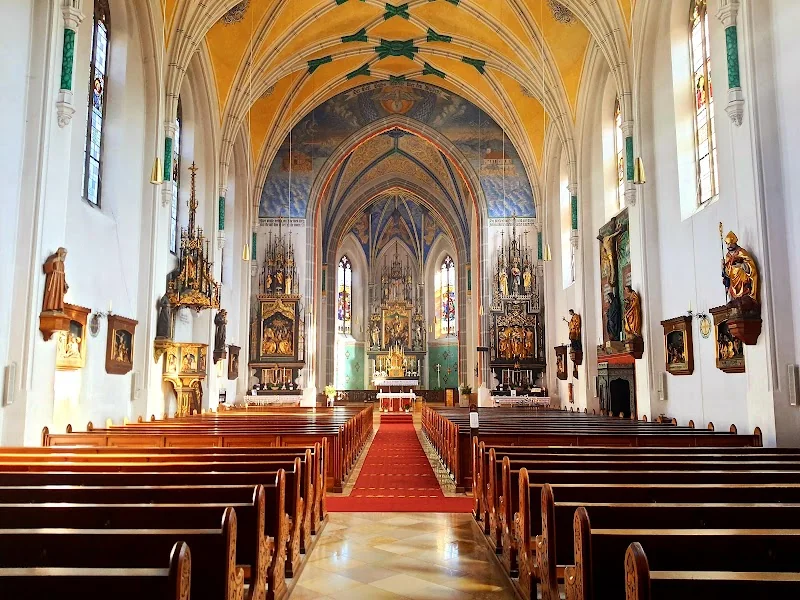
The current appearance of the Parish Church St. Nicholas Übersee dates back to the new building from 1902 to 1904. The community and the official tourism site describe the building as neo-Gothic and emphasize that with its 50 meters in length and its towering shape, it represents a significant architectural achievement. The plans were created by the Munich architect Elsner. Particularly striking is the material effect of the building: it is a brick construction that deliberately unfolds a strong presence in the Chiemgau landscape. The church was not meant to be inconspicuous but to form a representative counter-design to the older baroque church. At the same time, it is strongly symbolically charged in content. The official description highlights the painting, whose symbolic representations have a local touch. This is exactly what makes the church so exciting inside: it is not just a space for prayer but a consciously designed pictorial space where the artistic language of neo-Gothic is combined with local characteristics. The altars were created in the neo-Gothic style. Additionally, the Stations of the Cross are expressly mentioned in the official description. The result is an interior that exemplarily showcases the church architecture of the early 20th century while working with a local, almost homegrown visual language. For visitors, this results in a very harmonious overall picture: outside the striking building, inside a carefully designed, religiously interpretable, and art-historically interesting spatial language. ([uebersee.com](https://www.uebersee.com/freizeit-tourismus/sehenswuerdigkeiten/kirchen-und-kapellen))
The official church page also shows that the interior encompasses much more than just altar and nave. The exterior view, the entrance portal, the interior view, a station of the cross, the neo-Gothic pulpit, the left and right side altars, the high altar, the patron figure, a memorial painting above the high altar, the interior view from the altar, and the weekday chapel are documented separately. Additionally, the Siemann organ is highlighted as a visual motif and thus as a valuable feature. This enumeration makes it clear that the church has a rich inventory of liturgical and artistic elements. Even if not every detail is described in detail in the publicly visible texts, the structure of the official page clearly shows that the most important focal points of the interior are consciously presented. This also includes the remembrance of the builder Pastor Kreitlhuber, whose grave is documented on the church grounds. Such references are valuable because they do not allow the church to appear as an anonymous sacred space but as a grown site of a concrete parish community. For search terms related to furnishings, interior, Stations of the Cross, organ, and altars, this is particularly relevant: St. Nicholas Übersee is a neo-Gothic total work of art with community history, pictorial program, and liturgical function in one. Therefore, those visiting the building see not only a beautiful church but a carefully developed form of Catholic spatial design from around 1900. ([www2.erzbistum-muenchen.de](https://www2.erzbistum-muenchen.de/pfarrei/st-nikolaus-uebersee/pfarreiinfos/kirchen/cont/79168?utm_source=openai))
Directions, Location, and Parish Office
When approaching the Parish Church St. Nicholas Übersee, the clear address information from the official pages is particularly helpful. The church itself is listed at Dorfstraße 30, 83236 Übersee. The parish office belongs to the same parish but is located at Kirchweg 4a and is linked to a location plan via the Bavarian Atlas. This separation is helpful for visitors: it shows that the church is present as a sacred center on Dorfstraße while the administrative paths run through the parish office. The Archdiocese's website also points out that the parish office is accessible without barriers. This is a practical advantage that makes orientation on site easier. The contact page also lists the phone number, fax, and email address of the parish, making inquiries about services, church celebrations, or organizational details easy. So, those looking for directions, opening hours, or contact do not need to research for long. The structure is clear: church on Dorfstraße, parish office on Kirchweg, along with an official location plan as a digital guide. This combination is particularly useful for people coming to Übersee for the first time or who want to register for a celebration, a visit, or a church event. Instead of vague hints, there are concrete data and comprehensible contacts. This makes the information situation around the parish church very usable in everyday life. ([uebersee.com](https://www.uebersee.com/freizeit-tourismus/sehenswuerdigkeiten/kirchen-und-kapellen))
The opening hours of the parish office are also clearly stated and thus practically relevant for anyone wanting to contact the community. On Mondays, the office is open from 09:00 to 11:00 and additionally from 15:00 to 17:00. On Tuesdays, Wednesdays, and Fridays, the hours are from 09:00 to 11:00. It is closed on Thursdays, Saturdays, and holidays; during vacation times, Monday afternoons are also omitted. This information is important for visitors because the parish office is explicitly described as a central point of contact for initial inquiries. So, those with questions about the church, baptisms, weddings, services, or room usage will find the right place here. The parish also names the parish administrator, the administrative area, and other contacts, making the organizational side of the community very transparent. A simple piece of advice can be derived for practical visitor guidance: first note the address of the church, then use the parish office as a contact for details. This turns a pure Google search into a real visit plan. Especially for a church that is searched in several inquiries regarding directions, opening hours, and contact, this clear structure is important. It saves detours and shows that the parish community focuses on visitor friendliness and reliability. ([www2.erzbistum-muenchen.de](https://www2.erzbistum-muenchen.de/pfarrei/st-nikolaus-uebersee/pfarrbuero))
Parish Hall and Church Life in Übersee
The Parish Church St. Nicholas Übersee includes not only the church building itself but also a vibrant environment of parish hall, groups, and community work. The parish hall is located at Kirchweg 4a, not far from the parish office and opposite the primary and secondary school. According to the official description, it has a larger and a smaller hall, which can be combined into a large room if needed. A fully equipped kitchen is also part of the facilities. Additionally, the parish hall houses group rooms for the youth meeting and the parent-child group. This is important for the perception of the entire parish church because it shows that church life in Übersee is not limited to services. The church rather forms the center of a small pastoral network with rooms, groups, and regular meetings. So, those looking for events, community life, or church spaces will find not only a beautiful church but also a functioning infrastructure. The use of the parish hall for events is also provided, but only in consultation with the parish office. This makes it clear: the community thinks of its buildings as a cohesive ensemble of liturgy, education, and encounter. This is exactly what makes the search for the parish hall, church, and parish office in Übersee so closely connected. ([www2.erzbistum-muenchen.de](https://www2.erzbistum-muenchen.de/pfarrei/st-nikolaus-uebersee/pfarreiinfos/pfarrheim))
The church life is also made visible through further official content. The homepage of the parish not only shows the service schedule and the parish office but also the areas of readings and gospels, pastoral team, and prayer intentions online. Current announcements, such as the election of the parish council, the World Day of Prayer, or confirmation preparations, are also included. The church choir of the parish rehearses every Monday at 20:00 in the Catholic parish hall, and new faces are explicitly welcome. Such details are crucial for the impact of the parish church because they demonstrate an active community life. The church is thus not a silent museum but a place where people regularly come together, sing, pray, plan, and celebrate. Even digital elements such as the bell ringing provided as MP3 or the ringing schedule as PDF emphasize how consciously the parish connects tradition and modern accessibility. For visitors, this creates a coherent picture: St. Nicholas Übersee is not only architecturally remarkable but also a center of lived Catholic community. This connection of architectural culture, liturgy, and everyday community work makes the place so interesting. Therefore, those visiting the church experience not only a historical building but a lively parish that knows its history and translates it into the present. ([erzbistum-muenchen.de](https://www.erzbistum-muenchen.de/pfarrei/st-nikolaus-uebersee/aktuell))
Patronage, Visiting Hours, and Practical Orientation
When considering the Parish Church St. Nicholas Übersee as a whole, it quickly becomes clear why it performs so well in search queries about history, services, directions, and photos. It combines the character of a local church with the claim of a striking landmark. The patronage on December 6 commemorates the patron saint St. Nicholas and anchors the church in the church year. The neo-Gothic architecture, the symbolic painting, the altars, and the Stations of the Cross give it a strong visual presence. At the same time, the parish office, service schedule, and parish hall ensure that the church can not only be viewed but also used. When thinking of Übersee, this church represents orientation in the village, religious tradition, and a piece of lived community. Therefore, it is worthwhile to look at three simple points for a visit: the address of the church at Dorfstraße 30, the opening hours of the parish office at Kirchweg 4a, and the continuously updated service schedule of the parish. Those who consider these three levels together will gain a very good first impression of what St. Nicholas Übersee is all about. The church has grown historically, is architecturally clearly readable, and is well connected organizationally. That is why it remains significant for both locals and guests alike. ([www2.erzbistum-muenchen.de](https://www2.erzbistum-muenchen.de/pfarrei/st-nikolaus-uebersee/pfarreiinfos/kirchen/cont/79168?utm_source=openai))
Sources:
- Archdiocese of Munich and Freising - Parish Information St. Nicholas Übersee ([erzbistum-muenchen.de](https://www.erzbistum-muenchen.de/pfarrei/st-nikolaus-uebersee/pfarreiinfos))
- Community Übersee - Churches and Chapels ([uebersee.com](https://www.uebersee.com/freizeit-tourismus/sehenswuerdigkeiten/kirchen-und-kapellen))
- Archdiocese of Munich and Freising - Parish Office ([www2.erzbistum-muenchen.de](https://www2.erzbistum-muenchen.de/pfarrei/st-nikolaus-uebersee/pfarrbuero))
- Archdiocese of Munich and Freising - Services ([erzbistum-muenchen.de](https://www.erzbistum-muenchen.de/pfarrei/st-nikolaus-uebersee/gottesdienst?utm_source=openai))
- Archdiocese of Munich and Freising - Parish Hall St. Nicholas ([www2.erzbistum-muenchen.de](https://www2.erzbistum-muenchen.de/pfarrei/st-nikolaus-uebersee/pfarrheim))
- Archdiocese of Munich and Freising - Parish Church St. Nicholas ([www2.erzbistum-muenchen.de](https://www2.erzbistum-muenchen.de/pfarrei/st-nikolaus-uebersee/pfarreiinfos/kirchen/cont/79168?utm_source=openai))
Show moreShow less
Parish Church St. Nicholas Übersee | Services & History
The Parish Church St. Nicholas Übersee is much more than a sacred building with a well-known address. It is a defining landmark of the community, a point of orientation in the village landscape, and a place where history, faith, and community life closely intertwine. Official pages of the parish and the community describe it as a neo-Gothic church, which can be seen from afar in the silhouette of the village and is therefore also referred to as the Cathedral of the Achental. Those who come to Übersee encounter not only a house of worship but also a structure that visibly carries the identity of the place. The church is located at Dorfstraße 30, while the parish organizes its administrative tasks through the parish office at Kirchweg 4a. This includes the service schedule, current notices, and further information about parish life. This blend of striking architecture, long history, and vibrant community work makes the Parish Church St. Nicholas equally exciting for visitors, believers, and culture enthusiasts. ([uebersee.com](https://www.uebersee.com/freizeit-tourismus/sehenswuerdigkeiten/kirchen-und-kapellen))
Service Schedule and Current Dates
Those who want to get to know the Parish Church St. Nicholas Übersee from a practical perspective should start with the official service schedule. The parish provides a dedicated page where masses, vespers, devotions, and prayers are continuously published. There, not only individual dates can be found, but also information about changes, additional celebrations, and the option to download service schedules. This is particularly helpful for visitors, as the liturgical everyday life of an active parish cannot be squeezed into a rigid framework. Instead, the website presents a lively community life with regularly maintained information and a clear recommendation to clarify changes directly through the parish office if in doubt. Thus, the church is not only a historical monument but also a place where the Catholic community continues to gather reliably today. The feast day is also firmly anchored: St. Nicholas has his feast day on December 6. This date is an important anchor for the church year of the parish and shows that the church, despite its historical depth, remains strongly anchored in the annual cycle of the community. The official page also makes it clear that digital access to the liturgy is taken seriously. So, those searching for the parish church will find not only architecture but also a functioning, up-to-date information channel for services and community dates. ([erzbistum-muenchen.de](https://www.erzbistum-muenchen.de/pfarrei/st-nikolaus-uebersee/gottesdienst?utm_source=openai))
For inquiries regarding services, service schedules, and current dates, it is also important that the parish of Übersee uses its website as a central information platform. The homepage clearly displays tiles for service schedules, readings and gospels, pastoral team, prayer intentions online, and parish office. This is supplemented by current news from the parish, such as the election of a new parish council, the World Day of Prayer, confirmation preparations, or special liturgical occasions. Such content shows that St. Nicholas is not just a church to look at but a place with a genuine community function. Even though specific dates may change, the structure remains the same for visitors and locals: those looking for mass, devotion, or special celebrations will find the current information on the official parish page. This is especially important because occasions and times can shift depending on the church year and community situation. For SEO logic, this topic should therefore be placed at the top, as many users are not only searching for the building but for immediate access to service times, feast days, and the next practical steps. The Parish Church St. Nicholas Übersee meets this need through clear digital information that connects directly with real community life. ([erzbistum-muenchen.de](https://www.erzbistum-muenchen.de/pfarrei/st-nikolaus-uebersee))
History of the Parish Church St. Nicholas
The history of the Parish Church St. Nicholas Übersee begins long before the building visible today. According to the official records of the Archdiocese, the place Übersee already appears in a Salzburg document from the late 8th century; even then, there was a small church that was probably dedicated to Saint Nicholas. Ecclesiastically, the place initially belonged to Grassau and thus to the Archdiocese of Salzburg. It was only with the founding of the Diocese of Chiemsee in 1216 that the ecclesiastical structures changed. A significant turning point came in 1485 when a All Souls Brotherhood was established in Übersee, which allowed for a clergyman to be employed on site. This meant that the place was better provided for pastorally, especially since it was often cut off from its mother parish due to frequent flooding. These early dates show that the location of the current church has emerged from a long religious tradition. Even then, the care of the population, the distance to the parish base, and the question of a viable church were at the forefront. The history of the parish church is therefore not just a building history but also a local history. It tells how a village gradually developed into an independent parish between water, agriculture, ecclesiastical administration, and a growing self-understanding. For this reason, the church is still more than just a beautiful building today: it stands for centuries-old continuity that extends to the present in Übersee. ([erzbistum-muenchen.de](https://www.erzbistum-muenchen.de/pfarrei/st-nikolaus-uebersee/pfarreiinfos))
In the 18th century, the predecessor church was replaced by a baroque church with an onion dome. According to official texts, Pastor Wolfgang Pauliel was responsible for Übersee between 1715 and 1745 and is considered the builder of this second historically verifiable church. The house of worship remained known to many Überseers through images for a long time before it had to make way for the new building in 1902. Another important step was marked in 1818: Übersee was separated from Grassau and elevated to an independent parish. This completed the development towards an independent ecclesiastical structure, even though the old parish house was later replaced and restored in 2002. From 1866, especially under Pastor Joseph Probst, the question of a new building became more pressing. The old baroque church had become dilapidated, and various new building ideas, including Romanesque or Renaissance designs, could not prevail. It was not until 1902 that the decision for the current new building was implemented. The construction of the current church was therefore not a spontaneous modernization but the result of long planning, debates, and the financial willingness of the population to sacrifice. This patient development makes the current Parish Church St. Nicholas Übersee historically so interesting: it connects early medieval roots, baroque predecessor buildings, the independence of the parish, and the architectural decision of the early 20th century into a coherent local history. ([erzbistum-muenchen.de](https://www.erzbistum-muenchen.de/pfarrei/st-nikolaus-uebersee/pfarreiinfos))
Neo-Gothic Architecture, Altars, and Interior
The current appearance of the Parish Church St. Nicholas Übersee dates back to the new building from 1902 to 1904. The community and the official tourism site describe the building as neo-Gothic and emphasize that with its 50 meters in length and its towering shape, it represents a significant architectural achievement. The plans were created by the Munich architect Elsner. Particularly striking is the material effect of the building: it is a brick construction that deliberately unfolds a strong presence in the Chiemgau landscape. The church was not meant to be inconspicuous but to form a representative counter-design to the older baroque church. At the same time, it is strongly symbolically charged in content. The official description highlights the painting, whose symbolic representations have a local touch. This is exactly what makes the church so exciting inside: it is not just a space for prayer but a consciously designed pictorial space where the artistic language of neo-Gothic is combined with local characteristics. The altars were created in the neo-Gothic style. Additionally, the Stations of the Cross are expressly mentioned in the official description. The result is an interior that exemplarily showcases the church architecture of the early 20th century while working with a local, almost homegrown visual language. For visitors, this results in a very harmonious overall picture: outside the striking building, inside a carefully designed, religiously interpretable, and art-historically interesting spatial language. ([uebersee.com](https://www.uebersee.com/freizeit-tourismus/sehenswuerdigkeiten/kirchen-und-kapellen))
The official church page also shows that the interior encompasses much more than just altar and nave. The exterior view, the entrance portal, the interior view, a station of the cross, the neo-Gothic pulpit, the left and right side altars, the high altar, the patron figure, a memorial painting above the high altar, the interior view from the altar, and the weekday chapel are documented separately. Additionally, the Siemann organ is highlighted as a visual motif and thus as a valuable feature. This enumeration makes it clear that the church has a rich inventory of liturgical and artistic elements. Even if not every detail is described in detail in the publicly visible texts, the structure of the official page clearly shows that the most important focal points of the interior are consciously presented. This also includes the remembrance of the builder Pastor Kreitlhuber, whose grave is documented on the church grounds. Such references are valuable because they do not allow the church to appear as an anonymous sacred space but as a grown site of a concrete parish community. For search terms related to furnishings, interior, Stations of the Cross, organ, and altars, this is particularly relevant: St. Nicholas Übersee is a neo-Gothic total work of art with community history, pictorial program, and liturgical function in one. Therefore, those visiting the building see not only a beautiful church but a carefully developed form of Catholic spatial design from around 1900. ([www2.erzbistum-muenchen.de](https://www2.erzbistum-muenchen.de/pfarrei/st-nikolaus-uebersee/pfarreiinfos/kirchen/cont/79168?utm_source=openai))
Directions, Location, and Parish Office
When approaching the Parish Church St. Nicholas Übersee, the clear address information from the official pages is particularly helpful. The church itself is listed at Dorfstraße 30, 83236 Übersee. The parish office belongs to the same parish but is located at Kirchweg 4a and is linked to a location plan via the Bavarian Atlas. This separation is helpful for visitors: it shows that the church is present as a sacred center on Dorfstraße while the administrative paths run through the parish office. The Archdiocese's website also points out that the parish office is accessible without barriers. This is a practical advantage that makes orientation on site easier. The contact page also lists the phone number, fax, and email address of the parish, making inquiries about services, church celebrations, or organizational details easy. So, those looking for directions, opening hours, or contact do not need to research for long. The structure is clear: church on Dorfstraße, parish office on Kirchweg, along with an official location plan as a digital guide. This combination is particularly useful for people coming to Übersee for the first time or who want to register for a celebration, a visit, or a church event. Instead of vague hints, there are concrete data and comprehensible contacts. This makes the information situation around the parish church very usable in everyday life. ([uebersee.com](https://www.uebersee.com/freizeit-tourismus/sehenswuerdigkeiten/kirchen-und-kapellen))
The opening hours of the parish office are also clearly stated and thus practically relevant for anyone wanting to contact the community. On Mondays, the office is open from 09:00 to 11:00 and additionally from 15:00 to 17:00. On Tuesdays, Wednesdays, and Fridays, the hours are from 09:00 to 11:00. It is closed on Thursdays, Saturdays, and holidays; during vacation times, Monday afternoons are also omitted. This information is important for visitors because the parish office is explicitly described as a central point of contact for initial inquiries. So, those with questions about the church, baptisms, weddings, services, or room usage will find the right place here. The parish also names the parish administrator, the administrative area, and other contacts, making the organizational side of the community very transparent. A simple piece of advice can be derived for practical visitor guidance: first note the address of the church, then use the parish office as a contact for details. This turns a pure Google search into a real visit plan. Especially for a church that is searched in several inquiries regarding directions, opening hours, and contact, this clear structure is important. It saves detours and shows that the parish community focuses on visitor friendliness and reliability. ([www2.erzbistum-muenchen.de](https://www2.erzbistum-muenchen.de/pfarrei/st-nikolaus-uebersee/pfarrbuero))
Parish Hall and Church Life in Übersee
The Parish Church St. Nicholas Übersee includes not only the church building itself but also a vibrant environment of parish hall, groups, and community work. The parish hall is located at Kirchweg 4a, not far from the parish office and opposite the primary and secondary school. According to the official description, it has a larger and a smaller hall, which can be combined into a large room if needed. A fully equipped kitchen is also part of the facilities. Additionally, the parish hall houses group rooms for the youth meeting and the parent-child group. This is important for the perception of the entire parish church because it shows that church life in Übersee is not limited to services. The church rather forms the center of a small pastoral network with rooms, groups, and regular meetings. So, those looking for events, community life, or church spaces will find not only a beautiful church but also a functioning infrastructure. The use of the parish hall for events is also provided, but only in consultation with the parish office. This makes it clear: the community thinks of its buildings as a cohesive ensemble of liturgy, education, and encounter. This is exactly what makes the search for the parish hall, church, and parish office in Übersee so closely connected. ([www2.erzbistum-muenchen.de](https://www2.erzbistum-muenchen.de/pfarrei/st-nikolaus-uebersee/pfarreiinfos/pfarrheim))
The church life is also made visible through further official content. The homepage of the parish not only shows the service schedule and the parish office but also the areas of readings and gospels, pastoral team, and prayer intentions online. Current announcements, such as the election of the parish council, the World Day of Prayer, or confirmation preparations, are also included. The church choir of the parish rehearses every Monday at 20:00 in the Catholic parish hall, and new faces are explicitly welcome. Such details are crucial for the impact of the parish church because they demonstrate an active community life. The church is thus not a silent museum but a place where people regularly come together, sing, pray, plan, and celebrate. Even digital elements such as the bell ringing provided as MP3 or the ringing schedule as PDF emphasize how consciously the parish connects tradition and modern accessibility. For visitors, this creates a coherent picture: St. Nicholas Übersee is not only architecturally remarkable but also a center of lived Catholic community. This connection of architectural culture, liturgy, and everyday community work makes the place so interesting. Therefore, those visiting the church experience not only a historical building but a lively parish that knows its history and translates it into the present. ([erzbistum-muenchen.de](https://www.erzbistum-muenchen.de/pfarrei/st-nikolaus-uebersee/aktuell))
Patronage, Visiting Hours, and Practical Orientation
When considering the Parish Church St. Nicholas Übersee as a whole, it quickly becomes clear why it performs so well in search queries about history, services, directions, and photos. It combines the character of a local church with the claim of a striking landmark. The patronage on December 6 commemorates the patron saint St. Nicholas and anchors the church in the church year. The neo-Gothic architecture, the symbolic painting, the altars, and the Stations of the Cross give it a strong visual presence. At the same time, the parish office, service schedule, and parish hall ensure that the church can not only be viewed but also used. When thinking of Übersee, this church represents orientation in the village, religious tradition, and a piece of lived community. Therefore, it is worthwhile to look at three simple points for a visit: the address of the church at Dorfstraße 30, the opening hours of the parish office at Kirchweg 4a, and the continuously updated service schedule of the parish. Those who consider these three levels together will gain a very good first impression of what St. Nicholas Übersee is all about. The church has grown historically, is architecturally clearly readable, and is well connected organizationally. That is why it remains significant for both locals and guests alike. ([www2.erzbistum-muenchen.de](https://www2.erzbistum-muenchen.de/pfarrei/st-nikolaus-uebersee/pfarreiinfos/kirchen/cont/79168?utm_source=openai))
Sources:
- Archdiocese of Munich and Freising - Parish Information St. Nicholas Übersee ([erzbistum-muenchen.de](https://www.erzbistum-muenchen.de/pfarrei/st-nikolaus-uebersee/pfarreiinfos))
- Community Übersee - Churches and Chapels ([uebersee.com](https://www.uebersee.com/freizeit-tourismus/sehenswuerdigkeiten/kirchen-und-kapellen))
- Archdiocese of Munich and Freising - Parish Office ([www2.erzbistum-muenchen.de](https://www2.erzbistum-muenchen.de/pfarrei/st-nikolaus-uebersee/pfarrbuero))
- Archdiocese of Munich and Freising - Services ([erzbistum-muenchen.de](https://www.erzbistum-muenchen.de/pfarrei/st-nikolaus-uebersee/gottesdienst?utm_source=openai))
- Archdiocese of Munich and Freising - Parish Hall St. Nicholas ([www2.erzbistum-muenchen.de](https://www2.erzbistum-muenchen.de/pfarrei/st-nikolaus-uebersee/pfarrheim))
- Archdiocese of Munich and Freising - Parish Church St. Nicholas ([www2.erzbistum-muenchen.de](https://www2.erzbistum-muenchen.de/pfarrei/st-nikolaus-uebersee/pfarreiinfos/kirchen/cont/79168?utm_source=openai))
Parish Church St. Nicholas Übersee | Services & History
The Parish Church St. Nicholas Übersee is much more than a sacred building with a well-known address. It is a defining landmark of the community, a point of orientation in the village landscape, and a place where history, faith, and community life closely intertwine. Official pages of the parish and the community describe it as a neo-Gothic church, which can be seen from afar in the silhouette of the village and is therefore also referred to as the Cathedral of the Achental. Those who come to Übersee encounter not only a house of worship but also a structure that visibly carries the identity of the place. The church is located at Dorfstraße 30, while the parish organizes its administrative tasks through the parish office at Kirchweg 4a. This includes the service schedule, current notices, and further information about parish life. This blend of striking architecture, long history, and vibrant community work makes the Parish Church St. Nicholas equally exciting for visitors, believers, and culture enthusiasts. ([uebersee.com](https://www.uebersee.com/freizeit-tourismus/sehenswuerdigkeiten/kirchen-und-kapellen))
Service Schedule and Current Dates
Those who want to get to know the Parish Church St. Nicholas Übersee from a practical perspective should start with the official service schedule. The parish provides a dedicated page where masses, vespers, devotions, and prayers are continuously published. There, not only individual dates can be found, but also information about changes, additional celebrations, and the option to download service schedules. This is particularly helpful for visitors, as the liturgical everyday life of an active parish cannot be squeezed into a rigid framework. Instead, the website presents a lively community life with regularly maintained information and a clear recommendation to clarify changes directly through the parish office if in doubt. Thus, the church is not only a historical monument but also a place where the Catholic community continues to gather reliably today. The feast day is also firmly anchored: St. Nicholas has his feast day on December 6. This date is an important anchor for the church year of the parish and shows that the church, despite its historical depth, remains strongly anchored in the annual cycle of the community. The official page also makes it clear that digital access to the liturgy is taken seriously. So, those searching for the parish church will find not only architecture but also a functioning, up-to-date information channel for services and community dates. ([erzbistum-muenchen.de](https://www.erzbistum-muenchen.de/pfarrei/st-nikolaus-uebersee/gottesdienst?utm_source=openai))
For inquiries regarding services, service schedules, and current dates, it is also important that the parish of Übersee uses its website as a central information platform. The homepage clearly displays tiles for service schedules, readings and gospels, pastoral team, prayer intentions online, and parish office. This is supplemented by current news from the parish, such as the election of a new parish council, the World Day of Prayer, confirmation preparations, or special liturgical occasions. Such content shows that St. Nicholas is not just a church to look at but a place with a genuine community function. Even though specific dates may change, the structure remains the same for visitors and locals: those looking for mass, devotion, or special celebrations will find the current information on the official parish page. This is especially important because occasions and times can shift depending on the church year and community situation. For SEO logic, this topic should therefore be placed at the top, as many users are not only searching for the building but for immediate access to service times, feast days, and the next practical steps. The Parish Church St. Nicholas Übersee meets this need through clear digital information that connects directly with real community life. ([erzbistum-muenchen.de](https://www.erzbistum-muenchen.de/pfarrei/st-nikolaus-uebersee))
History of the Parish Church St. Nicholas
The history of the Parish Church St. Nicholas Übersee begins long before the building visible today. According to the official records of the Archdiocese, the place Übersee already appears in a Salzburg document from the late 8th century; even then, there was a small church that was probably dedicated to Saint Nicholas. Ecclesiastically, the place initially belonged to Grassau and thus to the Archdiocese of Salzburg. It was only with the founding of the Diocese of Chiemsee in 1216 that the ecclesiastical structures changed. A significant turning point came in 1485 when a All Souls Brotherhood was established in Übersee, which allowed for a clergyman to be employed on site. This meant that the place was better provided for pastorally, especially since it was often cut off from its mother parish due to frequent flooding. These early dates show that the location of the current church has emerged from a long religious tradition. Even then, the care of the population, the distance to the parish base, and the question of a viable church were at the forefront. The history of the parish church is therefore not just a building history but also a local history. It tells how a village gradually developed into an independent parish between water, agriculture, ecclesiastical administration, and a growing self-understanding. For this reason, the church is still more than just a beautiful building today: it stands for centuries-old continuity that extends to the present in Übersee. ([erzbistum-muenchen.de](https://www.erzbistum-muenchen.de/pfarrei/st-nikolaus-uebersee/pfarreiinfos))
In the 18th century, the predecessor church was replaced by a baroque church with an onion dome. According to official texts, Pastor Wolfgang Pauliel was responsible for Übersee between 1715 and 1745 and is considered the builder of this second historically verifiable church. The house of worship remained known to many Überseers through images for a long time before it had to make way for the new building in 1902. Another important step was marked in 1818: Übersee was separated from Grassau and elevated to an independent parish. This completed the development towards an independent ecclesiastical structure, even though the old parish house was later replaced and restored in 2002. From 1866, especially under Pastor Joseph Probst, the question of a new building became more pressing. The old baroque church had become dilapidated, and various new building ideas, including Romanesque or Renaissance designs, could not prevail. It was not until 1902 that the decision for the current new building was implemented. The construction of the current church was therefore not a spontaneous modernization but the result of long planning, debates, and the financial willingness of the population to sacrifice. This patient development makes the current Parish Church St. Nicholas Übersee historically so interesting: it connects early medieval roots, baroque predecessor buildings, the independence of the parish, and the architectural decision of the early 20th century into a coherent local history. ([erzbistum-muenchen.de](https://www.erzbistum-muenchen.de/pfarrei/st-nikolaus-uebersee/pfarreiinfos))
Neo-Gothic Architecture, Altars, and Interior
The current appearance of the Parish Church St. Nicholas Übersee dates back to the new building from 1902 to 1904. The community and the official tourism site describe the building as neo-Gothic and emphasize that with its 50 meters in length and its towering shape, it represents a significant architectural achievement. The plans were created by the Munich architect Elsner. Particularly striking is the material effect of the building: it is a brick construction that deliberately unfolds a strong presence in the Chiemgau landscape. The church was not meant to be inconspicuous but to form a representative counter-design to the older baroque church. At the same time, it is strongly symbolically charged in content. The official description highlights the painting, whose symbolic representations have a local touch. This is exactly what makes the church so exciting inside: it is not just a space for prayer but a consciously designed pictorial space where the artistic language of neo-Gothic is combined with local characteristics. The altars were created in the neo-Gothic style. Additionally, the Stations of the Cross are expressly mentioned in the official description. The result is an interior that exemplarily showcases the church architecture of the early 20th century while working with a local, almost homegrown visual language. For visitors, this results in a very harmonious overall picture: outside the striking building, inside a carefully designed, religiously interpretable, and art-historically interesting spatial language. ([uebersee.com](https://www.uebersee.com/freizeit-tourismus/sehenswuerdigkeiten/kirchen-und-kapellen))
The official church page also shows that the interior encompasses much more than just altar and nave. The exterior view, the entrance portal, the interior view, a station of the cross, the neo-Gothic pulpit, the left and right side altars, the high altar, the patron figure, a memorial painting above the high altar, the interior view from the altar, and the weekday chapel are documented separately. Additionally, the Siemann organ is highlighted as a visual motif and thus as a valuable feature. This enumeration makes it clear that the church has a rich inventory of liturgical and artistic elements. Even if not every detail is described in detail in the publicly visible texts, the structure of the official page clearly shows that the most important focal points of the interior are consciously presented. This also includes the remembrance of the builder Pastor Kreitlhuber, whose grave is documented on the church grounds. Such references are valuable because they do not allow the church to appear as an anonymous sacred space but as a grown site of a concrete parish community. For search terms related to furnishings, interior, Stations of the Cross, organ, and altars, this is particularly relevant: St. Nicholas Übersee is a neo-Gothic total work of art with community history, pictorial program, and liturgical function in one. Therefore, those visiting the building see not only a beautiful church but a carefully developed form of Catholic spatial design from around 1900. ([www2.erzbistum-muenchen.de](https://www2.erzbistum-muenchen.de/pfarrei/st-nikolaus-uebersee/pfarreiinfos/kirchen/cont/79168?utm_source=openai))
Directions, Location, and Parish Office
When approaching the Parish Church St. Nicholas Übersee, the clear address information from the official pages is particularly helpful. The church itself is listed at Dorfstraße 30, 83236 Übersee. The parish office belongs to the same parish but is located at Kirchweg 4a and is linked to a location plan via the Bavarian Atlas. This separation is helpful for visitors: it shows that the church is present as a sacred center on Dorfstraße while the administrative paths run through the parish office. The Archdiocese's website also points out that the parish office is accessible without barriers. This is a practical advantage that makes orientation on site easier. The contact page also lists the phone number, fax, and email address of the parish, making inquiries about services, church celebrations, or organizational details easy. So, those looking for directions, opening hours, or contact do not need to research for long. The structure is clear: church on Dorfstraße, parish office on Kirchweg, along with an official location plan as a digital guide. This combination is particularly useful for people coming to Übersee for the first time or who want to register for a celebration, a visit, or a church event. Instead of vague hints, there are concrete data and comprehensible contacts. This makes the information situation around the parish church very usable in everyday life. ([uebersee.com](https://www.uebersee.com/freizeit-tourismus/sehenswuerdigkeiten/kirchen-und-kapellen))
The opening hours of the parish office are also clearly stated and thus practically relevant for anyone wanting to contact the community. On Mondays, the office is open from 09:00 to 11:00 and additionally from 15:00 to 17:00. On Tuesdays, Wednesdays, and Fridays, the hours are from 09:00 to 11:00. It is closed on Thursdays, Saturdays, and holidays; during vacation times, Monday afternoons are also omitted. This information is important for visitors because the parish office is explicitly described as a central point of contact for initial inquiries. So, those with questions about the church, baptisms, weddings, services, or room usage will find the right place here. The parish also names the parish administrator, the administrative area, and other contacts, making the organizational side of the community very transparent. A simple piece of advice can be derived for practical visitor guidance: first note the address of the church, then use the parish office as a contact for details. This turns a pure Google search into a real visit plan. Especially for a church that is searched in several inquiries regarding directions, opening hours, and contact, this clear structure is important. It saves detours and shows that the parish community focuses on visitor friendliness and reliability. ([www2.erzbistum-muenchen.de](https://www2.erzbistum-muenchen.de/pfarrei/st-nikolaus-uebersee/pfarrbuero))
Parish Hall and Church Life in Übersee
The Parish Church St. Nicholas Übersee includes not only the church building itself but also a vibrant environment of parish hall, groups, and community work. The parish hall is located at Kirchweg 4a, not far from the parish office and opposite the primary and secondary school. According to the official description, it has a larger and a smaller hall, which can be combined into a large room if needed. A fully equipped kitchen is also part of the facilities. Additionally, the parish hall houses group rooms for the youth meeting and the parent-child group. This is important for the perception of the entire parish church because it shows that church life in Übersee is not limited to services. The church rather forms the center of a small pastoral network with rooms, groups, and regular meetings. So, those looking for events, community life, or church spaces will find not only a beautiful church but also a functioning infrastructure. The use of the parish hall for events is also provided, but only in consultation with the parish office. This makes it clear: the community thinks of its buildings as a cohesive ensemble of liturgy, education, and encounter. This is exactly what makes the search for the parish hall, church, and parish office in Übersee so closely connected. ([www2.erzbistum-muenchen.de](https://www2.erzbistum-muenchen.de/pfarrei/st-nikolaus-uebersee/pfarreiinfos/pfarrheim))
The church life is also made visible through further official content. The homepage of the parish not only shows the service schedule and the parish office but also the areas of readings and gospels, pastoral team, and prayer intentions online. Current announcements, such as the election of the parish council, the World Day of Prayer, or confirmation preparations, are also included. The church choir of the parish rehearses every Monday at 20:00 in the Catholic parish hall, and new faces are explicitly welcome. Such details are crucial for the impact of the parish church because they demonstrate an active community life. The church is thus not a silent museum but a place where people regularly come together, sing, pray, plan, and celebrate. Even digital elements such as the bell ringing provided as MP3 or the ringing schedule as PDF emphasize how consciously the parish connects tradition and modern accessibility. For visitors, this creates a coherent picture: St. Nicholas Übersee is not only architecturally remarkable but also a center of lived Catholic community. This connection of architectural culture, liturgy, and everyday community work makes the place so interesting. Therefore, those visiting the church experience not only a historical building but a lively parish that knows its history and translates it into the present. ([erzbistum-muenchen.de](https://www.erzbistum-muenchen.de/pfarrei/st-nikolaus-uebersee/aktuell))
Patronage, Visiting Hours, and Practical Orientation
When considering the Parish Church St. Nicholas Übersee as a whole, it quickly becomes clear why it performs so well in search queries about history, services, directions, and photos. It combines the character of a local church with the claim of a striking landmark. The patronage on December 6 commemorates the patron saint St. Nicholas and anchors the church in the church year. The neo-Gothic architecture, the symbolic painting, the altars, and the Stations of the Cross give it a strong visual presence. At the same time, the parish office, service schedule, and parish hall ensure that the church can not only be viewed but also used. When thinking of Übersee, this church represents orientation in the village, religious tradition, and a piece of lived community. Therefore, it is worthwhile to look at three simple points for a visit: the address of the church at Dorfstraße 30, the opening hours of the parish office at Kirchweg 4a, and the continuously updated service schedule of the parish. Those who consider these three levels together will gain a very good first impression of what St. Nicholas Übersee is all about. The church has grown historically, is architecturally clearly readable, and is well connected organizationally. That is why it remains significant for both locals and guests alike. ([www2.erzbistum-muenchen.de](https://www2.erzbistum-muenchen.de/pfarrei/st-nikolaus-uebersee/pfarreiinfos/kirchen/cont/79168?utm_source=openai))
Sources:
- Archdiocese of Munich and Freising - Parish Information St. Nicholas Übersee ([erzbistum-muenchen.de](https://www.erzbistum-muenchen.de/pfarrei/st-nikolaus-uebersee/pfarreiinfos))
- Community Übersee - Churches and Chapels ([uebersee.com](https://www.uebersee.com/freizeit-tourismus/sehenswuerdigkeiten/kirchen-und-kapellen))
- Archdiocese of Munich and Freising - Parish Office ([www2.erzbistum-muenchen.de](https://www2.erzbistum-muenchen.de/pfarrei/st-nikolaus-uebersee/pfarrbuero))
- Archdiocese of Munich and Freising - Services ([erzbistum-muenchen.de](https://www.erzbistum-muenchen.de/pfarrei/st-nikolaus-uebersee/gottesdienst?utm_source=openai))
- Archdiocese of Munich and Freising - Parish Hall St. Nicholas ([www2.erzbistum-muenchen.de](https://www2.erzbistum-muenchen.de/pfarrei/st-nikolaus-uebersee/pfarrheim))
- Archdiocese of Munich and Freising - Parish Church St. Nicholas ([www2.erzbistum-muenchen.de](https://www2.erzbistum-muenchen.de/pfarrei/st-nikolaus-uebersee/pfarreiinfos/kirchen/cont/79168?utm_source=openai))
Upcoming Events
No events found
Frequently Asked Questions
Reviews
AnJa Mack
20. May 2024
Just opposite the church you can park. What a stunning church. From the outside and inside. So peaceful and really well taken care of. Enjoyed just sitting there and praying to SEL. Irmengard is very well known in the Chiemgau area.
Dietmar Wuttke
6. September 2020
A beautiful brick church on the edge of Lake Chiemsee. Even from afar, this red church is visible, and it radiates calmness and contemplation. Surrounded by beautiful church art, you can let your senses wander and sink into a prayer.
TRK Füssi
18. June 2021
A really beautiful church and very special for this region.
Ulrich Mack
12. September 2023
The 10-year anniversary concert of CMC - Collegia Musica Chiemgau e.V. 2013 and 2023 in Übersee, St. Nikolaus, 17:00, which I noticed on fb, drew my sister and me to the beautiful red Catholic church with sunlight streaming onto the altars and orchestra for the first time. Other attendees headed straight to the nearby Gasthof Hinterwirt, which we also liked with its Lüftlmalerei and full garden.
Marco R.
24. August 2021
Very nicely decorated church. Not overloaded or excessively gold-plated. Great organ, impressive. Everything fits together well here, very worth seeing.