
Aschau im Chiemgau
Kirchstraße 15, 83229 Aschau im Chiemgau-Sachrang, Deutschland
Parish Church St. Michael | Photos & History
The Parish Church St. Michael in Sachrang is one of those places where inquiries about photos, reviews, history, directions, or parking quickly lead to something bigger: a historic ensemble that not only looks beautiful but also possesses a strong atmosphere. The first impression is special because the church does not stand isolated but lies within the historic village cemetery, thus closely connected to the developed village image of Sachrang. Official tourism and church websites show pictures, mention the key dates, and make it clear that this is about much more than just a pretty church motif. Those who visit St. Michael experience a baroque country church with remarkable furnishings, a long construction history, and an environment that is typical for the mountain climbing village of Sachrang: calm, rich in tradition, close to nature, and culturally dense. This very mix makes the church equally exciting for day visitors, hikers, culture enthusiasts, and people interested in sacred art. ([aschau.de](https://www.aschau.de/kirche-st-michael))
The location in Chiemgau, the connection to the village center, and the embedding in a historic cemetery ensure that St. Michael has a much stronger impact than many churches that can be reduced to just a facade or a tower. The view of the building already tells of the connection between history and quiet dignity that characterizes the place. That is precisely why it is worth considering the church not just as a sight but as a cultural whole: architecture, furnishings, cemetery, village, and landscape interconnect here. Those who inform themselves about photos in advance are often seeking answers to a larger question: What kind of place radiates so much historical depth and at the same time so much tranquility? The following sections provide a precise yet readable answer to that. ([aschau.de](https://www.aschau.de/kirche-st-michael))
Photos, Reviews, and the First Impression of the Parish Church St. Michael
Those searching for photos or reviews of the Parish Church St. Michael usually want to quickly assess whether a visit is worthwhile, how the church looks from the outside, and what atmosphere it conveys on-site. Here, Sachrang scores with a rare interplay of village architecture, cemetery, and baroque church. The official tourism site shows a whole series of images documenting the exterior view, portal, interior, altars, side altars, and other details. This not only creates a pretty visual impression but also a realistic picture of how much art-historical substance is contained in this building. The church is explicitly described there as one of the most impressive rural churches in the region, and this classification fits the experience on-site: small in scale but grand in expression and finesse. ([aschau.de](https://www.aschau.de/kirche-st-michael))
The first impression is so strong because St. Michael does not only impress with monumental size but also with unity, proportion, and surroundings. The historic village cemetery enhances the effect of the building because it frames the church and gives it a quiet, almost timeless character. Old grave crosses, the reference to the most famous Sachrang citizen Peter Hueber, known as Müllner-Peter, and the carefully preserved layout make the place an ensemble that invites more to linger than to quickly pass by. Those who primarily want to know from inquiries about reviews whether the church is authentic, impressive, and photogenic find a clear answer here: Yes, and not because of spectacular size but because of the rare cohesion of outdoor space, cemetery, and art. This overall picture is particularly convincing for visitors because it is immediately readable both visually and historically. ([aschau.de](https://www.aschau.de/kirche-st-michael))
From an SEO perspective, this very mix is interesting because the terms photos, reviews, and sights indicate a strong desire for information. People want not just an address but context. They want to know if the church fits into a walk, if it is suitable for a short detour, and if the image seen online corresponds to reality. In the case of St. Michael, this is indeed the case: the official images show a church that appears rather reserved in its external appearance but is surprisingly rich in detail. This makes it a typical search target for users who first come for images and then stay for history. This movement from a quick visual impression to a deeper cultural discovery is particularly pronounced in Sachrang. ([aschau.de](https://www.aschau.de/kirche-st-michael))
History and Construction Development from the Romanesque Predecessor Church to the Baroque Building
The history of the Parish Church St. Michael does not begin with the current baroque building but with a much older predecessor church. Sources mention that the church was already documented in 1400. When the condition of the older church was no longer sufficient in the 17th century, a new building became necessary. By 1685, the Romanesque predecessor church was considered dilapidated and too small. Subsequently, in 1687, the foundation stone for the new house of worship was laid, and the current baroque church was built in 1687/88. This chronological development is important because it explains why St. Michael appears so cohesive and at the same time so historically charged in its current form: the church is not a random new building but the conscious result of a cultural and religious new beginning. ([aschau.de](https://www.aschau.de/kirche-st-michael))
Particularly interesting is that several builders and artists were involved in the planning and execution. The official site names Wolfgang Steindlmüller as the master mason from Schlechtenberg near Aschau, who executed the construction in 1687/88 and had already created initial plans in 1685. Before construction began, Lorenzo Sciasca also made corrections to the church model, and in early 1696, the designs were further improved by an experienced builder from Salzburg, apparently Johann Caspar von Zuccalli. The tower is late Gothic up to the eaves height, and the upper structure was built in 1699. Thus, the building connects various construction phases without losing its unity. It is precisely this layering that makes St. Michael exciting for historically interested visitors because they can read from the building how sacred architecture has developed in a rural region. ([aschau.de](https://www.aschau.de/kirche-st-michael))
Additionally, there is the ecclesiastical status: according to the parish website, St. Michael was elevated to the status of a parish church in 1806. This is another important milestone, as it marks the development from a local sacred building to a church center of the place. In regional historiography, the church is also described as a gem of baroque architecture that serves as a monument to the Counts Preysing of Hohenaschau. Such formulations are not merely decorative words but refer to a real historical anchoring in the history of rule and culture of the Priental. Thus, those who visit the church today do not simply see a beautiful baroque building but a place where regional piety, noble patronage, and artisanal quality have condensed over centuries. ([chiemsee-alpenland.de](https://www.chiemsee-alpenland.de/entdecken/alle-sehenswuerdigkeiten/pfarrkirche-st.-michael-0fb45fb4cb))
Interior, Altars, and Artistic Furnishings
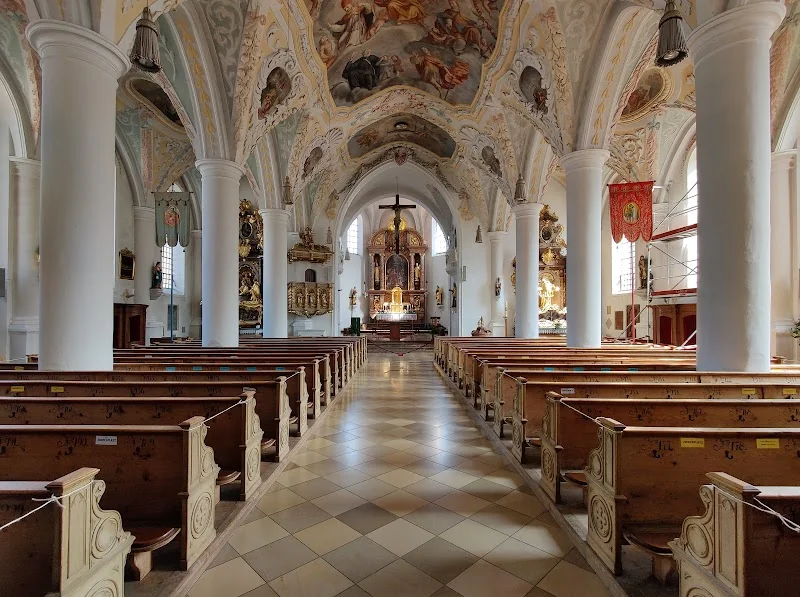
The interior of St. Michael is one of the main reasons why the church in Sachrang is so frequently searched with terms like photos, beauty, and uniqueness. The official description emphasizes two wooden galleries resting on Tuscan wooden columns. Particularly, the lower gallery dates from the time of construction and features a richly carved balustrade with five embedded paintings by Jacob Carnutsch from Prien. Even this detail shows how carefully the furnishings have been coordinated. The space does not appear overloaded but distinctly artistic: one recognizes a baroque discipline in form, combined with a high density of artisanal and artistic elements. The result is an interior that remains surprisingly lively despite its clear structure. ([aschau.de](https://www.aschau.de/kirche-st-michael))
The stucco also comes from great quality, as it is attributed to the brothers Pietro and Giulio Zuccali. The ceiling fresco in the choir, The Seven Holy Refugees, was created in 1768 by Simon Zaglacher as a renewal of an earlier depiction. The three altars were erected by Michael Furtner the Younger from Hohenaschau; the figurative sculpture comes from Carl Antretter from Neubeuern, and the altar paintings are works by Jacob Carnutsch and Joseph Eder. Thus, the interior is not a loose collection of individual artworks but a cohesive baroque program. It is precisely this unity of architecture, stucco, painting, and sculpture that makes the church so convincing and makes the historical evaluations in the sources plausible. ([aschau.de](https://www.aschau.de/kirche-st-michael))
For visitors looking for a hall plan, seating plan, or the best spots, a different question arises at a church than at a concert hall: Where can the spatial order be best grasped? Here, the view of the two galleries, the choir area, and the clear baroque structure helps. Those who take their time can read the church well from several angles because the furnishings do not obscure the space but structure it. The fact that in 1982 a folk altar, ambo, and sedilia were added by Josef Hamberger also shows that while the space has grown historically, it has been liturgically further developed. This connection between preservation and careful adaptation keeps the church alive today. It is not a museum in the narrow sense but a well-maintained, still-used church space with a clear artistic signature. ([aschau.de](https://www.aschau.de/kirche-st-michael))
Cemetery, Müllner-Peter, and the Quiet Atmosphere Around the Church
A central feature of the Parish Church St. Michael is its location in the historic village cemetery. This is not just a picturesque detail but shapes the entire perception of the place. The church wall, the cemetery space, the old grave markers, and the direct connection to the village make it clear that St. Michael has always been a place of remembrance. The official tourism description highlights this location, and the hiking site for the Sinnstifterweg describes the church as Station 6, thus as a place of farewell and remembrance. This gives the church visit an additional dimension: it is not only about architecture but also about how a community makes its history, its dead, and its faith visible in the village image. For many visitors, this is the moment when St. Michael has an emotionally strong impact. ([chiemsee-alpenland.de](https://www.chiemsee-alpenland.de/entdecken/alle-sehenswuerdigkeiten/pfarrkirche-st.-michael-0fb45fb4cb))
The cemetery also contains the grave of the famous Müllner-Peter, that is, Peter Hueber, who still plays an important cultural role in Sachrang. The sources also refer to a larger number of wrought-iron grave crosses from the 18th century, including some in rich Rococo forms. This shows that the cemetery itself is a memorial space and not just a functional accompanying place of the church. Those who walk slowly here experience a landscape of grave markers, old walls, and quiet sightlines that make the baroque church stand out even more. It is precisely this connection of art, transience, and local memory that makes the place so impressive for those interested in cultural history. ([aschau.de](https://www.aschau.de/station-6-friedhof-sachrang-kirche-st-michael))
For the search intentions for photos and reviews, this cemetery character is an important plus because it explains why many visitors find the atmosphere particularly impressive. The place does not appear superficially spectacular but quiet, concentrated, and dignified. This effect arises from the relationship between church and cemetery, from historical continuity, and from the fact that the ensemble has been preserved in the village center. When one visits the church with the right perspective, it quickly becomes clear: St. Michael is not just a building but a place of remembrance where the history of the place becomes almost physically tangible. This distinguishes the church from many other sights that, while pretty, are atmospherically interchangeable. Here, the atmosphere itself is part of the attraction. ([aschau.de](https://www.aschau.de/station-6-friedhof-sachrang-kirche-st-michael))
Location in the Mountain Climbing Village of Sachrang, Directions, and Parking
The Parish Church St. Michael is located in the mountain climbing village of Sachrang, which lies at an altitude of 738 meters in the Priental and is surrounded by Geigelstein and Spitzstein. The official tourism site describes Sachrang as a place with a view of the Zahmer Kaiser in Tyrol; at the same time, the baroque church St. Michael is highlighted as the most prominent building in the village. This is important for visitors because it clearly anchors the church in the landscape and village context. Those looking for directions or parking usually want to know how a visit can be combined with a walk, a small tour of the village, or a hike. Sachrang is particularly well-suited for this because the tourism sites present the place as a starting point for nature, culture, and hiking experiences. ([aschau.de](https://www.aschau.de/bergsteigerdoerfer-sachrang))
Regarding parking, the official hiking information provides hints about the hiking parking lot Sachrang/Geigelstein and other parking options in the vicinity of Sachrang. Additionally, various starting points and parking areas appear in the tour and path information that open up the place as a hiking and visiting site. Practically, for a church visit, this means: one can easily combine the parish church with a short tour of the village instead of just stopping for a single photo. This is not merely a guess but arises from the character of the place as a mountain climbing village where paths, village structure, and attractions are closely intertwined. Therefore, those arriving by car should not only consider the church itself but the entire village image of Sachrang. ([aschau.de](https://www.aschau.de/data/mediadb/cms_mime/%7B3c9c8adc-fffc-3375-562c-5a99e8636e5b%7D.pdf?utm_source=openai))
The location of the church also makes clear why inquiries about directions and parking are so frequent: St. Michael is not an isolated destination on a main road but part of a historically grown village center. This is charming on one hand but requires explanation for first-time visitors on the other. Those who inform themselves in advance benefit from the fact that Sachrang is well integrated into regional path and culture concepts. The Sinnstifterweg leads between Aschau and Sachrang past several stations and integrates the church into a larger experience context. Thus, a church visit quickly becomes a whole half or full day in the Priental, which meaningfully brings together the search intentions for photos, attractions, and parking. ([aschau.de](https://www.aschau.de/sinnstifterweg?utm_source=openai))
Opening Hours, Audioguide, and Visiting Tips for a Quiet Church Visit
Those wishing to visit the Parish Church St. Michael will find a clear and helpful indication on the official tourism site: the church is open daily from 08:00 to about 19:00. This is particularly convenient for travelers and day visitors because it allows for flexible integration of the visit into a walk, a village tour, or a hike. Additionally, the parish website mentions the responsibility of the parish office Sachrang and the parish office Aschau, which is helpful for inquiries or pastoral topics. The patronage with St. Michael is also noted on September 29. Such information may be small but is useful as it organizes the church visit both administratively and liturgically. ([chiemsee-alpenland.de](https://www.chiemsee-alpenland.de/entdecken/alle-sehenswuerdigkeiten/pfarrkirche-st.-michael-0fb45fb4cb))
Another advantage for visitors is the audioguide that the official site offers for the church. Especially with a church that has such a rich history of furnishings, this is sensible because individual elements may not always be immediately apparent on-site. Those who want to not only see the space but also understand it can better place the galleries, the fresco, the altars, and the construction history. This is particularly attractive for guests who specifically seek cultural background information and like to deepen their impressions with a short audio tour. In combination with the images from the tourism site, this creates a very complete initial access: view in advance, listen on-site, and then let the place resonate again. ([aschau.de](https://www.aschau.de/kirche-st-michael))
Therefore, the main visiting tip is: take your time. St. Michael is not a church to check off while passing by. The charm lies in the tranquility, in the proportions, and in the interplay with the cemetery and village. Those visiting the church should also include the surroundings because the historic Sachrang with its hiking trails, its mountain-farming character, and its cultural references to Müllner-Peter meaningfully complements the church. For search inquiries about opening hours, attractions, and history, this results in a coherent overall picture: the church is easily accessible but rich enough to justify a longer stay. This is what makes it one of the most exciting destinations in the upper Priental. ([aschau.de](https://www.aschau.de/bergsteigerdoerfer-sachrang))
Sources:
- Church St. Michael Sachrang - Official Tourism Site Aschau
- Parish Church St. Michael - Chiemsee-Alpenland Tourism
- St. Michael Sachrang - Archdiocese of Munich and Freising
- Historical Society Aschau - Collection Sheet 11 (Parish Church St. Michael)
- Mountain Climbing Village Sachrang - Official Tourism Site Aschau
Show moreShow less
Parish Church St. Michael | Photos & History
The Parish Church St. Michael in Sachrang is one of those places where inquiries about photos, reviews, history, directions, or parking quickly lead to something bigger: a historic ensemble that not only looks beautiful but also possesses a strong atmosphere. The first impression is special because the church does not stand isolated but lies within the historic village cemetery, thus closely connected to the developed village image of Sachrang. Official tourism and church websites show pictures, mention the key dates, and make it clear that this is about much more than just a pretty church motif. Those who visit St. Michael experience a baroque country church with remarkable furnishings, a long construction history, and an environment that is typical for the mountain climbing village of Sachrang: calm, rich in tradition, close to nature, and culturally dense. This very mix makes the church equally exciting for day visitors, hikers, culture enthusiasts, and people interested in sacred art. ([aschau.de](https://www.aschau.de/kirche-st-michael))
The location in Chiemgau, the connection to the village center, and the embedding in a historic cemetery ensure that St. Michael has a much stronger impact than many churches that can be reduced to just a facade or a tower. The view of the building already tells of the connection between history and quiet dignity that characterizes the place. That is precisely why it is worth considering the church not just as a sight but as a cultural whole: architecture, furnishings, cemetery, village, and landscape interconnect here. Those who inform themselves about photos in advance are often seeking answers to a larger question: What kind of place radiates so much historical depth and at the same time so much tranquility? The following sections provide a precise yet readable answer to that. ([aschau.de](https://www.aschau.de/kirche-st-michael))
Photos, Reviews, and the First Impression of the Parish Church St. Michael
Those searching for photos or reviews of the Parish Church St. Michael usually want to quickly assess whether a visit is worthwhile, how the church looks from the outside, and what atmosphere it conveys on-site. Here, Sachrang scores with a rare interplay of village architecture, cemetery, and baroque church. The official tourism site shows a whole series of images documenting the exterior view, portal, interior, altars, side altars, and other details. This not only creates a pretty visual impression but also a realistic picture of how much art-historical substance is contained in this building. The church is explicitly described there as one of the most impressive rural churches in the region, and this classification fits the experience on-site: small in scale but grand in expression and finesse. ([aschau.de](https://www.aschau.de/kirche-st-michael))
The first impression is so strong because St. Michael does not only impress with monumental size but also with unity, proportion, and surroundings. The historic village cemetery enhances the effect of the building because it frames the church and gives it a quiet, almost timeless character. Old grave crosses, the reference to the most famous Sachrang citizen Peter Hueber, known as Müllner-Peter, and the carefully preserved layout make the place an ensemble that invites more to linger than to quickly pass by. Those who primarily want to know from inquiries about reviews whether the church is authentic, impressive, and photogenic find a clear answer here: Yes, and not because of spectacular size but because of the rare cohesion of outdoor space, cemetery, and art. This overall picture is particularly convincing for visitors because it is immediately readable both visually and historically. ([aschau.de](https://www.aschau.de/kirche-st-michael))
From an SEO perspective, this very mix is interesting because the terms photos, reviews, and sights indicate a strong desire for information. People want not just an address but context. They want to know if the church fits into a walk, if it is suitable for a short detour, and if the image seen online corresponds to reality. In the case of St. Michael, this is indeed the case: the official images show a church that appears rather reserved in its external appearance but is surprisingly rich in detail. This makes it a typical search target for users who first come for images and then stay for history. This movement from a quick visual impression to a deeper cultural discovery is particularly pronounced in Sachrang. ([aschau.de](https://www.aschau.de/kirche-st-michael))
History and Construction Development from the Romanesque Predecessor Church to the Baroque Building
The history of the Parish Church St. Michael does not begin with the current baroque building but with a much older predecessor church. Sources mention that the church was already documented in 1400. When the condition of the older church was no longer sufficient in the 17th century, a new building became necessary. By 1685, the Romanesque predecessor church was considered dilapidated and too small. Subsequently, in 1687, the foundation stone for the new house of worship was laid, and the current baroque church was built in 1687/88. This chronological development is important because it explains why St. Michael appears so cohesive and at the same time so historically charged in its current form: the church is not a random new building but the conscious result of a cultural and religious new beginning. ([aschau.de](https://www.aschau.de/kirche-st-michael))
Particularly interesting is that several builders and artists were involved in the planning and execution. The official site names Wolfgang Steindlmüller as the master mason from Schlechtenberg near Aschau, who executed the construction in 1687/88 and had already created initial plans in 1685. Before construction began, Lorenzo Sciasca also made corrections to the church model, and in early 1696, the designs were further improved by an experienced builder from Salzburg, apparently Johann Caspar von Zuccalli. The tower is late Gothic up to the eaves height, and the upper structure was built in 1699. Thus, the building connects various construction phases without losing its unity. It is precisely this layering that makes St. Michael exciting for historically interested visitors because they can read from the building how sacred architecture has developed in a rural region. ([aschau.de](https://www.aschau.de/kirche-st-michael))
Additionally, there is the ecclesiastical status: according to the parish website, St. Michael was elevated to the status of a parish church in 1806. This is another important milestone, as it marks the development from a local sacred building to a church center of the place. In regional historiography, the church is also described as a gem of baroque architecture that serves as a monument to the Counts Preysing of Hohenaschau. Such formulations are not merely decorative words but refer to a real historical anchoring in the history of rule and culture of the Priental. Thus, those who visit the church today do not simply see a beautiful baroque building but a place where regional piety, noble patronage, and artisanal quality have condensed over centuries. ([chiemsee-alpenland.de](https://www.chiemsee-alpenland.de/entdecken/alle-sehenswuerdigkeiten/pfarrkirche-st.-michael-0fb45fb4cb))
Interior, Altars, and Artistic Furnishings
The interior of St. Michael is one of the main reasons why the church in Sachrang is so frequently searched with terms like photos, beauty, and uniqueness. The official description emphasizes two wooden galleries resting on Tuscan wooden columns. Particularly, the lower gallery dates from the time of construction and features a richly carved balustrade with five embedded paintings by Jacob Carnutsch from Prien. Even this detail shows how carefully the furnishings have been coordinated. The space does not appear overloaded but distinctly artistic: one recognizes a baroque discipline in form, combined with a high density of artisanal and artistic elements. The result is an interior that remains surprisingly lively despite its clear structure. ([aschau.de](https://www.aschau.de/kirche-st-michael))
The stucco also comes from great quality, as it is attributed to the brothers Pietro and Giulio Zuccali. The ceiling fresco in the choir, The Seven Holy Refugees, was created in 1768 by Simon Zaglacher as a renewal of an earlier depiction. The three altars were erected by Michael Furtner the Younger from Hohenaschau; the figurative sculpture comes from Carl Antretter from Neubeuern, and the altar paintings are works by Jacob Carnutsch and Joseph Eder. Thus, the interior is not a loose collection of individual artworks but a cohesive baroque program. It is precisely this unity of architecture, stucco, painting, and sculpture that makes the church so convincing and makes the historical evaluations in the sources plausible. ([aschau.de](https://www.aschau.de/kirche-st-michael))
For visitors looking for a hall plan, seating plan, or the best spots, a different question arises at a church than at a concert hall: Where can the spatial order be best grasped? Here, the view of the two galleries, the choir area, and the clear baroque structure helps. Those who take their time can read the church well from several angles because the furnishings do not obscure the space but structure it. The fact that in 1982 a folk altar, ambo, and sedilia were added by Josef Hamberger also shows that while the space has grown historically, it has been liturgically further developed. This connection between preservation and careful adaptation keeps the church alive today. It is not a museum in the narrow sense but a well-maintained, still-used church space with a clear artistic signature. ([aschau.de](https://www.aschau.de/kirche-st-michael))
Cemetery, Müllner-Peter, and the Quiet Atmosphere Around the Church
A central feature of the Parish Church St. Michael is its location in the historic village cemetery. This is not just a picturesque detail but shapes the entire perception of the place. The church wall, the cemetery space, the old grave markers, and the direct connection to the village make it clear that St. Michael has always been a place of remembrance. The official tourism description highlights this location, and the hiking site for the Sinnstifterweg describes the church as Station 6, thus as a place of farewell and remembrance. This gives the church visit an additional dimension: it is not only about architecture but also about how a community makes its history, its dead, and its faith visible in the village image. For many visitors, this is the moment when St. Michael has an emotionally strong impact. ([chiemsee-alpenland.de](https://www.chiemsee-alpenland.de/entdecken/alle-sehenswuerdigkeiten/pfarrkirche-st.-michael-0fb45fb4cb))
The cemetery also contains the grave of the famous Müllner-Peter, that is, Peter Hueber, who still plays an important cultural role in Sachrang. The sources also refer to a larger number of wrought-iron grave crosses from the 18th century, including some in rich Rococo forms. This shows that the cemetery itself is a memorial space and not just a functional accompanying place of the church. Those who walk slowly here experience a landscape of grave markers, old walls, and quiet sightlines that make the baroque church stand out even more. It is precisely this connection of art, transience, and local memory that makes the place so impressive for those interested in cultural history. ([aschau.de](https://www.aschau.de/station-6-friedhof-sachrang-kirche-st-michael))
For the search intentions for photos and reviews, this cemetery character is an important plus because it explains why many visitors find the atmosphere particularly impressive. The place does not appear superficially spectacular but quiet, concentrated, and dignified. This effect arises from the relationship between church and cemetery, from historical continuity, and from the fact that the ensemble has been preserved in the village center. When one visits the church with the right perspective, it quickly becomes clear: St. Michael is not just a building but a place of remembrance where the history of the place becomes almost physically tangible. This distinguishes the church from many other sights that, while pretty, are atmospherically interchangeable. Here, the atmosphere itself is part of the attraction. ([aschau.de](https://www.aschau.de/station-6-friedhof-sachrang-kirche-st-michael))
Location in the Mountain Climbing Village of Sachrang, Directions, and Parking
The Parish Church St. Michael is located in the mountain climbing village of Sachrang, which lies at an altitude of 738 meters in the Priental and is surrounded by Geigelstein and Spitzstein. The official tourism site describes Sachrang as a place with a view of the Zahmer Kaiser in Tyrol; at the same time, the baroque church St. Michael is highlighted as the most prominent building in the village. This is important for visitors because it clearly anchors the church in the landscape and village context. Those looking for directions or parking usually want to know how a visit can be combined with a walk, a small tour of the village, or a hike. Sachrang is particularly well-suited for this because the tourism sites present the place as a starting point for nature, culture, and hiking experiences. ([aschau.de](https://www.aschau.de/bergsteigerdoerfer-sachrang))
Regarding parking, the official hiking information provides hints about the hiking parking lot Sachrang/Geigelstein and other parking options in the vicinity of Sachrang. Additionally, various starting points and parking areas appear in the tour and path information that open up the place as a hiking and visiting site. Practically, for a church visit, this means: one can easily combine the parish church with a short tour of the village instead of just stopping for a single photo. This is not merely a guess but arises from the character of the place as a mountain climbing village where paths, village structure, and attractions are closely intertwined. Therefore, those arriving by car should not only consider the church itself but the entire village image of Sachrang. ([aschau.de](https://www.aschau.de/data/mediadb/cms_mime/%7B3c9c8adc-fffc-3375-562c-5a99e8636e5b%7D.pdf?utm_source=openai))
The location of the church also makes clear why inquiries about directions and parking are so frequent: St. Michael is not an isolated destination on a main road but part of a historically grown village center. This is charming on one hand but requires explanation for first-time visitors on the other. Those who inform themselves in advance benefit from the fact that Sachrang is well integrated into regional path and culture concepts. The Sinnstifterweg leads between Aschau and Sachrang past several stations and integrates the church into a larger experience context. Thus, a church visit quickly becomes a whole half or full day in the Priental, which meaningfully brings together the search intentions for photos, attractions, and parking. ([aschau.de](https://www.aschau.de/sinnstifterweg?utm_source=openai))
Opening Hours, Audioguide, and Visiting Tips for a Quiet Church Visit
Those wishing to visit the Parish Church St. Michael will find a clear and helpful indication on the official tourism site: the church is open daily from 08:00 to about 19:00. This is particularly convenient for travelers and day visitors because it allows for flexible integration of the visit into a walk, a village tour, or a hike. Additionally, the parish website mentions the responsibility of the parish office Sachrang and the parish office Aschau, which is helpful for inquiries or pastoral topics. The patronage with St. Michael is also noted on September 29. Such information may be small but is useful as it organizes the church visit both administratively and liturgically. ([chiemsee-alpenland.de](https://www.chiemsee-alpenland.de/entdecken/alle-sehenswuerdigkeiten/pfarrkirche-st.-michael-0fb45fb4cb))
Another advantage for visitors is the audioguide that the official site offers for the church. Especially with a church that has such a rich history of furnishings, this is sensible because individual elements may not always be immediately apparent on-site. Those who want to not only see the space but also understand it can better place the galleries, the fresco, the altars, and the construction history. This is particularly attractive for guests who specifically seek cultural background information and like to deepen their impressions with a short audio tour. In combination with the images from the tourism site, this creates a very complete initial access: view in advance, listen on-site, and then let the place resonate again. ([aschau.de](https://www.aschau.de/kirche-st-michael))
Therefore, the main visiting tip is: take your time. St. Michael is not a church to check off while passing by. The charm lies in the tranquility, in the proportions, and in the interplay with the cemetery and village. Those visiting the church should also include the surroundings because the historic Sachrang with its hiking trails, its mountain-farming character, and its cultural references to Müllner-Peter meaningfully complements the church. For search inquiries about opening hours, attractions, and history, this results in a coherent overall picture: the church is easily accessible but rich enough to justify a longer stay. This is what makes it one of the most exciting destinations in the upper Priental. ([aschau.de](https://www.aschau.de/bergsteigerdoerfer-sachrang))
Sources:
- Church St. Michael Sachrang - Official Tourism Site Aschau
- Parish Church St. Michael - Chiemsee-Alpenland Tourism
- St. Michael Sachrang - Archdiocese of Munich and Freising
- Historical Society Aschau - Collection Sheet 11 (Parish Church St. Michael)
- Mountain Climbing Village Sachrang - Official Tourism Site Aschau
Parish Church St. Michael | Photos & History
The Parish Church St. Michael in Sachrang is one of those places where inquiries about photos, reviews, history, directions, or parking quickly lead to something bigger: a historic ensemble that not only looks beautiful but also possesses a strong atmosphere. The first impression is special because the church does not stand isolated but lies within the historic village cemetery, thus closely connected to the developed village image of Sachrang. Official tourism and church websites show pictures, mention the key dates, and make it clear that this is about much more than just a pretty church motif. Those who visit St. Michael experience a baroque country church with remarkable furnishings, a long construction history, and an environment that is typical for the mountain climbing village of Sachrang: calm, rich in tradition, close to nature, and culturally dense. This very mix makes the church equally exciting for day visitors, hikers, culture enthusiasts, and people interested in sacred art. ([aschau.de](https://www.aschau.de/kirche-st-michael))
The location in Chiemgau, the connection to the village center, and the embedding in a historic cemetery ensure that St. Michael has a much stronger impact than many churches that can be reduced to just a facade or a tower. The view of the building already tells of the connection between history and quiet dignity that characterizes the place. That is precisely why it is worth considering the church not just as a sight but as a cultural whole: architecture, furnishings, cemetery, village, and landscape interconnect here. Those who inform themselves about photos in advance are often seeking answers to a larger question: What kind of place radiates so much historical depth and at the same time so much tranquility? The following sections provide a precise yet readable answer to that. ([aschau.de](https://www.aschau.de/kirche-st-michael))
Photos, Reviews, and the First Impression of the Parish Church St. Michael
Those searching for photos or reviews of the Parish Church St. Michael usually want to quickly assess whether a visit is worthwhile, how the church looks from the outside, and what atmosphere it conveys on-site. Here, Sachrang scores with a rare interplay of village architecture, cemetery, and baroque church. The official tourism site shows a whole series of images documenting the exterior view, portal, interior, altars, side altars, and other details. This not only creates a pretty visual impression but also a realistic picture of how much art-historical substance is contained in this building. The church is explicitly described there as one of the most impressive rural churches in the region, and this classification fits the experience on-site: small in scale but grand in expression and finesse. ([aschau.de](https://www.aschau.de/kirche-st-michael))
The first impression is so strong because St. Michael does not only impress with monumental size but also with unity, proportion, and surroundings. The historic village cemetery enhances the effect of the building because it frames the church and gives it a quiet, almost timeless character. Old grave crosses, the reference to the most famous Sachrang citizen Peter Hueber, known as Müllner-Peter, and the carefully preserved layout make the place an ensemble that invites more to linger than to quickly pass by. Those who primarily want to know from inquiries about reviews whether the church is authentic, impressive, and photogenic find a clear answer here: Yes, and not because of spectacular size but because of the rare cohesion of outdoor space, cemetery, and art. This overall picture is particularly convincing for visitors because it is immediately readable both visually and historically. ([aschau.de](https://www.aschau.de/kirche-st-michael))
From an SEO perspective, this very mix is interesting because the terms photos, reviews, and sights indicate a strong desire for information. People want not just an address but context. They want to know if the church fits into a walk, if it is suitable for a short detour, and if the image seen online corresponds to reality. In the case of St. Michael, this is indeed the case: the official images show a church that appears rather reserved in its external appearance but is surprisingly rich in detail. This makes it a typical search target for users who first come for images and then stay for history. This movement from a quick visual impression to a deeper cultural discovery is particularly pronounced in Sachrang. ([aschau.de](https://www.aschau.de/kirche-st-michael))
History and Construction Development from the Romanesque Predecessor Church to the Baroque Building
The history of the Parish Church St. Michael does not begin with the current baroque building but with a much older predecessor church. Sources mention that the church was already documented in 1400. When the condition of the older church was no longer sufficient in the 17th century, a new building became necessary. By 1685, the Romanesque predecessor church was considered dilapidated and too small. Subsequently, in 1687, the foundation stone for the new house of worship was laid, and the current baroque church was built in 1687/88. This chronological development is important because it explains why St. Michael appears so cohesive and at the same time so historically charged in its current form: the church is not a random new building but the conscious result of a cultural and religious new beginning. ([aschau.de](https://www.aschau.de/kirche-st-michael))
Particularly interesting is that several builders and artists were involved in the planning and execution. The official site names Wolfgang Steindlmüller as the master mason from Schlechtenberg near Aschau, who executed the construction in 1687/88 and had already created initial plans in 1685. Before construction began, Lorenzo Sciasca also made corrections to the church model, and in early 1696, the designs were further improved by an experienced builder from Salzburg, apparently Johann Caspar von Zuccalli. The tower is late Gothic up to the eaves height, and the upper structure was built in 1699. Thus, the building connects various construction phases without losing its unity. It is precisely this layering that makes St. Michael exciting for historically interested visitors because they can read from the building how sacred architecture has developed in a rural region. ([aschau.de](https://www.aschau.de/kirche-st-michael))
Additionally, there is the ecclesiastical status: according to the parish website, St. Michael was elevated to the status of a parish church in 1806. This is another important milestone, as it marks the development from a local sacred building to a church center of the place. In regional historiography, the church is also described as a gem of baroque architecture that serves as a monument to the Counts Preysing of Hohenaschau. Such formulations are not merely decorative words but refer to a real historical anchoring in the history of rule and culture of the Priental. Thus, those who visit the church today do not simply see a beautiful baroque building but a place where regional piety, noble patronage, and artisanal quality have condensed over centuries. ([chiemsee-alpenland.de](https://www.chiemsee-alpenland.de/entdecken/alle-sehenswuerdigkeiten/pfarrkirche-st.-michael-0fb45fb4cb))
Interior, Altars, and Artistic Furnishings
The interior of St. Michael is one of the main reasons why the church in Sachrang is so frequently searched with terms like photos, beauty, and uniqueness. The official description emphasizes two wooden galleries resting on Tuscan wooden columns. Particularly, the lower gallery dates from the time of construction and features a richly carved balustrade with five embedded paintings by Jacob Carnutsch from Prien. Even this detail shows how carefully the furnishings have been coordinated. The space does not appear overloaded but distinctly artistic: one recognizes a baroque discipline in form, combined with a high density of artisanal and artistic elements. The result is an interior that remains surprisingly lively despite its clear structure. ([aschau.de](https://www.aschau.de/kirche-st-michael))
The stucco also comes from great quality, as it is attributed to the brothers Pietro and Giulio Zuccali. The ceiling fresco in the choir, The Seven Holy Refugees, was created in 1768 by Simon Zaglacher as a renewal of an earlier depiction. The three altars were erected by Michael Furtner the Younger from Hohenaschau; the figurative sculpture comes from Carl Antretter from Neubeuern, and the altar paintings are works by Jacob Carnutsch and Joseph Eder. Thus, the interior is not a loose collection of individual artworks but a cohesive baroque program. It is precisely this unity of architecture, stucco, painting, and sculpture that makes the church so convincing and makes the historical evaluations in the sources plausible. ([aschau.de](https://www.aschau.de/kirche-st-michael))
For visitors looking for a hall plan, seating plan, or the best spots, a different question arises at a church than at a concert hall: Where can the spatial order be best grasped? Here, the view of the two galleries, the choir area, and the clear baroque structure helps. Those who take their time can read the church well from several angles because the furnishings do not obscure the space but structure it. The fact that in 1982 a folk altar, ambo, and sedilia were added by Josef Hamberger also shows that while the space has grown historically, it has been liturgically further developed. This connection between preservation and careful adaptation keeps the church alive today. It is not a museum in the narrow sense but a well-maintained, still-used church space with a clear artistic signature. ([aschau.de](https://www.aschau.de/kirche-st-michael))
Cemetery, Müllner-Peter, and the Quiet Atmosphere Around the Church
A central feature of the Parish Church St. Michael is its location in the historic village cemetery. This is not just a picturesque detail but shapes the entire perception of the place. The church wall, the cemetery space, the old grave markers, and the direct connection to the village make it clear that St. Michael has always been a place of remembrance. The official tourism description highlights this location, and the hiking site for the Sinnstifterweg describes the church as Station 6, thus as a place of farewell and remembrance. This gives the church visit an additional dimension: it is not only about architecture but also about how a community makes its history, its dead, and its faith visible in the village image. For many visitors, this is the moment when St. Michael has an emotionally strong impact. ([chiemsee-alpenland.de](https://www.chiemsee-alpenland.de/entdecken/alle-sehenswuerdigkeiten/pfarrkirche-st.-michael-0fb45fb4cb))
The cemetery also contains the grave of the famous Müllner-Peter, that is, Peter Hueber, who still plays an important cultural role in Sachrang. The sources also refer to a larger number of wrought-iron grave crosses from the 18th century, including some in rich Rococo forms. This shows that the cemetery itself is a memorial space and not just a functional accompanying place of the church. Those who walk slowly here experience a landscape of grave markers, old walls, and quiet sightlines that make the baroque church stand out even more. It is precisely this connection of art, transience, and local memory that makes the place so impressive for those interested in cultural history. ([aschau.de](https://www.aschau.de/station-6-friedhof-sachrang-kirche-st-michael))
For the search intentions for photos and reviews, this cemetery character is an important plus because it explains why many visitors find the atmosphere particularly impressive. The place does not appear superficially spectacular but quiet, concentrated, and dignified. This effect arises from the relationship between church and cemetery, from historical continuity, and from the fact that the ensemble has been preserved in the village center. When one visits the church with the right perspective, it quickly becomes clear: St. Michael is not just a building but a place of remembrance where the history of the place becomes almost physically tangible. This distinguishes the church from many other sights that, while pretty, are atmospherically interchangeable. Here, the atmosphere itself is part of the attraction. ([aschau.de](https://www.aschau.de/station-6-friedhof-sachrang-kirche-st-michael))
Location in the Mountain Climbing Village of Sachrang, Directions, and Parking
The Parish Church St. Michael is located in the mountain climbing village of Sachrang, which lies at an altitude of 738 meters in the Priental and is surrounded by Geigelstein and Spitzstein. The official tourism site describes Sachrang as a place with a view of the Zahmer Kaiser in Tyrol; at the same time, the baroque church St. Michael is highlighted as the most prominent building in the village. This is important for visitors because it clearly anchors the church in the landscape and village context. Those looking for directions or parking usually want to know how a visit can be combined with a walk, a small tour of the village, or a hike. Sachrang is particularly well-suited for this because the tourism sites present the place as a starting point for nature, culture, and hiking experiences. ([aschau.de](https://www.aschau.de/bergsteigerdoerfer-sachrang))
Regarding parking, the official hiking information provides hints about the hiking parking lot Sachrang/Geigelstein and other parking options in the vicinity of Sachrang. Additionally, various starting points and parking areas appear in the tour and path information that open up the place as a hiking and visiting site. Practically, for a church visit, this means: one can easily combine the parish church with a short tour of the village instead of just stopping for a single photo. This is not merely a guess but arises from the character of the place as a mountain climbing village where paths, village structure, and attractions are closely intertwined. Therefore, those arriving by car should not only consider the church itself but the entire village image of Sachrang. ([aschau.de](https://www.aschau.de/data/mediadb/cms_mime/%7B3c9c8adc-fffc-3375-562c-5a99e8636e5b%7D.pdf?utm_source=openai))
The location of the church also makes clear why inquiries about directions and parking are so frequent: St. Michael is not an isolated destination on a main road but part of a historically grown village center. This is charming on one hand but requires explanation for first-time visitors on the other. Those who inform themselves in advance benefit from the fact that Sachrang is well integrated into regional path and culture concepts. The Sinnstifterweg leads between Aschau and Sachrang past several stations and integrates the church into a larger experience context. Thus, a church visit quickly becomes a whole half or full day in the Priental, which meaningfully brings together the search intentions for photos, attractions, and parking. ([aschau.de](https://www.aschau.de/sinnstifterweg?utm_source=openai))
Opening Hours, Audioguide, and Visiting Tips for a Quiet Church Visit
Those wishing to visit the Parish Church St. Michael will find a clear and helpful indication on the official tourism site: the church is open daily from 08:00 to about 19:00. This is particularly convenient for travelers and day visitors because it allows for flexible integration of the visit into a walk, a village tour, or a hike. Additionally, the parish website mentions the responsibility of the parish office Sachrang and the parish office Aschau, which is helpful for inquiries or pastoral topics. The patronage with St. Michael is also noted on September 29. Such information may be small but is useful as it organizes the church visit both administratively and liturgically. ([chiemsee-alpenland.de](https://www.chiemsee-alpenland.de/entdecken/alle-sehenswuerdigkeiten/pfarrkirche-st.-michael-0fb45fb4cb))
Another advantage for visitors is the audioguide that the official site offers for the church. Especially with a church that has such a rich history of furnishings, this is sensible because individual elements may not always be immediately apparent on-site. Those who want to not only see the space but also understand it can better place the galleries, the fresco, the altars, and the construction history. This is particularly attractive for guests who specifically seek cultural background information and like to deepen their impressions with a short audio tour. In combination with the images from the tourism site, this creates a very complete initial access: view in advance, listen on-site, and then let the place resonate again. ([aschau.de](https://www.aschau.de/kirche-st-michael))
Therefore, the main visiting tip is: take your time. St. Michael is not a church to check off while passing by. The charm lies in the tranquility, in the proportions, and in the interplay with the cemetery and village. Those visiting the church should also include the surroundings because the historic Sachrang with its hiking trails, its mountain-farming character, and its cultural references to Müllner-Peter meaningfully complements the church. For search inquiries about opening hours, attractions, and history, this results in a coherent overall picture: the church is easily accessible but rich enough to justify a longer stay. This is what makes it one of the most exciting destinations in the upper Priental. ([aschau.de](https://www.aschau.de/bergsteigerdoerfer-sachrang))
Sources:
- Church St. Michael Sachrang - Official Tourism Site Aschau
- Parish Church St. Michael - Chiemsee-Alpenland Tourism
- St. Michael Sachrang - Archdiocese of Munich and Freising
- Historical Society Aschau - Collection Sheet 11 (Parish Church St. Michael)
- Mountain Climbing Village Sachrang - Official Tourism Site Aschau
Frequently Asked Questions
Reviews
No reviews found