
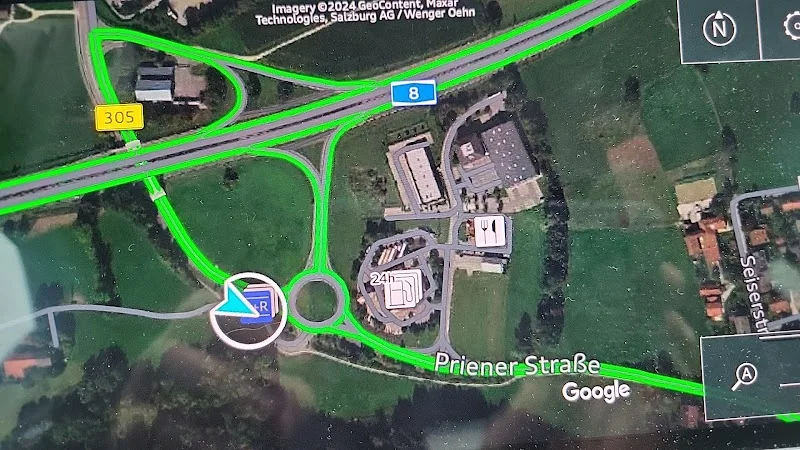
Bernau am Chiemsee
B305, 83233 Bernau am Chiemsee, Deutschland
Commuter Parking Lot Bernau am Chiemsee | Parking & Access
The commuter parking lot Bernau am Chiemsee is not a glamorous place, but that is exactly what makes it interesting: It stands for practical mobility in a community that is very consciously organized between the highway, train station, lakeshore, and excursion destinations. The search queries for this location show primarily three needs: people want to know what others say about the place, what it looks like, and how to get there the fastest. For a location like this, that is logical. A commuter parking lot is rarely sought after for its architecture, but rather for orientation, reliability, and proximity to the important routes of everyday life. This is where Bernau am Chiemsee's strength lies, as the community describes the location as well-connected via the A8, with a train station in regional traffic, bus connections, and short distances to the tourist points around Lake Chiemsee. ([bernau-am-chiemsee.de](https://www.bernau-am-chiemsee.de/service/anreise-mobilitaet-fahrplaene))
The provided location data gives the parking lot a rating of 4.4 stars based on 9 reviews. This is not a large amount, but it is quite typical for a commuter and functional parking lot. Such places are often used but are less frequently described in detail compared to restaurants, hotels, or event venues. For this type of location, the practical aspects are particularly important: Is the access easy? Is there enough orientation? How close is the lot to the train, local bus, and other parking options? And what role does the location play in the interplay between commuters, day visitors, and excursionists? The keyword situation indicates that users are not just looking for a parking space, but for a quick, reliable decision-making aid. Therefore, it is worth looking at reviews, photos, and the official mobility structure around Bernau. Because when someone chooses a parking lot, they ultimately want no surprises, but a clear starting point.
For Bernau am Chiemsee, this starting point is particularly valuable. According to the official mobility page, the community is located about 80 kilometers from Munich and around 55 kilometers from Salzburg, has two highway exits, and is served hourly by the Bernau train station in BRB traffic. Additionally, there are regional bus lines, the call bus Rosi, and other offers that make the location interesting not only for visitors but also for commuters. The commuter parking lot is thus part of a larger system of road, rail, and leisure mobility. It is not just a parking spot, but a building block of the route chain that holds Bernau together as a place to live, work, and vacation. ([bernau-am-chiemsee.de](https://www.bernau-am-chiemsee.de/service/anreise-mobilitaet-fahrplaene))
Reviews of the Commuter Parking Lot Bernau am Chiemsee
Those looking for reviews of the commuter parking lot Bernau am Chiemsee usually do not expect long experience reports, but rather short practical hints. This is where the true value of such reviews lies: they do not talk about attractions, but about everyday usability. For a commuter parking lot, different criteria count than for an attraction. People pay attention to whether you can quickly get in and out, whether the paths seem logical, whether you can find your way around immediately, and whether the area gives the impression that it also works in the morning or at the end of the day. The provided location data states 4.4 stars based on 9 reviews. This is a small base, so rather a mood picture than a statistically reliable measurement. Nevertheless, this mood picture is valuable because it shows that the place is apparently perceived positively by several users. For a parking search, often just the impression from a few voices is enough, as long as one knows that it is only a small sample.
For functional parking lots, it is also important to read reviews in context. A good commuter parking lot is not the one with the most emotions, but the one with the least friction losses. When reviews are brief, the surrounding facts help: Bernau am Chiemsee is a place with hourly train connections, with bus transfer options, and with a community that visibly intervenes in parking matters. The administration itself reports on increasing parking pressure in the train station area, more illegal parking, and that many drivers from the surrounding area specifically drive to Bernau because there are still free parking options and the cheap MVV fare begins there. This explains why reviews for a parking lot in Bernau should not be viewed in isolation. They always also reflect the general traffic situation in the area. ([gemeinde-bernau.de](https://www.gemeinde-bernau.de/aktuelles/mitteilungen/parkplatzsituation-am-bahnhof-gemeinde-beschliesst-sofortmassnahmen-und-prueft-langfristige-verbesserung))
For seekers, reviews are therefore primarily a source of orientation. When the parking lot is used as a commuter parking lot, the most important questions are usually quite pragmatic: How quickly can you get from there to the train station? Is the access at the B305 logical? Is the lot recognizable as a public parking lot at first glance? And are there indications of usage rules, such as for long-term parking, motorhomes, or digital payment in other parking areas of the community? The answers to such questions arise not only from star ratings but from the combination of reviews, maps, photos, and official information. That is why the parking lot is so exciting for local SEO: it is not sought after because of a large event scene, but because of a clear intention to use it. Reviews here become less a marketing tool and more a safety check before arrival.
Another point: for a parking lot like this, fluctuating ratings are normal. Perception strongly depends on when one was there. Those arriving in the morning during rush hours rate differently than someone arriving late in the evening. Someone who only stops briefly perceives differently than someone who is switching to the train or visiting the lake. Therefore, it makes sense to read reviews together with the location. The public data shows that Bernau is a place with a real mobility function, not just a tourist stop. In such places, reviews are often brief but useful. For SEO, this means: reviews here are not an end in themselves, but an indication that people are looking for a quick, safe, and understandable parking solution.
Images of Commuter Parking Lot Bernau am Chiemsee: Assessing the Location
The search impulse for images of the commuter parking lot Bernau am Chiemsee reveals a lot about user expectations. Those looking for images do not want an abstract directory, but visual security. They want to see if the place looks open, how the access is organized, and whether the surroundings are more urban, rural, or tourist-oriented. Especially for a parking lot in a community like Bernau am Chiemsee, this visual impression is important because several spaces overlap there: proximity to the train station, B305, lakeshore, recreational areas, and local thoroughfare. Official POI pages of the community therefore often work with images and map views in many places. For the Bernau train station and the Bernau-Felden beach, there are separate image and map pages, which significantly improve the realistic impression of the surroundings. This way, one not only gets a location but also a picture of how the place is embedded in the mobility and leisure landscape. ([bernau-am-chiemsee.de](https://www.bernau-am-chiemsee.de/media/pois/bahnhof-bernau))
For the commuter parking lot itself, the surroundings are particularly revealing. The given address at the B305 shows that the lot is located on one of the most important traffic axes of the area. The B305 connects Bernau with the regional road network, and the official arrival page additionally mentions the two highway exits Bernau Ort and Felden on the A8. Those viewing photos should therefore not only want to see the parking lot itself but also the paths leading there. Is the signage clear? Does the access seem direct and without detours? Are parking spaces and footpaths intuitively recognizable? Such questions primarily help commuters who have little time in the morning and do not want to experiment with traffic flow. On the community's map and image pages, it is also helpful that they not only make the parking lot visible but also the nearby surroundings such as the train station, beach, local map, and tourist info. ([bernau-am-chiemsee.de](https://www.bernau-am-chiemsee.de/service/anreise-mobilitaet-fahrplaene))
Visual orientation is also useful here because Bernau is a place that is strongly influenced by seasonal movement. In summer, the traffic picture changes due to bathers, cycling tourists, and boat landings, while in everyday life, commuters and train travelers are more visible. Images then help to classify the relationship between these types of use. A parking lot that is full of excursion traffic in summer can be perceived quite differently in everyday life than a typical commuter location. For SEO and content, this means: a need for images is always also a need for expectation management. Those who understand in advance how the location appears arrive more relaxed. Therefore, on this page, the visual and spatial information is consciously closely linked with the official mobility and POI data.
Additionally, Bernau am Chiemsee publicly documents many places with image material and map views. The Bernau-Felden beach has a detailed POI page with images, amenities, map views, and surrounding entries. The Bernau train station also has its own image and map section. This shows that the community makes its most important places visually accessible. For the commuter parking lot itself, this is not only helpful but also a good indication of the quality of the surroundings: those parking in a community that visibly documents its infrastructure can often orient themselves more easily on-site. This is exactly what users are looking for when they ask for images of the commuter parking lot. They do not want the perfect shot but the quick certainty that the location appears logical and understandable. ([bernau-am-chiemsee.de](https://www.bernau-am-chiemsee.de/media/pois/bahnhof-bernau))
Access via B305, A8, and Bernau Train Station
Access is the central theme at this location, as the commuter parking lot Bernau am Chiemsee is primarily intended as a practical waypoint. The community describes Bernau am Chiemsee as a place that can be easily reached via the A8. At the same time, it mentions the distances of about 80 kilometers from Munich and around 55 kilometers from Salzburg, as well as the two highway exits Bernau Ort and Felden. This makes the place interesting for local commuters as well as for travelers coming from further away. Those arriving by car benefit from the fact that the region is clearly geared towards mobility. And those traveling by train will find an hourly BRB connection at the Bernau train station on the Munich-Salzburg route. This combination of road and rail explains why a commuter parking lot at the B305 makes sense here. It is not located somewhere on the edge but in a place that consciously bundles traffic. ([bernau-am-chiemsee.de](https://www.bernau-am-chiemsee.de/service/anreise-mobilitaet-fahrplaene))
The official train station page adds to the picture. It states that the Bernau train station is served hourly by BRB trains and that there are transfer options to the Chiemsee ring line and the Bernau local bus. This makes it clear that the train station is not just a stop on the Munich-Salzburg line but a transfer point in the local and regional network. This is relevant for the commuter parking lot because users appreciate exactly such short, clear transitions: arrive, park, continue by train or bus. The train station is also freely accessible and always open, which makes it an important anchor point in the local structure. Therefore, it is worthwhile to look at both the train station and the parking lot for route planning. Both places are closely connected, even if they have different functions. ([bernau-am-chiemsee.de](https://www.bernau-am-chiemsee.de/media/pois/bahnhof-bernau))
Another component of access is public transport in Bernau. The community points out the call bus Rosi, which serves around 55 stops in the community area and can be booked via an app. The official stop plan also lists a stop named Commuter Parking Lot KV South, which further confirms the parking-related mobility character of the area. For seekers, this is important information because it shows that the location is not isolated but part of a larger, finely branched system. Even those who do not start directly at the parking lot can switch relatively flexibly between parking lot, train station, local bus, and on-demand offers in Bernau. This is particularly practical for commuters who are looking for not just a parking space but a reliable mobility chain. ([bernau-am-chiemsee.de](https://www.bernau-am-chiemsee.de/service/anreise-mobilitaet-fahrplaene/rufbus-rosi?utm_source=openai))
In everyday life, this means: the direct access via the B305 and the connection to the A8 make the place easily understandable for motorized traffic, while the Bernau train station and public transport facilitate the switch to train and bus. This mix is typical for Bernau. The place is touristically attractive but at the same time a functioning everyday community. That is why the commuter parking lot is interesting not only for people who want to park their car but for everyone who wants to structure their journey cleverly. Those coming from the surrounding area cannot do without a car; those who then switch in Bernau often save time and nerves in the destination area. The location at the B305 is therefore less an endpoint than a joint between different modes of transport.
Parking, Parkster App, and Local Rules in Bernau
Bernau am Chiemsee actively addresses the issue of parking. The community reports that digital parking via the Parkster app has been introduced at the two parking lots P1 and P2. Drivers can purchase parking tickets on their smartphones, extend parking time while on the go, and digitally store seasonal parking tickets. For users, this is important because it shows that Bernau is modernizing its parking system and not just providing spaces. Those searching for a parking space today often think not only of parking capacity but also of comfort. Digitalization is a real factor, especially in a place with high visitor and commuter frequency. The municipality also emphasizes that municipal traffic monitoring can view the digitally issued parking tickets in real-time. This means: digital tickets are not just an additional feature here but a fully-fledged element of parking organization. ([gemeinde-bernau.de](https://www.gemeinde-bernau.de/aktuelles/mitteilungen/parken-mit-der-parkster-app-in-bernau))
The fact that parking in Bernau is a real issue is also shown by the municipal announcement regarding the parking situation at the train station. It states that parking demand in the train station area has significantly increased and that there is a strong increase in parking violations. The community speaks of drivers from the surrounding area who specifically use the Bernau train station because, compared to neighboring communities, there are still free parking options and the cheap MVV fare already begins there. This information is indirectly very valuable for the commuter parking lot because it explains the pressure on the entire parking system in Bernau. If train station and commuter parking lots are in high demand, it is no coincidence but part of an everyday mobility story. Therefore, those searching for a space should understand the local parking situation as dynamic. ([gemeinde-bernau.de](https://www.gemeinde-bernau.de/aktuelles/mitteilungen/parkplatzsituation-am-bahnhof-gemeinde-beschliesst-sofortmassnahmen-und-prueft-langfristige-verbesserung))
Another indication of the parking reality in Bernau can be found along the B305 itself. The state road construction authority reported the renovation of a parking bay about 100 meters long along the federal highway 305 in Bernau, opposite the parking lot at the mini-golf course. This is not a spectacular but a very telling finding: even along the federal highway, parking spaces are regularly maintained and adjusted. This underscores that parking in Bernau does not happen incidentally but is part of a functional infrastructure. Those who understand this as users will perceive the commuter parking lot more as a component of a larger system in which roadside bays, train station parking lots, and tourist parking spaces also play a role. ([stbaro.bayern.de](https://www.stbaro.bayern.de/service/medien/pressemitteilungen/2020/62/index.html))
There are also clear rules in Bernau for specific vehicle groups. The community has stipulated that motorhomes may only be parked in certain parking lots from 8 AM to 9 PM, while cars are not affected by this regulation. The background was, among other things, that traffic to existing motorhome parking spaces, campsites, and parking lot P1 should be channeled. This is important for the content strategy because it shows that Bernau treats its parking spaces differently. A commuter parking lot is not automatically a camping site, and an excursion parking lot is not automatically a long-term parking space. Therefore, those parking here should pay attention to the current signage and respect local usage. For seekers, this clarity is crucial. No one wants to be surprised on-site, and that is why official rules in Bernau are a real added value. ([gemeinde-bernau.de](https://www.gemeinde-bernau.de/aktuelles/mitteilungen/uebernachtungsverbot-fuer-wohnmobile))
In practice, this means: those using the commuter parking lot Bernau am Chiemsee are moving in a community that does not just tolerate parking but structures it. The combination of digital parking at P1 and P2, public discussion about the train station, regulated special uses, and ongoing maintenance along the B305 presents a clear picture. Bernau wants to keep traffic routes functional. For commuters and day visitors, this is good because they encounter a place where parking is not left to chance. For local SEO, this is equally important because users searching for reviews or photos ultimately want to know whether the parking lot reliably fits into the local concept. And it does.
Bernau am Chiemsee as a Starting Point for Lake, Beach, and Excursions
The commuter parking lot Bernau am Chiemsee gains additional relevance because Bernau is much more than just a transit point. The official tourism page describes the place as a location with an excellent position directly on the A8 and at the same time in the midst of unspoiled nature. There are three motorhome parking spaces and a campsite, but also many classic day destinations that can be reached by car, train, or bus. That is why a commuter parking lot here is never only interesting for work routes. It can also be a starting point for a beach day, a walk, a boat trip, or a short change of location. Those parking in Bernau often park near the Chiemsee experience, which makes the location strong in SEO, even if it remains inconspicuous itself. ([bernau-am-chiemsee.de](https://www.bernau-am-chiemsee.de/urlaub-am-chiemsee/camping-stellplaetze))
This is particularly evident at the Bernau-Felden beach. The official POI page describes the beach as a place for play, sports, and relaxation on a small peninsula on the southern shore of Lake Chiemsee. Visiting the beach is free of charge, the parking lots P1 and P2 in Felden are paid, and at the Bernau-Felden boat landing, ships depart five times daily to Herreninsel and Fraueninsel during the season. Additionally, there are changing rooms, toilets, water rescue, playground, beach volleyball, beach soccer, table tennis, boat rental, SUP, kayak, and sailing school. This information is relevant for the commuter parking lot because it shows how strongly local parking is integrated into leisure flows. A parking lot in Bernau is never just for the car but often also for the direct switch into the tourist life by the lake. ([bernau-am-chiemsee.de](https://www.bernau-am-chiemsee.de/media/pois/strandbad-chiemseepark-bernau-felden))
The official tours around Bernau also show how closely parking and movement are connected. The Chiemseepark Bernau-Felden jogging route starts at the parking lot and leads along side streets to the Chiemsee park, past the Irschener Winkel with a nature observation station and back again. On the way, the main road B305 is crossed, and the route beautifully illustrates how the parking lot is embedded in the local path network. Other official tours also name parking lots on Rottauer Straße at the mini-golf course or at the Bernau train station as starting points. This is a clear indication that Bernau is a place with many possible entry points. Those arriving by car park where it makes the most sense for the planned activity. Those arriving by train use the train station. Those arriving at the lake use P1 or P2. The commuter parking lot complements this system as a flexible building block. ([bernau-am-chiemsee.de](https://www.bernau-am-chiemsee.de/media/touren/chiemseepark-bernau-felden-joggingrunde))
The tourist information Bernau am Chiemsee has also created a clear service point with its move to Aschauer Straße 10, where visitors can obtain information, tickets, maps, hiking poles, child carriers, and services. At first glance, this seems far from the commuter parking lot, but in reality, it is another building block of the same infrastructure. A place that organizes tourist info, local maps, mobility offers, and recreational areas in close proximity is easier for visitors and commuters to read. That is why Bernau am Chiemsee works so well as a location: the paths are clear, the functions are distributed, and the usage is understandable. A commuter parking lot thus becomes part of a community that does not separate mobility and leisure but coordinates them with each other. ([bernau-am-chiemsee.de](https://www.bernau-am-chiemsee.de/service/ortsplan-neu))
For people who visit Bernau only briefly, this mix is ideal. Those arriving in the morning can take the train or drive directly on. Those parking at noon can quickly switch to the lake, the town center, or a walking path. Those arriving in the evening benefit from the proximity to the train station, B305, and the tourist destinations. Especially in the Chiemgau, these transitions are important because everyday life and excursions often blend. The commuter parking lot Bernau am Chiemsee thus stands not only for parking space but for a reliable start in a place that enables both work routes and relaxation. That is what makes it so relevant in the search for reviews, images, and access.
Sources:
Show moreShow less
Commuter Parking Lot Bernau am Chiemsee | Parking & Access
The commuter parking lot Bernau am Chiemsee is not a glamorous place, but that is exactly what makes it interesting: It stands for practical mobility in a community that is very consciously organized between the highway, train station, lakeshore, and excursion destinations. The search queries for this location show primarily three needs: people want to know what others say about the place, what it looks like, and how to get there the fastest. For a location like this, that is logical. A commuter parking lot is rarely sought after for its architecture, but rather for orientation, reliability, and proximity to the important routes of everyday life. This is where Bernau am Chiemsee's strength lies, as the community describes the location as well-connected via the A8, with a train station in regional traffic, bus connections, and short distances to the tourist points around Lake Chiemsee. ([bernau-am-chiemsee.de](https://www.bernau-am-chiemsee.de/service/anreise-mobilitaet-fahrplaene))
The provided location data gives the parking lot a rating of 4.4 stars based on 9 reviews. This is not a large amount, but it is quite typical for a commuter and functional parking lot. Such places are often used but are less frequently described in detail compared to restaurants, hotels, or event venues. For this type of location, the practical aspects are particularly important: Is the access easy? Is there enough orientation? How close is the lot to the train, local bus, and other parking options? And what role does the location play in the interplay between commuters, day visitors, and excursionists? The keyword situation indicates that users are not just looking for a parking space, but for a quick, reliable decision-making aid. Therefore, it is worth looking at reviews, photos, and the official mobility structure around Bernau. Because when someone chooses a parking lot, they ultimately want no surprises, but a clear starting point.
For Bernau am Chiemsee, this starting point is particularly valuable. According to the official mobility page, the community is located about 80 kilometers from Munich and around 55 kilometers from Salzburg, has two highway exits, and is served hourly by the Bernau train station in BRB traffic. Additionally, there are regional bus lines, the call bus Rosi, and other offers that make the location interesting not only for visitors but also for commuters. The commuter parking lot is thus part of a larger system of road, rail, and leisure mobility. It is not just a parking spot, but a building block of the route chain that holds Bernau together as a place to live, work, and vacation. ([bernau-am-chiemsee.de](https://www.bernau-am-chiemsee.de/service/anreise-mobilitaet-fahrplaene))
Reviews of the Commuter Parking Lot Bernau am Chiemsee
Those looking for reviews of the commuter parking lot Bernau am Chiemsee usually do not expect long experience reports, but rather short practical hints. This is where the true value of such reviews lies: they do not talk about attractions, but about everyday usability. For a commuter parking lot, different criteria count than for an attraction. People pay attention to whether you can quickly get in and out, whether the paths seem logical, whether you can find your way around immediately, and whether the area gives the impression that it also works in the morning or at the end of the day. The provided location data states 4.4 stars based on 9 reviews. This is a small base, so rather a mood picture than a statistically reliable measurement. Nevertheless, this mood picture is valuable because it shows that the place is apparently perceived positively by several users. For a parking search, often just the impression from a few voices is enough, as long as one knows that it is only a small sample.
For functional parking lots, it is also important to read reviews in context. A good commuter parking lot is not the one with the most emotions, but the one with the least friction losses. When reviews are brief, the surrounding facts help: Bernau am Chiemsee is a place with hourly train connections, with bus transfer options, and with a community that visibly intervenes in parking matters. The administration itself reports on increasing parking pressure in the train station area, more illegal parking, and that many drivers from the surrounding area specifically drive to Bernau because there are still free parking options and the cheap MVV fare begins there. This explains why reviews for a parking lot in Bernau should not be viewed in isolation. They always also reflect the general traffic situation in the area. ([gemeinde-bernau.de](https://www.gemeinde-bernau.de/aktuelles/mitteilungen/parkplatzsituation-am-bahnhof-gemeinde-beschliesst-sofortmassnahmen-und-prueft-langfristige-verbesserung))
For seekers, reviews are therefore primarily a source of orientation. When the parking lot is used as a commuter parking lot, the most important questions are usually quite pragmatic: How quickly can you get from there to the train station? Is the access at the B305 logical? Is the lot recognizable as a public parking lot at first glance? And are there indications of usage rules, such as for long-term parking, motorhomes, or digital payment in other parking areas of the community? The answers to such questions arise not only from star ratings but from the combination of reviews, maps, photos, and official information. That is why the parking lot is so exciting for local SEO: it is not sought after because of a large event scene, but because of a clear intention to use it. Reviews here become less a marketing tool and more a safety check before arrival.
Another point: for a parking lot like this, fluctuating ratings are normal. Perception strongly depends on when one was there. Those arriving in the morning during rush hours rate differently than someone arriving late in the evening. Someone who only stops briefly perceives differently than someone who is switching to the train or visiting the lake. Therefore, it makes sense to read reviews together with the location. The public data shows that Bernau is a place with a real mobility function, not just a tourist stop. In such places, reviews are often brief but useful. For SEO, this means: reviews here are not an end in themselves, but an indication that people are looking for a quick, safe, and understandable parking solution.
Images of Commuter Parking Lot Bernau am Chiemsee: Assessing the Location
The search impulse for images of the commuter parking lot Bernau am Chiemsee reveals a lot about user expectations. Those looking for images do not want an abstract directory, but visual security. They want to see if the place looks open, how the access is organized, and whether the surroundings are more urban, rural, or tourist-oriented. Especially for a parking lot in a community like Bernau am Chiemsee, this visual impression is important because several spaces overlap there: proximity to the train station, B305, lakeshore, recreational areas, and local thoroughfare. Official POI pages of the community therefore often work with images and map views in many places. For the Bernau train station and the Bernau-Felden beach, there are separate image and map pages, which significantly improve the realistic impression of the surroundings. This way, one not only gets a location but also a picture of how the place is embedded in the mobility and leisure landscape. ([bernau-am-chiemsee.de](https://www.bernau-am-chiemsee.de/media/pois/bahnhof-bernau))
For the commuter parking lot itself, the surroundings are particularly revealing. The given address at the B305 shows that the lot is located on one of the most important traffic axes of the area. The B305 connects Bernau with the regional road network, and the official arrival page additionally mentions the two highway exits Bernau Ort and Felden on the A8. Those viewing photos should therefore not only want to see the parking lot itself but also the paths leading there. Is the signage clear? Does the access seem direct and without detours? Are parking spaces and footpaths intuitively recognizable? Such questions primarily help commuters who have little time in the morning and do not want to experiment with traffic flow. On the community's map and image pages, it is also helpful that they not only make the parking lot visible but also the nearby surroundings such as the train station, beach, local map, and tourist info. ([bernau-am-chiemsee.de](https://www.bernau-am-chiemsee.de/service/anreise-mobilitaet-fahrplaene))
Visual orientation is also useful here because Bernau is a place that is strongly influenced by seasonal movement. In summer, the traffic picture changes due to bathers, cycling tourists, and boat landings, while in everyday life, commuters and train travelers are more visible. Images then help to classify the relationship between these types of use. A parking lot that is full of excursion traffic in summer can be perceived quite differently in everyday life than a typical commuter location. For SEO and content, this means: a need for images is always also a need for expectation management. Those who understand in advance how the location appears arrive more relaxed. Therefore, on this page, the visual and spatial information is consciously closely linked with the official mobility and POI data.
Additionally, Bernau am Chiemsee publicly documents many places with image material and map views. The Bernau-Felden beach has a detailed POI page with images, amenities, map views, and surrounding entries. The Bernau train station also has its own image and map section. This shows that the community makes its most important places visually accessible. For the commuter parking lot itself, this is not only helpful but also a good indication of the quality of the surroundings: those parking in a community that visibly documents its infrastructure can often orient themselves more easily on-site. This is exactly what users are looking for when they ask for images of the commuter parking lot. They do not want the perfect shot but the quick certainty that the location appears logical and understandable. ([bernau-am-chiemsee.de](https://www.bernau-am-chiemsee.de/media/pois/bahnhof-bernau))
Access via B305, A8, and Bernau Train Station
Access is the central theme at this location, as the commuter parking lot Bernau am Chiemsee is primarily intended as a practical waypoint. The community describes Bernau am Chiemsee as a place that can be easily reached via the A8. At the same time, it mentions the distances of about 80 kilometers from Munich and around 55 kilometers from Salzburg, as well as the two highway exits Bernau Ort and Felden. This makes the place interesting for local commuters as well as for travelers coming from further away. Those arriving by car benefit from the fact that the region is clearly geared towards mobility. And those traveling by train will find an hourly BRB connection at the Bernau train station on the Munich-Salzburg route. This combination of road and rail explains why a commuter parking lot at the B305 makes sense here. It is not located somewhere on the edge but in a place that consciously bundles traffic. ([bernau-am-chiemsee.de](https://www.bernau-am-chiemsee.de/service/anreise-mobilitaet-fahrplaene))
The official train station page adds to the picture. It states that the Bernau train station is served hourly by BRB trains and that there are transfer options to the Chiemsee ring line and the Bernau local bus. This makes it clear that the train station is not just a stop on the Munich-Salzburg line but a transfer point in the local and regional network. This is relevant for the commuter parking lot because users appreciate exactly such short, clear transitions: arrive, park, continue by train or bus. The train station is also freely accessible and always open, which makes it an important anchor point in the local structure. Therefore, it is worthwhile to look at both the train station and the parking lot for route planning. Both places are closely connected, even if they have different functions. ([bernau-am-chiemsee.de](https://www.bernau-am-chiemsee.de/media/pois/bahnhof-bernau))
Another component of access is public transport in Bernau. The community points out the call bus Rosi, which serves around 55 stops in the community area and can be booked via an app. The official stop plan also lists a stop named Commuter Parking Lot KV South, which further confirms the parking-related mobility character of the area. For seekers, this is important information because it shows that the location is not isolated but part of a larger, finely branched system. Even those who do not start directly at the parking lot can switch relatively flexibly between parking lot, train station, local bus, and on-demand offers in Bernau. This is particularly practical for commuters who are looking for not just a parking space but a reliable mobility chain. ([bernau-am-chiemsee.de](https://www.bernau-am-chiemsee.de/service/anreise-mobilitaet-fahrplaene/rufbus-rosi?utm_source=openai))
In everyday life, this means: the direct access via the B305 and the connection to the A8 make the place easily understandable for motorized traffic, while the Bernau train station and public transport facilitate the switch to train and bus. This mix is typical for Bernau. The place is touristically attractive but at the same time a functioning everyday community. That is why the commuter parking lot is interesting not only for people who want to park their car but for everyone who wants to structure their journey cleverly. Those coming from the surrounding area cannot do without a car; those who then switch in Bernau often save time and nerves in the destination area. The location at the B305 is therefore less an endpoint than a joint between different modes of transport.
Parking, Parkster App, and Local Rules in Bernau
Bernau am Chiemsee actively addresses the issue of parking. The community reports that digital parking via the Parkster app has been introduced at the two parking lots P1 and P2. Drivers can purchase parking tickets on their smartphones, extend parking time while on the go, and digitally store seasonal parking tickets. For users, this is important because it shows that Bernau is modernizing its parking system and not just providing spaces. Those searching for a parking space today often think not only of parking capacity but also of comfort. Digitalization is a real factor, especially in a place with high visitor and commuter frequency. The municipality also emphasizes that municipal traffic monitoring can view the digitally issued parking tickets in real-time. This means: digital tickets are not just an additional feature here but a fully-fledged element of parking organization. ([gemeinde-bernau.de](https://www.gemeinde-bernau.de/aktuelles/mitteilungen/parken-mit-der-parkster-app-in-bernau))
The fact that parking in Bernau is a real issue is also shown by the municipal announcement regarding the parking situation at the train station. It states that parking demand in the train station area has significantly increased and that there is a strong increase in parking violations. The community speaks of drivers from the surrounding area who specifically use the Bernau train station because, compared to neighboring communities, there are still free parking options and the cheap MVV fare already begins there. This information is indirectly very valuable for the commuter parking lot because it explains the pressure on the entire parking system in Bernau. If train station and commuter parking lots are in high demand, it is no coincidence but part of an everyday mobility story. Therefore, those searching for a space should understand the local parking situation as dynamic. ([gemeinde-bernau.de](https://www.gemeinde-bernau.de/aktuelles/mitteilungen/parkplatzsituation-am-bahnhof-gemeinde-beschliesst-sofortmassnahmen-und-prueft-langfristige-verbesserung))
Another indication of the parking reality in Bernau can be found along the B305 itself. The state road construction authority reported the renovation of a parking bay about 100 meters long along the federal highway 305 in Bernau, opposite the parking lot at the mini-golf course. This is not a spectacular but a very telling finding: even along the federal highway, parking spaces are regularly maintained and adjusted. This underscores that parking in Bernau does not happen incidentally but is part of a functional infrastructure. Those who understand this as users will perceive the commuter parking lot more as a component of a larger system in which roadside bays, train station parking lots, and tourist parking spaces also play a role. ([stbaro.bayern.de](https://www.stbaro.bayern.de/service/medien/pressemitteilungen/2020/62/index.html))
There are also clear rules in Bernau for specific vehicle groups. The community has stipulated that motorhomes may only be parked in certain parking lots from 8 AM to 9 PM, while cars are not affected by this regulation. The background was, among other things, that traffic to existing motorhome parking spaces, campsites, and parking lot P1 should be channeled. This is important for the content strategy because it shows that Bernau treats its parking spaces differently. A commuter parking lot is not automatically a camping site, and an excursion parking lot is not automatically a long-term parking space. Therefore, those parking here should pay attention to the current signage and respect local usage. For seekers, this clarity is crucial. No one wants to be surprised on-site, and that is why official rules in Bernau are a real added value. ([gemeinde-bernau.de](https://www.gemeinde-bernau.de/aktuelles/mitteilungen/uebernachtungsverbot-fuer-wohnmobile))
In practice, this means: those using the commuter parking lot Bernau am Chiemsee are moving in a community that does not just tolerate parking but structures it. The combination of digital parking at P1 and P2, public discussion about the train station, regulated special uses, and ongoing maintenance along the B305 presents a clear picture. Bernau wants to keep traffic routes functional. For commuters and day visitors, this is good because they encounter a place where parking is not left to chance. For local SEO, this is equally important because users searching for reviews or photos ultimately want to know whether the parking lot reliably fits into the local concept. And it does.
Bernau am Chiemsee as a Starting Point for Lake, Beach, and Excursions
The commuter parking lot Bernau am Chiemsee gains additional relevance because Bernau is much more than just a transit point. The official tourism page describes the place as a location with an excellent position directly on the A8 and at the same time in the midst of unspoiled nature. There are three motorhome parking spaces and a campsite, but also many classic day destinations that can be reached by car, train, or bus. That is why a commuter parking lot here is never only interesting for work routes. It can also be a starting point for a beach day, a walk, a boat trip, or a short change of location. Those parking in Bernau often park near the Chiemsee experience, which makes the location strong in SEO, even if it remains inconspicuous itself. ([bernau-am-chiemsee.de](https://www.bernau-am-chiemsee.de/urlaub-am-chiemsee/camping-stellplaetze))
This is particularly evident at the Bernau-Felden beach. The official POI page describes the beach as a place for play, sports, and relaxation on a small peninsula on the southern shore of Lake Chiemsee. Visiting the beach is free of charge, the parking lots P1 and P2 in Felden are paid, and at the Bernau-Felden boat landing, ships depart five times daily to Herreninsel and Fraueninsel during the season. Additionally, there are changing rooms, toilets, water rescue, playground, beach volleyball, beach soccer, table tennis, boat rental, SUP, kayak, and sailing school. This information is relevant for the commuter parking lot because it shows how strongly local parking is integrated into leisure flows. A parking lot in Bernau is never just for the car but often also for the direct switch into the tourist life by the lake. ([bernau-am-chiemsee.de](https://www.bernau-am-chiemsee.de/media/pois/strandbad-chiemseepark-bernau-felden))
The official tours around Bernau also show how closely parking and movement are connected. The Chiemseepark Bernau-Felden jogging route starts at the parking lot and leads along side streets to the Chiemsee park, past the Irschener Winkel with a nature observation station and back again. On the way, the main road B305 is crossed, and the route beautifully illustrates how the parking lot is embedded in the local path network. Other official tours also name parking lots on Rottauer Straße at the mini-golf course or at the Bernau train station as starting points. This is a clear indication that Bernau is a place with many possible entry points. Those arriving by car park where it makes the most sense for the planned activity. Those arriving by train use the train station. Those arriving at the lake use P1 or P2. The commuter parking lot complements this system as a flexible building block. ([bernau-am-chiemsee.de](https://www.bernau-am-chiemsee.de/media/touren/chiemseepark-bernau-felden-joggingrunde))
The tourist information Bernau am Chiemsee has also created a clear service point with its move to Aschauer Straße 10, where visitors can obtain information, tickets, maps, hiking poles, child carriers, and services. At first glance, this seems far from the commuter parking lot, but in reality, it is another building block of the same infrastructure. A place that organizes tourist info, local maps, mobility offers, and recreational areas in close proximity is easier for visitors and commuters to read. That is why Bernau am Chiemsee works so well as a location: the paths are clear, the functions are distributed, and the usage is understandable. A commuter parking lot thus becomes part of a community that does not separate mobility and leisure but coordinates them with each other. ([bernau-am-chiemsee.de](https://www.bernau-am-chiemsee.de/service/ortsplan-neu))
For people who visit Bernau only briefly, this mix is ideal. Those arriving in the morning can take the train or drive directly on. Those parking at noon can quickly switch to the lake, the town center, or a walking path. Those arriving in the evening benefit from the proximity to the train station, B305, and the tourist destinations. Especially in the Chiemgau, these transitions are important because everyday life and excursions often blend. The commuter parking lot Bernau am Chiemsee thus stands not only for parking space but for a reliable start in a place that enables both work routes and relaxation. That is what makes it so relevant in the search for reviews, images, and access.
Sources:
Commuter Parking Lot Bernau am Chiemsee | Parking & Access
The commuter parking lot Bernau am Chiemsee is not a glamorous place, but that is exactly what makes it interesting: It stands for practical mobility in a community that is very consciously organized between the highway, train station, lakeshore, and excursion destinations. The search queries for this location show primarily three needs: people want to know what others say about the place, what it looks like, and how to get there the fastest. For a location like this, that is logical. A commuter parking lot is rarely sought after for its architecture, but rather for orientation, reliability, and proximity to the important routes of everyday life. This is where Bernau am Chiemsee's strength lies, as the community describes the location as well-connected via the A8, with a train station in regional traffic, bus connections, and short distances to the tourist points around Lake Chiemsee. ([bernau-am-chiemsee.de](https://www.bernau-am-chiemsee.de/service/anreise-mobilitaet-fahrplaene))
The provided location data gives the parking lot a rating of 4.4 stars based on 9 reviews. This is not a large amount, but it is quite typical for a commuter and functional parking lot. Such places are often used but are less frequently described in detail compared to restaurants, hotels, or event venues. For this type of location, the practical aspects are particularly important: Is the access easy? Is there enough orientation? How close is the lot to the train, local bus, and other parking options? And what role does the location play in the interplay between commuters, day visitors, and excursionists? The keyword situation indicates that users are not just looking for a parking space, but for a quick, reliable decision-making aid. Therefore, it is worth looking at reviews, photos, and the official mobility structure around Bernau. Because when someone chooses a parking lot, they ultimately want no surprises, but a clear starting point.
For Bernau am Chiemsee, this starting point is particularly valuable. According to the official mobility page, the community is located about 80 kilometers from Munich and around 55 kilometers from Salzburg, has two highway exits, and is served hourly by the Bernau train station in BRB traffic. Additionally, there are regional bus lines, the call bus Rosi, and other offers that make the location interesting not only for visitors but also for commuters. The commuter parking lot is thus part of a larger system of road, rail, and leisure mobility. It is not just a parking spot, but a building block of the route chain that holds Bernau together as a place to live, work, and vacation. ([bernau-am-chiemsee.de](https://www.bernau-am-chiemsee.de/service/anreise-mobilitaet-fahrplaene))
Reviews of the Commuter Parking Lot Bernau am Chiemsee
Those looking for reviews of the commuter parking lot Bernau am Chiemsee usually do not expect long experience reports, but rather short practical hints. This is where the true value of such reviews lies: they do not talk about attractions, but about everyday usability. For a commuter parking lot, different criteria count than for an attraction. People pay attention to whether you can quickly get in and out, whether the paths seem logical, whether you can find your way around immediately, and whether the area gives the impression that it also works in the morning or at the end of the day. The provided location data states 4.4 stars based on 9 reviews. This is a small base, so rather a mood picture than a statistically reliable measurement. Nevertheless, this mood picture is valuable because it shows that the place is apparently perceived positively by several users. For a parking search, often just the impression from a few voices is enough, as long as one knows that it is only a small sample.
For functional parking lots, it is also important to read reviews in context. A good commuter parking lot is not the one with the most emotions, but the one with the least friction losses. When reviews are brief, the surrounding facts help: Bernau am Chiemsee is a place with hourly train connections, with bus transfer options, and with a community that visibly intervenes in parking matters. The administration itself reports on increasing parking pressure in the train station area, more illegal parking, and that many drivers from the surrounding area specifically drive to Bernau because there are still free parking options and the cheap MVV fare begins there. This explains why reviews for a parking lot in Bernau should not be viewed in isolation. They always also reflect the general traffic situation in the area. ([gemeinde-bernau.de](https://www.gemeinde-bernau.de/aktuelles/mitteilungen/parkplatzsituation-am-bahnhof-gemeinde-beschliesst-sofortmassnahmen-und-prueft-langfristige-verbesserung))
For seekers, reviews are therefore primarily a source of orientation. When the parking lot is used as a commuter parking lot, the most important questions are usually quite pragmatic: How quickly can you get from there to the train station? Is the access at the B305 logical? Is the lot recognizable as a public parking lot at first glance? And are there indications of usage rules, such as for long-term parking, motorhomes, or digital payment in other parking areas of the community? The answers to such questions arise not only from star ratings but from the combination of reviews, maps, photos, and official information. That is why the parking lot is so exciting for local SEO: it is not sought after because of a large event scene, but because of a clear intention to use it. Reviews here become less a marketing tool and more a safety check before arrival.
Another point: for a parking lot like this, fluctuating ratings are normal. Perception strongly depends on when one was there. Those arriving in the morning during rush hours rate differently than someone arriving late in the evening. Someone who only stops briefly perceives differently than someone who is switching to the train or visiting the lake. Therefore, it makes sense to read reviews together with the location. The public data shows that Bernau is a place with a real mobility function, not just a tourist stop. In such places, reviews are often brief but useful. For SEO, this means: reviews here are not an end in themselves, but an indication that people are looking for a quick, safe, and understandable parking solution.
Images of Commuter Parking Lot Bernau am Chiemsee: Assessing the Location
The search impulse for images of the commuter parking lot Bernau am Chiemsee reveals a lot about user expectations. Those looking for images do not want an abstract directory, but visual security. They want to see if the place looks open, how the access is organized, and whether the surroundings are more urban, rural, or tourist-oriented. Especially for a parking lot in a community like Bernau am Chiemsee, this visual impression is important because several spaces overlap there: proximity to the train station, B305, lakeshore, recreational areas, and local thoroughfare. Official POI pages of the community therefore often work with images and map views in many places. For the Bernau train station and the Bernau-Felden beach, there are separate image and map pages, which significantly improve the realistic impression of the surroundings. This way, one not only gets a location but also a picture of how the place is embedded in the mobility and leisure landscape. ([bernau-am-chiemsee.de](https://www.bernau-am-chiemsee.de/media/pois/bahnhof-bernau))
For the commuter parking lot itself, the surroundings are particularly revealing. The given address at the B305 shows that the lot is located on one of the most important traffic axes of the area. The B305 connects Bernau with the regional road network, and the official arrival page additionally mentions the two highway exits Bernau Ort and Felden on the A8. Those viewing photos should therefore not only want to see the parking lot itself but also the paths leading there. Is the signage clear? Does the access seem direct and without detours? Are parking spaces and footpaths intuitively recognizable? Such questions primarily help commuters who have little time in the morning and do not want to experiment with traffic flow. On the community's map and image pages, it is also helpful that they not only make the parking lot visible but also the nearby surroundings such as the train station, beach, local map, and tourist info. ([bernau-am-chiemsee.de](https://www.bernau-am-chiemsee.de/service/anreise-mobilitaet-fahrplaene))
Visual orientation is also useful here because Bernau is a place that is strongly influenced by seasonal movement. In summer, the traffic picture changes due to bathers, cycling tourists, and boat landings, while in everyday life, commuters and train travelers are more visible. Images then help to classify the relationship between these types of use. A parking lot that is full of excursion traffic in summer can be perceived quite differently in everyday life than a typical commuter location. For SEO and content, this means: a need for images is always also a need for expectation management. Those who understand in advance how the location appears arrive more relaxed. Therefore, on this page, the visual and spatial information is consciously closely linked with the official mobility and POI data.
Additionally, Bernau am Chiemsee publicly documents many places with image material and map views. The Bernau-Felden beach has a detailed POI page with images, amenities, map views, and surrounding entries. The Bernau train station also has its own image and map section. This shows that the community makes its most important places visually accessible. For the commuter parking lot itself, this is not only helpful but also a good indication of the quality of the surroundings: those parking in a community that visibly documents its infrastructure can often orient themselves more easily on-site. This is exactly what users are looking for when they ask for images of the commuter parking lot. They do not want the perfect shot but the quick certainty that the location appears logical and understandable. ([bernau-am-chiemsee.de](https://www.bernau-am-chiemsee.de/media/pois/bahnhof-bernau))
Access via B305, A8, and Bernau Train Station
Access is the central theme at this location, as the commuter parking lot Bernau am Chiemsee is primarily intended as a practical waypoint. The community describes Bernau am Chiemsee as a place that can be easily reached via the A8. At the same time, it mentions the distances of about 80 kilometers from Munich and around 55 kilometers from Salzburg, as well as the two highway exits Bernau Ort and Felden. This makes the place interesting for local commuters as well as for travelers coming from further away. Those arriving by car benefit from the fact that the region is clearly geared towards mobility. And those traveling by train will find an hourly BRB connection at the Bernau train station on the Munich-Salzburg route. This combination of road and rail explains why a commuter parking lot at the B305 makes sense here. It is not located somewhere on the edge but in a place that consciously bundles traffic. ([bernau-am-chiemsee.de](https://www.bernau-am-chiemsee.de/service/anreise-mobilitaet-fahrplaene))
The official train station page adds to the picture. It states that the Bernau train station is served hourly by BRB trains and that there are transfer options to the Chiemsee ring line and the Bernau local bus. This makes it clear that the train station is not just a stop on the Munich-Salzburg line but a transfer point in the local and regional network. This is relevant for the commuter parking lot because users appreciate exactly such short, clear transitions: arrive, park, continue by train or bus. The train station is also freely accessible and always open, which makes it an important anchor point in the local structure. Therefore, it is worthwhile to look at both the train station and the parking lot for route planning. Both places are closely connected, even if they have different functions. ([bernau-am-chiemsee.de](https://www.bernau-am-chiemsee.de/media/pois/bahnhof-bernau))
Another component of access is public transport in Bernau. The community points out the call bus Rosi, which serves around 55 stops in the community area and can be booked via an app. The official stop plan also lists a stop named Commuter Parking Lot KV South, which further confirms the parking-related mobility character of the area. For seekers, this is important information because it shows that the location is not isolated but part of a larger, finely branched system. Even those who do not start directly at the parking lot can switch relatively flexibly between parking lot, train station, local bus, and on-demand offers in Bernau. This is particularly practical for commuters who are looking for not just a parking space but a reliable mobility chain. ([bernau-am-chiemsee.de](https://www.bernau-am-chiemsee.de/service/anreise-mobilitaet-fahrplaene/rufbus-rosi?utm_source=openai))
In everyday life, this means: the direct access via the B305 and the connection to the A8 make the place easily understandable for motorized traffic, while the Bernau train station and public transport facilitate the switch to train and bus. This mix is typical for Bernau. The place is touristically attractive but at the same time a functioning everyday community. That is why the commuter parking lot is interesting not only for people who want to park their car but for everyone who wants to structure their journey cleverly. Those coming from the surrounding area cannot do without a car; those who then switch in Bernau often save time and nerves in the destination area. The location at the B305 is therefore less an endpoint than a joint between different modes of transport.
Parking, Parkster App, and Local Rules in Bernau
Bernau am Chiemsee actively addresses the issue of parking. The community reports that digital parking via the Parkster app has been introduced at the two parking lots P1 and P2. Drivers can purchase parking tickets on their smartphones, extend parking time while on the go, and digitally store seasonal parking tickets. For users, this is important because it shows that Bernau is modernizing its parking system and not just providing spaces. Those searching for a parking space today often think not only of parking capacity but also of comfort. Digitalization is a real factor, especially in a place with high visitor and commuter frequency. The municipality also emphasizes that municipal traffic monitoring can view the digitally issued parking tickets in real-time. This means: digital tickets are not just an additional feature here but a fully-fledged element of parking organization. ([gemeinde-bernau.de](https://www.gemeinde-bernau.de/aktuelles/mitteilungen/parken-mit-der-parkster-app-in-bernau))
The fact that parking in Bernau is a real issue is also shown by the municipal announcement regarding the parking situation at the train station. It states that parking demand in the train station area has significantly increased and that there is a strong increase in parking violations. The community speaks of drivers from the surrounding area who specifically use the Bernau train station because, compared to neighboring communities, there are still free parking options and the cheap MVV fare already begins there. This information is indirectly very valuable for the commuter parking lot because it explains the pressure on the entire parking system in Bernau. If train station and commuter parking lots are in high demand, it is no coincidence but part of an everyday mobility story. Therefore, those searching for a space should understand the local parking situation as dynamic. ([gemeinde-bernau.de](https://www.gemeinde-bernau.de/aktuelles/mitteilungen/parkplatzsituation-am-bahnhof-gemeinde-beschliesst-sofortmassnahmen-und-prueft-langfristige-verbesserung))
Another indication of the parking reality in Bernau can be found along the B305 itself. The state road construction authority reported the renovation of a parking bay about 100 meters long along the federal highway 305 in Bernau, opposite the parking lot at the mini-golf course. This is not a spectacular but a very telling finding: even along the federal highway, parking spaces are regularly maintained and adjusted. This underscores that parking in Bernau does not happen incidentally but is part of a functional infrastructure. Those who understand this as users will perceive the commuter parking lot more as a component of a larger system in which roadside bays, train station parking lots, and tourist parking spaces also play a role. ([stbaro.bayern.de](https://www.stbaro.bayern.de/service/medien/pressemitteilungen/2020/62/index.html))
There are also clear rules in Bernau for specific vehicle groups. The community has stipulated that motorhomes may only be parked in certain parking lots from 8 AM to 9 PM, while cars are not affected by this regulation. The background was, among other things, that traffic to existing motorhome parking spaces, campsites, and parking lot P1 should be channeled. This is important for the content strategy because it shows that Bernau treats its parking spaces differently. A commuter parking lot is not automatically a camping site, and an excursion parking lot is not automatically a long-term parking space. Therefore, those parking here should pay attention to the current signage and respect local usage. For seekers, this clarity is crucial. No one wants to be surprised on-site, and that is why official rules in Bernau are a real added value. ([gemeinde-bernau.de](https://www.gemeinde-bernau.de/aktuelles/mitteilungen/uebernachtungsverbot-fuer-wohnmobile))
In practice, this means: those using the commuter parking lot Bernau am Chiemsee are moving in a community that does not just tolerate parking but structures it. The combination of digital parking at P1 and P2, public discussion about the train station, regulated special uses, and ongoing maintenance along the B305 presents a clear picture. Bernau wants to keep traffic routes functional. For commuters and day visitors, this is good because they encounter a place where parking is not left to chance. For local SEO, this is equally important because users searching for reviews or photos ultimately want to know whether the parking lot reliably fits into the local concept. And it does.
Bernau am Chiemsee as a Starting Point for Lake, Beach, and Excursions
The commuter parking lot Bernau am Chiemsee gains additional relevance because Bernau is much more than just a transit point. The official tourism page describes the place as a location with an excellent position directly on the A8 and at the same time in the midst of unspoiled nature. There are three motorhome parking spaces and a campsite, but also many classic day destinations that can be reached by car, train, or bus. That is why a commuter parking lot here is never only interesting for work routes. It can also be a starting point for a beach day, a walk, a boat trip, or a short change of location. Those parking in Bernau often park near the Chiemsee experience, which makes the location strong in SEO, even if it remains inconspicuous itself. ([bernau-am-chiemsee.de](https://www.bernau-am-chiemsee.de/urlaub-am-chiemsee/camping-stellplaetze))
This is particularly evident at the Bernau-Felden beach. The official POI page describes the beach as a place for play, sports, and relaxation on a small peninsula on the southern shore of Lake Chiemsee. Visiting the beach is free of charge, the parking lots P1 and P2 in Felden are paid, and at the Bernau-Felden boat landing, ships depart five times daily to Herreninsel and Fraueninsel during the season. Additionally, there are changing rooms, toilets, water rescue, playground, beach volleyball, beach soccer, table tennis, boat rental, SUP, kayak, and sailing school. This information is relevant for the commuter parking lot because it shows how strongly local parking is integrated into leisure flows. A parking lot in Bernau is never just for the car but often also for the direct switch into the tourist life by the lake. ([bernau-am-chiemsee.de](https://www.bernau-am-chiemsee.de/media/pois/strandbad-chiemseepark-bernau-felden))
The official tours around Bernau also show how closely parking and movement are connected. The Chiemseepark Bernau-Felden jogging route starts at the parking lot and leads along side streets to the Chiemsee park, past the Irschener Winkel with a nature observation station and back again. On the way, the main road B305 is crossed, and the route beautifully illustrates how the parking lot is embedded in the local path network. Other official tours also name parking lots on Rottauer Straße at the mini-golf course or at the Bernau train station as starting points. This is a clear indication that Bernau is a place with many possible entry points. Those arriving by car park where it makes the most sense for the planned activity. Those arriving by train use the train station. Those arriving at the lake use P1 or P2. The commuter parking lot complements this system as a flexible building block. ([bernau-am-chiemsee.de](https://www.bernau-am-chiemsee.de/media/touren/chiemseepark-bernau-felden-joggingrunde))
The tourist information Bernau am Chiemsee has also created a clear service point with its move to Aschauer Straße 10, where visitors can obtain information, tickets, maps, hiking poles, child carriers, and services. At first glance, this seems far from the commuter parking lot, but in reality, it is another building block of the same infrastructure. A place that organizes tourist info, local maps, mobility offers, and recreational areas in close proximity is easier for visitors and commuters to read. That is why Bernau am Chiemsee works so well as a location: the paths are clear, the functions are distributed, and the usage is understandable. A commuter parking lot thus becomes part of a community that does not separate mobility and leisure but coordinates them with each other. ([bernau-am-chiemsee.de](https://www.bernau-am-chiemsee.de/service/ortsplan-neu))
For people who visit Bernau only briefly, this mix is ideal. Those arriving in the morning can take the train or drive directly on. Those parking at noon can quickly switch to the lake, the town center, or a walking path. Those arriving in the evening benefit from the proximity to the train station, B305, and the tourist destinations. Especially in the Chiemgau, these transitions are important because everyday life and excursions often blend. The commuter parking lot Bernau am Chiemsee thus stands not only for parking space but for a reliable start in a place that enables both work routes and relaxation. That is what makes it so relevant in the search for reviews, images, and access.
Sources:
Upcoming Events
No events found
Frequently Asked Questions
Reviews
No reviews found