Rimsting
Greimharting, 83253 Rimsting, Deutschland
Local Church Greimharting | History & Leonhardi Procession
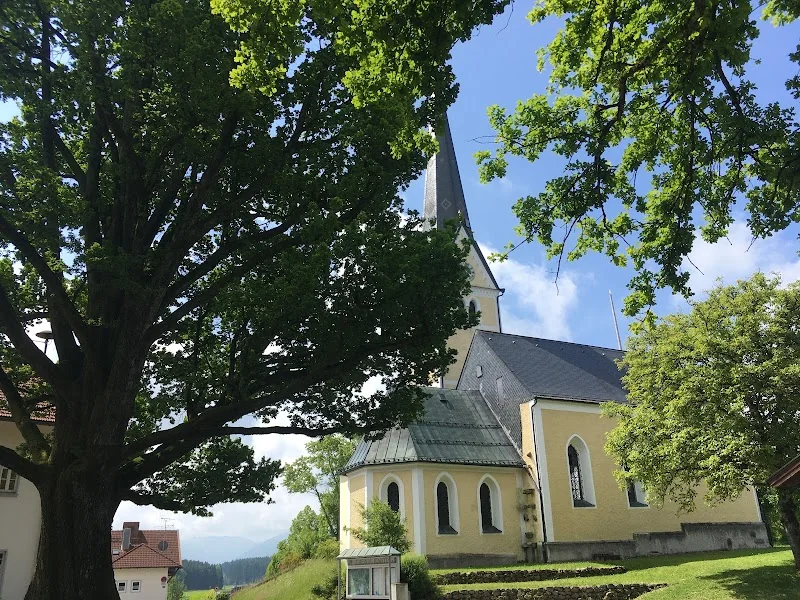
The local church Greimharting is not an anonymous building on the edge of the village, but a historical center with a strong local identity. Anyone traveling in Rimsting and at the foot of Ratzinger Höhe will encounter a church that has grown out of the history of the place and continues to shape the image of Greimharting to this day. Officially, it is the Catholic branch church of St. Peter and St. Leonhard in the parish association of the western Chiemsee shore. The community provides the address Greimharting 5, right in the middle of the village and just a few steps away from everyday village life. This fits with the impact of the building: It is a religious place, a cultural monument, and a point of orientation for walks, hikes, and customs at the same time. ([rimsting.de](https://www.rimsting.de/ortsinfo/kirchen/131-katholische-filialkirche-greimharting.html))
Even the recorded data shows how deeply the church is rooted in the settlement history. Greimharting is first mentioned in a document in 1135, and the church itself is first documented in 1399. The monument list of the Bavarian State Office for Monument Preservation describes the church as a late Gothic hall building with a gable roof, a recessed choir, and a south tower with a spire; the choir dates from the mid-15th century, the nave from around 1500, the baroque expansion took place in 1758, and the tower top was completed in 1882. The tourist description additionally refers to a uniform fresco program from the mid-15th century. It is clear: Here stands a building with genuine historical depth, not just a decorative village church. ([rimsting.de](https://rimsting.de/ortsinfo/zahlen-daten-und-geschichte/greimharting-geschichte.html))
History of the Local Church Greimharting since 1399
The history of this church does not begin with its current form, but with an older settlement and dominion area. The community of Rimsting itself writes that a castle once stood on the site or in its immediate vicinity and that the Greimharting church was later built from the stones and blocks of this noble residence. The tourist representation also reminds us that only the massive block stones in the foundation of the church remind us of the decayed castle. For visitors, this is an important thought: The building is not detached from the landscape but literally stands on the traces of earlier history. From a castle, a sacred building emerged; from remnants of dominion, a spiritual center was created. ([rimsting.de](https://rimsting.de/ortsinfo/zahlen-daten-und-geschichte/greimharting-geschichte.html))
The first written evidence of the place of worship dates back to 1399. This early mention is interesting because the original patronage of St. Peter likely indicates an even older origin. The reference to Peter points to the early ecclesiastical location of the place. However, in the late Middle Ages, St. Leonhard increasingly came to the forefront. This shift in patronage is not just a marginal note but an expression of vibrant piety. The veneration of St. Leonhard made the church a local pilgrimage and grace site, a destination that gained religious significance far beyond the narrower village borders. This development explains why the church still appears in regional descriptions as a former pilgrimage church. ([chiemsee-alpenland.de](https://www.chiemsee-alpenland.de/entdecken/alle-sehenswuerdigkeiten/ehemalige-wallfahrtskirche-filialkirche-st.-petrus-und-st.-leonhard-in-greimharting-47a6b2d5f8))
The later building history also shows a typical but very well-documented development of southern German village churches. The current structure is late Gothic, the interior was baroque in 1758, with stuccos and ceiling frescoes added. In the 19th century, the then-popular Rococo furnishings were removed; a regothicization took place in 1873. The last major interior restoration in 1960 brought the rediscovery of extensive wall paintings from the 15th to 18th centuries. For today's perception, this means: When visiting the church, one does not see just a single era but several layers of sacred art that come together in one space and make the history of the place visible. ([chiemsee-alpenland.de](https://www.chiemsee-alpenland.de/entdecken/alle-sehenswuerdigkeiten/ehemalige-wallfahrtskirche-filialkirche-st.-petrus-und-st.-leonhard-in-greimharting-47a6b2d5f8))
From an SEO perspective, this mixture of historical depth and local embedding is particularly relevant. People searching for local church, church board, ecclesiastical classification, or related terms often expect a clear connection between community, history, and current use. Greimharting fulfills this pattern very well: The church is a branch church of the parish association of the western Chiemsee shore, it is located in the village center, and it has grown out of the history of the place. In this sense, it is an example of how local church and village identity belong together. The search intent is thus directed not only at a building but at a living piece of church culture in Chiemgau. ([rimsting.de](https://www.rimsting.de/ortsinfo/kirchen/131-katholische-filialkirche-greimharting.html))
Patronage of St. Peter and St. Leonhard and Leonhardi Procession
The patronage is a key to understanding the church in Greimharting. Originally, St. Peter was the patron, as the Greimharting community coat of arms still symbolically makes visible: The golden key refers to the apostle prince and thus to the original church patron. Later, St. Leonhard came to the forefront, whose veneration has been documented in Greimharting since the 15th century. This development is typical for places where local saint veneration exerts a strong binding force. Over time, a church dedicated to Peter became a church dedicated to Leonhard, without the older layer completely disappearing. It is precisely this overlay that makes the charm of the place. ([rimsting.de](https://www.rimsting.de/ortsinfo/zahlen-daten-und-geschichte/298-gemindewappen-greimharting.html))
The tourist description of the church explicitly emphasizes that the veneration of St. Leonhard made the house of worship a pilgrimage and grace site. For many decades, a procession around the church with horse blessing takes place on the feast day of Leonhard. Thus, Greimharting is not just a quiet monument but a place of lived customs. For the region, the Leonhardi procession is a visible sign of how religious practice and rural culture intertwine. Horses, processions, blessings, and church square form an ensemble that can be experienced in this concentrated form only in a few places. ([chiemsee-alpenland.de](https://www.chiemsee-alpenland.de/entdecken/alle-sehenswuerdigkeiten/ehemalige-wallfahrtskirche-filialkirche-st.-petrus-und-st.-leonhard-in-greimharting-47a6b2d5f8))
The customs are also interesting for visitors who do not come primarily from a religious interest. Those searching for local church and world church often think about how the great is manifested in the small. Greimharting is a convincing example of this. The place is small, but its traditions are not small: The connection of local church history, centuries-old saint veneration, and publicly visible horse blessing makes it clear that world church in the village is not abstract but becomes tangible through concrete festivals and rituals. Precisely for this reason, the church is also so exciting for guests interested in cultural history. ([rimsting.de](https://www.rimsting.de/ortsinfo/zahlen-daten-und-geschichte/298-gemindewappen-greimharting.html))
Moreover, the feast day of Leonhard in Greimharting does not appear as a museum-like presentation but as a lived tradition. This makes the difference between a mere sight and a truly anchored custom. The church thus remains part of the social memory. For SEO logic, this is important because many search queries target not just data but experiences: When does the procession take place, what happens there, why is the church dedicated to this saint? The reliable answers lie in local tradition, in the coat of arms, and in the official descriptions of the community and tourism. ([rimsting.de](https://www.rimsting.de/ortsinfo/zahlen-daten-und-geschichte/298-gemindewappen-greimharting.html))
Building Form, Frescoes, and Restorations of the Branch Church
Architecturally, the local church Greimharting is a hall-like, late Gothic building with a gable roof, recessed choir, and south tower with a spire. The Bavarian State Office for Monument Preservation dates the choir to the mid-15th century and the nave to around 1500. The baroque expansion of 1758 and the later tower top of 1882 show that the church developed over the centuries without losing its fundamental character. Such building histories are typical for village churches in Upper Bavaria, but in Greimharting, they are particularly well documented because the data is clearly transmitted from official monument and tourism texts. ([geodaten.bayern.de](https://www.geodaten.bayern.de/denkmal_static_data/externe_denkmalliste/pdf/denkmalliste_merge_187168.pdf))
Particularly noteworthy is the interior. The tourist description emphasizes that the presbytery is adorned with a uniform fresco cycle from the time of construction, that is, from the mid-15th century. In the vault in the center is the crowning of the Mother of God by the Holy Trinity, with angels holding instruments of suffering in the spandrels. These hints reveal that the church possesses not only historical but also art-historical value. For a small local church, such a well-preserved image cycle is a true rarity. ([chiemsee-alpenland.de](https://www.chiemsee-alpenland.de/entdecken/alle-sehenswuerdigkeiten/ehemalige-wallfahrtskirche-filialkirche-st.-petrus-und-st.-leonhard-in-greimharting-47a6b2d5f8))
The restoration history is also enlightening. In 1758, the interior was baroque and adorned with stuccos and ceiling frescoes. In the 19th century, these elements were adapted to the artistic taste of the time, necessitating a regothicization. In 1960, the most recent major interior restoration followed, revealing extensive wall paintings from several centuries. This means for today's impression of the church that its furnishings are not frozen in a single, static form but represent the result of a long history of care and restoration. This is precisely what makes the place authentic: It lives with history rather than just showing it. ([chiemsee-alpenland.de](https://www.chiemsee-alpenland.de/entdecken/alle-sehenswuerdigkeiten/ehemalige-wallfahrtskirche-filialkirche-st.-petrus-und-st.-leonhard-in-greimharting-47a6b2d5f8))
The monument character is also clearly documented. The church is listed as a monument; at the same time, below-ground medieval and early modern finds in the area of the branch church and its predecessor building with an abandoned cemetery are mentioned. For the local church, this means that the ground beneath the building also has historical significance. From a visitor's perspective, this is particularly exciting because visible and invisible history overlap here. When viewing the church, one sees a late Gothic hall building; those familiar with the documentation also recognize an archaeological and architectural repository of the place. ([geodaten.bayern.de](https://www.geodaten.bayern.de/denkmal_static_data/externe_denkmalliste/pdf/denkmalliste_merge_187168.pdf))
Location in Greimharting, Access and Parking
The location of the local church is one of the biggest advantages for many visitors. Greimharting is located at the foot of Ratzinger Höhe and belongs to the municipality of Rimsting in Chiemgau. The tourist region describes Greimharting as a church village with a village oak and points out that the parking lot at the village oak directly next to the church is particularly suitable. Additionally, a hiking parking lot is mentioned for Greimharting, and the village square is also marked as a starting point for paths around the place. This means: The church is not only accessible by car but also an ideal starting point for walks and short hikes. ([chiemsee-alpenland.de](https://www.chiemsee-alpenland.de/entdecken/region/alle-orte/rimsting-ebfd73f864))
For guests visiting the place for the first time, orientation is easy. The official address is Greimharting 5, 83253 Rimsting. In the immediate vicinity is also the community house Greimharting or the community hall, which is described in the official information as located next to the church. Thus, the church is situated in a small, functional village center where religious, village, and community use are closely intertwined. This is a practical advantage because one can easily combine a visit to the church with a short stroll through the village or a hike. ([rimsting.de](https://www.rimsting.de/ortsinfo/kirchen/131-katholische-filialkirche-greimharting.html))
The surrounding landscape is also attractive. Rimsting is described by the tourism site as a spa resort, with views from the western shore of Lake Chiemsee to Ratzinger Höhe and further to the Chiemgau Alps. The church of Greimharting lies exactly in this transition area between village, hills, and wider landscape. So, for those who want to experience not just a single monument but the place as a whole, there is a very harmonious combination of culture and nature. This also explains why the church keeps appearing in hiking and cultural paths. ([chiemsee-alpenland.de](https://www.chiemsee-alpenland.de/entdecken/region/alle-orte/rimsting-ebfd73f864))
For search queries related to parking and access, it is important that official pages do not mention complicated access rules but rather highlight the available local parking options and starting points. The parking lot at the village oak next to the church and the village square are the clearest points of reference. Those who wish to orient themselves more precisely can also use the regional tourism information or the community. This combination of manageable infrastructure and rural location is typical for Greimharting: practical enough for visitors but without the character of a large tourist operation. ([chiemsee-alpenland.de](https://www.chiemsee-alpenland.de/entdecken/region/alle-orte/rimsting-ebfd73f864))
Parish Association, Services, and Visits around Rimsting
Ecclesiastically, the local church Greimharting belongs to the parish association of the western Chiemsee shore with its seat in Prien. The community points out that current service times can be inquired at the parish office in Prien. This is an important point for all those who do not plan their visit merely as an architectural detour but also have a service, blessing, or church appointment in mind. The official information here is deliberately reserved and focused on current events, rather than publishing fixed times that may change. ([rimsting.de](https://www.rimsting.de/ortsinfo/kirchen/131-katholische-filialkirche-greimharting.html))
For this reason, Greimharting is a good example of a local church that remains embedded in the larger structure of the Catholic region. The place is small, but the parish association connects several communities and places along the western Chiemsee shore. This corresponds exactly to the idea that many search queries around local church and world church convey: The church on site is part of a larger whole without losing its own character. In Greimharting, this dual perspective is particularly tangible because tradition, customs, and parish integration coexist side by side. ([rimsting.de](https://www.rimsting.de/ortsinfo/kirchen/131-katholische-filialkirche-greimharting.html))
Those who combine their visit with a small excursion will find further good points of connection in the area. Rimsting offers natural beaches on Lake Chiemsee, cycling and hiking trails, the Ratzinger Höhe experience trail, and the fruit and cultural hiking trail. The region is therefore interesting not only because of the church but also due to the connection of sacred culture and landscape experience. Especially the large Rimsting circular hiking trail and the fruit and cultural path show how strongly historical places, nature, and movement intertwine in this part of Chiemgau. For visitors, this means: A detour to the local church can easily be integrated into a half-day or full-day stay. ([chiemsee-alpenland.de](https://www.chiemsee-alpenland.de/entdecken/region/alle-orte/rimsting-ebfd73f864))
The village life itself also remains visible. The tourism information mentions Christmas markets, Advent singing, and the Leonhardi procession as part of the regional customs preservation for Greimharting and Rimsting. Together with the church, this creates an image of a place where culture does not exist as a closed exhibition space but as everyday life, celebration, and memory. This is precisely what makes the local church Greimharting so attractive for visitors: It is small enough for a quiet encounter and large enough to tell a long history. ([chiemsee-alpenland.de](https://www.chiemsee-alpenland.de/entdecken/region/alle-orte/rimsting-ebfd73f864))
Sources:
Show moreShow less
Local Church Greimharting | History & Leonhardi Procession
The local church Greimharting is not an anonymous building on the edge of the village, but a historical center with a strong local identity. Anyone traveling in Rimsting and at the foot of Ratzinger Höhe will encounter a church that has grown out of the history of the place and continues to shape the image of Greimharting to this day. Officially, it is the Catholic branch church of St. Peter and St. Leonhard in the parish association of the western Chiemsee shore. The community provides the address Greimharting 5, right in the middle of the village and just a few steps away from everyday village life. This fits with the impact of the building: It is a religious place, a cultural monument, and a point of orientation for walks, hikes, and customs at the same time. ([rimsting.de](https://www.rimsting.de/ortsinfo/kirchen/131-katholische-filialkirche-greimharting.html))
Even the recorded data shows how deeply the church is rooted in the settlement history. Greimharting is first mentioned in a document in 1135, and the church itself is first documented in 1399. The monument list of the Bavarian State Office for Monument Preservation describes the church as a late Gothic hall building with a gable roof, a recessed choir, and a south tower with a spire; the choir dates from the mid-15th century, the nave from around 1500, the baroque expansion took place in 1758, and the tower top was completed in 1882. The tourist description additionally refers to a uniform fresco program from the mid-15th century. It is clear: Here stands a building with genuine historical depth, not just a decorative village church. ([rimsting.de](https://rimsting.de/ortsinfo/zahlen-daten-und-geschichte/greimharting-geschichte.html))
History of the Local Church Greimharting since 1399
The history of this church does not begin with its current form, but with an older settlement and dominion area. The community of Rimsting itself writes that a castle once stood on the site or in its immediate vicinity and that the Greimharting church was later built from the stones and blocks of this noble residence. The tourist representation also reminds us that only the massive block stones in the foundation of the church remind us of the decayed castle. For visitors, this is an important thought: The building is not detached from the landscape but literally stands on the traces of earlier history. From a castle, a sacred building emerged; from remnants of dominion, a spiritual center was created. ([rimsting.de](https://rimsting.de/ortsinfo/zahlen-daten-und-geschichte/greimharting-geschichte.html))
The first written evidence of the place of worship dates back to 1399. This early mention is interesting because the original patronage of St. Peter likely indicates an even older origin. The reference to Peter points to the early ecclesiastical location of the place. However, in the late Middle Ages, St. Leonhard increasingly came to the forefront. This shift in patronage is not just a marginal note but an expression of vibrant piety. The veneration of St. Leonhard made the church a local pilgrimage and grace site, a destination that gained religious significance far beyond the narrower village borders. This development explains why the church still appears in regional descriptions as a former pilgrimage church. ([chiemsee-alpenland.de](https://www.chiemsee-alpenland.de/entdecken/alle-sehenswuerdigkeiten/ehemalige-wallfahrtskirche-filialkirche-st.-petrus-und-st.-leonhard-in-greimharting-47a6b2d5f8))
The later building history also shows a typical but very well-documented development of southern German village churches. The current structure is late Gothic, the interior was baroque in 1758, with stuccos and ceiling frescoes added. In the 19th century, the then-popular Rococo furnishings were removed; a regothicization took place in 1873. The last major interior restoration in 1960 brought the rediscovery of extensive wall paintings from the 15th to 18th centuries. For today's perception, this means: When visiting the church, one does not see just a single era but several layers of sacred art that come together in one space and make the history of the place visible. ([chiemsee-alpenland.de](https://www.chiemsee-alpenland.de/entdecken/alle-sehenswuerdigkeiten/ehemalige-wallfahrtskirche-filialkirche-st.-petrus-und-st.-leonhard-in-greimharting-47a6b2d5f8))
From an SEO perspective, this mixture of historical depth and local embedding is particularly relevant. People searching for local church, church board, ecclesiastical classification, or related terms often expect a clear connection between community, history, and current use. Greimharting fulfills this pattern very well: The church is a branch church of the parish association of the western Chiemsee shore, it is located in the village center, and it has grown out of the history of the place. In this sense, it is an example of how local church and village identity belong together. The search intent is thus directed not only at a building but at a living piece of church culture in Chiemgau. ([rimsting.de](https://www.rimsting.de/ortsinfo/kirchen/131-katholische-filialkirche-greimharting.html))
Patronage of St. Peter and St. Leonhard and Leonhardi Procession
The patronage is a key to understanding the church in Greimharting. Originally, St. Peter was the patron, as the Greimharting community coat of arms still symbolically makes visible: The golden key refers to the apostle prince and thus to the original church patron. Later, St. Leonhard came to the forefront, whose veneration has been documented in Greimharting since the 15th century. This development is typical for places where local saint veneration exerts a strong binding force. Over time, a church dedicated to Peter became a church dedicated to Leonhard, without the older layer completely disappearing. It is precisely this overlay that makes the charm of the place. ([rimsting.de](https://www.rimsting.de/ortsinfo/zahlen-daten-und-geschichte/298-gemindewappen-greimharting.html))
The tourist description of the church explicitly emphasizes that the veneration of St. Leonhard made the house of worship a pilgrimage and grace site. For many decades, a procession around the church with horse blessing takes place on the feast day of Leonhard. Thus, Greimharting is not just a quiet monument but a place of lived customs. For the region, the Leonhardi procession is a visible sign of how religious practice and rural culture intertwine. Horses, processions, blessings, and church square form an ensemble that can be experienced in this concentrated form only in a few places. ([chiemsee-alpenland.de](https://www.chiemsee-alpenland.de/entdecken/alle-sehenswuerdigkeiten/ehemalige-wallfahrtskirche-filialkirche-st.-petrus-und-st.-leonhard-in-greimharting-47a6b2d5f8))
The customs are also interesting for visitors who do not come primarily from a religious interest. Those searching for local church and world church often think about how the great is manifested in the small. Greimharting is a convincing example of this. The place is small, but its traditions are not small: The connection of local church history, centuries-old saint veneration, and publicly visible horse blessing makes it clear that world church in the village is not abstract but becomes tangible through concrete festivals and rituals. Precisely for this reason, the church is also so exciting for guests interested in cultural history. ([rimsting.de](https://www.rimsting.de/ortsinfo/zahlen-daten-und-geschichte/298-gemindewappen-greimharting.html))
Moreover, the feast day of Leonhard in Greimharting does not appear as a museum-like presentation but as a lived tradition. This makes the difference between a mere sight and a truly anchored custom. The church thus remains part of the social memory. For SEO logic, this is important because many search queries target not just data but experiences: When does the procession take place, what happens there, why is the church dedicated to this saint? The reliable answers lie in local tradition, in the coat of arms, and in the official descriptions of the community and tourism. ([rimsting.de](https://www.rimsting.de/ortsinfo/zahlen-daten-und-geschichte/298-gemindewappen-greimharting.html))
Building Form, Frescoes, and Restorations of the Branch Church
Architecturally, the local church Greimharting is a hall-like, late Gothic building with a gable roof, recessed choir, and south tower with a spire. The Bavarian State Office for Monument Preservation dates the choir to the mid-15th century and the nave to around 1500. The baroque expansion of 1758 and the later tower top of 1882 show that the church developed over the centuries without losing its fundamental character. Such building histories are typical for village churches in Upper Bavaria, but in Greimharting, they are particularly well documented because the data is clearly transmitted from official monument and tourism texts. ([geodaten.bayern.de](https://www.geodaten.bayern.de/denkmal_static_data/externe_denkmalliste/pdf/denkmalliste_merge_187168.pdf))
Particularly noteworthy is the interior. The tourist description emphasizes that the presbytery is adorned with a uniform fresco cycle from the time of construction, that is, from the mid-15th century. In the vault in the center is the crowning of the Mother of God by the Holy Trinity, with angels holding instruments of suffering in the spandrels. These hints reveal that the church possesses not only historical but also art-historical value. For a small local church, such a well-preserved image cycle is a true rarity. ([chiemsee-alpenland.de](https://www.chiemsee-alpenland.de/entdecken/alle-sehenswuerdigkeiten/ehemalige-wallfahrtskirche-filialkirche-st.-petrus-und-st.-leonhard-in-greimharting-47a6b2d5f8))
The restoration history is also enlightening. In 1758, the interior was baroque and adorned with stuccos and ceiling frescoes. In the 19th century, these elements were adapted to the artistic taste of the time, necessitating a regothicization. In 1960, the most recent major interior restoration followed, revealing extensive wall paintings from several centuries. This means for today's impression of the church that its furnishings are not frozen in a single, static form but represent the result of a long history of care and restoration. This is precisely what makes the place authentic: It lives with history rather than just showing it. ([chiemsee-alpenland.de](https://www.chiemsee-alpenland.de/entdecken/alle-sehenswuerdigkeiten/ehemalige-wallfahrtskirche-filialkirche-st.-petrus-und-st.-leonhard-in-greimharting-47a6b2d5f8))
The monument character is also clearly documented. The church is listed as a monument; at the same time, below-ground medieval and early modern finds in the area of the branch church and its predecessor building with an abandoned cemetery are mentioned. For the local church, this means that the ground beneath the building also has historical significance. From a visitor's perspective, this is particularly exciting because visible and invisible history overlap here. When viewing the church, one sees a late Gothic hall building; those familiar with the documentation also recognize an archaeological and architectural repository of the place. ([geodaten.bayern.de](https://www.geodaten.bayern.de/denkmal_static_data/externe_denkmalliste/pdf/denkmalliste_merge_187168.pdf))
Location in Greimharting, Access and Parking
The location of the local church is one of the biggest advantages for many visitors. Greimharting is located at the foot of Ratzinger Höhe and belongs to the municipality of Rimsting in Chiemgau. The tourist region describes Greimharting as a church village with a village oak and points out that the parking lot at the village oak directly next to the church is particularly suitable. Additionally, a hiking parking lot is mentioned for Greimharting, and the village square is also marked as a starting point for paths around the place. This means: The church is not only accessible by car but also an ideal starting point for walks and short hikes. ([chiemsee-alpenland.de](https://www.chiemsee-alpenland.de/entdecken/region/alle-orte/rimsting-ebfd73f864))
For guests visiting the place for the first time, orientation is easy. The official address is Greimharting 5, 83253 Rimsting. In the immediate vicinity is also the community house Greimharting or the community hall, which is described in the official information as located next to the church. Thus, the church is situated in a small, functional village center where religious, village, and community use are closely intertwined. This is a practical advantage because one can easily combine a visit to the church with a short stroll through the village or a hike. ([rimsting.de](https://www.rimsting.de/ortsinfo/kirchen/131-katholische-filialkirche-greimharting.html))
The surrounding landscape is also attractive. Rimsting is described by the tourism site as a spa resort, with views from the western shore of Lake Chiemsee to Ratzinger Höhe and further to the Chiemgau Alps. The church of Greimharting lies exactly in this transition area between village, hills, and wider landscape. So, for those who want to experience not just a single monument but the place as a whole, there is a very harmonious combination of culture and nature. This also explains why the church keeps appearing in hiking and cultural paths. ([chiemsee-alpenland.de](https://www.chiemsee-alpenland.de/entdecken/region/alle-orte/rimsting-ebfd73f864))
For search queries related to parking and access, it is important that official pages do not mention complicated access rules but rather highlight the available local parking options and starting points. The parking lot at the village oak next to the church and the village square are the clearest points of reference. Those who wish to orient themselves more precisely can also use the regional tourism information or the community. This combination of manageable infrastructure and rural location is typical for Greimharting: practical enough for visitors but without the character of a large tourist operation. ([chiemsee-alpenland.de](https://www.chiemsee-alpenland.de/entdecken/region/alle-orte/rimsting-ebfd73f864))
Parish Association, Services, and Visits around Rimsting
Ecclesiastically, the local church Greimharting belongs to the parish association of the western Chiemsee shore with its seat in Prien. The community points out that current service times can be inquired at the parish office in Prien. This is an important point for all those who do not plan their visit merely as an architectural detour but also have a service, blessing, or church appointment in mind. The official information here is deliberately reserved and focused on current events, rather than publishing fixed times that may change. ([rimsting.de](https://www.rimsting.de/ortsinfo/kirchen/131-katholische-filialkirche-greimharting.html))
For this reason, Greimharting is a good example of a local church that remains embedded in the larger structure of the Catholic region. The place is small, but the parish association connects several communities and places along the western Chiemsee shore. This corresponds exactly to the idea that many search queries around local church and world church convey: The church on site is part of a larger whole without losing its own character. In Greimharting, this dual perspective is particularly tangible because tradition, customs, and parish integration coexist side by side. ([rimsting.de](https://www.rimsting.de/ortsinfo/kirchen/131-katholische-filialkirche-greimharting.html))
Those who combine their visit with a small excursion will find further good points of connection in the area. Rimsting offers natural beaches on Lake Chiemsee, cycling and hiking trails, the Ratzinger Höhe experience trail, and the fruit and cultural hiking trail. The region is therefore interesting not only because of the church but also due to the connection of sacred culture and landscape experience. Especially the large Rimsting circular hiking trail and the fruit and cultural path show how strongly historical places, nature, and movement intertwine in this part of Chiemgau. For visitors, this means: A detour to the local church can easily be integrated into a half-day or full-day stay. ([chiemsee-alpenland.de](https://www.chiemsee-alpenland.de/entdecken/region/alle-orte/rimsting-ebfd73f864))
The village life itself also remains visible. The tourism information mentions Christmas markets, Advent singing, and the Leonhardi procession as part of the regional customs preservation for Greimharting and Rimsting. Together with the church, this creates an image of a place where culture does not exist as a closed exhibition space but as everyday life, celebration, and memory. This is precisely what makes the local church Greimharting so attractive for visitors: It is small enough for a quiet encounter and large enough to tell a long history. ([chiemsee-alpenland.de](https://www.chiemsee-alpenland.de/entdecken/region/alle-orte/rimsting-ebfd73f864))
Sources:
Local Church Greimharting | History & Leonhardi Procession
The local church Greimharting is not an anonymous building on the edge of the village, but a historical center with a strong local identity. Anyone traveling in Rimsting and at the foot of Ratzinger Höhe will encounter a church that has grown out of the history of the place and continues to shape the image of Greimharting to this day. Officially, it is the Catholic branch church of St. Peter and St. Leonhard in the parish association of the western Chiemsee shore. The community provides the address Greimharting 5, right in the middle of the village and just a few steps away from everyday village life. This fits with the impact of the building: It is a religious place, a cultural monument, and a point of orientation for walks, hikes, and customs at the same time. ([rimsting.de](https://www.rimsting.de/ortsinfo/kirchen/131-katholische-filialkirche-greimharting.html))
Even the recorded data shows how deeply the church is rooted in the settlement history. Greimharting is first mentioned in a document in 1135, and the church itself is first documented in 1399. The monument list of the Bavarian State Office for Monument Preservation describes the church as a late Gothic hall building with a gable roof, a recessed choir, and a south tower with a spire; the choir dates from the mid-15th century, the nave from around 1500, the baroque expansion took place in 1758, and the tower top was completed in 1882. The tourist description additionally refers to a uniform fresco program from the mid-15th century. It is clear: Here stands a building with genuine historical depth, not just a decorative village church. ([rimsting.de](https://rimsting.de/ortsinfo/zahlen-daten-und-geschichte/greimharting-geschichte.html))
History of the Local Church Greimharting since 1399
The history of this church does not begin with its current form, but with an older settlement and dominion area. The community of Rimsting itself writes that a castle once stood on the site or in its immediate vicinity and that the Greimharting church was later built from the stones and blocks of this noble residence. The tourist representation also reminds us that only the massive block stones in the foundation of the church remind us of the decayed castle. For visitors, this is an important thought: The building is not detached from the landscape but literally stands on the traces of earlier history. From a castle, a sacred building emerged; from remnants of dominion, a spiritual center was created. ([rimsting.de](https://rimsting.de/ortsinfo/zahlen-daten-und-geschichte/greimharting-geschichte.html))
The first written evidence of the place of worship dates back to 1399. This early mention is interesting because the original patronage of St. Peter likely indicates an even older origin. The reference to Peter points to the early ecclesiastical location of the place. However, in the late Middle Ages, St. Leonhard increasingly came to the forefront. This shift in patronage is not just a marginal note but an expression of vibrant piety. The veneration of St. Leonhard made the church a local pilgrimage and grace site, a destination that gained religious significance far beyond the narrower village borders. This development explains why the church still appears in regional descriptions as a former pilgrimage church. ([chiemsee-alpenland.de](https://www.chiemsee-alpenland.de/entdecken/alle-sehenswuerdigkeiten/ehemalige-wallfahrtskirche-filialkirche-st.-petrus-und-st.-leonhard-in-greimharting-47a6b2d5f8))
The later building history also shows a typical but very well-documented development of southern German village churches. The current structure is late Gothic, the interior was baroque in 1758, with stuccos and ceiling frescoes added. In the 19th century, the then-popular Rococo furnishings were removed; a regothicization took place in 1873. The last major interior restoration in 1960 brought the rediscovery of extensive wall paintings from the 15th to 18th centuries. For today's perception, this means: When visiting the church, one does not see just a single era but several layers of sacred art that come together in one space and make the history of the place visible. ([chiemsee-alpenland.de](https://www.chiemsee-alpenland.de/entdecken/alle-sehenswuerdigkeiten/ehemalige-wallfahrtskirche-filialkirche-st.-petrus-und-st.-leonhard-in-greimharting-47a6b2d5f8))
From an SEO perspective, this mixture of historical depth and local embedding is particularly relevant. People searching for local church, church board, ecclesiastical classification, or related terms often expect a clear connection between community, history, and current use. Greimharting fulfills this pattern very well: The church is a branch church of the parish association of the western Chiemsee shore, it is located in the village center, and it has grown out of the history of the place. In this sense, it is an example of how local church and village identity belong together. The search intent is thus directed not only at a building but at a living piece of church culture in Chiemgau. ([rimsting.de](https://www.rimsting.de/ortsinfo/kirchen/131-katholische-filialkirche-greimharting.html))
Patronage of St. Peter and St. Leonhard and Leonhardi Procession
The patronage is a key to understanding the church in Greimharting. Originally, St. Peter was the patron, as the Greimharting community coat of arms still symbolically makes visible: The golden key refers to the apostle prince and thus to the original church patron. Later, St. Leonhard came to the forefront, whose veneration has been documented in Greimharting since the 15th century. This development is typical for places where local saint veneration exerts a strong binding force. Over time, a church dedicated to Peter became a church dedicated to Leonhard, without the older layer completely disappearing. It is precisely this overlay that makes the charm of the place. ([rimsting.de](https://www.rimsting.de/ortsinfo/zahlen-daten-und-geschichte/298-gemindewappen-greimharting.html))
The tourist description of the church explicitly emphasizes that the veneration of St. Leonhard made the house of worship a pilgrimage and grace site. For many decades, a procession around the church with horse blessing takes place on the feast day of Leonhard. Thus, Greimharting is not just a quiet monument but a place of lived customs. For the region, the Leonhardi procession is a visible sign of how religious practice and rural culture intertwine. Horses, processions, blessings, and church square form an ensemble that can be experienced in this concentrated form only in a few places. ([chiemsee-alpenland.de](https://www.chiemsee-alpenland.de/entdecken/alle-sehenswuerdigkeiten/ehemalige-wallfahrtskirche-filialkirche-st.-petrus-und-st.-leonhard-in-greimharting-47a6b2d5f8))
The customs are also interesting for visitors who do not come primarily from a religious interest. Those searching for local church and world church often think about how the great is manifested in the small. Greimharting is a convincing example of this. The place is small, but its traditions are not small: The connection of local church history, centuries-old saint veneration, and publicly visible horse blessing makes it clear that world church in the village is not abstract but becomes tangible through concrete festivals and rituals. Precisely for this reason, the church is also so exciting for guests interested in cultural history. ([rimsting.de](https://www.rimsting.de/ortsinfo/zahlen-daten-und-geschichte/298-gemindewappen-greimharting.html))
Moreover, the feast day of Leonhard in Greimharting does not appear as a museum-like presentation but as a lived tradition. This makes the difference between a mere sight and a truly anchored custom. The church thus remains part of the social memory. For SEO logic, this is important because many search queries target not just data but experiences: When does the procession take place, what happens there, why is the church dedicated to this saint? The reliable answers lie in local tradition, in the coat of arms, and in the official descriptions of the community and tourism. ([rimsting.de](https://www.rimsting.de/ortsinfo/zahlen-daten-und-geschichte/298-gemindewappen-greimharting.html))
Building Form, Frescoes, and Restorations of the Branch Church
Architecturally, the local church Greimharting is a hall-like, late Gothic building with a gable roof, recessed choir, and south tower with a spire. The Bavarian State Office for Monument Preservation dates the choir to the mid-15th century and the nave to around 1500. The baroque expansion of 1758 and the later tower top of 1882 show that the church developed over the centuries without losing its fundamental character. Such building histories are typical for village churches in Upper Bavaria, but in Greimharting, they are particularly well documented because the data is clearly transmitted from official monument and tourism texts. ([geodaten.bayern.de](https://www.geodaten.bayern.de/denkmal_static_data/externe_denkmalliste/pdf/denkmalliste_merge_187168.pdf))
Particularly noteworthy is the interior. The tourist description emphasizes that the presbytery is adorned with a uniform fresco cycle from the time of construction, that is, from the mid-15th century. In the vault in the center is the crowning of the Mother of God by the Holy Trinity, with angels holding instruments of suffering in the spandrels. These hints reveal that the church possesses not only historical but also art-historical value. For a small local church, such a well-preserved image cycle is a true rarity. ([chiemsee-alpenland.de](https://www.chiemsee-alpenland.de/entdecken/alle-sehenswuerdigkeiten/ehemalige-wallfahrtskirche-filialkirche-st.-petrus-und-st.-leonhard-in-greimharting-47a6b2d5f8))
The restoration history is also enlightening. In 1758, the interior was baroque and adorned with stuccos and ceiling frescoes. In the 19th century, these elements were adapted to the artistic taste of the time, necessitating a regothicization. In 1960, the most recent major interior restoration followed, revealing extensive wall paintings from several centuries. This means for today's impression of the church that its furnishings are not frozen in a single, static form but represent the result of a long history of care and restoration. This is precisely what makes the place authentic: It lives with history rather than just showing it. ([chiemsee-alpenland.de](https://www.chiemsee-alpenland.de/entdecken/alle-sehenswuerdigkeiten/ehemalige-wallfahrtskirche-filialkirche-st.-petrus-und-st.-leonhard-in-greimharting-47a6b2d5f8))
The monument character is also clearly documented. The church is listed as a monument; at the same time, below-ground medieval and early modern finds in the area of the branch church and its predecessor building with an abandoned cemetery are mentioned. For the local church, this means that the ground beneath the building also has historical significance. From a visitor's perspective, this is particularly exciting because visible and invisible history overlap here. When viewing the church, one sees a late Gothic hall building; those familiar with the documentation also recognize an archaeological and architectural repository of the place. ([geodaten.bayern.de](https://www.geodaten.bayern.de/denkmal_static_data/externe_denkmalliste/pdf/denkmalliste_merge_187168.pdf))
Location in Greimharting, Access and Parking
The location of the local church is one of the biggest advantages for many visitors. Greimharting is located at the foot of Ratzinger Höhe and belongs to the municipality of Rimsting in Chiemgau. The tourist region describes Greimharting as a church village with a village oak and points out that the parking lot at the village oak directly next to the church is particularly suitable. Additionally, a hiking parking lot is mentioned for Greimharting, and the village square is also marked as a starting point for paths around the place. This means: The church is not only accessible by car but also an ideal starting point for walks and short hikes. ([chiemsee-alpenland.de](https://www.chiemsee-alpenland.de/entdecken/region/alle-orte/rimsting-ebfd73f864))
For guests visiting the place for the first time, orientation is easy. The official address is Greimharting 5, 83253 Rimsting. In the immediate vicinity is also the community house Greimharting or the community hall, which is described in the official information as located next to the church. Thus, the church is situated in a small, functional village center where religious, village, and community use are closely intertwined. This is a practical advantage because one can easily combine a visit to the church with a short stroll through the village or a hike. ([rimsting.de](https://www.rimsting.de/ortsinfo/kirchen/131-katholische-filialkirche-greimharting.html))
The surrounding landscape is also attractive. Rimsting is described by the tourism site as a spa resort, with views from the western shore of Lake Chiemsee to Ratzinger Höhe and further to the Chiemgau Alps. The church of Greimharting lies exactly in this transition area between village, hills, and wider landscape. So, for those who want to experience not just a single monument but the place as a whole, there is a very harmonious combination of culture and nature. This also explains why the church keeps appearing in hiking and cultural paths. ([chiemsee-alpenland.de](https://www.chiemsee-alpenland.de/entdecken/region/alle-orte/rimsting-ebfd73f864))
For search queries related to parking and access, it is important that official pages do not mention complicated access rules but rather highlight the available local parking options and starting points. The parking lot at the village oak next to the church and the village square are the clearest points of reference. Those who wish to orient themselves more precisely can also use the regional tourism information or the community. This combination of manageable infrastructure and rural location is typical for Greimharting: practical enough for visitors but without the character of a large tourist operation. ([chiemsee-alpenland.de](https://www.chiemsee-alpenland.de/entdecken/region/alle-orte/rimsting-ebfd73f864))
Parish Association, Services, and Visits around Rimsting
Ecclesiastically, the local church Greimharting belongs to the parish association of the western Chiemsee shore with its seat in Prien. The community points out that current service times can be inquired at the parish office in Prien. This is an important point for all those who do not plan their visit merely as an architectural detour but also have a service, blessing, or church appointment in mind. The official information here is deliberately reserved and focused on current events, rather than publishing fixed times that may change. ([rimsting.de](https://www.rimsting.de/ortsinfo/kirchen/131-katholische-filialkirche-greimharting.html))
For this reason, Greimharting is a good example of a local church that remains embedded in the larger structure of the Catholic region. The place is small, but the parish association connects several communities and places along the western Chiemsee shore. This corresponds exactly to the idea that many search queries around local church and world church convey: The church on site is part of a larger whole without losing its own character. In Greimharting, this dual perspective is particularly tangible because tradition, customs, and parish integration coexist side by side. ([rimsting.de](https://www.rimsting.de/ortsinfo/kirchen/131-katholische-filialkirche-greimharting.html))
Those who combine their visit with a small excursion will find further good points of connection in the area. Rimsting offers natural beaches on Lake Chiemsee, cycling and hiking trails, the Ratzinger Höhe experience trail, and the fruit and cultural hiking trail. The region is therefore interesting not only because of the church but also due to the connection of sacred culture and landscape experience. Especially the large Rimsting circular hiking trail and the fruit and cultural path show how strongly historical places, nature, and movement intertwine in this part of Chiemgau. For visitors, this means: A detour to the local church can easily be integrated into a half-day or full-day stay. ([chiemsee-alpenland.de](https://www.chiemsee-alpenland.de/entdecken/region/alle-orte/rimsting-ebfd73f864))
The village life itself also remains visible. The tourism information mentions Christmas markets, Advent singing, and the Leonhardi procession as part of the regional customs preservation for Greimharting and Rimsting. Together with the church, this creates an image of a place where culture does not exist as a closed exhibition space but as everyday life, celebration, and memory. This is precisely what makes the local church Greimharting so attractive for visitors: It is small enough for a quiet encounter and large enough to tell a long history. ([chiemsee-alpenland.de](https://www.chiemsee-alpenland.de/entdecken/region/alle-orte/rimsting-ebfd73f864))
Sources:
Upcoming Events
No events found
Frequently Asked Questions
Reviews
No reviews found