
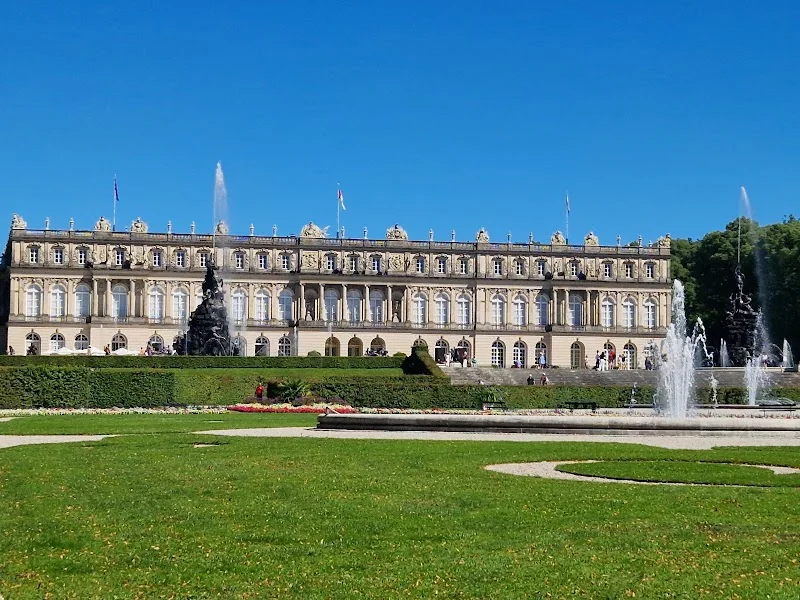
Herrenchiemsee
Altes Schloß, 83209 Herrenchiemsee, Deutschland
New Palace Herrenchiemsee | Opening Hours & Tours
The New Palace Herrenchiemsee is much more than a spectacular excursion destination on an island in Lake Chiemsee. It is a historical monument of longing, the display of power, and the architectural self-realization of King Ludwig II, who had a replica of Versailles built on Herreninsel starting in 1878. Today, the palace is one of the most famous sights in Bavaria and has been part of the UNESCO World Heritage since 2025, along with Neuschwanstein, Linderhof, and the King's House at Schachen. Visitors to the palace experience not only golden state rooms and the famous mirror hall but also an extraordinary island location, a well-organized visitor operation, and an ensemble that uniquely connects history and landscape. ([schloesser.bayern.de](https://www.schloesser.bayern.de/deutsch/schloss/objekte/hch_ns.htm))
For SEO searches related to Herrenchiemsee, Google Autocomplete terms clearly show what visitors really want to know: opening hours, tours, boat trips, access, parking, mirror hall, history, interior views, photos, winter visits, and dog rules. These topics are crucial for planning because the New Palace is not a place for a short stop but an excursion destination best visited with time, good preparation, and a look at the schedules. The palace can only be visited internally as part of a guided tour, and the journey to Herreninsel is also part of the experience. ([schloesser.bayern.de](https://www.schloesser.bayern.de/deutsch/schloss/objekte/hch_ns.htm))
Opening Hours and Tours at the New Palace Herrenchiemsee
The current opening hours are clearly defined: The New Palace Herrenchiemsee is open daily, but with seasonally adjusted times. From October 25 to March, the hours are 10:00 AM to 4:45 PM, and from April to October 24, 9:00 AM to 6:00 PM. It is only closed on a few days of the year, namely January 1, on Shrove Tuesday, and on December 24, 25, and 31. This regulation makes planning easy, as the visit can be well coordinated with a day trip. Especially important: The state rooms of the New Palace are only accessible as part of a guided tour, and tours run regularly. ([schloesser.bayern.de](https://www.schloesser.bayern.de/deutsch/schloss/objekte/hch_ns.htm))
The tours last about 40 minutes, which is pleasantly compact for visitors but still allows enough time to experience the most important rooms at leisure. Those who do not want to clarify everything spontaneously on-site can book tickets in the online ticket shop or purchase them on the island; there is also a contingent for spontaneous guests, but during peak times, waiting times or fully booked tours may occur. For the 2026 season, the special exhibition “Can You Still? – Art and Democracy” is also planned at the New Palace, which will run from May 18 to October 18, 2026, and is included in the overall island ticket. This is particularly interesting for visitors looking for an additional exhibition incentive alongside the classic palace tour. ([herrenchiemsee.de](https://www.herrenchiemsee.de/englisch/tourist/index.htm))
The King Ludwig II Museum in the south wing is also part of the visitor experience and can be visited without a guided tour. It complements the state rooms with biographical and historical backgrounds and is ideal for those who want to understand the palace not just as a photo motif but as a cultural place. Those who want to experience the entire Herreninsel should also plan to visit the Augustinian Canons' Monastery and the other island offerings. This way, a single palace visit becomes a complete day trip that connects architecture, museum, landscape, and history. ([schloesser.bayern.de](https://www.schloesser.bayern.de/deutsch/schloss/objekte/hch_ns.htm))
Access, Boat Trips, and Parking on Herreninsel
The journey to the New Palace Herrenchiemsee is a central topic because the palace cannot be reached directly by car. The official route leads via the A8, exit Bernau, continuing to Prien am Chiemsee. There, follow the signs towards Chiemsee or the royal palace to the paid parking lot. Regular boats operate from Prien/Stock to Herreninsel. Those who plan their journey well should understand the land route and the boat passage as a cohesive trip, as the island character is part of the experience here. ([herrenchiemsee.de](https://www.herrenchiemsee.de/deutsch/tourist/anfahrt.htm))
Using public transport, the journey is also comfortable. The train goes to Prien am Chiemsee, and from there, the Chiemsee-Bahn operates to the boat landing stage Prien/Stock during the summer season. The walk from the train station to the landing stage takes about 30 minutes. The official site recommends planning about an hour for the entire journey, including the boat trip. This is particularly sensible on days with high visitor numbers, as it prevents arriving under time pressure for the tour. For many visitors, the boat ride across Lake Chiemsee is already a highlight, as the approach to the island builds the first impression of the palace, park, and lake landscape. ([herrenchiemsee.de](https://www.herrenchiemsee.de/deutsch/tourist/anfahrt.htm))
Upon landing on Herreninsel, there is a practical carriage connection in summer. The carriages usually operate from mid-April to the end of October, depending on the weather, between the boat landing stage and the New Palace. The ride takes about 15 minutes and costs 5 euros for adults, and 2 euros for children and teenagers aged 5 to 14. Those who prefer to walk can reach the New Palace in about 20 minutes, but the carriage is particularly convenient when traveling with children, older people, or after a longer journey. For visitors with mobility impairments, the administration particularly recommends the crossing from Prien am Chiemsee; there, accessible toilets and parking spaces are easily reachable, and the boats are accessible via mobile ramps. ([herrenchiemsee.de](https://www.herrenchiemsee.de/englisch/tourist/index.htm))
The Mirror Hall and the State Rooms from the Inside
The interior of the New Palace is the real reason why Herrenchiemsee receives worldwide attention. The most famous room is the Great Mirror Gallery, which stretches 98 meters along the garden front. Thus, it is longer than its Versailles model. The building was executed from 1879 to 1881 according to plans and under the direction of Georg Dollmann and combines wall mirrors, standing candlesticks, and glass chandeliers into a staging of light and brilliance that still overwhelms today. For Ludwig II, this room was not just decoration but a tangible expression of the absolutist ideal and the veneration of Louis XIV, the “Sun King.” ([herrenchiemsee.de](https://www.herrenchiemsee.de/deutsch/n_schloss/spiegelgalerie.htm?utm_source=openai))
Highlights of the tour also include the grand staircase, the Hartschiersaal, the state bedroom, the porcelain cabinet, and the small gallery. The southern staircase was the original main entrance to the palace and is oriented towards the former ambassador staircase in Versailles. The Hartschiersaal recalls the royal guard of the Bavarian kings, while the state bedroom was handed over to the king as the first completed room on September 18, 1881. The color and material world is also striking: white, gold, and blue characterize many rooms, along with marble, stucco marble, textiles, and intricately carved woodwork. The porcelain cabinet was originally intended to have an even richer decoration with porcelain plates; ultimately, mainly the folding doors and ceiling paintings were realized. ([herrenchiemsee.de](https://www.herrenchiemsee.de/deutsch/n_schloss/prunktreppe.htm?utm_source=openai))
Those who experience the rooms in practice quickly realize that the New Palace is not a sterile museum but a conscious stage architecture. Many elements are designed for representation and impact, not for everyday usability. This is exactly why the rooms are so fascinating: they show how Ludwig II idealized the courtly world of France and translated it into a Bavarian palace landscape. Although the palace remained unfinished, this is precisely part of its effect. It is simultaneously a manifesto, a torso, and dream architecture. The visitor tour makes this character well-experienced, as it makes the sequence of rooms a staged path through a royal image program. ([schloesser.bayern.de](https://www.schloesser.bayern.de/deutsch/schloss/objekte/hch_ns.htm))
History, Construction Idea, and UNESCO World Heritage
The history of Herrenchiemsee begins with an idea that had already matured before the actual construction. Planning for Ludwig's dream world began in 1868, in 1873 he acquired the Chiemsee island Herrenwörth as a construction site, and from 1878 he had a replica of Versailles built on Herreninsel. The architect Georg Dollmann had to study the model closely and also reconstruct rooms that no longer existed in Versailles itself. In historical sources, the New Palace is described as a “temple of glory” for Louis XIV, thus as a monument of absolutist kingship without practical function. This claim explains the overwhelming splendor as well as the special coherence of the overall concept. ([schloesser.bayern.de](https://www.schloesser.bayern.de/deutsch/schloss/objekte/hch_ns.htm))
The interior was intended to even surpass the French model. During the construction and furnishing phase, Georg Dollmann initially and later Julius Hofmann were involved. Within a few years, an interior world of floors, paneling, stucco marble, wall and ceiling paintings, sculptures, and precious furniture emerged. However, the construction was never completed: in 1885, the work had to be stopped for financial reasons, and the death of Ludwig II in 1886 ultimately ended the grand project. Therefore, Herrenchiemsee is often described as a torso, that is, an unfinished building whose effect arises precisely from this tension between the idea of completion and open end. ([bayernportal.de](https://www.bayernportal.de/dokumente/behoerde/711412981678))
After the king's death, a new history of use began. About forty years later, in 1927, the King Ludwig II Museum was opened on the ground floor of the south wing. It received its furnishings from the collections of the Residence Museum in Munich and the memorial site at Schloss Berg on Lake Starnberg, supplemented by new acquisitions from the palace administration. In the 1960s, the museum had to close due to moisture, but the place remained culturally vibrant. The restoration of the water features in the palace park was also particularly important: starting in the fall of 1969, the Bavarian Palace Administration worked on this, and the Latona Fountain was reconstructed in 1970/72, followed by the Fama and Fortuna Fountains in 1994. Since 2025, Herrenchiemsee has been part of the UNESCO World Heritage of Ludwig II's castles, further emphasizing the international significance of the ensemble. ([bayernportal.de](https://www.bayernportal.de/dokumente/behoerde/711412981678))
Dogs, Photos, Winter, and Practical Visitor Tips
For concrete visit planning, the practical rules at Herrenchiemsee are just as important as the historical facts. Dogs and other pets are not allowed in the buildings, and dogs should remain on a leash on the island. Bicycles, scooters, and roller skates are also not allowed on the island for safety reasons. Those traveling with children, backpacks, or umbrellas should also note that bulky items such as large backpacks or strollers are not permitted in the museum rooms; only a limited number of lockers are available. These guidelines may seem strict at first, but they ensure that the historical rooms remain protected and that visitor flow functions well. ([herrenchiemsee.de](https://www.herrenchiemsee.de/englisch/tourist/index.htm))
The topic of photos is also one of the frequently searched questions. Photography and filming are not allowed inside the buildings; exterior shots are only permitted for private purposes. Special permits apply for further photo or film use. Therefore, those who want to bring pictures of the New Palace should focus on exterior views, the view from the lake, and the park landscape. For the actual interior visit, it is worthwhile to consciously put away the smartphone and experience the rooms with one's own eyes. Especially the mirror gallery, the staircase, and the state bedroom reveal their effect most strongly when the tour is followed without constant photographing. ([herrenchiemsee.de](https://www.herrenchiemsee.de/englisch/tourist/index.htm))
In winter and during the off-season, not only the opening hours change, but also the conditions on the island. The water features in front of the New Palace only operate from early May to October 3, and paths that are not cleared or salted in winter are considered not open to the public. This is an important note for anyone wanting to travel to Herrenchiemsee in winter: sturdy footwear, a warm jacket, and some time reserve are advisable, as the island weather at Chiemsee often feels fresher than inland. At the same time, the quieter season is particularly appealing because the palace is less crowded, and the view over the lake and shore can appear particularly clear. ([herrenchiemsee.de](https://herrenchiemsee.de/englisch/tourist/opening.htm))
It is also practical that there is free accessible Wi-Fi on the island at several hotspots and that groups of 15 or more should plan a reservation. The administration recommends submitting inquiries at least 14 days before the visit. Those who prepare well for the day ideally combine the boat, carriage, palace tour, and museum in a single excursion. This way, the visit becomes not just a mere program point but a complete island day with clear dramaturgy: arrival by boat, approach to the palace, tour through the state rooms, and then a walk through the park and island. It is precisely in this mix that Herrenchiemsee's special strength lies. ([herrenchiemsee.de](https://www.herrenchiemsee.de/englisch/tourist/index.htm))
Sources:
Show moreShow less
New Palace Herrenchiemsee | Opening Hours & Tours
The New Palace Herrenchiemsee is much more than a spectacular excursion destination on an island in Lake Chiemsee. It is a historical monument of longing, the display of power, and the architectural self-realization of King Ludwig II, who had a replica of Versailles built on Herreninsel starting in 1878. Today, the palace is one of the most famous sights in Bavaria and has been part of the UNESCO World Heritage since 2025, along with Neuschwanstein, Linderhof, and the King's House at Schachen. Visitors to the palace experience not only golden state rooms and the famous mirror hall but also an extraordinary island location, a well-organized visitor operation, and an ensemble that uniquely connects history and landscape. ([schloesser.bayern.de](https://www.schloesser.bayern.de/deutsch/schloss/objekte/hch_ns.htm))
For SEO searches related to Herrenchiemsee, Google Autocomplete terms clearly show what visitors really want to know: opening hours, tours, boat trips, access, parking, mirror hall, history, interior views, photos, winter visits, and dog rules. These topics are crucial for planning because the New Palace is not a place for a short stop but an excursion destination best visited with time, good preparation, and a look at the schedules. The palace can only be visited internally as part of a guided tour, and the journey to Herreninsel is also part of the experience. ([schloesser.bayern.de](https://www.schloesser.bayern.de/deutsch/schloss/objekte/hch_ns.htm))
Opening Hours and Tours at the New Palace Herrenchiemsee
The current opening hours are clearly defined: The New Palace Herrenchiemsee is open daily, but with seasonally adjusted times. From October 25 to March, the hours are 10:00 AM to 4:45 PM, and from April to October 24, 9:00 AM to 6:00 PM. It is only closed on a few days of the year, namely January 1, on Shrove Tuesday, and on December 24, 25, and 31. This regulation makes planning easy, as the visit can be well coordinated with a day trip. Especially important: The state rooms of the New Palace are only accessible as part of a guided tour, and tours run regularly. ([schloesser.bayern.de](https://www.schloesser.bayern.de/deutsch/schloss/objekte/hch_ns.htm))
The tours last about 40 minutes, which is pleasantly compact for visitors but still allows enough time to experience the most important rooms at leisure. Those who do not want to clarify everything spontaneously on-site can book tickets in the online ticket shop or purchase them on the island; there is also a contingent for spontaneous guests, but during peak times, waiting times or fully booked tours may occur. For the 2026 season, the special exhibition “Can You Still? – Art and Democracy” is also planned at the New Palace, which will run from May 18 to October 18, 2026, and is included in the overall island ticket. This is particularly interesting for visitors looking for an additional exhibition incentive alongside the classic palace tour. ([herrenchiemsee.de](https://www.herrenchiemsee.de/englisch/tourist/index.htm))
The King Ludwig II Museum in the south wing is also part of the visitor experience and can be visited without a guided tour. It complements the state rooms with biographical and historical backgrounds and is ideal for those who want to understand the palace not just as a photo motif but as a cultural place. Those who want to experience the entire Herreninsel should also plan to visit the Augustinian Canons' Monastery and the other island offerings. This way, a single palace visit becomes a complete day trip that connects architecture, museum, landscape, and history. ([schloesser.bayern.de](https://www.schloesser.bayern.de/deutsch/schloss/objekte/hch_ns.htm))
Access, Boat Trips, and Parking on Herreninsel
The journey to the New Palace Herrenchiemsee is a central topic because the palace cannot be reached directly by car. The official route leads via the A8, exit Bernau, continuing to Prien am Chiemsee. There, follow the signs towards Chiemsee or the royal palace to the paid parking lot. Regular boats operate from Prien/Stock to Herreninsel. Those who plan their journey well should understand the land route and the boat passage as a cohesive trip, as the island character is part of the experience here. ([herrenchiemsee.de](https://www.herrenchiemsee.de/deutsch/tourist/anfahrt.htm))
Using public transport, the journey is also comfortable. The train goes to Prien am Chiemsee, and from there, the Chiemsee-Bahn operates to the boat landing stage Prien/Stock during the summer season. The walk from the train station to the landing stage takes about 30 minutes. The official site recommends planning about an hour for the entire journey, including the boat trip. This is particularly sensible on days with high visitor numbers, as it prevents arriving under time pressure for the tour. For many visitors, the boat ride across Lake Chiemsee is already a highlight, as the approach to the island builds the first impression of the palace, park, and lake landscape. ([herrenchiemsee.de](https://www.herrenchiemsee.de/deutsch/tourist/anfahrt.htm))
Upon landing on Herreninsel, there is a practical carriage connection in summer. The carriages usually operate from mid-April to the end of October, depending on the weather, between the boat landing stage and the New Palace. The ride takes about 15 minutes and costs 5 euros for adults, and 2 euros for children and teenagers aged 5 to 14. Those who prefer to walk can reach the New Palace in about 20 minutes, but the carriage is particularly convenient when traveling with children, older people, or after a longer journey. For visitors with mobility impairments, the administration particularly recommends the crossing from Prien am Chiemsee; there, accessible toilets and parking spaces are easily reachable, and the boats are accessible via mobile ramps. ([herrenchiemsee.de](https://www.herrenchiemsee.de/englisch/tourist/index.htm))
The Mirror Hall and the State Rooms from the Inside
The interior of the New Palace is the real reason why Herrenchiemsee receives worldwide attention. The most famous room is the Great Mirror Gallery, which stretches 98 meters along the garden front. Thus, it is longer than its Versailles model. The building was executed from 1879 to 1881 according to plans and under the direction of Georg Dollmann and combines wall mirrors, standing candlesticks, and glass chandeliers into a staging of light and brilliance that still overwhelms today. For Ludwig II, this room was not just decoration but a tangible expression of the absolutist ideal and the veneration of Louis XIV, the “Sun King.” ([herrenchiemsee.de](https://www.herrenchiemsee.de/deutsch/n_schloss/spiegelgalerie.htm?utm_source=openai))
Highlights of the tour also include the grand staircase, the Hartschiersaal, the state bedroom, the porcelain cabinet, and the small gallery. The southern staircase was the original main entrance to the palace and is oriented towards the former ambassador staircase in Versailles. The Hartschiersaal recalls the royal guard of the Bavarian kings, while the state bedroom was handed over to the king as the first completed room on September 18, 1881. The color and material world is also striking: white, gold, and blue characterize many rooms, along with marble, stucco marble, textiles, and intricately carved woodwork. The porcelain cabinet was originally intended to have an even richer decoration with porcelain plates; ultimately, mainly the folding doors and ceiling paintings were realized. ([herrenchiemsee.de](https://www.herrenchiemsee.de/deutsch/n_schloss/prunktreppe.htm?utm_source=openai))
Those who experience the rooms in practice quickly realize that the New Palace is not a sterile museum but a conscious stage architecture. Many elements are designed for representation and impact, not for everyday usability. This is exactly why the rooms are so fascinating: they show how Ludwig II idealized the courtly world of France and translated it into a Bavarian palace landscape. Although the palace remained unfinished, this is precisely part of its effect. It is simultaneously a manifesto, a torso, and dream architecture. The visitor tour makes this character well-experienced, as it makes the sequence of rooms a staged path through a royal image program. ([schloesser.bayern.de](https://www.schloesser.bayern.de/deutsch/schloss/objekte/hch_ns.htm))
History, Construction Idea, and UNESCO World Heritage
The history of Herrenchiemsee begins with an idea that had already matured before the actual construction. Planning for Ludwig's dream world began in 1868, in 1873 he acquired the Chiemsee island Herrenwörth as a construction site, and from 1878 he had a replica of Versailles built on Herreninsel. The architect Georg Dollmann had to study the model closely and also reconstruct rooms that no longer existed in Versailles itself. In historical sources, the New Palace is described as a “temple of glory” for Louis XIV, thus as a monument of absolutist kingship without practical function. This claim explains the overwhelming splendor as well as the special coherence of the overall concept. ([schloesser.bayern.de](https://www.schloesser.bayern.de/deutsch/schloss/objekte/hch_ns.htm))
The interior was intended to even surpass the French model. During the construction and furnishing phase, Georg Dollmann initially and later Julius Hofmann were involved. Within a few years, an interior world of floors, paneling, stucco marble, wall and ceiling paintings, sculptures, and precious furniture emerged. However, the construction was never completed: in 1885, the work had to be stopped for financial reasons, and the death of Ludwig II in 1886 ultimately ended the grand project. Therefore, Herrenchiemsee is often described as a torso, that is, an unfinished building whose effect arises precisely from this tension between the idea of completion and open end. ([bayernportal.de](https://www.bayernportal.de/dokumente/behoerde/711412981678))
After the king's death, a new history of use began. About forty years later, in 1927, the King Ludwig II Museum was opened on the ground floor of the south wing. It received its furnishings from the collections of the Residence Museum in Munich and the memorial site at Schloss Berg on Lake Starnberg, supplemented by new acquisitions from the palace administration. In the 1960s, the museum had to close due to moisture, but the place remained culturally vibrant. The restoration of the water features in the palace park was also particularly important: starting in the fall of 1969, the Bavarian Palace Administration worked on this, and the Latona Fountain was reconstructed in 1970/72, followed by the Fama and Fortuna Fountains in 1994. Since 2025, Herrenchiemsee has been part of the UNESCO World Heritage of Ludwig II's castles, further emphasizing the international significance of the ensemble. ([bayernportal.de](https://www.bayernportal.de/dokumente/behoerde/711412981678))
Dogs, Photos, Winter, and Practical Visitor Tips
For concrete visit planning, the practical rules at Herrenchiemsee are just as important as the historical facts. Dogs and other pets are not allowed in the buildings, and dogs should remain on a leash on the island. Bicycles, scooters, and roller skates are also not allowed on the island for safety reasons. Those traveling with children, backpacks, or umbrellas should also note that bulky items such as large backpacks or strollers are not permitted in the museum rooms; only a limited number of lockers are available. These guidelines may seem strict at first, but they ensure that the historical rooms remain protected and that visitor flow functions well. ([herrenchiemsee.de](https://www.herrenchiemsee.de/englisch/tourist/index.htm))
The topic of photos is also one of the frequently searched questions. Photography and filming are not allowed inside the buildings; exterior shots are only permitted for private purposes. Special permits apply for further photo or film use. Therefore, those who want to bring pictures of the New Palace should focus on exterior views, the view from the lake, and the park landscape. For the actual interior visit, it is worthwhile to consciously put away the smartphone and experience the rooms with one's own eyes. Especially the mirror gallery, the staircase, and the state bedroom reveal their effect most strongly when the tour is followed without constant photographing. ([herrenchiemsee.de](https://www.herrenchiemsee.de/englisch/tourist/index.htm))
In winter and during the off-season, not only the opening hours change, but also the conditions on the island. The water features in front of the New Palace only operate from early May to October 3, and paths that are not cleared or salted in winter are considered not open to the public. This is an important note for anyone wanting to travel to Herrenchiemsee in winter: sturdy footwear, a warm jacket, and some time reserve are advisable, as the island weather at Chiemsee often feels fresher than inland. At the same time, the quieter season is particularly appealing because the palace is less crowded, and the view over the lake and shore can appear particularly clear. ([herrenchiemsee.de](https://herrenchiemsee.de/englisch/tourist/opening.htm))
It is also practical that there is free accessible Wi-Fi on the island at several hotspots and that groups of 15 or more should plan a reservation. The administration recommends submitting inquiries at least 14 days before the visit. Those who prepare well for the day ideally combine the boat, carriage, palace tour, and museum in a single excursion. This way, the visit becomes not just a mere program point but a complete island day with clear dramaturgy: arrival by boat, approach to the palace, tour through the state rooms, and then a walk through the park and island. It is precisely in this mix that Herrenchiemsee's special strength lies. ([herrenchiemsee.de](https://www.herrenchiemsee.de/englisch/tourist/index.htm))
Sources:
New Palace Herrenchiemsee | Opening Hours & Tours
The New Palace Herrenchiemsee is much more than a spectacular excursion destination on an island in Lake Chiemsee. It is a historical monument of longing, the display of power, and the architectural self-realization of King Ludwig II, who had a replica of Versailles built on Herreninsel starting in 1878. Today, the palace is one of the most famous sights in Bavaria and has been part of the UNESCO World Heritage since 2025, along with Neuschwanstein, Linderhof, and the King's House at Schachen. Visitors to the palace experience not only golden state rooms and the famous mirror hall but also an extraordinary island location, a well-organized visitor operation, and an ensemble that uniquely connects history and landscape. ([schloesser.bayern.de](https://www.schloesser.bayern.de/deutsch/schloss/objekte/hch_ns.htm))
For SEO searches related to Herrenchiemsee, Google Autocomplete terms clearly show what visitors really want to know: opening hours, tours, boat trips, access, parking, mirror hall, history, interior views, photos, winter visits, and dog rules. These topics are crucial for planning because the New Palace is not a place for a short stop but an excursion destination best visited with time, good preparation, and a look at the schedules. The palace can only be visited internally as part of a guided tour, and the journey to Herreninsel is also part of the experience. ([schloesser.bayern.de](https://www.schloesser.bayern.de/deutsch/schloss/objekte/hch_ns.htm))
Opening Hours and Tours at the New Palace Herrenchiemsee
The current opening hours are clearly defined: The New Palace Herrenchiemsee is open daily, but with seasonally adjusted times. From October 25 to March, the hours are 10:00 AM to 4:45 PM, and from April to October 24, 9:00 AM to 6:00 PM. It is only closed on a few days of the year, namely January 1, on Shrove Tuesday, and on December 24, 25, and 31. This regulation makes planning easy, as the visit can be well coordinated with a day trip. Especially important: The state rooms of the New Palace are only accessible as part of a guided tour, and tours run regularly. ([schloesser.bayern.de](https://www.schloesser.bayern.de/deutsch/schloss/objekte/hch_ns.htm))
The tours last about 40 minutes, which is pleasantly compact for visitors but still allows enough time to experience the most important rooms at leisure. Those who do not want to clarify everything spontaneously on-site can book tickets in the online ticket shop or purchase them on the island; there is also a contingent for spontaneous guests, but during peak times, waiting times or fully booked tours may occur. For the 2026 season, the special exhibition “Can You Still? – Art and Democracy” is also planned at the New Palace, which will run from May 18 to October 18, 2026, and is included in the overall island ticket. This is particularly interesting for visitors looking for an additional exhibition incentive alongside the classic palace tour. ([herrenchiemsee.de](https://www.herrenchiemsee.de/englisch/tourist/index.htm))
The King Ludwig II Museum in the south wing is also part of the visitor experience and can be visited without a guided tour. It complements the state rooms with biographical and historical backgrounds and is ideal for those who want to understand the palace not just as a photo motif but as a cultural place. Those who want to experience the entire Herreninsel should also plan to visit the Augustinian Canons' Monastery and the other island offerings. This way, a single palace visit becomes a complete day trip that connects architecture, museum, landscape, and history. ([schloesser.bayern.de](https://www.schloesser.bayern.de/deutsch/schloss/objekte/hch_ns.htm))
Access, Boat Trips, and Parking on Herreninsel
The journey to the New Palace Herrenchiemsee is a central topic because the palace cannot be reached directly by car. The official route leads via the A8, exit Bernau, continuing to Prien am Chiemsee. There, follow the signs towards Chiemsee or the royal palace to the paid parking lot. Regular boats operate from Prien/Stock to Herreninsel. Those who plan their journey well should understand the land route and the boat passage as a cohesive trip, as the island character is part of the experience here. ([herrenchiemsee.de](https://www.herrenchiemsee.de/deutsch/tourist/anfahrt.htm))
Using public transport, the journey is also comfortable. The train goes to Prien am Chiemsee, and from there, the Chiemsee-Bahn operates to the boat landing stage Prien/Stock during the summer season. The walk from the train station to the landing stage takes about 30 minutes. The official site recommends planning about an hour for the entire journey, including the boat trip. This is particularly sensible on days with high visitor numbers, as it prevents arriving under time pressure for the tour. For many visitors, the boat ride across Lake Chiemsee is already a highlight, as the approach to the island builds the first impression of the palace, park, and lake landscape. ([herrenchiemsee.de](https://www.herrenchiemsee.de/deutsch/tourist/anfahrt.htm))
Upon landing on Herreninsel, there is a practical carriage connection in summer. The carriages usually operate from mid-April to the end of October, depending on the weather, between the boat landing stage and the New Palace. The ride takes about 15 minutes and costs 5 euros for adults, and 2 euros for children and teenagers aged 5 to 14. Those who prefer to walk can reach the New Palace in about 20 minutes, but the carriage is particularly convenient when traveling with children, older people, or after a longer journey. For visitors with mobility impairments, the administration particularly recommends the crossing from Prien am Chiemsee; there, accessible toilets and parking spaces are easily reachable, and the boats are accessible via mobile ramps. ([herrenchiemsee.de](https://www.herrenchiemsee.de/englisch/tourist/index.htm))
The Mirror Hall and the State Rooms from the Inside
The interior of the New Palace is the real reason why Herrenchiemsee receives worldwide attention. The most famous room is the Great Mirror Gallery, which stretches 98 meters along the garden front. Thus, it is longer than its Versailles model. The building was executed from 1879 to 1881 according to plans and under the direction of Georg Dollmann and combines wall mirrors, standing candlesticks, and glass chandeliers into a staging of light and brilliance that still overwhelms today. For Ludwig II, this room was not just decoration but a tangible expression of the absolutist ideal and the veneration of Louis XIV, the “Sun King.” ([herrenchiemsee.de](https://www.herrenchiemsee.de/deutsch/n_schloss/spiegelgalerie.htm?utm_source=openai))
Highlights of the tour also include the grand staircase, the Hartschiersaal, the state bedroom, the porcelain cabinet, and the small gallery. The southern staircase was the original main entrance to the palace and is oriented towards the former ambassador staircase in Versailles. The Hartschiersaal recalls the royal guard of the Bavarian kings, while the state bedroom was handed over to the king as the first completed room on September 18, 1881. The color and material world is also striking: white, gold, and blue characterize many rooms, along with marble, stucco marble, textiles, and intricately carved woodwork. The porcelain cabinet was originally intended to have an even richer decoration with porcelain plates; ultimately, mainly the folding doors and ceiling paintings were realized. ([herrenchiemsee.de](https://www.herrenchiemsee.de/deutsch/n_schloss/prunktreppe.htm?utm_source=openai))
Those who experience the rooms in practice quickly realize that the New Palace is not a sterile museum but a conscious stage architecture. Many elements are designed for representation and impact, not for everyday usability. This is exactly why the rooms are so fascinating: they show how Ludwig II idealized the courtly world of France and translated it into a Bavarian palace landscape. Although the palace remained unfinished, this is precisely part of its effect. It is simultaneously a manifesto, a torso, and dream architecture. The visitor tour makes this character well-experienced, as it makes the sequence of rooms a staged path through a royal image program. ([schloesser.bayern.de](https://www.schloesser.bayern.de/deutsch/schloss/objekte/hch_ns.htm))
History, Construction Idea, and UNESCO World Heritage
The history of Herrenchiemsee begins with an idea that had already matured before the actual construction. Planning for Ludwig's dream world began in 1868, in 1873 he acquired the Chiemsee island Herrenwörth as a construction site, and from 1878 he had a replica of Versailles built on Herreninsel. The architect Georg Dollmann had to study the model closely and also reconstruct rooms that no longer existed in Versailles itself. In historical sources, the New Palace is described as a “temple of glory” for Louis XIV, thus as a monument of absolutist kingship without practical function. This claim explains the overwhelming splendor as well as the special coherence of the overall concept. ([schloesser.bayern.de](https://www.schloesser.bayern.de/deutsch/schloss/objekte/hch_ns.htm))
The interior was intended to even surpass the French model. During the construction and furnishing phase, Georg Dollmann initially and later Julius Hofmann were involved. Within a few years, an interior world of floors, paneling, stucco marble, wall and ceiling paintings, sculptures, and precious furniture emerged. However, the construction was never completed: in 1885, the work had to be stopped for financial reasons, and the death of Ludwig II in 1886 ultimately ended the grand project. Therefore, Herrenchiemsee is often described as a torso, that is, an unfinished building whose effect arises precisely from this tension between the idea of completion and open end. ([bayernportal.de](https://www.bayernportal.de/dokumente/behoerde/711412981678))
After the king's death, a new history of use began. About forty years later, in 1927, the King Ludwig II Museum was opened on the ground floor of the south wing. It received its furnishings from the collections of the Residence Museum in Munich and the memorial site at Schloss Berg on Lake Starnberg, supplemented by new acquisitions from the palace administration. In the 1960s, the museum had to close due to moisture, but the place remained culturally vibrant. The restoration of the water features in the palace park was also particularly important: starting in the fall of 1969, the Bavarian Palace Administration worked on this, and the Latona Fountain was reconstructed in 1970/72, followed by the Fama and Fortuna Fountains in 1994. Since 2025, Herrenchiemsee has been part of the UNESCO World Heritage of Ludwig II's castles, further emphasizing the international significance of the ensemble. ([bayernportal.de](https://www.bayernportal.de/dokumente/behoerde/711412981678))
Dogs, Photos, Winter, and Practical Visitor Tips
For concrete visit planning, the practical rules at Herrenchiemsee are just as important as the historical facts. Dogs and other pets are not allowed in the buildings, and dogs should remain on a leash on the island. Bicycles, scooters, and roller skates are also not allowed on the island for safety reasons. Those traveling with children, backpacks, or umbrellas should also note that bulky items such as large backpacks or strollers are not permitted in the museum rooms; only a limited number of lockers are available. These guidelines may seem strict at first, but they ensure that the historical rooms remain protected and that visitor flow functions well. ([herrenchiemsee.de](https://www.herrenchiemsee.de/englisch/tourist/index.htm))
The topic of photos is also one of the frequently searched questions. Photography and filming are not allowed inside the buildings; exterior shots are only permitted for private purposes. Special permits apply for further photo or film use. Therefore, those who want to bring pictures of the New Palace should focus on exterior views, the view from the lake, and the park landscape. For the actual interior visit, it is worthwhile to consciously put away the smartphone and experience the rooms with one's own eyes. Especially the mirror gallery, the staircase, and the state bedroom reveal their effect most strongly when the tour is followed without constant photographing. ([herrenchiemsee.de](https://www.herrenchiemsee.de/englisch/tourist/index.htm))
In winter and during the off-season, not only the opening hours change, but also the conditions on the island. The water features in front of the New Palace only operate from early May to October 3, and paths that are not cleared or salted in winter are considered not open to the public. This is an important note for anyone wanting to travel to Herrenchiemsee in winter: sturdy footwear, a warm jacket, and some time reserve are advisable, as the island weather at Chiemsee often feels fresher than inland. At the same time, the quieter season is particularly appealing because the palace is less crowded, and the view over the lake and shore can appear particularly clear. ([herrenchiemsee.de](https://herrenchiemsee.de/englisch/tourist/opening.htm))
It is also practical that there is free accessible Wi-Fi on the island at several hotspots and that groups of 15 or more should plan a reservation. The administration recommends submitting inquiries at least 14 days before the visit. Those who prepare well for the day ideally combine the boat, carriage, palace tour, and museum in a single excursion. This way, the visit becomes not just a mere program point but a complete island day with clear dramaturgy: arrival by boat, approach to the palace, tour through the state rooms, and then a walk through the park and island. It is precisely in this mix that Herrenchiemsee's special strength lies. ([herrenchiemsee.de](https://www.herrenchiemsee.de/englisch/tourist/index.htm))
Sources:
Frequently Asked Questions
Reviews
Pav Vlad
3. June 2026
Herrenchiemsee is the third and final palace commission by Ludwig II. It was designed to directly emulate Versailles (its central part). It was always meant to be Ludwig's private museum and not meant to host court or any guests. Only 20 of the 70 rooms were finished before Ludwig's demise. Unfortunately, photos are not allowed inside. But there is a museum with some things from Ludwig's Munich Residence. These you could photograph, and they provide a pale shadow of the palace's glamour. There is also a model of Ludwig's 4th castle project, which was never started. I was so impressed by the other two projects: Linderhof and Neuschwanstein, that I scrapped my plans for one of two days in Salzburg and drove here. Of the three palaces, I found Herrenchiemsee the least impressive. But still absolutely worth visiting. Access to the palace is on guided tour only (same as the other two). Tours run every 10 minutes, but only a handful are in English a day - I recommend booking in advance, as people jump on the first tour they can get, even without knowing that language. The palace is on an island. The best way to get here is from Prien am Chiemsee. A ferry runs every 30 minutes and it takes 15 minutes for a one-way trip. A return ferry ticket was €11.50. I paid €7.50 for about 5 hours of parking and had no issues finding a spot at 10:00 AM, but parking was full when I left after 3:00 PM.
Raphaëlle
11. January 2026
Amazing visit at Herrenchiemsee on a snowy and cold day. Probably because of those difficult conditions, we had the privilege of having a private tour of the castle with Carolina. She was an outstanding guide, full of energy, engaging, and really friendly. We had a great time! Beware though, if you come in winter, the castle is very cold inside, and you won’t move much, so keep extra layers. Fountains are covered, but pretty much everything else works as normal, boats run every hour from Prien and the café in the castle is open. The park, though not as spectacular as in the summer, looked like a winter wonderland ❄️.
Michael Mack
30. August 2025
Absolutely stunning castle built by King Ludwig II located on a beautiful island in Bavaria. The palace tour we took was amazing. Our tour was in English and our guide was terrific. Extremely knowledgeable on the history of the castle. She was very friendly and spoke perfect English. The castle rooms were spectacular. The two bedrooms are out of this world in terms of its decor. It is amazing that 2/3 of this castle are still not completed. King Ludwig barely stayed here before he died. The castle grounds are perfectly manicured. Several beautiful fountains. Plenty of places to sit and enjoy the outdoors. The walk around the grounds was very peaceful. We took the train from the main train station and the boat across to the castle. We had a perfect day out and loved our visit. Highly recommend visiting this majestic castle.
Tim
7. November 2025
Lake Helen Kim Palace is a magnificent palace modeled after the Palace of Versailles in France. It is a Baroque building. In winter, flocks of geese and ducks graze on the lake, and strolling through the woods on the island offers stunning views of the vibrant autumn foliage.
Viplava
24. September 2025
Magnificent, and rich interiors. If the king hadn't lived in his dream project for more than a handful of days, it wouldn't deserve to be visited more than once in my lifetime. The palace guided tour is about 40 minutes. No photography allowed strictly! This is what I didn't like the most. It's worth the hype and not worth the hype at the same time. The museum is also an interesting visit.