
Chiemsee
Frauenchiemsee (Insel), 83256 Chiemsee, Deutschland
Münster Frauenwörth | History & Access
The Münster Frauenwörth on Fraueninsel in Chiemsee is one of those places that seem quiet at first glance yet carry an extraordinarily rich history. Arriving by ship, one sees not only a monastery complex on an island but a vibrant spiritual center with centuries-old continuity, a clear Benedictine character, and an atmosphere that distinctly differs from classic tourist destinations. The Abbey of Frauenwörth is one of the oldest women's monasteries in the German-speaking world and remains home to a community of Benedictine nuns to this day. Accessible to visitors are primarily the church and the gate hall; the actual monastery remains protected as the living space of the community. This blend of openness and seclusion is precisely what makes the place appealing. At the same time, Frauenwörth is not only a spiritual anchor point but also a venue for seminars, retreats, and culturally interested guests. Therefore, those seeking the Münster Frauenwörth are often looking for more than just a building: they seek history, island feeling, lake access, tranquility, and a very special view of Bavarian culture. ([frauenwoerth.de](https://www.frauenwoerth.de/en/gemeinschaft/geschichte))
History of the Münster and the Abbey of Frauenwörth
The history of Frauenwörth begins in the Carolingian period, a time that was formative for Bavaria and the entire southern German region. The tradition of the abbey traces its founding back to Duke Tassilo III; the abbey itself cites the consecration of the church on September 1, 782, by Bishop Virgil of Salzburg. Although some popular sources mention different years, the core is undisputed: Frauenwörth is a very early, permanently significant women's monastery with roots in the early Middle Ages. By around 850, the blessed Irmengard is documented as the first known abbess. Later, the monastery experienced times of political upheaval, including invasions by Hungarians, the situation of the imperial church, and changes in medieval territorial rule. Important for today's perception is especially the long line of destruction, reconstruction, and renewal: in 1803, the abbey was dissolved during the secularization, but the sisters were allowed to stay. Under King Ludwig I, the monastery was revived in 1837/1838 and was again elevated to abbey status in 1901. The abbey describes itself today as the oldest existing German-speaking women's abbey north of the Alps, alongside Nonnberg in Salzburg. This continuity is not only historically interesting but is also reflected in the local landscape: Frauenwörth is not a museum-like frozen place but a living community with centuries-old memory. This makes the visit so impressive because visitors not only see building blocks from different centuries but also experience the ongoing use of a spiritual place. ([frauenwoerth.de](https://www.frauenwoerth.de/en/gemeinschaft/geschichte))
Access to Fraueninsel and Parking at Chiemsee
The access to the Münster Frauenwörth is inseparably linked to the island situation. There is no direct road connection to Fraueninsel; instead, the journey is made by ship. The Chiemsee shipping line operates year-round from Prien/Stock and Gstadt to Fraueninsel; in summer, additional locations such as Bernau, Chieming, Seebruck, and Übersee/Feldwies are added. Those arriving by train or bus can also easily reach the landing stages, and from there, the ships take them to the island. Practically important is especially the issue of parking: there are no parking spaces on Fraueninsel itself. Instead, paid parking options are available at the landings on the mainland, such as a large parking lot at the Prien/Stock harbor and several parking spaces in Gstadt. Therefore, those arriving by car should always plan the parking strategy before changing ships. For day visitors, Prien/Stock is often the obvious starting point because there is a large parking lot and restrooms available. The shipping providers also point out that all passenger ships have restrooms. This makes the journey manageable and relaxed for families or visitors with longer travel times. For SEO searches related to the Münster Frauenwörth, the topics of access, parking, and ship landings are particularly important because they significantly influence the actual visitor decision. Those planning a quiet cultural or monastery visit benefit from seeing the island as a consciously decelerated destination: one parks at the shore, leaves everyday life behind on the mainland, and approaches the destination across the lake. This short crossing is already part of the experience. ([chiemsee-alpenland.de](https://www.chiemsee-alpenland.de/entdecken/alle-sehenswuerdigkeiten/schiffsanleger-fraueninsel-462e238a08))
Opening Hours, Admission, and Accessibility
For the actual visit to the Münster, practical information is particularly important. According to the Bavarian Palace Administration, the Frauenchiemsee Monastery is open daily from May to October from 11 a.m. to 6 p.m.; during the winter months, the facility is closed. Only the monastery church and the gate hall are accessible to the public, while the monastery itself is not open for visits. Admission is free. This combination of free access and clearly limited visiting areas fits well with the function of the place as a spiritual community and as a cultural monument at the same time. Therefore, upon arrival, one does not experience a classic museum facility with continuous tourist development but rather a historical monastery space that remains in active use. Regarding accessibility, there is a helpful but honest regulation: the main entrance of the monastery church is not suitable for wheelchairs. However, if one calls the monastery gate under the provided phone number, an alternative access option can be opened. Additionally, the paths on Fraueninsel are accessible for wheelchair users. This information is important because it transforms a potentially uncertain visit plan into a well-prepared excursion. Those traveling with elderly relatives, with strollers, or with limited mobility should plan the journey, the ship change, and the church access in advance. This also speaks for the special visitor culture of Frauenwörth: one does not just drop by but consciously prepares the stay. This is precisely why the place is often experienced as quieter, more respectful, and more personal than many other tourist destinations at Chiemsee. ([schloss.bayern.de](https://www.schloss.bayern.de/englisch/palace/objects/fr_chiem.htm))
Seminars, Conferences, and Guesthouse Scholastika
Frauenwörth is not only a historical place but also an active center for encounter, education, and retreat. The abbey opens its monastery for adult education and explicitly emphasizes that non-Christians can also find space. The seminar offerings are diverse: they range from retreats and reflection to visual arts, dance, music, and movement, as well as seminars for heart patients, further training for employees from the private sector and public service, and international congresses in fields such as medicine, law, and business administration. This mix of spiritual tranquility and professional educational work is one of the strongest unique selling points of the location. For seminar participants, the monastery offers simple but comfortable rooms in three categories, including rooms with lake views, courtyard views, or with shared shower and toilet. There are also seminar and event rooms of varying sizes, including rooms up to 50 square meters, up to 90 square meters, and an auditorium measuring 24 by 12 meters. For organizers, this is an important note because Frauenwörth is thus suitable not only for small retreat groups but also for larger formats. Practical arrangements are also made regarding meals, quiet times, and behavior in the monastery: the monastery innkeeper provides meals, no one should be disturbed by noise after 9:30 p.m., and smoking is prohibited in the entire seminar area. Additionally, the guesthouse Scholastika has a special role. It is located directly on the shore of Chiemsee, was built in 1611, and has never been architecturally changed inside or out; after renovation, the historically shaped rooms can be used again. The house explicitly does not consider itself a hotel but rather a place for quiet days, reflection, and retreat. This profile makes Frauenwörth highly relevant for search inquiries related to seminars, guesthouses, and quiet getaways. ([frauenwoerth.de](https://www.frauenwoerth.de/seminare))
Gate Hall, Campanile, and Special Attractions
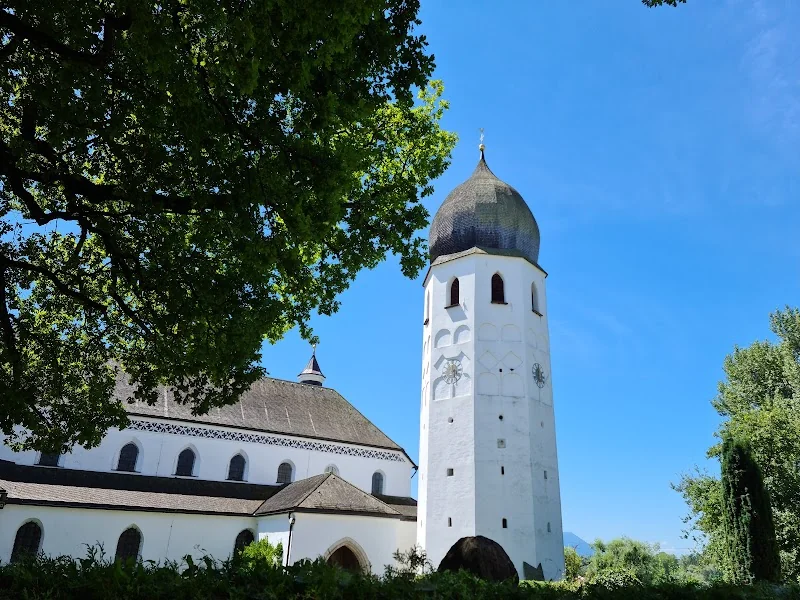
Those searching for the Münster Frauenwörth often mean the entire historical ensemble on Fraueninsel. Particularly important are the gate hall and the free-standing campanile. The gate hall was built in the late Carolingian period around 860 as a gate building of a palace presumably erected by Ludwig the German. During restorations, frescoes from this time were discovered there in 1961. Today, the gate hall is regarded not only as an architectural monument but also as a site for early sacred art in Bavaria; it features medieval architectural and sculptural remnants as well as copies of Agilolfing and Carolingian artworks. The free-standing bell tower of the Münster strongly shapes the silhouette of the island. According to the Bavarian Palace Administration, the lower floors likely date from the 12th century, the upper part of the tower was added in 1395, and the characteristic onion dome was added in 1626. The church itself is also art-historically noteworthy: the current church already existed in the 11th century, was expanded in the 12th and 13th centuries, and received its late Gothic appearance between 1468 and 1476. Particularly significant are the frescoes from around 1130, which are among the earliest surviving examples of Romanesque wall painting in Europe. For visitors, the connection to the blessed Irmengard is also important, whose grave on the island is part of many tours and guided walks. Guided island tours usually last about one to one and a half hours and can be adapted to group programs. This connection of architecture, art history, piety, and island path makes Frauenwörth an unusually dense excursion destination. It is not a single monument but an ensemble in which early Christianity, monastic culture, and Chiemsee landscape mutually reinforce each other. ([museen-in-bayern.de](https://museen-in-bayern.de/museen/detailseite-museum/torhalle-frauenchiemsee-und-vikarhaus))
Why Frauenwörth Feels So Special
Frauenwörth is particularly memorable because several levels come together simultaneously: an active monastery, a historical monument, a seminar location, and an island that is only accessible by lake. This combination creates a tranquility that announces itself already during the crossing. Visitors do not experience a hectic urban space but a place where history has remained visible and which continues to live in the everyday life of a religious community. This also explains why the location frequently appears in search queries with terms such as history, access, parking, opening hours, seminars, guesthouse, and gate hall. Those visiting the Münster Frauenwörth usually want not just to take a picture but to understand a place: How old is it? What can I see? How do I get there? Can I stay there? What is open, what is protected? Frauenwörth provides clear answers to these questions. The publicly accessible church, the free admission for visits, the good ship connections, the clearly described parking options on the mainland, the accessibility information, and the seminar and guesthouse offerings make planning transparent. At the same time, the place remains deliberately quiet and demanding. It is not a loud event location but a characterful place that draws its strength from measure, silence, and historical depth. Those seeking this will find one of the most impressive places at Chiemsee in Frauenwörth. And those who let their gaze wander from the island back to the lake and the mountains quickly understand why this place has attracted people for centuries who want to connect tranquility, meaning, and beauty. ([frauenwoerth.de](https://www.frauenwoerth.de/en/gemeinschaft/geschichte))
Sources:
- Abbey Frauenwörth - History and Contact ([frauenwoerth.de](https://www.frauenwoerth.de/en/gemeinschaft/geschichte))
- Bavarian Palace Administration - Frauenchiemsee Monastery ([schloss.bayern.de](https://www.schloss.bayern.de/englisch/palace/objects/fr_chiem.htm))
- Chiemsee-Alpenland Tourism - Ship Landings Fraueninsel ([chiemsee-alpenland.de](https://www.chiemsee-alpenland.de/entdecken/alle-sehenswuerdigkeiten/schiffsanleger-fraueninsel-462e238a08))
- Chiemsee Shipping - Parking and Restrooms ([chiemsee-schifffahrt.de](https://www.chiemsee-schifffahrt.de/de/infos/parkplaetze-toiletten?cHash=a1edc43b591ff639741ce54dc0375e40&vendor=here))
- Abbey Frauenwörth - Seminars and Guesthouse Scholastika ([frauenwoerth.de](https://www.frauenwoerth.de/seminare))
- Museums in Bavaria - Gate Hall Frauenchiemsee and Vicarage ([museen-in-bayern.de](https://museen-in-bayern.de/museen/detailseite-museum/torhalle-frauenchiemsee-und-vikarhaus))
Show moreShow less
Münster Frauenwörth | History & Access
The Münster Frauenwörth on Fraueninsel in Chiemsee is one of those places that seem quiet at first glance yet carry an extraordinarily rich history. Arriving by ship, one sees not only a monastery complex on an island but a vibrant spiritual center with centuries-old continuity, a clear Benedictine character, and an atmosphere that distinctly differs from classic tourist destinations. The Abbey of Frauenwörth is one of the oldest women's monasteries in the German-speaking world and remains home to a community of Benedictine nuns to this day. Accessible to visitors are primarily the church and the gate hall; the actual monastery remains protected as the living space of the community. This blend of openness and seclusion is precisely what makes the place appealing. At the same time, Frauenwörth is not only a spiritual anchor point but also a venue for seminars, retreats, and culturally interested guests. Therefore, those seeking the Münster Frauenwörth are often looking for more than just a building: they seek history, island feeling, lake access, tranquility, and a very special view of Bavarian culture. ([frauenwoerth.de](https://www.frauenwoerth.de/en/gemeinschaft/geschichte))
History of the Münster and the Abbey of Frauenwörth
The history of Frauenwörth begins in the Carolingian period, a time that was formative for Bavaria and the entire southern German region. The tradition of the abbey traces its founding back to Duke Tassilo III; the abbey itself cites the consecration of the church on September 1, 782, by Bishop Virgil of Salzburg. Although some popular sources mention different years, the core is undisputed: Frauenwörth is a very early, permanently significant women's monastery with roots in the early Middle Ages. By around 850, the blessed Irmengard is documented as the first known abbess. Later, the monastery experienced times of political upheaval, including invasions by Hungarians, the situation of the imperial church, and changes in medieval territorial rule. Important for today's perception is especially the long line of destruction, reconstruction, and renewal: in 1803, the abbey was dissolved during the secularization, but the sisters were allowed to stay. Under King Ludwig I, the monastery was revived in 1837/1838 and was again elevated to abbey status in 1901. The abbey describes itself today as the oldest existing German-speaking women's abbey north of the Alps, alongside Nonnberg in Salzburg. This continuity is not only historically interesting but is also reflected in the local landscape: Frauenwörth is not a museum-like frozen place but a living community with centuries-old memory. This makes the visit so impressive because visitors not only see building blocks from different centuries but also experience the ongoing use of a spiritual place. ([frauenwoerth.de](https://www.frauenwoerth.de/en/gemeinschaft/geschichte))
Access to Fraueninsel and Parking at Chiemsee
The access to the Münster Frauenwörth is inseparably linked to the island situation. There is no direct road connection to Fraueninsel; instead, the journey is made by ship. The Chiemsee shipping line operates year-round from Prien/Stock and Gstadt to Fraueninsel; in summer, additional locations such as Bernau, Chieming, Seebruck, and Übersee/Feldwies are added. Those arriving by train or bus can also easily reach the landing stages, and from there, the ships take them to the island. Practically important is especially the issue of parking: there are no parking spaces on Fraueninsel itself. Instead, paid parking options are available at the landings on the mainland, such as a large parking lot at the Prien/Stock harbor and several parking spaces in Gstadt. Therefore, those arriving by car should always plan the parking strategy before changing ships. For day visitors, Prien/Stock is often the obvious starting point because there is a large parking lot and restrooms available. The shipping providers also point out that all passenger ships have restrooms. This makes the journey manageable and relaxed for families or visitors with longer travel times. For SEO searches related to the Münster Frauenwörth, the topics of access, parking, and ship landings are particularly important because they significantly influence the actual visitor decision. Those planning a quiet cultural or monastery visit benefit from seeing the island as a consciously decelerated destination: one parks at the shore, leaves everyday life behind on the mainland, and approaches the destination across the lake. This short crossing is already part of the experience. ([chiemsee-alpenland.de](https://www.chiemsee-alpenland.de/entdecken/alle-sehenswuerdigkeiten/schiffsanleger-fraueninsel-462e238a08))
Opening Hours, Admission, and Accessibility
For the actual visit to the Münster, practical information is particularly important. According to the Bavarian Palace Administration, the Frauenchiemsee Monastery is open daily from May to October from 11 a.m. to 6 p.m.; during the winter months, the facility is closed. Only the monastery church and the gate hall are accessible to the public, while the monastery itself is not open for visits. Admission is free. This combination of free access and clearly limited visiting areas fits well with the function of the place as a spiritual community and as a cultural monument at the same time. Therefore, upon arrival, one does not experience a classic museum facility with continuous tourist development but rather a historical monastery space that remains in active use. Regarding accessibility, there is a helpful but honest regulation: the main entrance of the monastery church is not suitable for wheelchairs. However, if one calls the monastery gate under the provided phone number, an alternative access option can be opened. Additionally, the paths on Fraueninsel are accessible for wheelchair users. This information is important because it transforms a potentially uncertain visit plan into a well-prepared excursion. Those traveling with elderly relatives, with strollers, or with limited mobility should plan the journey, the ship change, and the church access in advance. This also speaks for the special visitor culture of Frauenwörth: one does not just drop by but consciously prepares the stay. This is precisely why the place is often experienced as quieter, more respectful, and more personal than many other tourist destinations at Chiemsee. ([schloss.bayern.de](https://www.schloss.bayern.de/englisch/palace/objects/fr_chiem.htm))
Seminars, Conferences, and Guesthouse Scholastika
Frauenwörth is not only a historical place but also an active center for encounter, education, and retreat. The abbey opens its monastery for adult education and explicitly emphasizes that non-Christians can also find space. The seminar offerings are diverse: they range from retreats and reflection to visual arts, dance, music, and movement, as well as seminars for heart patients, further training for employees from the private sector and public service, and international congresses in fields such as medicine, law, and business administration. This mix of spiritual tranquility and professional educational work is one of the strongest unique selling points of the location. For seminar participants, the monastery offers simple but comfortable rooms in three categories, including rooms with lake views, courtyard views, or with shared shower and toilet. There are also seminar and event rooms of varying sizes, including rooms up to 50 square meters, up to 90 square meters, and an auditorium measuring 24 by 12 meters. For organizers, this is an important note because Frauenwörth is thus suitable not only for small retreat groups but also for larger formats. Practical arrangements are also made regarding meals, quiet times, and behavior in the monastery: the monastery innkeeper provides meals, no one should be disturbed by noise after 9:30 p.m., and smoking is prohibited in the entire seminar area. Additionally, the guesthouse Scholastika has a special role. It is located directly on the shore of Chiemsee, was built in 1611, and has never been architecturally changed inside or out; after renovation, the historically shaped rooms can be used again. The house explicitly does not consider itself a hotel but rather a place for quiet days, reflection, and retreat. This profile makes Frauenwörth highly relevant for search inquiries related to seminars, guesthouses, and quiet getaways. ([frauenwoerth.de](https://www.frauenwoerth.de/seminare))
Gate Hall, Campanile, and Special Attractions
Those searching for the Münster Frauenwörth often mean the entire historical ensemble on Fraueninsel. Particularly important are the gate hall and the free-standing campanile. The gate hall was built in the late Carolingian period around 860 as a gate building of a palace presumably erected by Ludwig the German. During restorations, frescoes from this time were discovered there in 1961. Today, the gate hall is regarded not only as an architectural monument but also as a site for early sacred art in Bavaria; it features medieval architectural and sculptural remnants as well as copies of Agilolfing and Carolingian artworks. The free-standing bell tower of the Münster strongly shapes the silhouette of the island. According to the Bavarian Palace Administration, the lower floors likely date from the 12th century, the upper part of the tower was added in 1395, and the characteristic onion dome was added in 1626. The church itself is also art-historically noteworthy: the current church already existed in the 11th century, was expanded in the 12th and 13th centuries, and received its late Gothic appearance between 1468 and 1476. Particularly significant are the frescoes from around 1130, which are among the earliest surviving examples of Romanesque wall painting in Europe. For visitors, the connection to the blessed Irmengard is also important, whose grave on the island is part of many tours and guided walks. Guided island tours usually last about one to one and a half hours and can be adapted to group programs. This connection of architecture, art history, piety, and island path makes Frauenwörth an unusually dense excursion destination. It is not a single monument but an ensemble in which early Christianity, monastic culture, and Chiemsee landscape mutually reinforce each other. ([museen-in-bayern.de](https://museen-in-bayern.de/museen/detailseite-museum/torhalle-frauenchiemsee-und-vikarhaus))
Why Frauenwörth Feels So Special
Frauenwörth is particularly memorable because several levels come together simultaneously: an active monastery, a historical monument, a seminar location, and an island that is only accessible by lake. This combination creates a tranquility that announces itself already during the crossing. Visitors do not experience a hectic urban space but a place where history has remained visible and which continues to live in the everyday life of a religious community. This also explains why the location frequently appears in search queries with terms such as history, access, parking, opening hours, seminars, guesthouse, and gate hall. Those visiting the Münster Frauenwörth usually want not just to take a picture but to understand a place: How old is it? What can I see? How do I get there? Can I stay there? What is open, what is protected? Frauenwörth provides clear answers to these questions. The publicly accessible church, the free admission for visits, the good ship connections, the clearly described parking options on the mainland, the accessibility information, and the seminar and guesthouse offerings make planning transparent. At the same time, the place remains deliberately quiet and demanding. It is not a loud event location but a characterful place that draws its strength from measure, silence, and historical depth. Those seeking this will find one of the most impressive places at Chiemsee in Frauenwörth. And those who let their gaze wander from the island back to the lake and the mountains quickly understand why this place has attracted people for centuries who want to connect tranquility, meaning, and beauty. ([frauenwoerth.de](https://www.frauenwoerth.de/en/gemeinschaft/geschichte))
Sources:
- Abbey Frauenwörth - History and Contact ([frauenwoerth.de](https://www.frauenwoerth.de/en/gemeinschaft/geschichte))
- Bavarian Palace Administration - Frauenchiemsee Monastery ([schloss.bayern.de](https://www.schloss.bayern.de/englisch/palace/objects/fr_chiem.htm))
- Chiemsee-Alpenland Tourism - Ship Landings Fraueninsel ([chiemsee-alpenland.de](https://www.chiemsee-alpenland.de/entdecken/alle-sehenswuerdigkeiten/schiffsanleger-fraueninsel-462e238a08))
- Chiemsee Shipping - Parking and Restrooms ([chiemsee-schifffahrt.de](https://www.chiemsee-schifffahrt.de/de/infos/parkplaetze-toiletten?cHash=a1edc43b591ff639741ce54dc0375e40&vendor=here))
- Abbey Frauenwörth - Seminars and Guesthouse Scholastika ([frauenwoerth.de](https://www.frauenwoerth.de/seminare))
- Museums in Bavaria - Gate Hall Frauenchiemsee and Vicarage ([museen-in-bayern.de](https://museen-in-bayern.de/museen/detailseite-museum/torhalle-frauenchiemsee-und-vikarhaus))
Münster Frauenwörth | History & Access
The Münster Frauenwörth on Fraueninsel in Chiemsee is one of those places that seem quiet at first glance yet carry an extraordinarily rich history. Arriving by ship, one sees not only a monastery complex on an island but a vibrant spiritual center with centuries-old continuity, a clear Benedictine character, and an atmosphere that distinctly differs from classic tourist destinations. The Abbey of Frauenwörth is one of the oldest women's monasteries in the German-speaking world and remains home to a community of Benedictine nuns to this day. Accessible to visitors are primarily the church and the gate hall; the actual monastery remains protected as the living space of the community. This blend of openness and seclusion is precisely what makes the place appealing. At the same time, Frauenwörth is not only a spiritual anchor point but also a venue for seminars, retreats, and culturally interested guests. Therefore, those seeking the Münster Frauenwörth are often looking for more than just a building: they seek history, island feeling, lake access, tranquility, and a very special view of Bavarian culture. ([frauenwoerth.de](https://www.frauenwoerth.de/en/gemeinschaft/geschichte))
History of the Münster and the Abbey of Frauenwörth
The history of Frauenwörth begins in the Carolingian period, a time that was formative for Bavaria and the entire southern German region. The tradition of the abbey traces its founding back to Duke Tassilo III; the abbey itself cites the consecration of the church on September 1, 782, by Bishop Virgil of Salzburg. Although some popular sources mention different years, the core is undisputed: Frauenwörth is a very early, permanently significant women's monastery with roots in the early Middle Ages. By around 850, the blessed Irmengard is documented as the first known abbess. Later, the monastery experienced times of political upheaval, including invasions by Hungarians, the situation of the imperial church, and changes in medieval territorial rule. Important for today's perception is especially the long line of destruction, reconstruction, and renewal: in 1803, the abbey was dissolved during the secularization, but the sisters were allowed to stay. Under King Ludwig I, the monastery was revived in 1837/1838 and was again elevated to abbey status in 1901. The abbey describes itself today as the oldest existing German-speaking women's abbey north of the Alps, alongside Nonnberg in Salzburg. This continuity is not only historically interesting but is also reflected in the local landscape: Frauenwörth is not a museum-like frozen place but a living community with centuries-old memory. This makes the visit so impressive because visitors not only see building blocks from different centuries but also experience the ongoing use of a spiritual place. ([frauenwoerth.de](https://www.frauenwoerth.de/en/gemeinschaft/geschichte))
Access to Fraueninsel and Parking at Chiemsee
The access to the Münster Frauenwörth is inseparably linked to the island situation. There is no direct road connection to Fraueninsel; instead, the journey is made by ship. The Chiemsee shipping line operates year-round from Prien/Stock and Gstadt to Fraueninsel; in summer, additional locations such as Bernau, Chieming, Seebruck, and Übersee/Feldwies are added. Those arriving by train or bus can also easily reach the landing stages, and from there, the ships take them to the island. Practically important is especially the issue of parking: there are no parking spaces on Fraueninsel itself. Instead, paid parking options are available at the landings on the mainland, such as a large parking lot at the Prien/Stock harbor and several parking spaces in Gstadt. Therefore, those arriving by car should always plan the parking strategy before changing ships. For day visitors, Prien/Stock is often the obvious starting point because there is a large parking lot and restrooms available. The shipping providers also point out that all passenger ships have restrooms. This makes the journey manageable and relaxed for families or visitors with longer travel times. For SEO searches related to the Münster Frauenwörth, the topics of access, parking, and ship landings are particularly important because they significantly influence the actual visitor decision. Those planning a quiet cultural or monastery visit benefit from seeing the island as a consciously decelerated destination: one parks at the shore, leaves everyday life behind on the mainland, and approaches the destination across the lake. This short crossing is already part of the experience. ([chiemsee-alpenland.de](https://www.chiemsee-alpenland.de/entdecken/alle-sehenswuerdigkeiten/schiffsanleger-fraueninsel-462e238a08))
Opening Hours, Admission, and Accessibility
For the actual visit to the Münster, practical information is particularly important. According to the Bavarian Palace Administration, the Frauenchiemsee Monastery is open daily from May to October from 11 a.m. to 6 p.m.; during the winter months, the facility is closed. Only the monastery church and the gate hall are accessible to the public, while the monastery itself is not open for visits. Admission is free. This combination of free access and clearly limited visiting areas fits well with the function of the place as a spiritual community and as a cultural monument at the same time. Therefore, upon arrival, one does not experience a classic museum facility with continuous tourist development but rather a historical monastery space that remains in active use. Regarding accessibility, there is a helpful but honest regulation: the main entrance of the monastery church is not suitable for wheelchairs. However, if one calls the monastery gate under the provided phone number, an alternative access option can be opened. Additionally, the paths on Fraueninsel are accessible for wheelchair users. This information is important because it transforms a potentially uncertain visit plan into a well-prepared excursion. Those traveling with elderly relatives, with strollers, or with limited mobility should plan the journey, the ship change, and the church access in advance. This also speaks for the special visitor culture of Frauenwörth: one does not just drop by but consciously prepares the stay. This is precisely why the place is often experienced as quieter, more respectful, and more personal than many other tourist destinations at Chiemsee. ([schloss.bayern.de](https://www.schloss.bayern.de/englisch/palace/objects/fr_chiem.htm))
Seminars, Conferences, and Guesthouse Scholastika
Frauenwörth is not only a historical place but also an active center for encounter, education, and retreat. The abbey opens its monastery for adult education and explicitly emphasizes that non-Christians can also find space. The seminar offerings are diverse: they range from retreats and reflection to visual arts, dance, music, and movement, as well as seminars for heart patients, further training for employees from the private sector and public service, and international congresses in fields such as medicine, law, and business administration. This mix of spiritual tranquility and professional educational work is one of the strongest unique selling points of the location. For seminar participants, the monastery offers simple but comfortable rooms in three categories, including rooms with lake views, courtyard views, or with shared shower and toilet. There are also seminar and event rooms of varying sizes, including rooms up to 50 square meters, up to 90 square meters, and an auditorium measuring 24 by 12 meters. For organizers, this is an important note because Frauenwörth is thus suitable not only for small retreat groups but also for larger formats. Practical arrangements are also made regarding meals, quiet times, and behavior in the monastery: the monastery innkeeper provides meals, no one should be disturbed by noise after 9:30 p.m., and smoking is prohibited in the entire seminar area. Additionally, the guesthouse Scholastika has a special role. It is located directly on the shore of Chiemsee, was built in 1611, and has never been architecturally changed inside or out; after renovation, the historically shaped rooms can be used again. The house explicitly does not consider itself a hotel but rather a place for quiet days, reflection, and retreat. This profile makes Frauenwörth highly relevant for search inquiries related to seminars, guesthouses, and quiet getaways. ([frauenwoerth.de](https://www.frauenwoerth.de/seminare))
Gate Hall, Campanile, and Special Attractions
Those searching for the Münster Frauenwörth often mean the entire historical ensemble on Fraueninsel. Particularly important are the gate hall and the free-standing campanile. The gate hall was built in the late Carolingian period around 860 as a gate building of a palace presumably erected by Ludwig the German. During restorations, frescoes from this time were discovered there in 1961. Today, the gate hall is regarded not only as an architectural monument but also as a site for early sacred art in Bavaria; it features medieval architectural and sculptural remnants as well as copies of Agilolfing and Carolingian artworks. The free-standing bell tower of the Münster strongly shapes the silhouette of the island. According to the Bavarian Palace Administration, the lower floors likely date from the 12th century, the upper part of the tower was added in 1395, and the characteristic onion dome was added in 1626. The church itself is also art-historically noteworthy: the current church already existed in the 11th century, was expanded in the 12th and 13th centuries, and received its late Gothic appearance between 1468 and 1476. Particularly significant are the frescoes from around 1130, which are among the earliest surviving examples of Romanesque wall painting in Europe. For visitors, the connection to the blessed Irmengard is also important, whose grave on the island is part of many tours and guided walks. Guided island tours usually last about one to one and a half hours and can be adapted to group programs. This connection of architecture, art history, piety, and island path makes Frauenwörth an unusually dense excursion destination. It is not a single monument but an ensemble in which early Christianity, monastic culture, and Chiemsee landscape mutually reinforce each other. ([museen-in-bayern.de](https://museen-in-bayern.de/museen/detailseite-museum/torhalle-frauenchiemsee-und-vikarhaus))
Why Frauenwörth Feels So Special
Frauenwörth is particularly memorable because several levels come together simultaneously: an active monastery, a historical monument, a seminar location, and an island that is only accessible by lake. This combination creates a tranquility that announces itself already during the crossing. Visitors do not experience a hectic urban space but a place where history has remained visible and which continues to live in the everyday life of a religious community. This also explains why the location frequently appears in search queries with terms such as history, access, parking, opening hours, seminars, guesthouse, and gate hall. Those visiting the Münster Frauenwörth usually want not just to take a picture but to understand a place: How old is it? What can I see? How do I get there? Can I stay there? What is open, what is protected? Frauenwörth provides clear answers to these questions. The publicly accessible church, the free admission for visits, the good ship connections, the clearly described parking options on the mainland, the accessibility information, and the seminar and guesthouse offerings make planning transparent. At the same time, the place remains deliberately quiet and demanding. It is not a loud event location but a characterful place that draws its strength from measure, silence, and historical depth. Those seeking this will find one of the most impressive places at Chiemsee in Frauenwörth. And those who let their gaze wander from the island back to the lake and the mountains quickly understand why this place has attracted people for centuries who want to connect tranquility, meaning, and beauty. ([frauenwoerth.de](https://www.frauenwoerth.de/en/gemeinschaft/geschichte))
Sources:
- Abbey Frauenwörth - History and Contact ([frauenwoerth.de](https://www.frauenwoerth.de/en/gemeinschaft/geschichte))
- Bavarian Palace Administration - Frauenchiemsee Monastery ([schloss.bayern.de](https://www.schloss.bayern.de/englisch/palace/objects/fr_chiem.htm))
- Chiemsee-Alpenland Tourism - Ship Landings Fraueninsel ([chiemsee-alpenland.de](https://www.chiemsee-alpenland.de/entdecken/alle-sehenswuerdigkeiten/schiffsanleger-fraueninsel-462e238a08))
- Chiemsee Shipping - Parking and Restrooms ([chiemsee-schifffahrt.de](https://www.chiemsee-schifffahrt.de/de/infos/parkplaetze-toiletten?cHash=a1edc43b591ff639741ce54dc0375e40&vendor=here))
- Abbey Frauenwörth - Seminars and Guesthouse Scholastika ([frauenwoerth.de](https://www.frauenwoerth.de/seminare))
- Museums in Bavaria - Gate Hall Frauenchiemsee and Vicarage ([museen-in-bayern.de](https://museen-in-bayern.de/museen/detailseite-museum/torhalle-frauenchiemsee-und-vikarhaus))
Frequently Asked Questions
Reviews
No reviews found