
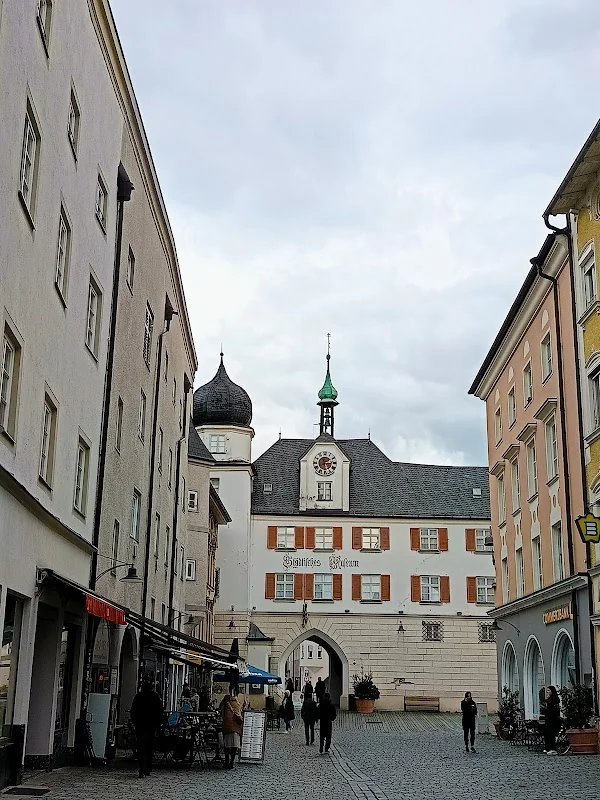
Rosenheim
Ludwigspl. 26, 83022 Rosenheim, Deutschland
Mittertor Rosenheim | Museum & History
The Mittertor in Rosenheim is much more than a distinctive historical building in the heart of the old town. Those searching for Mittertor Rosenheim, Museum Mittertor, or City Museum Rosenheim refer to a place where city history, architecture, and cultural identity directly meet. The museum is located at Ludwigsplatz 26, right in the city center. For many visitors, it is the first point of contact when they want to not just see Rosenheim but understand it. The special charm of the building lies in the fact that this former city gate has served various functions over the centuries and today tells the story of the city. The combination of a historical site, a lively exhibition, and a central location makes the Mittertor one of the most important cultural destinations in Rosenheim. At the same time, it is a practical starting point for a stroll through the old town, as Max-Josefs-Platz, Ludwigsplatz, and the adjacent paths are only a few steps apart. Therefore, anyone looking for a sight with a real connection to the city's history will find here a place that not only exhibits the past but embodies it. ([museum.rosenheim.de](https://museum.rosenheim.de/ueber-uns/foerderverein/))
For the search intent surrounding Mittertor Rosenheim, Mittertor photos, opening hours, directions, and parking, the house is particularly relevant because it is strongly anchored both touristically and locally. The City Museum shows the development of Rosenheim from early times to more recent city history, making it a place for culture enthusiasts, families, school classes, groups, and anyone seeking an authentic old town experience. The official museum website provides clear visiting hours, admission prices, parking options, and accessibility information. Thus, the Mittertor is not only a beautiful photo motif but also a very concrete address for a planned visit. Especially in a city like Rosenheim, whose center is characterized by pedestrian zones, squares, and historical axes, good orientation is crucial. The Mittertor fulfills exactly this role: it is visually striking, historically significant, and organizationally a clear focal point for all those planning a museum visit in the old town. ([museum.rosenheim.de](https://museum.rosenheim.de/besuch/informationen/))
History of the Mittertor and the City Museum
The history of the building dates back deep into the Middle Ages. According to the City Museum, there was already a gate at the eastern end of today's Max-Josefs-Platz. This was destroyed, like the entire market, during the great fire of 1641, down to its foundations, and was then gradually rebuilt in its current form. Over the centuries, the building has served, among other things, as a customs station, bread bank for the bakers of Rosenheim, magistrate's office, and as the residence of the tower keeper and music master. Since 1895, the museum has been housed here, founded at that time by civic initiative. Thus, the Mittertor unites several layers of city history in a single structure: medieval function, early modern reconstruction, and modern museum use. This continuity is one of the main reasons why so many people search for the history of Mittertor or Museum Mittertor Rosenheim. The building tells not only of objects in showcases but of a place that is itself a historical testament. ([museum.rosenheim.de](https://museum.rosenheim.de/ueber-uns/foerderverein/))
The current permanent exhibition is understood as a city history walk through several epochs and simultaneously documents 130 years of museum design. According to the museum, the exhibition rooms have been designed in several phases from 1902 to 2024, each shaped by the ideas of its time. This makes a visit particularly interesting because not only the content but also the presentation forms themselves are part of the history. Red information panels provide additional insights into the development of the building. The museum also emphasizes that after nearly 60 years, a comprehensive renovation of the Mittertor is imminent to preserve the historical building and adapt it to current standards. This keeps the house a vibrant place of cultural memory. For visitors, this means: those who see the Mittertor are not just looking at a museum location but a monument of urban continuity that has brought together knowledge, memory, and identity for generations. ([museum.rosenheim.de](https://museum.rosenheim.de/ueber-uns/foerderverein/))
The role of the Mittertor as the oldest or one of the oldest buildings in the city is repeatedly highlighted in the public cityscape. The city of Rosenheim describes the building as the historical center of the old town, and on the information pages in easy language, it is explicitly referred to as the last remaining market gate. This phrasing is particularly relevant for the search for Mittertor photos or Mittertor Rosenheim Museum because many people expect a well-recognizable historical landmark. Exactly that is provided by the Mittertor: it is not just any old house but a symbol of the city's development from a market town to a modern city center. In connection with the museum, it becomes a very dense place where politics, trade, everyday life, and memory historically overlap. Therefore, anyone wanting to understand the history of Rosenheim cannot overlook the Mittertor. ([museum.rosenheim.de](https://museum.rosenheim.de/leichte-sprache/?utm_source=openai))
Opening Hours, Admission, and Planning a Visit
For concrete visit planning, the practical information from the museum is particularly important. According to the official museum website, the City Museum Rosenheim is open from Tuesday to Sunday from 12:00 to 17:00. It is closed on Mondays, on public holidays, and on December 24 and 31. Groups and school classes can also visit the museum in the morning between 8:30 and 12:00 by prior arrangement. These clear times make planning very simple, especially for travelers who want to combine their old town visit with a museum visit. Those searching for opening hours Mittertor Rosenheim will quickly find reliable orientation. This is also important for families, day trippers, and visitors, as the museum is centrally located and can be easily integrated into a walk between Ludwigsplatz and Max-Josefs-Platz. ([museum.rosenheim.de](https://museum.rosenheim.de/besuch/informationen/))
Regarding admission, the museum works with transparent prices. The regular admission is 6 euros, and the reduced price is 4 euros. Discounts apply, among others, to students and trainees over 22 years, persons over 60 years, groups of ten or more, people with disabilities, participants in the federal volunteer service or the voluntary social year, as well as holders of certain cards and memberships. Free admission is granted, among others, to visitors up to and including 21 years, closed school classes with supervision, preparatory visits by teachers or educators, recognized guides, and other defined groups. This structure is very useful for search queries like admission Mittertor Rosenheim or tickets City Museum Rosenheim because it answers the most important decisions without detours. The house is thus family-friendly in terms of pricing and open to education, youth work, and cultural participation. ([museum.rosenheim.de](https://museum.rosenheim.de/besuch/informationen/))
Anyone planning an annual pass or repeated visits will also find suitable information on the museum's website. There is an annual pass in regular and reduced form; it is valid in the house where it was purchased and offers reduced admission to other houses of the City Collections. Special events have separate admission prices, which are mentioned in the event announcement. It is also practical that visitors do not need to make elaborate advance reservations for normal admission; the museum can be visited regularly during opening hours. Therefore, anyone spontaneously traveling in Rosenheim can easily integrate the Mittertor into their daily schedule. Especially in sunny weather or during a city stroll through the pedestrian zone, this is an advantage, as no long lead time needs to be planned. The combination of a central location, clear times, and manageable prices makes the museum a very accessible cultural offering in the city center. ([museum.rosenheim.de](https://museum.rosenheim.de/besuch/informationen/))
An important practical point is accessibility. The museum itself points out that the exhibition is unfortunately not barrier-free due to the structural conditions. At the same time, it is offered to contact them in advance for questions or individual support needs. This openness is important because the Mittertor is a historical building and thus does not have the same accessibility as a new building. For visitors with special needs, this is a relevant planning factor that should be considered in advance. Therefore, those traveling with a group, older relatives, or specific mobility requirements should consciously organize and, in case of doubt, contact in advance. For search queries like accessibility Mittertor Rosenheim, the official museum website provides an honest and direct answer without presenting the historical building as more accessible than it is structurally. ([museum.rosenheim.de](https://museum.rosenheim.de/besuch/informationen/))
Directions, Parking, and Route from the Train Station
The route to the Mittertor is uncomplicated thanks to its location in the Rosenheim city center. The museum provides the address Ludwigsplatz 26, 83022 Rosenheim for navigation devices. Those arriving by car can reach Rosenheim via the A8 Munich-Salzburg, the A93 Rosenheim/Inntal-Brenner, and from the north via the B15 Landshut-Rosenheim. This central traffic location is one of the reasons why the Mittertor is also easily accessible from outside. For many guests, it is important that a museum visit can be combined with a tour of the old town. The house is located at the edge of the pedestrian zone, where historical squares, shopping opportunities, and sights are closely intertwined. Therefore, those searching for directions Mittertor Rosenheim will find here not only a museum address but also a very well-embedded starting point for their stay in the city center. ([museum.rosenheim.de](https://museum.rosenheim.de/besuch/informationen/))
When it comes to parking, the museum mentions two particularly practical options: P 4 Mitte with about a five-minute walk and P 7 Altstadt-Ost with about a six-minute walk. This is very pleasant for a central old town location, as the walk to the museum remains short and easy to understand. Especially for visitors traveling with family, a camera, or luggage, short distances are often decisive. Since the Mittertor is located directly in the city center, parking is consciously part of the visit planning. The official site also refers to other parking options in the city of Rosenheim. For search queries like parking Mittertor Rosenheim or parking lot Mittertor Rosenheim, this is important because the combination of a central destination and nearby parking garages makes the visit practical. Those exploring the old town can conveniently park their car and handle the rest on foot. ([museum.rosenheim.de](https://museum.rosenheim.de/besuch/informationen/))
The arrival by train and bus is also very well described. From Rosenheim train station, you take the city bus to the Stadtmitte stop and then walk about five minutes along Heilig-Geist-Straße to Max-Josefs-Platz. At the Nepomuk Fountain, you turn left and walk another minute towards Ludwigsplatz. Walking from the train station via Bahnhofstraße and Münchener Straße through the pedestrian zone to Max-Josefs-Platz and further to Ludwigsplatz takes about twelve minutes. This route description is particularly helpful for visitors without a car. It also shows that the Mittertor is located in a well-walkable city center area and seamlessly fits into a city stroll. For travel groups, train travelers, or day guests, this is a significant advantage as no complicated orientation is necessary. ([museum.rosenheim.de](https://museum.rosenheim.de/besuch/informationen/))
Anyone exploring Rosenheim on foot will experience the character of the city center on the way to the Mittertor. The museum is located in close proximity to the central squares and thus acts as a historical junction between everyday life and culture. This is precisely why the location is so attractive for photos: the building is not hidden but part of the urban experience. The location between Max-Josefs-Platz and Ludwigsplatz makes it easy to combine a visit with a café, shopping, or other cultural stations. For the search intent directions Mittertor Rosenheim, this means: no complicated special route is needed, just a clear city center address, a short route description, and the choice between car, bus, or walking. This makes the museum very accessible for both planning guests and spontaneous visitors. ([museum.rosenheim.de](https://museum.rosenheim.de/besuch/informationen/))
Permanent Exhibition, Collections, and Depot
Content-wise, the City Museum in the Mittertor is a true city memory. The permanent exhibition tells central episodes of Rosenheim's history and guides visitors through different epochs. According to the museum's website, the themes range from early historical developments to more recent city history, and the exhibition also reflects 130 years of museum history. Particularly noteworthy is that the exhibition rooms have been designed and revised over a long period. This creates not only a classic collection display but a space where the development of museum presentation becomes visible. Therefore, those searching for Museum Mittertor or City Museum Rosenheim will find a house that goes far beyond individual objects. It shows how Rosenheim has lived, worked, and changed. This perspective makes the visit interesting for both locals and guests experiencing the city for the first time. ([museum.rosenheim.de](https://museum.rosenheim.de/ueber-uns/foerderverein/))
The museum is particularly strong in the area of collections and depot. The official depot page explains that the City Museum even has two depots: a storage depot in the attic of the Mittertor and an external depot for large objects. About 20,000 exhibits that cannot be displayed in the permanent exhibition are stored there. The objects are organized by material and object groups, all connected to Rosenheim by origin or history. This number is impressive for interested parties as it shows that the visible museum is only a fraction of a much larger cultural stock. Those searching for background, depth, and authenticity will find a real treasure of regional testimonies here. It is also important to note that the storage capacities are currently fully utilized and a central large depot is planned. This makes clear how lively and challenging museum work is in everyday life. ([museum.rosenheim.de](https://museum.rosenheim.de/sammlungen/blick-ins-depot/?utm_source=openai))
The collection strategy of the house is also clearly formulated. At its founding in 1895, the city council and magistrate determined which objects should be collected. The comprehensive mandate ranged from historical finds and documents to coins, seals, paintings, furniture, clothing, and musical instruments from Rosenheim and the surrounding area. Today, a clear principle applies: only items with a clear connection to Rosenheim are accepted. This shows that the museum does not collect arbitrarily but consciously maintains a regional identity. For the search for the history of Mittertor or Museum Rosenheim, this is an important point because the collection is not abstract but consistently places the city and its surroundings at the center. The museum thus preserves not only beautiful things but also relevant traces of everyday life, work, culture, and change for Rosenheim. ([museum.rosenheim.de](https://museum.rosenheim.de/sammlungen/sammlungskonzept/?utm_source=openai))
This claim becomes very tangible in the mediation. The city of Rosenheim describes the City Museum in the historical Mittertor as a place where it becomes visible how life in Rosenheim used to be. The permanent exhibition shows how people lived, worked, and celebrated, and regular special exhibitions, actions, and workshops make history tangible. This is precisely where the added value lies for search queries like City Museum Rosenheim or Museum Mittertor: the house is not a static depot but a place of learning and experience. Even if you just stop by briefly, you can tell that a very lively form of city history is conveyed here. The Mittertor is thus not only a stage for the past but also a space for education, debate, and memory. ([rosenheim.de](https://www.rosenheim.de/kultur-bildung/))
Photos, Weddings, and Special Motifs at the Mittertor
Those searching for Mittertor photos are usually interested in the special character of the building as a photo motif. This is understandable, as the Mittertor combines a historical facade, a central location, and immediate proximity to the most beautiful old town axes of Rosenheim. The official museum website even mentions that wedding parties can use the courtyard for a small standing reception after a ceremony and can use various motifs in and around the Mittertor for wedding photos. This clearly shows how photogenic and atmospheric the place is. For portraits, city views, and memory pictures, the building is therefore ideal. Unlike many museums, the focus here is not only on the interior but also on the external impact as a historical landmark. Therefore, anyone wanting to explore Rosenheim photographically will find a strongly recognizable and historically rich setting at the Mittertor. ([museum.rosenheim.de](https://museum.rosenheim.de/besuch/museum-mieten/?utm_source=openai))
Additionally, the location between Ludwigsplatz, Max-Josefs-Platz, and the pedestrian zones of the city center makes it easy to incorporate the Mittertor into a small photo walk. The house is not isolated but part of an urban ensemble where historical buildings and lively squares meet. This contrast between monument and everyday life creates strong motifs. Those photographing the museum from the outside benefit from the distinctive gate architecture and strong presence in the street space. Those photographing people, groups, or families use the old town as a lively backdrop. Therefore, the Mittertor is more than just a sight: it is a place where Rosenheim becomes visible at a glance. For those searching for Mittertor Rosenheim Museum or Mittertor photos, this is a clear advantage because the visual language of the place is so directly connected to the city's history. ([museum.rosenheim.de](https://museum.rosenheim.de/leichte-sprache/?utm_source=openai))
As a place for special life events, the Mittertor also plays an important role. The registry office in Rosenheim has been conducting weddings at the City Museum on three dates a year since 2015, each on a Saturday morning between 10 and 11 a.m. This utilizes the historical framework of the house for civil occasions. For many couples, this mixture of history and intimacy is attractive: a place with character, but right in the city and easily accessible for guests. The combination of the ceremony, courtyard, and photo motifs makes the Mittertor a very personal place of remembrance. For the search intent photos Mittertor or wedding photos Rosenheim, this is particularly relevant because no artificial backdrop is created here, but real architecture with real history. This gives the images authenticity and depth. ([museum.rosenheim.de](https://museum.rosenheim.de/besuch/museum-mieten/?utm_source=openai))
For culture-interested visitors looking for beautiful views, the Mittertor remains a worthwhile destination. The building is a piece of city identity that can be read differently from many perspectives: as a gate, as a museum, as a place of remembrance, and as a background for pictures that tell more than mere architecture. Those taking photos benefit from the fact that the Mittertor is centrally located and can be combined with a walk through the old town. Thus, motifs arise not only at the building itself but also from the interplay with squares, streets, and passages. This makes the Mittertor an ideal destination for all those wanting to visually discover Rosenheim while also searching for a historically anchored motif. ([museum.rosenheim.de](https://museum.rosenheim.de/leichte-sprache/?utm_source=openai))
Guided Tours, Children's Offers, and Groups in the Historical Mittertor
The City Museum is also very active in education. The museum's website lists public tours, tours on request, and offers for educational institutions. For groups and school classes, prior registration is possible; visits can then also be planned in the morning outside regular opening hours. Particularly interesting is the broad mediation offer of the City Collections Rosenheim, to which the museum belongs. The city emphasizes that history should be made tangible, and regular actions and workshops make the life of earlier times experienceable. Thus, the Mittertor is not only a place for quiet contemplation but also for active learning. Those searching for tours City Museum Rosenheim or group offers Mittertor will find a house that consciously focuses on mediation and participation. ([museum.rosenheim.de](https://museum.rosenheim.de/besuch/informationen/))
For children, there is a particularly appealing format. The interactive tour for kindergartens begins right in front of the museum with a view through the old Mittertor and takes the children on a journey back to Roman times, the Middle Ages, and the years around the founding of the city of Rosenheim. They experience history with all their senses: touching, smelling, hearing, dressing up, and discovering are explicitly included. Accompanying them is the museum mascot Muckl, who guides the little explorers through the rooms. The tour lasts about 45 to 60 minutes, costs 50 euros, and is designed for a maximum of 15 children. This is ideal for educational groups because the historical house not only imparts knowledge but also enables experiences. This makes the search for children's tour Mittertor or Museum Rosenheim children very relevant. ([museum.rosenheim.de](https://museum.rosenheim.de/vermittlung/fuer-kindergaerten/?utm_source=openai))
The house also offers suitable formats for school classes and teachers. The museum's website lists tours for educational institutions, practical programs, and preparatory visits for teachers or educators. In addition, cultural educational offers for seminars, project work, and workshops are described in the City Collections. This shows that the Mittertor is firmly anchored in the educational landscape of the city. Therefore, anyone coming to Rosenheim with a class, youth group, or seminar will find not only a beautiful building but also a professionally compatible learning location. The historical rooms, the collection, and the old town location create a strong context for this. Particularly exciting is that history is not conveyed abstractly but takes place directly in the historical house. This enhances the impact of every visit and makes the Mittertor an authentic place of learning. ([museum.rosenheim.de](https://museum.rosenheim.de/besuch/informationen/))
For visitors who want to experience Rosenheim culturally, the Mittertor is finally also interesting as a combination location. The museum refers to combination tours that start in the Mittertor and then lead into the old town. This turns the museum visit into a larger tour through the history of the city. This is particularly attractive for people who do not just want to see a single exhibition room but seek a narrative connection between the interior, the house, and the city. Especially in Rosenheim, where the historical core is easily experienced on foot, this form of mediation unfolds its special charm. For search queries like Museum Mittertor Rosenheim, events Mittertor, or tours old town Rosenheim, this is a strong signal: the house is not just a destination but also a starting point for an in-depth urban experience. ([museum.rosenheim.de](https://museum.rosenheim.de/kombifuehrung-museumsschaetze-und-stadtgeschichten-1/?utm_source=openai))
Sources:
- City Museum Rosenheim - Official Homepage
- City Museum Rosenheim - Information / Visit
- City Museum Rosenheim - History of the House
- City Museum Rosenheim - Look into the Depot
- City Museum Rosenheim - For Kindergartens
- City Museum Rosenheim - Weddings
- City Rosenheim - Cultural Education in the City Collections Rosenheim
Show moreShow less
Mittertor Rosenheim | Museum & History
The Mittertor in Rosenheim is much more than a distinctive historical building in the heart of the old town. Those searching for Mittertor Rosenheim, Museum Mittertor, or City Museum Rosenheim refer to a place where city history, architecture, and cultural identity directly meet. The museum is located at Ludwigsplatz 26, right in the city center. For many visitors, it is the first point of contact when they want to not just see Rosenheim but understand it. The special charm of the building lies in the fact that this former city gate has served various functions over the centuries and today tells the story of the city. The combination of a historical site, a lively exhibition, and a central location makes the Mittertor one of the most important cultural destinations in Rosenheim. At the same time, it is a practical starting point for a stroll through the old town, as Max-Josefs-Platz, Ludwigsplatz, and the adjacent paths are only a few steps apart. Therefore, anyone looking for a sight with a real connection to the city's history will find here a place that not only exhibits the past but embodies it. ([museum.rosenheim.de](https://museum.rosenheim.de/ueber-uns/foerderverein/))
For the search intent surrounding Mittertor Rosenheim, Mittertor photos, opening hours, directions, and parking, the house is particularly relevant because it is strongly anchored both touristically and locally. The City Museum shows the development of Rosenheim from early times to more recent city history, making it a place for culture enthusiasts, families, school classes, groups, and anyone seeking an authentic old town experience. The official museum website provides clear visiting hours, admission prices, parking options, and accessibility information. Thus, the Mittertor is not only a beautiful photo motif but also a very concrete address for a planned visit. Especially in a city like Rosenheim, whose center is characterized by pedestrian zones, squares, and historical axes, good orientation is crucial. The Mittertor fulfills exactly this role: it is visually striking, historically significant, and organizationally a clear focal point for all those planning a museum visit in the old town. ([museum.rosenheim.de](https://museum.rosenheim.de/besuch/informationen/))
History of the Mittertor and the City Museum
The history of the building dates back deep into the Middle Ages. According to the City Museum, there was already a gate at the eastern end of today's Max-Josefs-Platz. This was destroyed, like the entire market, during the great fire of 1641, down to its foundations, and was then gradually rebuilt in its current form. Over the centuries, the building has served, among other things, as a customs station, bread bank for the bakers of Rosenheim, magistrate's office, and as the residence of the tower keeper and music master. Since 1895, the museum has been housed here, founded at that time by civic initiative. Thus, the Mittertor unites several layers of city history in a single structure: medieval function, early modern reconstruction, and modern museum use. This continuity is one of the main reasons why so many people search for the history of Mittertor or Museum Mittertor Rosenheim. The building tells not only of objects in showcases but of a place that is itself a historical testament. ([museum.rosenheim.de](https://museum.rosenheim.de/ueber-uns/foerderverein/))
The current permanent exhibition is understood as a city history walk through several epochs and simultaneously documents 130 years of museum design. According to the museum, the exhibition rooms have been designed in several phases from 1902 to 2024, each shaped by the ideas of its time. This makes a visit particularly interesting because not only the content but also the presentation forms themselves are part of the history. Red information panels provide additional insights into the development of the building. The museum also emphasizes that after nearly 60 years, a comprehensive renovation of the Mittertor is imminent to preserve the historical building and adapt it to current standards. This keeps the house a vibrant place of cultural memory. For visitors, this means: those who see the Mittertor are not just looking at a museum location but a monument of urban continuity that has brought together knowledge, memory, and identity for generations. ([museum.rosenheim.de](https://museum.rosenheim.de/ueber-uns/foerderverein/))
The role of the Mittertor as the oldest or one of the oldest buildings in the city is repeatedly highlighted in the public cityscape. The city of Rosenheim describes the building as the historical center of the old town, and on the information pages in easy language, it is explicitly referred to as the last remaining market gate. This phrasing is particularly relevant for the search for Mittertor photos or Mittertor Rosenheim Museum because many people expect a well-recognizable historical landmark. Exactly that is provided by the Mittertor: it is not just any old house but a symbol of the city's development from a market town to a modern city center. In connection with the museum, it becomes a very dense place where politics, trade, everyday life, and memory historically overlap. Therefore, anyone wanting to understand the history of Rosenheim cannot overlook the Mittertor. ([museum.rosenheim.de](https://museum.rosenheim.de/leichte-sprache/?utm_source=openai))
Opening Hours, Admission, and Planning a Visit
For concrete visit planning, the practical information from the museum is particularly important. According to the official museum website, the City Museum Rosenheim is open from Tuesday to Sunday from 12:00 to 17:00. It is closed on Mondays, on public holidays, and on December 24 and 31. Groups and school classes can also visit the museum in the morning between 8:30 and 12:00 by prior arrangement. These clear times make planning very simple, especially for travelers who want to combine their old town visit with a museum visit. Those searching for opening hours Mittertor Rosenheim will quickly find reliable orientation. This is also important for families, day trippers, and visitors, as the museum is centrally located and can be easily integrated into a walk between Ludwigsplatz and Max-Josefs-Platz. ([museum.rosenheim.de](https://museum.rosenheim.de/besuch/informationen/))
Regarding admission, the museum works with transparent prices. The regular admission is 6 euros, and the reduced price is 4 euros. Discounts apply, among others, to students and trainees over 22 years, persons over 60 years, groups of ten or more, people with disabilities, participants in the federal volunteer service or the voluntary social year, as well as holders of certain cards and memberships. Free admission is granted, among others, to visitors up to and including 21 years, closed school classes with supervision, preparatory visits by teachers or educators, recognized guides, and other defined groups. This structure is very useful for search queries like admission Mittertor Rosenheim or tickets City Museum Rosenheim because it answers the most important decisions without detours. The house is thus family-friendly in terms of pricing and open to education, youth work, and cultural participation. ([museum.rosenheim.de](https://museum.rosenheim.de/besuch/informationen/))
Anyone planning an annual pass or repeated visits will also find suitable information on the museum's website. There is an annual pass in regular and reduced form; it is valid in the house where it was purchased and offers reduced admission to other houses of the City Collections. Special events have separate admission prices, which are mentioned in the event announcement. It is also practical that visitors do not need to make elaborate advance reservations for normal admission; the museum can be visited regularly during opening hours. Therefore, anyone spontaneously traveling in Rosenheim can easily integrate the Mittertor into their daily schedule. Especially in sunny weather or during a city stroll through the pedestrian zone, this is an advantage, as no long lead time needs to be planned. The combination of a central location, clear times, and manageable prices makes the museum a very accessible cultural offering in the city center. ([museum.rosenheim.de](https://museum.rosenheim.de/besuch/informationen/))
An important practical point is accessibility. The museum itself points out that the exhibition is unfortunately not barrier-free due to the structural conditions. At the same time, it is offered to contact them in advance for questions or individual support needs. This openness is important because the Mittertor is a historical building and thus does not have the same accessibility as a new building. For visitors with special needs, this is a relevant planning factor that should be considered in advance. Therefore, those traveling with a group, older relatives, or specific mobility requirements should consciously organize and, in case of doubt, contact in advance. For search queries like accessibility Mittertor Rosenheim, the official museum website provides an honest and direct answer without presenting the historical building as more accessible than it is structurally. ([museum.rosenheim.de](https://museum.rosenheim.de/besuch/informationen/))
Directions, Parking, and Route from the Train Station
The route to the Mittertor is uncomplicated thanks to its location in the Rosenheim city center. The museum provides the address Ludwigsplatz 26, 83022 Rosenheim for navigation devices. Those arriving by car can reach Rosenheim via the A8 Munich-Salzburg, the A93 Rosenheim/Inntal-Brenner, and from the north via the B15 Landshut-Rosenheim. This central traffic location is one of the reasons why the Mittertor is also easily accessible from outside. For many guests, it is important that a museum visit can be combined with a tour of the old town. The house is located at the edge of the pedestrian zone, where historical squares, shopping opportunities, and sights are closely intertwined. Therefore, those searching for directions Mittertor Rosenheim will find here not only a museum address but also a very well-embedded starting point for their stay in the city center. ([museum.rosenheim.de](https://museum.rosenheim.de/besuch/informationen/))
When it comes to parking, the museum mentions two particularly practical options: P 4 Mitte with about a five-minute walk and P 7 Altstadt-Ost with about a six-minute walk. This is very pleasant for a central old town location, as the walk to the museum remains short and easy to understand. Especially for visitors traveling with family, a camera, or luggage, short distances are often decisive. Since the Mittertor is located directly in the city center, parking is consciously part of the visit planning. The official site also refers to other parking options in the city of Rosenheim. For search queries like parking Mittertor Rosenheim or parking lot Mittertor Rosenheim, this is important because the combination of a central destination and nearby parking garages makes the visit practical. Those exploring the old town can conveniently park their car and handle the rest on foot. ([museum.rosenheim.de](https://museum.rosenheim.de/besuch/informationen/))
The arrival by train and bus is also very well described. From Rosenheim train station, you take the city bus to the Stadtmitte stop and then walk about five minutes along Heilig-Geist-Straße to Max-Josefs-Platz. At the Nepomuk Fountain, you turn left and walk another minute towards Ludwigsplatz. Walking from the train station via Bahnhofstraße and Münchener Straße through the pedestrian zone to Max-Josefs-Platz and further to Ludwigsplatz takes about twelve minutes. This route description is particularly helpful for visitors without a car. It also shows that the Mittertor is located in a well-walkable city center area and seamlessly fits into a city stroll. For travel groups, train travelers, or day guests, this is a significant advantage as no complicated orientation is necessary. ([museum.rosenheim.de](https://museum.rosenheim.de/besuch/informationen/))
Anyone exploring Rosenheim on foot will experience the character of the city center on the way to the Mittertor. The museum is located in close proximity to the central squares and thus acts as a historical junction between everyday life and culture. This is precisely why the location is so attractive for photos: the building is not hidden but part of the urban experience. The location between Max-Josefs-Platz and Ludwigsplatz makes it easy to combine a visit with a café, shopping, or other cultural stations. For the search intent directions Mittertor Rosenheim, this means: no complicated special route is needed, just a clear city center address, a short route description, and the choice between car, bus, or walking. This makes the museum very accessible for both planning guests and spontaneous visitors. ([museum.rosenheim.de](https://museum.rosenheim.de/besuch/informationen/))
Permanent Exhibition, Collections, and Depot
Content-wise, the City Museum in the Mittertor is a true city memory. The permanent exhibition tells central episodes of Rosenheim's history and guides visitors through different epochs. According to the museum's website, the themes range from early historical developments to more recent city history, and the exhibition also reflects 130 years of museum history. Particularly noteworthy is that the exhibition rooms have been designed and revised over a long period. This creates not only a classic collection display but a space where the development of museum presentation becomes visible. Therefore, those searching for Museum Mittertor or City Museum Rosenheim will find a house that goes far beyond individual objects. It shows how Rosenheim has lived, worked, and changed. This perspective makes the visit interesting for both locals and guests experiencing the city for the first time. ([museum.rosenheim.de](https://museum.rosenheim.de/ueber-uns/foerderverein/))
The museum is particularly strong in the area of collections and depot. The official depot page explains that the City Museum even has two depots: a storage depot in the attic of the Mittertor and an external depot for large objects. About 20,000 exhibits that cannot be displayed in the permanent exhibition are stored there. The objects are organized by material and object groups, all connected to Rosenheim by origin or history. This number is impressive for interested parties as it shows that the visible museum is only a fraction of a much larger cultural stock. Those searching for background, depth, and authenticity will find a real treasure of regional testimonies here. It is also important to note that the storage capacities are currently fully utilized and a central large depot is planned. This makes clear how lively and challenging museum work is in everyday life. ([museum.rosenheim.de](https://museum.rosenheim.de/sammlungen/blick-ins-depot/?utm_source=openai))
The collection strategy of the house is also clearly formulated. At its founding in 1895, the city council and magistrate determined which objects should be collected. The comprehensive mandate ranged from historical finds and documents to coins, seals, paintings, furniture, clothing, and musical instruments from Rosenheim and the surrounding area. Today, a clear principle applies: only items with a clear connection to Rosenheim are accepted. This shows that the museum does not collect arbitrarily but consciously maintains a regional identity. For the search for the history of Mittertor or Museum Rosenheim, this is an important point because the collection is not abstract but consistently places the city and its surroundings at the center. The museum thus preserves not only beautiful things but also relevant traces of everyday life, work, culture, and change for Rosenheim. ([museum.rosenheim.de](https://museum.rosenheim.de/sammlungen/sammlungskonzept/?utm_source=openai))
This claim becomes very tangible in the mediation. The city of Rosenheim describes the City Museum in the historical Mittertor as a place where it becomes visible how life in Rosenheim used to be. The permanent exhibition shows how people lived, worked, and celebrated, and regular special exhibitions, actions, and workshops make history tangible. This is precisely where the added value lies for search queries like City Museum Rosenheim or Museum Mittertor: the house is not a static depot but a place of learning and experience. Even if you just stop by briefly, you can tell that a very lively form of city history is conveyed here. The Mittertor is thus not only a stage for the past but also a space for education, debate, and memory. ([rosenheim.de](https://www.rosenheim.de/kultur-bildung/))
Photos, Weddings, and Special Motifs at the Mittertor
Those searching for Mittertor photos are usually interested in the special character of the building as a photo motif. This is understandable, as the Mittertor combines a historical facade, a central location, and immediate proximity to the most beautiful old town axes of Rosenheim. The official museum website even mentions that wedding parties can use the courtyard for a small standing reception after a ceremony and can use various motifs in and around the Mittertor for wedding photos. This clearly shows how photogenic and atmospheric the place is. For portraits, city views, and memory pictures, the building is therefore ideal. Unlike many museums, the focus here is not only on the interior but also on the external impact as a historical landmark. Therefore, anyone wanting to explore Rosenheim photographically will find a strongly recognizable and historically rich setting at the Mittertor. ([museum.rosenheim.de](https://museum.rosenheim.de/besuch/museum-mieten/?utm_source=openai))
Additionally, the location between Ludwigsplatz, Max-Josefs-Platz, and the pedestrian zones of the city center makes it easy to incorporate the Mittertor into a small photo walk. The house is not isolated but part of an urban ensemble where historical buildings and lively squares meet. This contrast between monument and everyday life creates strong motifs. Those photographing the museum from the outside benefit from the distinctive gate architecture and strong presence in the street space. Those photographing people, groups, or families use the old town as a lively backdrop. Therefore, the Mittertor is more than just a sight: it is a place where Rosenheim becomes visible at a glance. For those searching for Mittertor Rosenheim Museum or Mittertor photos, this is a clear advantage because the visual language of the place is so directly connected to the city's history. ([museum.rosenheim.de](https://museum.rosenheim.de/leichte-sprache/?utm_source=openai))
As a place for special life events, the Mittertor also plays an important role. The registry office in Rosenheim has been conducting weddings at the City Museum on three dates a year since 2015, each on a Saturday morning between 10 and 11 a.m. This utilizes the historical framework of the house for civil occasions. For many couples, this mixture of history and intimacy is attractive: a place with character, but right in the city and easily accessible for guests. The combination of the ceremony, courtyard, and photo motifs makes the Mittertor a very personal place of remembrance. For the search intent photos Mittertor or wedding photos Rosenheim, this is particularly relevant because no artificial backdrop is created here, but real architecture with real history. This gives the images authenticity and depth. ([museum.rosenheim.de](https://museum.rosenheim.de/besuch/museum-mieten/?utm_source=openai))
For culture-interested visitors looking for beautiful views, the Mittertor remains a worthwhile destination. The building is a piece of city identity that can be read differently from many perspectives: as a gate, as a museum, as a place of remembrance, and as a background for pictures that tell more than mere architecture. Those taking photos benefit from the fact that the Mittertor is centrally located and can be combined with a walk through the old town. Thus, motifs arise not only at the building itself but also from the interplay with squares, streets, and passages. This makes the Mittertor an ideal destination for all those wanting to visually discover Rosenheim while also searching for a historically anchored motif. ([museum.rosenheim.de](https://museum.rosenheim.de/leichte-sprache/?utm_source=openai))
Guided Tours, Children's Offers, and Groups in the Historical Mittertor
The City Museum is also very active in education. The museum's website lists public tours, tours on request, and offers for educational institutions. For groups and school classes, prior registration is possible; visits can then also be planned in the morning outside regular opening hours. Particularly interesting is the broad mediation offer of the City Collections Rosenheim, to which the museum belongs. The city emphasizes that history should be made tangible, and regular actions and workshops make the life of earlier times experienceable. Thus, the Mittertor is not only a place for quiet contemplation but also for active learning. Those searching for tours City Museum Rosenheim or group offers Mittertor will find a house that consciously focuses on mediation and participation. ([museum.rosenheim.de](https://museum.rosenheim.de/besuch/informationen/))
For children, there is a particularly appealing format. The interactive tour for kindergartens begins right in front of the museum with a view through the old Mittertor and takes the children on a journey back to Roman times, the Middle Ages, and the years around the founding of the city of Rosenheim. They experience history with all their senses: touching, smelling, hearing, dressing up, and discovering are explicitly included. Accompanying them is the museum mascot Muckl, who guides the little explorers through the rooms. The tour lasts about 45 to 60 minutes, costs 50 euros, and is designed for a maximum of 15 children. This is ideal for educational groups because the historical house not only imparts knowledge but also enables experiences. This makes the search for children's tour Mittertor or Museum Rosenheim children very relevant. ([museum.rosenheim.de](https://museum.rosenheim.de/vermittlung/fuer-kindergaerten/?utm_source=openai))
The house also offers suitable formats for school classes and teachers. The museum's website lists tours for educational institutions, practical programs, and preparatory visits for teachers or educators. In addition, cultural educational offers for seminars, project work, and workshops are described in the City Collections. This shows that the Mittertor is firmly anchored in the educational landscape of the city. Therefore, anyone coming to Rosenheim with a class, youth group, or seminar will find not only a beautiful building but also a professionally compatible learning location. The historical rooms, the collection, and the old town location create a strong context for this. Particularly exciting is that history is not conveyed abstractly but takes place directly in the historical house. This enhances the impact of every visit and makes the Mittertor an authentic place of learning. ([museum.rosenheim.de](https://museum.rosenheim.de/besuch/informationen/))
For visitors who want to experience Rosenheim culturally, the Mittertor is finally also interesting as a combination location. The museum refers to combination tours that start in the Mittertor and then lead into the old town. This turns the museum visit into a larger tour through the history of the city. This is particularly attractive for people who do not just want to see a single exhibition room but seek a narrative connection between the interior, the house, and the city. Especially in Rosenheim, where the historical core is easily experienced on foot, this form of mediation unfolds its special charm. For search queries like Museum Mittertor Rosenheim, events Mittertor, or tours old town Rosenheim, this is a strong signal: the house is not just a destination but also a starting point for an in-depth urban experience. ([museum.rosenheim.de](https://museum.rosenheim.de/kombifuehrung-museumsschaetze-und-stadtgeschichten-1/?utm_source=openai))
Sources:
- City Museum Rosenheim - Official Homepage
- City Museum Rosenheim - Information / Visit
- City Museum Rosenheim - History of the House
- City Museum Rosenheim - Look into the Depot
- City Museum Rosenheim - For Kindergartens
- City Museum Rosenheim - Weddings
- City Rosenheim - Cultural Education in the City Collections Rosenheim
Mittertor Rosenheim | Museum & History
The Mittertor in Rosenheim is much more than a distinctive historical building in the heart of the old town. Those searching for Mittertor Rosenheim, Museum Mittertor, or City Museum Rosenheim refer to a place where city history, architecture, and cultural identity directly meet. The museum is located at Ludwigsplatz 26, right in the city center. For many visitors, it is the first point of contact when they want to not just see Rosenheim but understand it. The special charm of the building lies in the fact that this former city gate has served various functions over the centuries and today tells the story of the city. The combination of a historical site, a lively exhibition, and a central location makes the Mittertor one of the most important cultural destinations in Rosenheim. At the same time, it is a practical starting point for a stroll through the old town, as Max-Josefs-Platz, Ludwigsplatz, and the adjacent paths are only a few steps apart. Therefore, anyone looking for a sight with a real connection to the city's history will find here a place that not only exhibits the past but embodies it. ([museum.rosenheim.de](https://museum.rosenheim.de/ueber-uns/foerderverein/))
For the search intent surrounding Mittertor Rosenheim, Mittertor photos, opening hours, directions, and parking, the house is particularly relevant because it is strongly anchored both touristically and locally. The City Museum shows the development of Rosenheim from early times to more recent city history, making it a place for culture enthusiasts, families, school classes, groups, and anyone seeking an authentic old town experience. The official museum website provides clear visiting hours, admission prices, parking options, and accessibility information. Thus, the Mittertor is not only a beautiful photo motif but also a very concrete address for a planned visit. Especially in a city like Rosenheim, whose center is characterized by pedestrian zones, squares, and historical axes, good orientation is crucial. The Mittertor fulfills exactly this role: it is visually striking, historically significant, and organizationally a clear focal point for all those planning a museum visit in the old town. ([museum.rosenheim.de](https://museum.rosenheim.de/besuch/informationen/))
History of the Mittertor and the City Museum
The history of the building dates back deep into the Middle Ages. According to the City Museum, there was already a gate at the eastern end of today's Max-Josefs-Platz. This was destroyed, like the entire market, during the great fire of 1641, down to its foundations, and was then gradually rebuilt in its current form. Over the centuries, the building has served, among other things, as a customs station, bread bank for the bakers of Rosenheim, magistrate's office, and as the residence of the tower keeper and music master. Since 1895, the museum has been housed here, founded at that time by civic initiative. Thus, the Mittertor unites several layers of city history in a single structure: medieval function, early modern reconstruction, and modern museum use. This continuity is one of the main reasons why so many people search for the history of Mittertor or Museum Mittertor Rosenheim. The building tells not only of objects in showcases but of a place that is itself a historical testament. ([museum.rosenheim.de](https://museum.rosenheim.de/ueber-uns/foerderverein/))
The current permanent exhibition is understood as a city history walk through several epochs and simultaneously documents 130 years of museum design. According to the museum, the exhibition rooms have been designed in several phases from 1902 to 2024, each shaped by the ideas of its time. This makes a visit particularly interesting because not only the content but also the presentation forms themselves are part of the history. Red information panels provide additional insights into the development of the building. The museum also emphasizes that after nearly 60 years, a comprehensive renovation of the Mittertor is imminent to preserve the historical building and adapt it to current standards. This keeps the house a vibrant place of cultural memory. For visitors, this means: those who see the Mittertor are not just looking at a museum location but a monument of urban continuity that has brought together knowledge, memory, and identity for generations. ([museum.rosenheim.de](https://museum.rosenheim.de/ueber-uns/foerderverein/))
The role of the Mittertor as the oldest or one of the oldest buildings in the city is repeatedly highlighted in the public cityscape. The city of Rosenheim describes the building as the historical center of the old town, and on the information pages in easy language, it is explicitly referred to as the last remaining market gate. This phrasing is particularly relevant for the search for Mittertor photos or Mittertor Rosenheim Museum because many people expect a well-recognizable historical landmark. Exactly that is provided by the Mittertor: it is not just any old house but a symbol of the city's development from a market town to a modern city center. In connection with the museum, it becomes a very dense place where politics, trade, everyday life, and memory historically overlap. Therefore, anyone wanting to understand the history of Rosenheim cannot overlook the Mittertor. ([museum.rosenheim.de](https://museum.rosenheim.de/leichte-sprache/?utm_source=openai))
Opening Hours, Admission, and Planning a Visit
For concrete visit planning, the practical information from the museum is particularly important. According to the official museum website, the City Museum Rosenheim is open from Tuesday to Sunday from 12:00 to 17:00. It is closed on Mondays, on public holidays, and on December 24 and 31. Groups and school classes can also visit the museum in the morning between 8:30 and 12:00 by prior arrangement. These clear times make planning very simple, especially for travelers who want to combine their old town visit with a museum visit. Those searching for opening hours Mittertor Rosenheim will quickly find reliable orientation. This is also important for families, day trippers, and visitors, as the museum is centrally located and can be easily integrated into a walk between Ludwigsplatz and Max-Josefs-Platz. ([museum.rosenheim.de](https://museum.rosenheim.de/besuch/informationen/))
Regarding admission, the museum works with transparent prices. The regular admission is 6 euros, and the reduced price is 4 euros. Discounts apply, among others, to students and trainees over 22 years, persons over 60 years, groups of ten or more, people with disabilities, participants in the federal volunteer service or the voluntary social year, as well as holders of certain cards and memberships. Free admission is granted, among others, to visitors up to and including 21 years, closed school classes with supervision, preparatory visits by teachers or educators, recognized guides, and other defined groups. This structure is very useful for search queries like admission Mittertor Rosenheim or tickets City Museum Rosenheim because it answers the most important decisions without detours. The house is thus family-friendly in terms of pricing and open to education, youth work, and cultural participation. ([museum.rosenheim.de](https://museum.rosenheim.de/besuch/informationen/))
Anyone planning an annual pass or repeated visits will also find suitable information on the museum's website. There is an annual pass in regular and reduced form; it is valid in the house where it was purchased and offers reduced admission to other houses of the City Collections. Special events have separate admission prices, which are mentioned in the event announcement. It is also practical that visitors do not need to make elaborate advance reservations for normal admission; the museum can be visited regularly during opening hours. Therefore, anyone spontaneously traveling in Rosenheim can easily integrate the Mittertor into their daily schedule. Especially in sunny weather or during a city stroll through the pedestrian zone, this is an advantage, as no long lead time needs to be planned. The combination of a central location, clear times, and manageable prices makes the museum a very accessible cultural offering in the city center. ([museum.rosenheim.de](https://museum.rosenheim.de/besuch/informationen/))
An important practical point is accessibility. The museum itself points out that the exhibition is unfortunately not barrier-free due to the structural conditions. At the same time, it is offered to contact them in advance for questions or individual support needs. This openness is important because the Mittertor is a historical building and thus does not have the same accessibility as a new building. For visitors with special needs, this is a relevant planning factor that should be considered in advance. Therefore, those traveling with a group, older relatives, or specific mobility requirements should consciously organize and, in case of doubt, contact in advance. For search queries like accessibility Mittertor Rosenheim, the official museum website provides an honest and direct answer without presenting the historical building as more accessible than it is structurally. ([museum.rosenheim.de](https://museum.rosenheim.de/besuch/informationen/))
Directions, Parking, and Route from the Train Station
The route to the Mittertor is uncomplicated thanks to its location in the Rosenheim city center. The museum provides the address Ludwigsplatz 26, 83022 Rosenheim for navigation devices. Those arriving by car can reach Rosenheim via the A8 Munich-Salzburg, the A93 Rosenheim/Inntal-Brenner, and from the north via the B15 Landshut-Rosenheim. This central traffic location is one of the reasons why the Mittertor is also easily accessible from outside. For many guests, it is important that a museum visit can be combined with a tour of the old town. The house is located at the edge of the pedestrian zone, where historical squares, shopping opportunities, and sights are closely intertwined. Therefore, those searching for directions Mittertor Rosenheim will find here not only a museum address but also a very well-embedded starting point for their stay in the city center. ([museum.rosenheim.de](https://museum.rosenheim.de/besuch/informationen/))
When it comes to parking, the museum mentions two particularly practical options: P 4 Mitte with about a five-minute walk and P 7 Altstadt-Ost with about a six-minute walk. This is very pleasant for a central old town location, as the walk to the museum remains short and easy to understand. Especially for visitors traveling with family, a camera, or luggage, short distances are often decisive. Since the Mittertor is located directly in the city center, parking is consciously part of the visit planning. The official site also refers to other parking options in the city of Rosenheim. For search queries like parking Mittertor Rosenheim or parking lot Mittertor Rosenheim, this is important because the combination of a central destination and nearby parking garages makes the visit practical. Those exploring the old town can conveniently park their car and handle the rest on foot. ([museum.rosenheim.de](https://museum.rosenheim.de/besuch/informationen/))
The arrival by train and bus is also very well described. From Rosenheim train station, you take the city bus to the Stadtmitte stop and then walk about five minutes along Heilig-Geist-Straße to Max-Josefs-Platz. At the Nepomuk Fountain, you turn left and walk another minute towards Ludwigsplatz. Walking from the train station via Bahnhofstraße and Münchener Straße through the pedestrian zone to Max-Josefs-Platz and further to Ludwigsplatz takes about twelve minutes. This route description is particularly helpful for visitors without a car. It also shows that the Mittertor is located in a well-walkable city center area and seamlessly fits into a city stroll. For travel groups, train travelers, or day guests, this is a significant advantage as no complicated orientation is necessary. ([museum.rosenheim.de](https://museum.rosenheim.de/besuch/informationen/))
Anyone exploring Rosenheim on foot will experience the character of the city center on the way to the Mittertor. The museum is located in close proximity to the central squares and thus acts as a historical junction between everyday life and culture. This is precisely why the location is so attractive for photos: the building is not hidden but part of the urban experience. The location between Max-Josefs-Platz and Ludwigsplatz makes it easy to combine a visit with a café, shopping, or other cultural stations. For the search intent directions Mittertor Rosenheim, this means: no complicated special route is needed, just a clear city center address, a short route description, and the choice between car, bus, or walking. This makes the museum very accessible for both planning guests and spontaneous visitors. ([museum.rosenheim.de](https://museum.rosenheim.de/besuch/informationen/))
Permanent Exhibition, Collections, and Depot
Content-wise, the City Museum in the Mittertor is a true city memory. The permanent exhibition tells central episodes of Rosenheim's history and guides visitors through different epochs. According to the museum's website, the themes range from early historical developments to more recent city history, and the exhibition also reflects 130 years of museum history. Particularly noteworthy is that the exhibition rooms have been designed and revised over a long period. This creates not only a classic collection display but a space where the development of museum presentation becomes visible. Therefore, those searching for Museum Mittertor or City Museum Rosenheim will find a house that goes far beyond individual objects. It shows how Rosenheim has lived, worked, and changed. This perspective makes the visit interesting for both locals and guests experiencing the city for the first time. ([museum.rosenheim.de](https://museum.rosenheim.de/ueber-uns/foerderverein/))
The museum is particularly strong in the area of collections and depot. The official depot page explains that the City Museum even has two depots: a storage depot in the attic of the Mittertor and an external depot for large objects. About 20,000 exhibits that cannot be displayed in the permanent exhibition are stored there. The objects are organized by material and object groups, all connected to Rosenheim by origin or history. This number is impressive for interested parties as it shows that the visible museum is only a fraction of a much larger cultural stock. Those searching for background, depth, and authenticity will find a real treasure of regional testimonies here. It is also important to note that the storage capacities are currently fully utilized and a central large depot is planned. This makes clear how lively and challenging museum work is in everyday life. ([museum.rosenheim.de](https://museum.rosenheim.de/sammlungen/blick-ins-depot/?utm_source=openai))
The collection strategy of the house is also clearly formulated. At its founding in 1895, the city council and magistrate determined which objects should be collected. The comprehensive mandate ranged from historical finds and documents to coins, seals, paintings, furniture, clothing, and musical instruments from Rosenheim and the surrounding area. Today, a clear principle applies: only items with a clear connection to Rosenheim are accepted. This shows that the museum does not collect arbitrarily but consciously maintains a regional identity. For the search for the history of Mittertor or Museum Rosenheim, this is an important point because the collection is not abstract but consistently places the city and its surroundings at the center. The museum thus preserves not only beautiful things but also relevant traces of everyday life, work, culture, and change for Rosenheim. ([museum.rosenheim.de](https://museum.rosenheim.de/sammlungen/sammlungskonzept/?utm_source=openai))
This claim becomes very tangible in the mediation. The city of Rosenheim describes the City Museum in the historical Mittertor as a place where it becomes visible how life in Rosenheim used to be. The permanent exhibition shows how people lived, worked, and celebrated, and regular special exhibitions, actions, and workshops make history tangible. This is precisely where the added value lies for search queries like City Museum Rosenheim or Museum Mittertor: the house is not a static depot but a place of learning and experience. Even if you just stop by briefly, you can tell that a very lively form of city history is conveyed here. The Mittertor is thus not only a stage for the past but also a space for education, debate, and memory. ([rosenheim.de](https://www.rosenheim.de/kultur-bildung/))
Photos, Weddings, and Special Motifs at the Mittertor
Those searching for Mittertor photos are usually interested in the special character of the building as a photo motif. This is understandable, as the Mittertor combines a historical facade, a central location, and immediate proximity to the most beautiful old town axes of Rosenheim. The official museum website even mentions that wedding parties can use the courtyard for a small standing reception after a ceremony and can use various motifs in and around the Mittertor for wedding photos. This clearly shows how photogenic and atmospheric the place is. For portraits, city views, and memory pictures, the building is therefore ideal. Unlike many museums, the focus here is not only on the interior but also on the external impact as a historical landmark. Therefore, anyone wanting to explore Rosenheim photographically will find a strongly recognizable and historically rich setting at the Mittertor. ([museum.rosenheim.de](https://museum.rosenheim.de/besuch/museum-mieten/?utm_source=openai))
Additionally, the location between Ludwigsplatz, Max-Josefs-Platz, and the pedestrian zones of the city center makes it easy to incorporate the Mittertor into a small photo walk. The house is not isolated but part of an urban ensemble where historical buildings and lively squares meet. This contrast between monument and everyday life creates strong motifs. Those photographing the museum from the outside benefit from the distinctive gate architecture and strong presence in the street space. Those photographing people, groups, or families use the old town as a lively backdrop. Therefore, the Mittertor is more than just a sight: it is a place where Rosenheim becomes visible at a glance. For those searching for Mittertor Rosenheim Museum or Mittertor photos, this is a clear advantage because the visual language of the place is so directly connected to the city's history. ([museum.rosenheim.de](https://museum.rosenheim.de/leichte-sprache/?utm_source=openai))
As a place for special life events, the Mittertor also plays an important role. The registry office in Rosenheim has been conducting weddings at the City Museum on three dates a year since 2015, each on a Saturday morning between 10 and 11 a.m. This utilizes the historical framework of the house for civil occasions. For many couples, this mixture of history and intimacy is attractive: a place with character, but right in the city and easily accessible for guests. The combination of the ceremony, courtyard, and photo motifs makes the Mittertor a very personal place of remembrance. For the search intent photos Mittertor or wedding photos Rosenheim, this is particularly relevant because no artificial backdrop is created here, but real architecture with real history. This gives the images authenticity and depth. ([museum.rosenheim.de](https://museum.rosenheim.de/besuch/museum-mieten/?utm_source=openai))
For culture-interested visitors looking for beautiful views, the Mittertor remains a worthwhile destination. The building is a piece of city identity that can be read differently from many perspectives: as a gate, as a museum, as a place of remembrance, and as a background for pictures that tell more than mere architecture. Those taking photos benefit from the fact that the Mittertor is centrally located and can be combined with a walk through the old town. Thus, motifs arise not only at the building itself but also from the interplay with squares, streets, and passages. This makes the Mittertor an ideal destination for all those wanting to visually discover Rosenheim while also searching for a historically anchored motif. ([museum.rosenheim.de](https://museum.rosenheim.de/leichte-sprache/?utm_source=openai))
Guided Tours, Children's Offers, and Groups in the Historical Mittertor
The City Museum is also very active in education. The museum's website lists public tours, tours on request, and offers for educational institutions. For groups and school classes, prior registration is possible; visits can then also be planned in the morning outside regular opening hours. Particularly interesting is the broad mediation offer of the City Collections Rosenheim, to which the museum belongs. The city emphasizes that history should be made tangible, and regular actions and workshops make the life of earlier times experienceable. Thus, the Mittertor is not only a place for quiet contemplation but also for active learning. Those searching for tours City Museum Rosenheim or group offers Mittertor will find a house that consciously focuses on mediation and participation. ([museum.rosenheim.de](https://museum.rosenheim.de/besuch/informationen/))
For children, there is a particularly appealing format. The interactive tour for kindergartens begins right in front of the museum with a view through the old Mittertor and takes the children on a journey back to Roman times, the Middle Ages, and the years around the founding of the city of Rosenheim. They experience history with all their senses: touching, smelling, hearing, dressing up, and discovering are explicitly included. Accompanying them is the museum mascot Muckl, who guides the little explorers through the rooms. The tour lasts about 45 to 60 minutes, costs 50 euros, and is designed for a maximum of 15 children. This is ideal for educational groups because the historical house not only imparts knowledge but also enables experiences. This makes the search for children's tour Mittertor or Museum Rosenheim children very relevant. ([museum.rosenheim.de](https://museum.rosenheim.de/vermittlung/fuer-kindergaerten/?utm_source=openai))
The house also offers suitable formats for school classes and teachers. The museum's website lists tours for educational institutions, practical programs, and preparatory visits for teachers or educators. In addition, cultural educational offers for seminars, project work, and workshops are described in the City Collections. This shows that the Mittertor is firmly anchored in the educational landscape of the city. Therefore, anyone coming to Rosenheim with a class, youth group, or seminar will find not only a beautiful building but also a professionally compatible learning location. The historical rooms, the collection, and the old town location create a strong context for this. Particularly exciting is that history is not conveyed abstractly but takes place directly in the historical house. This enhances the impact of every visit and makes the Mittertor an authentic place of learning. ([museum.rosenheim.de](https://museum.rosenheim.de/besuch/informationen/))
For visitors who want to experience Rosenheim culturally, the Mittertor is finally also interesting as a combination location. The museum refers to combination tours that start in the Mittertor and then lead into the old town. This turns the museum visit into a larger tour through the history of the city. This is particularly attractive for people who do not just want to see a single exhibition room but seek a narrative connection between the interior, the house, and the city. Especially in Rosenheim, where the historical core is easily experienced on foot, this form of mediation unfolds its special charm. For search queries like Museum Mittertor Rosenheim, events Mittertor, or tours old town Rosenheim, this is a strong signal: the house is not just a destination but also a starting point for an in-depth urban experience. ([museum.rosenheim.de](https://museum.rosenheim.de/kombifuehrung-museumsschaetze-und-stadtgeschichten-1/?utm_source=openai))
Sources:
- City Museum Rosenheim - Official Homepage
- City Museum Rosenheim - Information / Visit
- City Museum Rosenheim - History of the House
- City Museum Rosenheim - Look into the Depot
- City Museum Rosenheim - For Kindergartens
- City Museum Rosenheim - Weddings
- City Rosenheim - Cultural Education in the City Collections Rosenheim

Frequently Asked Questions
Reviews
No reviews found