
Inzell
Reichenhaller Str. 79, 83334 Inzell-See, Deutschland
Max Aicher Arena | Opening Hours & Public Skating
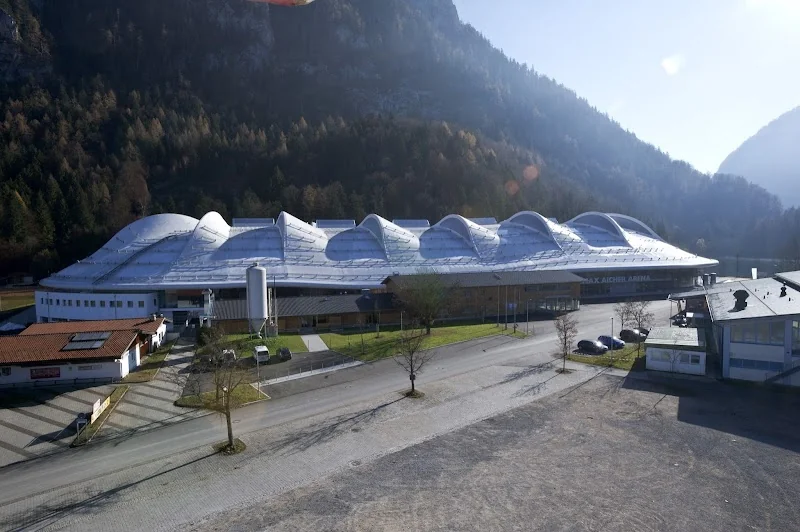
The Max Aicher Arena in Inzell is much more than a classic ice stadium: It combines a 400 m speed skating track, a 30 x 60 m hockey field, an inline track, a gym, a sports hall, and an athletics sprint facility under one roof. Officially, it is described as one of the most modern speed skating halls in the world and as a landmark of the region. Its history dates back to the Frillensee and the current location; the roots lie in 1959, the natural ice stadium was built in 1963, the transformation into an artificial ice stadium took place in 1965, and the current covered arena was used for the World Championship in 2011. For visitors, it serves as a sports venue, excursion destination, and event location with modular capacity for up to 7,000 people, clear opening hours, guided tours, and changing events. The all-round glazing and award-winning architecture ensure that the arena looks distinctive from the outside and that the combination of sport and technology is particularly impressive inside. ([max-aicher-arena.de](https://www.max-aicher-arena.de/arena/?utm_source=openai))
Opening Hours and Current Program
Those looking for "today", "program", or "events" will find the most up-to-date information fastest through the official homepage, the service area, and the event pages of the arena. There, guided tours, flea market dates, summer ice, and special notices are continuously published; for example, several guided tours are listed for June 2026, a flea market on June 14, 2026, and summer ice on the 400 m track and the hockey field from July 4 to July 26, 2026. It is also important to look at the season: For 2026/27, the arena announces the start on Saturday, September 26, 2026. Because operations are season-dependent and special events can shift individual skating times, it is worthwhile to check the info box and event calendar briefly before each visit. Online tickets lead directly through the turnstile and avoid waiting times at the box office. This means the arena is prepared for spontaneous visitors as well as for guests who want to plan their day around a skating session, a tour, or an event. ([max-aicher-arena.de](https://www.max-aicher-arena.de/service/oeffnungszeiten/))
From an SEO perspective, this search behavior is particularly valuable, as terms like "today" or "program" almost always indicate a concrete intention to visit. The arena responds to this intention with a mix of service, booking, and schedule overview: Opening hours, occupancy plans, admission prices, guided tours, and current news are clearly separated but easily accessible. This allows everyone to quickly find out whether public skating, a tour, an event, or a sports occupancy is taking place on a specific day. Those looking for the arena not just as a sports venue but as an excursion and experience location particularly benefit from this, as the official website consolidates the most important visitor questions in one place. Even short-term special cases are visible there, making it possible to realistically plan the visit and significantly simplifying orientation on-site. ([max-aicher-arena.de](https://www.max-aicher-arena.de/service/oeffnungszeiten/))
Public Skating, Speed Skating, and Ice Hockey in the Arena
A central theme is public skating. In the winter season 2025/26, it takes place on the hockey field daily from 1:30 PM to 3:30 PM, additionally during the holidays from 9:30 AM to 11:30 AM; public skating on the 400 m track is scheduled for Wednesdays from 7:15 PM to 9:15 PM and Sundays from 1:30 PM to 3:30 PM. A clear rule applies to the 400 m track: only hockey or figure skates are allowed. This is important for visitors because the arena consciously distinguishes between recreational activities and competitive sports. Additionally, curling dates are also listed on the official opening hours page. Thus, the arena is not only a place for spectators but also for people who want to skate themselves and are looking for a structured, well-supervised offer. Families, beginners, or recreational skaters can orient themselves to the clear times and plan their visit according to their desired skating style. ([max-aicher-arena.de](https://www.max-aicher-arena.de/service/oeffnungszeiten/))
The versatility of the facility is one of its strongest features. On the official arena page, the 400 m speed skating track, the 30 x 60 m hockey field, the inline track, the gym, the sports hall, and the athletics sprint facility are described as a cohesive ensemble. The data page adds that the facility is also interesting for the public, competitive sports, and tourist use. This is also reflected in the offers related to free skating, public skating, training times, and ice sports events. Therefore, those searching for "speed skating" will find not just a track but a complete training and competition center. Those looking for "ice hockey" will additionally receive the hockey field as a clearly defined usage area. And those simply planning a sporty outing will see various ice and sports formats that are closely connected in Inzell at one location. This multiple use is the reason why the arena remains attractive to sports target groups, visitors, and organizers alike. ([max-aicher-arena.de](https://www.max-aicher-arena.de/service/daten-und-fakten))
Parking and Directions to the Max Aicher Arena
The journey to the Max Aicher Arena is relatively straightforward. The official address is Reichenhaller Straße 79 in 83334 Inzell. Drivers from Munich follow the A8 to exit 112 Traunstein/Siegsdorf and then follow the signs to Inzell; a travel time of about 1 hour and 15 minutes is indicated. From Salzburg, the approach also runs via the A8 and the same exit, with a travel time of around 45 minutes. The arena also provides useful orientation values for further journeys: Munich Airport is about 110 km away, and Salzburg Airport is about 60 km away. This makes the location easy to place for both regional visitors and external guests. Those wishing to attend a program with a guided tour, public skating, or a special date can thus roughly estimate in advance how much buffer should be planned for the route. The clear directions are particularly helpful for first-time visitors as they greatly facilitate orientation on the last leg to Inzell. ([events.max-aicher-arena.de](https://events.max-aicher-arena.de/?page=travel))
The parking situation is clearly regulated, and this is particularly relevant for inquiries about "parking". The official travel information mentions parking spaces in the town, but no regular parking options directly at the arena; P9 is not available. Disabled parking spaces are located directly at the arena but require registration. This is complemented by the barrier-free accessibility of the arena with wheelchair-accessible entrances and a disabled toilet. For visitors, this means: Those coming for public skating, a tour, or an event should not plan their arrival too tightly and should allow some buffer for parking in the town. Especially for special events, an early arrival pays off because the location is well accessible, but the spaces on-site are clearly limited. These details are often more important for realistic visit planning than general promotional statements, as they directly determine whether the start on-site will be relaxed or hectic. ([events.max-aicher-arena.de](https://events.max-aicher-arena.de/?page=travel))
Seating Plan, Seats, and Capacity
The seating plan provides answers to the frequent questions about "seats" and "number of spectators". Block A includes about 1,300 seats, Block B about 1,100 seats, and Block C/D offers around 2,800 standing places. Together, this results in a modular total capacity of 1,000 to 7,000 people. This flexibility is particularly valuable for a speed skating hall because it can accommodate both small training and public situations as well as large championships, show formats, or events with high demand. The arena is thus not fixed to a single type of use but is intentionally designed as a variably usable location. This makes the seating plan relevant not only for fans but also for organizers, promoters, and media. Those wanting to know how people are distributed in the interior will get a very clear impression of the seating and standing areas with the block specifications. This allows for a better assessment of which events will appear more intimate and which will seem more large-scale. ([max-aicher-arena.de](https://www.max-aicher-arena.de/service/zuschauerplan))
The structural key data also show why the hall has such an impressive architectural appearance. According to the seating plan, the arena is 203.00 m long and 92.50 m wide, the hall height is 13.50 m, and the highest point of the roof structure is at 27.00 m. The roof area covers 22,000 square meters, and the snow load is estimated at about 400 kg per square meter. The hockey field measures 30 x 60 m, the 400 m track is 70.00 m wide, and the inner radius is 21.00 m. Together, these data provide a very clear picture of a large, technically demanding arena that possesses a lot of volume and presence not only on paper but also in the space itself. Therefore, those searching for "seats" will not only get a number here but a complete understanding of the dimensions. This transparency is particularly useful for groups, clubs, organizers, and anyone who wants to have an idea of sightlines, spatial feeling, and scale before a visit. ([max-aicher-arena.de](https://www.max-aicher-arena.de/service/zuschauerplan))
Year of Construction, History, and Architecture
The history of the Max Aicher Arena does not begin only with the construction of the current hall but with a long tradition of ice sports in Inzell. As early as 1959, the preparation of natural ice for training and competitions began at the Frillensee. In 1963, the municipality of Inzell, together with the German Speed Skating Club Frillensee, built a natural ice stadium at Zwingsee, which was transformed into an artificial ice stadium in 1965; in this context, the 400 m artificial ice track was also created. Therefore, the current arena stands in a direct development line from natural track, artificial ice stadium, and modern covered hall. The official historical representation also mentions eleven world championships, two European championships, and more than 150 other international major events that have shaped the location over the decades. This sequence makes it clear that Inzell did not become the center of speed skating by chance but has grown consistently over decades. ([max-aicher-arena.de](https://www.max-aicher-arena.de/ueber-uns/geschichte))
The actual new construction of the enclosure was accelerated by the award for the individual distance world championships in 2011. In summer 2008, Inzell was awarded by the ISU, in 2009 the planning for the approximately 36 million euro project began, and in March 2011, the World Championship was already held in the new ice arena. The official construction history emphasizes that the arena was created in about one and a half years of planning and construction and aimed to be one of the most modern halls in the world. This includes a column-free interior, targeted air circulation above the ice, and the use of waste heat from ice cooling for heating the hall. The tourism page additionally highlights the all-round glazing and describes the architecture as award-winning. For these reasons, the arena is so interesting for inquiries about "year of construction", "history", and "architecture": it combines historical depth, technical innovation, and a clear sporting identity. ([max-aicher-arena.de](https://www.max-aicher-arena.de/ueber-uns/bau-der-max-aicher-arena))
Guided Tours, Photos, and Visitor Information
Guided tours are a fixed part of the visitor program and cover the search intention behind "tour" very well. The official website regularly lists dates starting at 10:00 AM and lasting about 1.5 hours; there are also special dates in the afternoon, for example, June 25, 2026, from 2:00 PM to about 3:30 PM. For guests, this means: The arena is not only a striking building from the outside but can also be experienced from a different perspective during a guided tour, namely as a place behind the scenes where sport, technology, and organization come together. That the tours are independently organized is also shown by the separate phone number on the contact page. This makes it clear that visitors are not just stopping by but are being integrated into the program in a targeted manner. Those planning a group or wanting to get to know the arena consciously thus receive a very practical entry point with the tours. At the same time, the dates fit well with the other visitor information as they are embedded in the seasonal structure of the arena. ([max-aicher-arena.de](https://www.max-aicher-arena.de/?utm_source=openai))
The arena is also well documented for photos, images, and general visitor information. The service area refers to images, training times, events, and activities, skating times, admission prices, history, and online tickets. Additionally, the tourism page shows that topics like ice speedway and other events also play a role around the Max Aicher Arena in the Inzell area, and that the municipality also maintains a webcams section, while the arena website primarily consolidates service and program information. From an SEO perspective, this combination is strong: The arena serves sports interest, experience interest, and practical planning all in one. Therefore, those searching for photos, webcams, or current impressions will find a clear entry point into the overall offering of the location on the official pages, without the use being limited to a single purpose. This creates a complete picture of a location that is equally suitable for sporting excellence, audience experiences, guided tours, and structured visitor planning. ([max-aicher-arena.de](https://www.max-aicher-arena.de/service/oeffnungszeiten/))
Sources:
Show moreShow less
Max Aicher Arena | Opening Hours & Public Skating
The Max Aicher Arena in Inzell is much more than a classic ice stadium: It combines a 400 m speed skating track, a 30 x 60 m hockey field, an inline track, a gym, a sports hall, and an athletics sprint facility under one roof. Officially, it is described as one of the most modern speed skating halls in the world and as a landmark of the region. Its history dates back to the Frillensee and the current location; the roots lie in 1959, the natural ice stadium was built in 1963, the transformation into an artificial ice stadium took place in 1965, and the current covered arena was used for the World Championship in 2011. For visitors, it serves as a sports venue, excursion destination, and event location with modular capacity for up to 7,000 people, clear opening hours, guided tours, and changing events. The all-round glazing and award-winning architecture ensure that the arena looks distinctive from the outside and that the combination of sport and technology is particularly impressive inside. ([max-aicher-arena.de](https://www.max-aicher-arena.de/arena/?utm_source=openai))
Opening Hours and Current Program
Those looking for "today", "program", or "events" will find the most up-to-date information fastest through the official homepage, the service area, and the event pages of the arena. There, guided tours, flea market dates, summer ice, and special notices are continuously published; for example, several guided tours are listed for June 2026, a flea market on June 14, 2026, and summer ice on the 400 m track and the hockey field from July 4 to July 26, 2026. It is also important to look at the season: For 2026/27, the arena announces the start on Saturday, September 26, 2026. Because operations are season-dependent and special events can shift individual skating times, it is worthwhile to check the info box and event calendar briefly before each visit. Online tickets lead directly through the turnstile and avoid waiting times at the box office. This means the arena is prepared for spontaneous visitors as well as for guests who want to plan their day around a skating session, a tour, or an event. ([max-aicher-arena.de](https://www.max-aicher-arena.de/service/oeffnungszeiten/))
From an SEO perspective, this search behavior is particularly valuable, as terms like "today" or "program" almost always indicate a concrete intention to visit. The arena responds to this intention with a mix of service, booking, and schedule overview: Opening hours, occupancy plans, admission prices, guided tours, and current news are clearly separated but easily accessible. This allows everyone to quickly find out whether public skating, a tour, an event, or a sports occupancy is taking place on a specific day. Those looking for the arena not just as a sports venue but as an excursion and experience location particularly benefit from this, as the official website consolidates the most important visitor questions in one place. Even short-term special cases are visible there, making it possible to realistically plan the visit and significantly simplifying orientation on-site. ([max-aicher-arena.de](https://www.max-aicher-arena.de/service/oeffnungszeiten/))
Public Skating, Speed Skating, and Ice Hockey in the Arena
A central theme is public skating. In the winter season 2025/26, it takes place on the hockey field daily from 1:30 PM to 3:30 PM, additionally during the holidays from 9:30 AM to 11:30 AM; public skating on the 400 m track is scheduled for Wednesdays from 7:15 PM to 9:15 PM and Sundays from 1:30 PM to 3:30 PM. A clear rule applies to the 400 m track: only hockey or figure skates are allowed. This is important for visitors because the arena consciously distinguishes between recreational activities and competitive sports. Additionally, curling dates are also listed on the official opening hours page. Thus, the arena is not only a place for spectators but also for people who want to skate themselves and are looking for a structured, well-supervised offer. Families, beginners, or recreational skaters can orient themselves to the clear times and plan their visit according to their desired skating style. ([max-aicher-arena.de](https://www.max-aicher-arena.de/service/oeffnungszeiten/))
The versatility of the facility is one of its strongest features. On the official arena page, the 400 m speed skating track, the 30 x 60 m hockey field, the inline track, the gym, the sports hall, and the athletics sprint facility are described as a cohesive ensemble. The data page adds that the facility is also interesting for the public, competitive sports, and tourist use. This is also reflected in the offers related to free skating, public skating, training times, and ice sports events. Therefore, those searching for "speed skating" will find not just a track but a complete training and competition center. Those looking for "ice hockey" will additionally receive the hockey field as a clearly defined usage area. And those simply planning a sporty outing will see various ice and sports formats that are closely connected in Inzell at one location. This multiple use is the reason why the arena remains attractive to sports target groups, visitors, and organizers alike. ([max-aicher-arena.de](https://www.max-aicher-arena.de/service/daten-und-fakten))
Parking and Directions to the Max Aicher Arena
The journey to the Max Aicher Arena is relatively straightforward. The official address is Reichenhaller Straße 79 in 83334 Inzell. Drivers from Munich follow the A8 to exit 112 Traunstein/Siegsdorf and then follow the signs to Inzell; a travel time of about 1 hour and 15 minutes is indicated. From Salzburg, the approach also runs via the A8 and the same exit, with a travel time of around 45 minutes. The arena also provides useful orientation values for further journeys: Munich Airport is about 110 km away, and Salzburg Airport is about 60 km away. This makes the location easy to place for both regional visitors and external guests. Those wishing to attend a program with a guided tour, public skating, or a special date can thus roughly estimate in advance how much buffer should be planned for the route. The clear directions are particularly helpful for first-time visitors as they greatly facilitate orientation on the last leg to Inzell. ([events.max-aicher-arena.de](https://events.max-aicher-arena.de/?page=travel))
The parking situation is clearly regulated, and this is particularly relevant for inquiries about "parking". The official travel information mentions parking spaces in the town, but no regular parking options directly at the arena; P9 is not available. Disabled parking spaces are located directly at the arena but require registration. This is complemented by the barrier-free accessibility of the arena with wheelchair-accessible entrances and a disabled toilet. For visitors, this means: Those coming for public skating, a tour, or an event should not plan their arrival too tightly and should allow some buffer for parking in the town. Especially for special events, an early arrival pays off because the location is well accessible, but the spaces on-site are clearly limited. These details are often more important for realistic visit planning than general promotional statements, as they directly determine whether the start on-site will be relaxed or hectic. ([events.max-aicher-arena.de](https://events.max-aicher-arena.de/?page=travel))
Seating Plan, Seats, and Capacity
The seating plan provides answers to the frequent questions about "seats" and "number of spectators". Block A includes about 1,300 seats, Block B about 1,100 seats, and Block C/D offers around 2,800 standing places. Together, this results in a modular total capacity of 1,000 to 7,000 people. This flexibility is particularly valuable for a speed skating hall because it can accommodate both small training and public situations as well as large championships, show formats, or events with high demand. The arena is thus not fixed to a single type of use but is intentionally designed as a variably usable location. This makes the seating plan relevant not only for fans but also for organizers, promoters, and media. Those wanting to know how people are distributed in the interior will get a very clear impression of the seating and standing areas with the block specifications. This allows for a better assessment of which events will appear more intimate and which will seem more large-scale. ([max-aicher-arena.de](https://www.max-aicher-arena.de/service/zuschauerplan))
The structural key data also show why the hall has such an impressive architectural appearance. According to the seating plan, the arena is 203.00 m long and 92.50 m wide, the hall height is 13.50 m, and the highest point of the roof structure is at 27.00 m. The roof area covers 22,000 square meters, and the snow load is estimated at about 400 kg per square meter. The hockey field measures 30 x 60 m, the 400 m track is 70.00 m wide, and the inner radius is 21.00 m. Together, these data provide a very clear picture of a large, technically demanding arena that possesses a lot of volume and presence not only on paper but also in the space itself. Therefore, those searching for "seats" will not only get a number here but a complete understanding of the dimensions. This transparency is particularly useful for groups, clubs, organizers, and anyone who wants to have an idea of sightlines, spatial feeling, and scale before a visit. ([max-aicher-arena.de](https://www.max-aicher-arena.de/service/zuschauerplan))
Year of Construction, History, and Architecture
The history of the Max Aicher Arena does not begin only with the construction of the current hall but with a long tradition of ice sports in Inzell. As early as 1959, the preparation of natural ice for training and competitions began at the Frillensee. In 1963, the municipality of Inzell, together with the German Speed Skating Club Frillensee, built a natural ice stadium at Zwingsee, which was transformed into an artificial ice stadium in 1965; in this context, the 400 m artificial ice track was also created. Therefore, the current arena stands in a direct development line from natural track, artificial ice stadium, and modern covered hall. The official historical representation also mentions eleven world championships, two European championships, and more than 150 other international major events that have shaped the location over the decades. This sequence makes it clear that Inzell did not become the center of speed skating by chance but has grown consistently over decades. ([max-aicher-arena.de](https://www.max-aicher-arena.de/ueber-uns/geschichte))
The actual new construction of the enclosure was accelerated by the award for the individual distance world championships in 2011. In summer 2008, Inzell was awarded by the ISU, in 2009 the planning for the approximately 36 million euro project began, and in March 2011, the World Championship was already held in the new ice arena. The official construction history emphasizes that the arena was created in about one and a half years of planning and construction and aimed to be one of the most modern halls in the world. This includes a column-free interior, targeted air circulation above the ice, and the use of waste heat from ice cooling for heating the hall. The tourism page additionally highlights the all-round glazing and describes the architecture as award-winning. For these reasons, the arena is so interesting for inquiries about "year of construction", "history", and "architecture": it combines historical depth, technical innovation, and a clear sporting identity. ([max-aicher-arena.de](https://www.max-aicher-arena.de/ueber-uns/bau-der-max-aicher-arena))
Guided Tours, Photos, and Visitor Information
Guided tours are a fixed part of the visitor program and cover the search intention behind "tour" very well. The official website regularly lists dates starting at 10:00 AM and lasting about 1.5 hours; there are also special dates in the afternoon, for example, June 25, 2026, from 2:00 PM to about 3:30 PM. For guests, this means: The arena is not only a striking building from the outside but can also be experienced from a different perspective during a guided tour, namely as a place behind the scenes where sport, technology, and organization come together. That the tours are independently organized is also shown by the separate phone number on the contact page. This makes it clear that visitors are not just stopping by but are being integrated into the program in a targeted manner. Those planning a group or wanting to get to know the arena consciously thus receive a very practical entry point with the tours. At the same time, the dates fit well with the other visitor information as they are embedded in the seasonal structure of the arena. ([max-aicher-arena.de](https://www.max-aicher-arena.de/?utm_source=openai))
The arena is also well documented for photos, images, and general visitor information. The service area refers to images, training times, events, and activities, skating times, admission prices, history, and online tickets. Additionally, the tourism page shows that topics like ice speedway and other events also play a role around the Max Aicher Arena in the Inzell area, and that the municipality also maintains a webcams section, while the arena website primarily consolidates service and program information. From an SEO perspective, this combination is strong: The arena serves sports interest, experience interest, and practical planning all in one. Therefore, those searching for photos, webcams, or current impressions will find a clear entry point into the overall offering of the location on the official pages, without the use being limited to a single purpose. This creates a complete picture of a location that is equally suitable for sporting excellence, audience experiences, guided tours, and structured visitor planning. ([max-aicher-arena.de](https://www.max-aicher-arena.de/service/oeffnungszeiten/))
Sources:
Max Aicher Arena | Opening Hours & Public Skating
The Max Aicher Arena in Inzell is much more than a classic ice stadium: It combines a 400 m speed skating track, a 30 x 60 m hockey field, an inline track, a gym, a sports hall, and an athletics sprint facility under one roof. Officially, it is described as one of the most modern speed skating halls in the world and as a landmark of the region. Its history dates back to the Frillensee and the current location; the roots lie in 1959, the natural ice stadium was built in 1963, the transformation into an artificial ice stadium took place in 1965, and the current covered arena was used for the World Championship in 2011. For visitors, it serves as a sports venue, excursion destination, and event location with modular capacity for up to 7,000 people, clear opening hours, guided tours, and changing events. The all-round glazing and award-winning architecture ensure that the arena looks distinctive from the outside and that the combination of sport and technology is particularly impressive inside. ([max-aicher-arena.de](https://www.max-aicher-arena.de/arena/?utm_source=openai))
Opening Hours and Current Program
Those looking for "today", "program", or "events" will find the most up-to-date information fastest through the official homepage, the service area, and the event pages of the arena. There, guided tours, flea market dates, summer ice, and special notices are continuously published; for example, several guided tours are listed for June 2026, a flea market on June 14, 2026, and summer ice on the 400 m track and the hockey field from July 4 to July 26, 2026. It is also important to look at the season: For 2026/27, the arena announces the start on Saturday, September 26, 2026. Because operations are season-dependent and special events can shift individual skating times, it is worthwhile to check the info box and event calendar briefly before each visit. Online tickets lead directly through the turnstile and avoid waiting times at the box office. This means the arena is prepared for spontaneous visitors as well as for guests who want to plan their day around a skating session, a tour, or an event. ([max-aicher-arena.de](https://www.max-aicher-arena.de/service/oeffnungszeiten/))
From an SEO perspective, this search behavior is particularly valuable, as terms like "today" or "program" almost always indicate a concrete intention to visit. The arena responds to this intention with a mix of service, booking, and schedule overview: Opening hours, occupancy plans, admission prices, guided tours, and current news are clearly separated but easily accessible. This allows everyone to quickly find out whether public skating, a tour, an event, or a sports occupancy is taking place on a specific day. Those looking for the arena not just as a sports venue but as an excursion and experience location particularly benefit from this, as the official website consolidates the most important visitor questions in one place. Even short-term special cases are visible there, making it possible to realistically plan the visit and significantly simplifying orientation on-site. ([max-aicher-arena.de](https://www.max-aicher-arena.de/service/oeffnungszeiten/))
Public Skating, Speed Skating, and Ice Hockey in the Arena
A central theme is public skating. In the winter season 2025/26, it takes place on the hockey field daily from 1:30 PM to 3:30 PM, additionally during the holidays from 9:30 AM to 11:30 AM; public skating on the 400 m track is scheduled for Wednesdays from 7:15 PM to 9:15 PM and Sundays from 1:30 PM to 3:30 PM. A clear rule applies to the 400 m track: only hockey or figure skates are allowed. This is important for visitors because the arena consciously distinguishes between recreational activities and competitive sports. Additionally, curling dates are also listed on the official opening hours page. Thus, the arena is not only a place for spectators but also for people who want to skate themselves and are looking for a structured, well-supervised offer. Families, beginners, or recreational skaters can orient themselves to the clear times and plan their visit according to their desired skating style. ([max-aicher-arena.de](https://www.max-aicher-arena.de/service/oeffnungszeiten/))
The versatility of the facility is one of its strongest features. On the official arena page, the 400 m speed skating track, the 30 x 60 m hockey field, the inline track, the gym, the sports hall, and the athletics sprint facility are described as a cohesive ensemble. The data page adds that the facility is also interesting for the public, competitive sports, and tourist use. This is also reflected in the offers related to free skating, public skating, training times, and ice sports events. Therefore, those searching for "speed skating" will find not just a track but a complete training and competition center. Those looking for "ice hockey" will additionally receive the hockey field as a clearly defined usage area. And those simply planning a sporty outing will see various ice and sports formats that are closely connected in Inzell at one location. This multiple use is the reason why the arena remains attractive to sports target groups, visitors, and organizers alike. ([max-aicher-arena.de](https://www.max-aicher-arena.de/service/daten-und-fakten))
Parking and Directions to the Max Aicher Arena
The journey to the Max Aicher Arena is relatively straightforward. The official address is Reichenhaller Straße 79 in 83334 Inzell. Drivers from Munich follow the A8 to exit 112 Traunstein/Siegsdorf and then follow the signs to Inzell; a travel time of about 1 hour and 15 minutes is indicated. From Salzburg, the approach also runs via the A8 and the same exit, with a travel time of around 45 minutes. The arena also provides useful orientation values for further journeys: Munich Airport is about 110 km away, and Salzburg Airport is about 60 km away. This makes the location easy to place for both regional visitors and external guests. Those wishing to attend a program with a guided tour, public skating, or a special date can thus roughly estimate in advance how much buffer should be planned for the route. The clear directions are particularly helpful for first-time visitors as they greatly facilitate orientation on the last leg to Inzell. ([events.max-aicher-arena.de](https://events.max-aicher-arena.de/?page=travel))
The parking situation is clearly regulated, and this is particularly relevant for inquiries about "parking". The official travel information mentions parking spaces in the town, but no regular parking options directly at the arena; P9 is not available. Disabled parking spaces are located directly at the arena but require registration. This is complemented by the barrier-free accessibility of the arena with wheelchair-accessible entrances and a disabled toilet. For visitors, this means: Those coming for public skating, a tour, or an event should not plan their arrival too tightly and should allow some buffer for parking in the town. Especially for special events, an early arrival pays off because the location is well accessible, but the spaces on-site are clearly limited. These details are often more important for realistic visit planning than general promotional statements, as they directly determine whether the start on-site will be relaxed or hectic. ([events.max-aicher-arena.de](https://events.max-aicher-arena.de/?page=travel))
Seating Plan, Seats, and Capacity
The seating plan provides answers to the frequent questions about "seats" and "number of spectators". Block A includes about 1,300 seats, Block B about 1,100 seats, and Block C/D offers around 2,800 standing places. Together, this results in a modular total capacity of 1,000 to 7,000 people. This flexibility is particularly valuable for a speed skating hall because it can accommodate both small training and public situations as well as large championships, show formats, or events with high demand. The arena is thus not fixed to a single type of use but is intentionally designed as a variably usable location. This makes the seating plan relevant not only for fans but also for organizers, promoters, and media. Those wanting to know how people are distributed in the interior will get a very clear impression of the seating and standing areas with the block specifications. This allows for a better assessment of which events will appear more intimate and which will seem more large-scale. ([max-aicher-arena.de](https://www.max-aicher-arena.de/service/zuschauerplan))
The structural key data also show why the hall has such an impressive architectural appearance. According to the seating plan, the arena is 203.00 m long and 92.50 m wide, the hall height is 13.50 m, and the highest point of the roof structure is at 27.00 m. The roof area covers 22,000 square meters, and the snow load is estimated at about 400 kg per square meter. The hockey field measures 30 x 60 m, the 400 m track is 70.00 m wide, and the inner radius is 21.00 m. Together, these data provide a very clear picture of a large, technically demanding arena that possesses a lot of volume and presence not only on paper but also in the space itself. Therefore, those searching for "seats" will not only get a number here but a complete understanding of the dimensions. This transparency is particularly useful for groups, clubs, organizers, and anyone who wants to have an idea of sightlines, spatial feeling, and scale before a visit. ([max-aicher-arena.de](https://www.max-aicher-arena.de/service/zuschauerplan))
Year of Construction, History, and Architecture
The history of the Max Aicher Arena does not begin only with the construction of the current hall but with a long tradition of ice sports in Inzell. As early as 1959, the preparation of natural ice for training and competitions began at the Frillensee. In 1963, the municipality of Inzell, together with the German Speed Skating Club Frillensee, built a natural ice stadium at Zwingsee, which was transformed into an artificial ice stadium in 1965; in this context, the 400 m artificial ice track was also created. Therefore, the current arena stands in a direct development line from natural track, artificial ice stadium, and modern covered hall. The official historical representation also mentions eleven world championships, two European championships, and more than 150 other international major events that have shaped the location over the decades. This sequence makes it clear that Inzell did not become the center of speed skating by chance but has grown consistently over decades. ([max-aicher-arena.de](https://www.max-aicher-arena.de/ueber-uns/geschichte))
The actual new construction of the enclosure was accelerated by the award for the individual distance world championships in 2011. In summer 2008, Inzell was awarded by the ISU, in 2009 the planning for the approximately 36 million euro project began, and in March 2011, the World Championship was already held in the new ice arena. The official construction history emphasizes that the arena was created in about one and a half years of planning and construction and aimed to be one of the most modern halls in the world. This includes a column-free interior, targeted air circulation above the ice, and the use of waste heat from ice cooling for heating the hall. The tourism page additionally highlights the all-round glazing and describes the architecture as award-winning. For these reasons, the arena is so interesting for inquiries about "year of construction", "history", and "architecture": it combines historical depth, technical innovation, and a clear sporting identity. ([max-aicher-arena.de](https://www.max-aicher-arena.de/ueber-uns/bau-der-max-aicher-arena))
Guided Tours, Photos, and Visitor Information
Guided tours are a fixed part of the visitor program and cover the search intention behind "tour" very well. The official website regularly lists dates starting at 10:00 AM and lasting about 1.5 hours; there are also special dates in the afternoon, for example, June 25, 2026, from 2:00 PM to about 3:30 PM. For guests, this means: The arena is not only a striking building from the outside but can also be experienced from a different perspective during a guided tour, namely as a place behind the scenes where sport, technology, and organization come together. That the tours are independently organized is also shown by the separate phone number on the contact page. This makes it clear that visitors are not just stopping by but are being integrated into the program in a targeted manner. Those planning a group or wanting to get to know the arena consciously thus receive a very practical entry point with the tours. At the same time, the dates fit well with the other visitor information as they are embedded in the seasonal structure of the arena. ([max-aicher-arena.de](https://www.max-aicher-arena.de/?utm_source=openai))
The arena is also well documented for photos, images, and general visitor information. The service area refers to images, training times, events, and activities, skating times, admission prices, history, and online tickets. Additionally, the tourism page shows that topics like ice speedway and other events also play a role around the Max Aicher Arena in the Inzell area, and that the municipality also maintains a webcams section, while the arena website primarily consolidates service and program information. From an SEO perspective, this combination is strong: The arena serves sports interest, experience interest, and practical planning all in one. Therefore, those searching for photos, webcams, or current impressions will find a clear entry point into the overall offering of the location on the official pages, without the use being limited to a single purpose. This creates a complete picture of a location that is equally suitable for sporting excellence, audience experiences, guided tours, and structured visitor planning. ([max-aicher-arena.de](https://www.max-aicher-arena.de/service/oeffnungszeiten/))
Sources:
Upcoming Events
Frequently Asked Questions
Reviews
No reviews found