
Aschau im Chiemgau
Kirchpl. 2, 83229 Aschau im Chiemgau, Deutschland
Catholic Parish Office Presentation of the Lord | Parish Office & Candlemas
The Catholic Parish Office Presentation of the Lord in Aschau im Chiemgau is more than just an administrative address: it is the organizational center of a well-established Catholic community at Kirchplatz 2, directly at the foot of the Kampenwand and within the parish association Oberes Priental. The parish belongs to the deanery Chiemsee in the southern region of the Archdiocese of Munich and Freising, has 2575 members according to diocesan representation (as of 2021), and oversees a widely branched area with districts, hamlets, and isolated farms around Aschau. This connection of pastoral care, local history, and distinctive church architecture makes the address interesting for locals, guests, and pilgrims alike. Those searching for the Catholic parish office Presentation of the Lord in Aschau im Chiemgau will find not only an office location here but also a vibrant center with clear opening hours, a prominent church, and a strong connection to the history of the place. ([erzbistum-muenchen.de](https://www.erzbistum-muenchen.de/pfarrei/pv-oberes-priental/aschau-chiemgau/cont/66715))
Parish Office, Opening Hours, and Contact in Aschau im Chiemgau
The Parish Office Aschau is located at Kirchplatz 2, 83229 Aschau im Chiemgau; the phone number 08052/4428 and the email address Darstellung-des-Herrn.Aschau@ebmuc.de are provided on the official parish page. The regular opening hours are Monday, Tuesday, Wednesday, and Friday from 8 to 10 AM and Thursday from 3 to 5 PM. During the Bavarian school holidays, availability is reduced to Monday, Wednesday, and Friday from 8 to 10 AM. For people specifically looking for the parish office, office hours, or contact information, these are the most important basic data at a glance. The clear structure helps not only with classic concerns such as inquiries about services but also when one wants to quickly orient themselves in the area and is looking for a reliable church contact point. ([erzbistum-muenchen.de](https://www.erzbistum-muenchen.de/pfarrei/pv-oberes-priental/aschau-chiemgau))
It is also practical that the parish community at Kirchplatz 2 maintains a well-visible communication point for community life. In the parish church, the church guide and the respective weekly information are available, and the parish newsletter Oberes Priental is distributed free of charge to all households; the official representation even mentions a circulation of 3250 copies. Thus, dates, services, and notices are made visible not only digitally but also in the traditional way on-site. The parish thus presents itself as a reliable structure that brings together everyday questions, liturgical processes, and information about community life. Therefore, those looking for the Catholic parish office Presentation of the Lord will find not an anonymous address but a lively community with fixed times, personal accessibility, and clear orientation for visitors. ([erzbistum-muenchen.de](https://www.erzbistum-muenchen.de/pfarrei/pv-oberes-priental/aschau-chiemgau))
History of the Parish Church Presentation of the Lord
The Parish Church Presentation of the Lord has shaped Aschau im Chiemgau for centuries and is one of the most prominent buildings in the Priental. Its first mention dates back to the end of the 12th century; later, the small church was expanded and redesigned in the late Gothic style, until it developed into the characteristic double-towered church we see today. The location above the Prien and at the edge of the Aschauer Kirchberg enhances the impression of a widely visible landmark that serves as both a religious center and an identity-forming monument of the place. The development from the early mention through the late Gothic expansion phase to the later Baroque shaping shows how closely intertwined building history and community history are in Aschau. This layering makes the church exciting not only for believers but also for culturally and historically interested visitors. ([chiemsee-alpenland.de](https://www.chiemsee-alpenland.de/entdecken/alle-sehenswuerdigkeiten/pfarrkirche-darstellung-des-herrn-c2cc44039b))
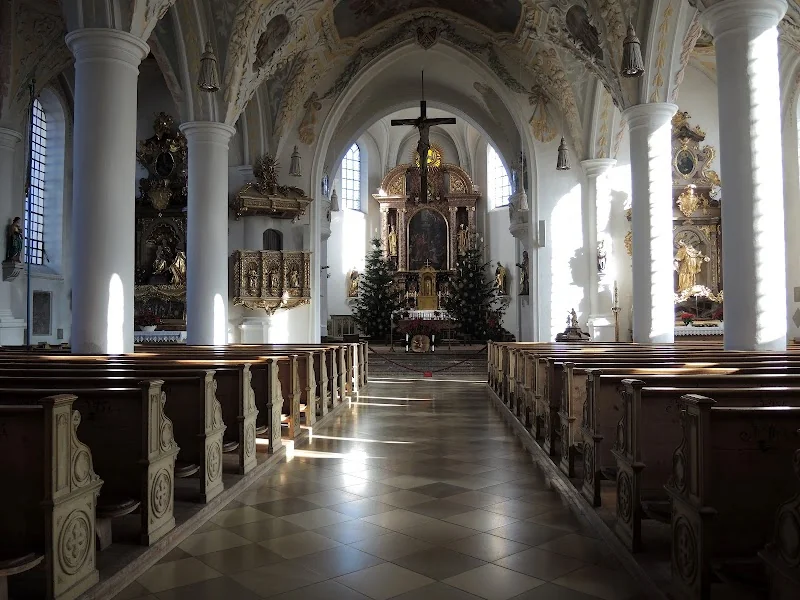
Particularly impressive is the art history of the interior. The rich Baroque stucco dates from 1702, the frescoes from 1753; the ceiling painting was created by Balthasar Mang in 1753/54. The altar painting goes back to the old Baroque altar from 1673 and depicts the Presentation of the Lord in the Temple. Later, Baron Theodor von Cramer-Klett had the high altar redesigned. The pulpit is also considered a rare Baroque relic. Thus, the church connects late Gothic substance with Baroque splendor and a strong historical spatial impression that appeals to art lovers as well as visitors seeking a quiet yet very expressive atmosphere. The church is therefore a place where piety, craftsmanship, artistic sensibility, and local consciousness remarkably overlap. ([chiemsee-alpenland.de](https://www.chiemsee-alpenland.de/entdecken/alle-sehenswuerdigkeiten/pfarrkirche-darstellung-des-herrn-c2cc44039b))
Holy Grave, Candlemas, and Special Services
A special unique feature is the Aschauer Holy Grave, one of the rare Baroque backdrop holy graves that have been preserved in Bavaria. The first mention is documented for 1618; in 1797/99, a new version was created for the parish church by the carpenter Sebastian Furtner from Hohenaschau and the painter Sebastian Rechenauer the Elder from Unterflintsbach, probably using older parts. The tradition connects to Baroque Passion and mystery plays and makes visible how closely liturgy, imagery, and theatrical staging belong together in Aschau. Those interested in religious folk culture will encounter a rare example of how faith can be expressed not only in prayer but also in impressive spatial and visual solutions. ([aschau.de](https://www.aschau.de/action/download?id=%7B937890a7-a425-153d-0c8a-a5afcf6de88d%7D))
After the Holy Grave had been set up annually during Holy Week until the mid-1950s, it disappeared for more than six decades into the church attic. It was only in 2019 that it was rebuilt after careful renovation; subsequent setups took place in 2022 and 2025, with the next one planned for 2028. The program surrounding the Holy Grave includes guided tours, evening music, Passion singing, and services. The events announced for 2025 show how strongly the theme is anchored in the area: from the solemn opening to guided tours to musical devotions and ecumenical services. Therefore, those visiting Aschau during Easter will experience not only a monument but a vibrant culture of faith and remembrance that continues to attract people from the region. ([erzbistum-muenchen.de](https://www.erzbistum-muenchen.de/pfarrei/pv-oberes-priental/aschau-chiemgau/aschauer-heiliges-grab))
The patronage of the church is the Presentation of the Lord, which is why February 2nd as Candlemas has a special significance in the local church year. The name itself refers to the biblical scene in the temple and explains why this church in Aschau is so often at the center of art historical tours, religious celebrations, and regional events. Thus, a liturgical feast day becomes a cultural anchor point for the entire valley. In connection with the Holy Grave and the Passion offerings, a yearly cycle emerges that extends beyond the mere Sunday service and makes the special spiritual imprint of the place visible. ([chiemsee-alpenland.de](https://www.chiemsee-alpenland.de/entdecken/alle-sehenswuerdigkeiten/pfarrkirche-darstellung-des-herrn-c2cc44039b))
Directions, Parking, and Chapel Paths around the Kirchplatz
For directions, the location at Kirchplatz 2 is crucial: The church sits atop the Kirchberg and dominates the area with its two Baroque onion domes. For day visitors, the official directions recommend the cemetery parking lot on Rosenheimer Straße, as there are only a few parking spaces available in the immediate Kirchberg area. Therefore, those intending to visit the parish office, the church, or a guided tour should not wait until they reach Kirchplatz to look for available parking spaces but should plan for the mentioned alternative. This advice is particularly valuable for visitors as it facilitates access to the area and avoids unnecessary detours. Thus, the church's central point in the village can be reached relaxed and without parking stress. ([erzbistum-muenchen.de](https://www.erzbistum-muenchen.de/pfarrei/pv-oberes-priental/aschau-chiemgau/kapellenweg/cont/66770?utm_source=openai))
Around the church, the local history and landscape can be particularly well explored on foot. From the parish church, the Aschauer Chapel Path with its circular routes leads south and north, as well as the Sinnstifterweg, which runs as a joint project of the church and tourism towards Sachrang. The tours open views of the Aschauer Valley, Hohenaschau Castle, and the peaks of the Kampenwand. This connection of a spiritual place, village center, and Alpine view makes the location so attractive for visitors who want to experience the character of the area alongside the parish office. Those who wish can thus combine their church visit with a walk and experience how strongly the place is shaped by its location between valley, mountains, and sacred stations. ([chiemsee-alpenland.de](https://www.chiemsee-alpenland.de/entdecken/alle-sehenswuerdigkeiten/pfarrkirche-darstellung-des-herrn-c2cc44039b?utm_source=openai))
Geographically, Aschau im Chiemgau is located approximately halfway between Munich and Salzburg, about five kilometers southwest of Lake Chiemsee and directly at the foot of the Kampenwand. For guests who wish to combine a visit to the parish office or the parish church with an excursion, this is an additional advantage: the church is easily identifiable as a destination in the town center and is also part of a landscape-defining overall picture of mountains, valley, and historical buildings. This makes the place interesting not only for a quick visit but also for longer stays, where church, village, and landscape can be consciously experienced together. ([erzbistum-muenchen.de](https://www.erzbistum-muenchen.de/pfarrei/pv-oberes-priental/aschau-chiemgau/cont/66715))
Parish Association Oberes Priental and Lively Pastoral Care
Organizationally, the parish Presentation of the Lord has belonged to the parish association Oberes Priental since September 1, 2002, together with Frasdorf and Sachrang. Within the Archdiocese of Munich and Freising, it is assigned to the deanery Chiemsee in the southern region. The parish community describes its area as a broadly defined pastoral field from Höhenberg in the north to Grattenbach in the south and from Hochries and Kampenwand in the west and east. This scale explains why the parish office is not only an office but also a coordination point for a very diverse, spatially widespread community. The historical development from the former branch of Prien to an independent parish since 1680 further emphasizes how long church life has been organized and maintained here. ([erzbistum-muenchen.de](https://www.erzbistum-muenchen.de/pfarrei/pv-oberes-priental/aschau-chiemgau/cont/66715))
The lived community includes numerous groups and services: Volunteers take on word-god celebrations, lector service, communion distribution, music, cantor service, and altar serving; there is also a Kolping family, Catholic women's association, scout troop, and parish home. In addition, there are church-run kindergartens, social work in the area, and musical life with church choirs and other ensembles. Thus, the parish presents itself not only on festive days but also in the regular interaction of families, seniors, youth, and engaged individuals who carry life around the parish church. The diversity of groups is a good sign that the parish office does not function in isolation but is embedded in a stable network of volunteer work, liturgy, and community culture. ([erzbistum-muenchen.de](https://www.erzbistum-muenchen.de/pfarrei/pv-oberes-priental/aschau-chiemgau/cont/66715))
The parish office and church information are supplemented by the free parish newsletter Oberes Priental, which is distributed in a circulation of 3250 copies to all households. This gives Aschau a well-visible communication structure for services, dates, and community life. Therefore, those looking for current information will find not only an address but a functioning information network of the parish office, weekly bulletin, service schedule, and personal presence on-site. This combination of reliability and proximity is typical of a community that has developed historically and remains open and approachable in everyday life. This makes the Catholic Parish Office Presentation of the Lord a place where church tradition and practical accessibility come together very clearly. ([erzbistum-muenchen.de](https://www.erzbistum-muenchen.de/pfarrei/pv-oberes-priental/aschau-chiemgau))
Sources:
- Archdiocese of Munich and Freising - Catholic Parish Community Aschau im Chiemgau
- Chiemsee-Alpenland Tourism - Parish Church Presentation of the Lord
- Community Aschau i.Chiemgau - Catholic Church Aschau im Chiemgau
- Archdiocese of Munich and Freising - The Aschauer Holy Grave
- Archdiocese of Munich and Freising - Directions to Circular Route 1
Show moreShow less
Catholic Parish Office Presentation of the Lord | Parish Office & Candlemas
The Catholic Parish Office Presentation of the Lord in Aschau im Chiemgau is more than just an administrative address: it is the organizational center of a well-established Catholic community at Kirchplatz 2, directly at the foot of the Kampenwand and within the parish association Oberes Priental. The parish belongs to the deanery Chiemsee in the southern region of the Archdiocese of Munich and Freising, has 2575 members according to diocesan representation (as of 2021), and oversees a widely branched area with districts, hamlets, and isolated farms around Aschau. This connection of pastoral care, local history, and distinctive church architecture makes the address interesting for locals, guests, and pilgrims alike. Those searching for the Catholic parish office Presentation of the Lord in Aschau im Chiemgau will find not only an office location here but also a vibrant center with clear opening hours, a prominent church, and a strong connection to the history of the place. ([erzbistum-muenchen.de](https://www.erzbistum-muenchen.de/pfarrei/pv-oberes-priental/aschau-chiemgau/cont/66715))
Parish Office, Opening Hours, and Contact in Aschau im Chiemgau
The Parish Office Aschau is located at Kirchplatz 2, 83229 Aschau im Chiemgau; the phone number 08052/4428 and the email address Darstellung-des-Herrn.Aschau@ebmuc.de are provided on the official parish page. The regular opening hours are Monday, Tuesday, Wednesday, and Friday from 8 to 10 AM and Thursday from 3 to 5 PM. During the Bavarian school holidays, availability is reduced to Monday, Wednesday, and Friday from 8 to 10 AM. For people specifically looking for the parish office, office hours, or contact information, these are the most important basic data at a glance. The clear structure helps not only with classic concerns such as inquiries about services but also when one wants to quickly orient themselves in the area and is looking for a reliable church contact point. ([erzbistum-muenchen.de](https://www.erzbistum-muenchen.de/pfarrei/pv-oberes-priental/aschau-chiemgau))
It is also practical that the parish community at Kirchplatz 2 maintains a well-visible communication point for community life. In the parish church, the church guide and the respective weekly information are available, and the parish newsletter Oberes Priental is distributed free of charge to all households; the official representation even mentions a circulation of 3250 copies. Thus, dates, services, and notices are made visible not only digitally but also in the traditional way on-site. The parish thus presents itself as a reliable structure that brings together everyday questions, liturgical processes, and information about community life. Therefore, those looking for the Catholic parish office Presentation of the Lord will find not an anonymous address but a lively community with fixed times, personal accessibility, and clear orientation for visitors. ([erzbistum-muenchen.de](https://www.erzbistum-muenchen.de/pfarrei/pv-oberes-priental/aschau-chiemgau))
History of the Parish Church Presentation of the Lord
The Parish Church Presentation of the Lord has shaped Aschau im Chiemgau for centuries and is one of the most prominent buildings in the Priental. Its first mention dates back to the end of the 12th century; later, the small church was expanded and redesigned in the late Gothic style, until it developed into the characteristic double-towered church we see today. The location above the Prien and at the edge of the Aschauer Kirchberg enhances the impression of a widely visible landmark that serves as both a religious center and an identity-forming monument of the place. The development from the early mention through the late Gothic expansion phase to the later Baroque shaping shows how closely intertwined building history and community history are in Aschau. This layering makes the church exciting not only for believers but also for culturally and historically interested visitors. ([chiemsee-alpenland.de](https://www.chiemsee-alpenland.de/entdecken/alle-sehenswuerdigkeiten/pfarrkirche-darstellung-des-herrn-c2cc44039b))
Particularly impressive is the art history of the interior. The rich Baroque stucco dates from 1702, the frescoes from 1753; the ceiling painting was created by Balthasar Mang in 1753/54. The altar painting goes back to the old Baroque altar from 1673 and depicts the Presentation of the Lord in the Temple. Later, Baron Theodor von Cramer-Klett had the high altar redesigned. The pulpit is also considered a rare Baroque relic. Thus, the church connects late Gothic substance with Baroque splendor and a strong historical spatial impression that appeals to art lovers as well as visitors seeking a quiet yet very expressive atmosphere. The church is therefore a place where piety, craftsmanship, artistic sensibility, and local consciousness remarkably overlap. ([chiemsee-alpenland.de](https://www.chiemsee-alpenland.de/entdecken/alle-sehenswuerdigkeiten/pfarrkirche-darstellung-des-herrn-c2cc44039b))
Holy Grave, Candlemas, and Special Services
A special unique feature is the Aschauer Holy Grave, one of the rare Baroque backdrop holy graves that have been preserved in Bavaria. The first mention is documented for 1618; in 1797/99, a new version was created for the parish church by the carpenter Sebastian Furtner from Hohenaschau and the painter Sebastian Rechenauer the Elder from Unterflintsbach, probably using older parts. The tradition connects to Baroque Passion and mystery plays and makes visible how closely liturgy, imagery, and theatrical staging belong together in Aschau. Those interested in religious folk culture will encounter a rare example of how faith can be expressed not only in prayer but also in impressive spatial and visual solutions. ([aschau.de](https://www.aschau.de/action/download?id=%7B937890a7-a425-153d-0c8a-a5afcf6de88d%7D))
After the Holy Grave had been set up annually during Holy Week until the mid-1950s, it disappeared for more than six decades into the church attic. It was only in 2019 that it was rebuilt after careful renovation; subsequent setups took place in 2022 and 2025, with the next one planned for 2028. The program surrounding the Holy Grave includes guided tours, evening music, Passion singing, and services. The events announced for 2025 show how strongly the theme is anchored in the area: from the solemn opening to guided tours to musical devotions and ecumenical services. Therefore, those visiting Aschau during Easter will experience not only a monument but a vibrant culture of faith and remembrance that continues to attract people from the region. ([erzbistum-muenchen.de](https://www.erzbistum-muenchen.de/pfarrei/pv-oberes-priental/aschau-chiemgau/aschauer-heiliges-grab))
The patronage of the church is the Presentation of the Lord, which is why February 2nd as Candlemas has a special significance in the local church year. The name itself refers to the biblical scene in the temple and explains why this church in Aschau is so often at the center of art historical tours, religious celebrations, and regional events. Thus, a liturgical feast day becomes a cultural anchor point for the entire valley. In connection with the Holy Grave and the Passion offerings, a yearly cycle emerges that extends beyond the mere Sunday service and makes the special spiritual imprint of the place visible. ([chiemsee-alpenland.de](https://www.chiemsee-alpenland.de/entdecken/alle-sehenswuerdigkeiten/pfarrkirche-darstellung-des-herrn-c2cc44039b))
Directions, Parking, and Chapel Paths around the Kirchplatz
For directions, the location at Kirchplatz 2 is crucial: The church sits atop the Kirchberg and dominates the area with its two Baroque onion domes. For day visitors, the official directions recommend the cemetery parking lot on Rosenheimer Straße, as there are only a few parking spaces available in the immediate Kirchberg area. Therefore, those intending to visit the parish office, the church, or a guided tour should not wait until they reach Kirchplatz to look for available parking spaces but should plan for the mentioned alternative. This advice is particularly valuable for visitors as it facilitates access to the area and avoids unnecessary detours. Thus, the church's central point in the village can be reached relaxed and without parking stress. ([erzbistum-muenchen.de](https://www.erzbistum-muenchen.de/pfarrei/pv-oberes-priental/aschau-chiemgau/kapellenweg/cont/66770?utm_source=openai))
Around the church, the local history and landscape can be particularly well explored on foot. From the parish church, the Aschauer Chapel Path with its circular routes leads south and north, as well as the Sinnstifterweg, which runs as a joint project of the church and tourism towards Sachrang. The tours open views of the Aschauer Valley, Hohenaschau Castle, and the peaks of the Kampenwand. This connection of a spiritual place, village center, and Alpine view makes the location so attractive for visitors who want to experience the character of the area alongside the parish office. Those who wish can thus combine their church visit with a walk and experience how strongly the place is shaped by its location between valley, mountains, and sacred stations. ([chiemsee-alpenland.de](https://www.chiemsee-alpenland.de/entdecken/alle-sehenswuerdigkeiten/pfarrkirche-darstellung-des-herrn-c2cc44039b?utm_source=openai))
Geographically, Aschau im Chiemgau is located approximately halfway between Munich and Salzburg, about five kilometers southwest of Lake Chiemsee and directly at the foot of the Kampenwand. For guests who wish to combine a visit to the parish office or the parish church with an excursion, this is an additional advantage: the church is easily identifiable as a destination in the town center and is also part of a landscape-defining overall picture of mountains, valley, and historical buildings. This makes the place interesting not only for a quick visit but also for longer stays, where church, village, and landscape can be consciously experienced together. ([erzbistum-muenchen.de](https://www.erzbistum-muenchen.de/pfarrei/pv-oberes-priental/aschau-chiemgau/cont/66715))
Parish Association Oberes Priental and Lively Pastoral Care
Organizationally, the parish Presentation of the Lord has belonged to the parish association Oberes Priental since September 1, 2002, together with Frasdorf and Sachrang. Within the Archdiocese of Munich and Freising, it is assigned to the deanery Chiemsee in the southern region. The parish community describes its area as a broadly defined pastoral field from Höhenberg in the north to Grattenbach in the south and from Hochries and Kampenwand in the west and east. This scale explains why the parish office is not only an office but also a coordination point for a very diverse, spatially widespread community. The historical development from the former branch of Prien to an independent parish since 1680 further emphasizes how long church life has been organized and maintained here. ([erzbistum-muenchen.de](https://www.erzbistum-muenchen.de/pfarrei/pv-oberes-priental/aschau-chiemgau/cont/66715))
The lived community includes numerous groups and services: Volunteers take on word-god celebrations, lector service, communion distribution, music, cantor service, and altar serving; there is also a Kolping family, Catholic women's association, scout troop, and parish home. In addition, there are church-run kindergartens, social work in the area, and musical life with church choirs and other ensembles. Thus, the parish presents itself not only on festive days but also in the regular interaction of families, seniors, youth, and engaged individuals who carry life around the parish church. The diversity of groups is a good sign that the parish office does not function in isolation but is embedded in a stable network of volunteer work, liturgy, and community culture. ([erzbistum-muenchen.de](https://www.erzbistum-muenchen.de/pfarrei/pv-oberes-priental/aschau-chiemgau/cont/66715))
The parish office and church information are supplemented by the free parish newsletter Oberes Priental, which is distributed in a circulation of 3250 copies to all households. This gives Aschau a well-visible communication structure for services, dates, and community life. Therefore, those looking for current information will find not only an address but a functioning information network of the parish office, weekly bulletin, service schedule, and personal presence on-site. This combination of reliability and proximity is typical of a community that has developed historically and remains open and approachable in everyday life. This makes the Catholic Parish Office Presentation of the Lord a place where church tradition and practical accessibility come together very clearly. ([erzbistum-muenchen.de](https://www.erzbistum-muenchen.de/pfarrei/pv-oberes-priental/aschau-chiemgau))
Sources:
- Archdiocese of Munich and Freising - Catholic Parish Community Aschau im Chiemgau
- Chiemsee-Alpenland Tourism - Parish Church Presentation of the Lord
- Community Aschau i.Chiemgau - Catholic Church Aschau im Chiemgau
- Archdiocese of Munich and Freising - The Aschauer Holy Grave
- Archdiocese of Munich and Freising - Directions to Circular Route 1
Catholic Parish Office Presentation of the Lord | Parish Office & Candlemas
The Catholic Parish Office Presentation of the Lord in Aschau im Chiemgau is more than just an administrative address: it is the organizational center of a well-established Catholic community at Kirchplatz 2, directly at the foot of the Kampenwand and within the parish association Oberes Priental. The parish belongs to the deanery Chiemsee in the southern region of the Archdiocese of Munich and Freising, has 2575 members according to diocesan representation (as of 2021), and oversees a widely branched area with districts, hamlets, and isolated farms around Aschau. This connection of pastoral care, local history, and distinctive church architecture makes the address interesting for locals, guests, and pilgrims alike. Those searching for the Catholic parish office Presentation of the Lord in Aschau im Chiemgau will find not only an office location here but also a vibrant center with clear opening hours, a prominent church, and a strong connection to the history of the place. ([erzbistum-muenchen.de](https://www.erzbistum-muenchen.de/pfarrei/pv-oberes-priental/aschau-chiemgau/cont/66715))
Parish Office, Opening Hours, and Contact in Aschau im Chiemgau
The Parish Office Aschau is located at Kirchplatz 2, 83229 Aschau im Chiemgau; the phone number 08052/4428 and the email address Darstellung-des-Herrn.Aschau@ebmuc.de are provided on the official parish page. The regular opening hours are Monday, Tuesday, Wednesday, and Friday from 8 to 10 AM and Thursday from 3 to 5 PM. During the Bavarian school holidays, availability is reduced to Monday, Wednesday, and Friday from 8 to 10 AM. For people specifically looking for the parish office, office hours, or contact information, these are the most important basic data at a glance. The clear structure helps not only with classic concerns such as inquiries about services but also when one wants to quickly orient themselves in the area and is looking for a reliable church contact point. ([erzbistum-muenchen.de](https://www.erzbistum-muenchen.de/pfarrei/pv-oberes-priental/aschau-chiemgau))
It is also practical that the parish community at Kirchplatz 2 maintains a well-visible communication point for community life. In the parish church, the church guide and the respective weekly information are available, and the parish newsletter Oberes Priental is distributed free of charge to all households; the official representation even mentions a circulation of 3250 copies. Thus, dates, services, and notices are made visible not only digitally but also in the traditional way on-site. The parish thus presents itself as a reliable structure that brings together everyday questions, liturgical processes, and information about community life. Therefore, those looking for the Catholic parish office Presentation of the Lord will find not an anonymous address but a lively community with fixed times, personal accessibility, and clear orientation for visitors. ([erzbistum-muenchen.de](https://www.erzbistum-muenchen.de/pfarrei/pv-oberes-priental/aschau-chiemgau))
History of the Parish Church Presentation of the Lord
The Parish Church Presentation of the Lord has shaped Aschau im Chiemgau for centuries and is one of the most prominent buildings in the Priental. Its first mention dates back to the end of the 12th century; later, the small church was expanded and redesigned in the late Gothic style, until it developed into the characteristic double-towered church we see today. The location above the Prien and at the edge of the Aschauer Kirchberg enhances the impression of a widely visible landmark that serves as both a religious center and an identity-forming monument of the place. The development from the early mention through the late Gothic expansion phase to the later Baroque shaping shows how closely intertwined building history and community history are in Aschau. This layering makes the church exciting not only for believers but also for culturally and historically interested visitors. ([chiemsee-alpenland.de](https://www.chiemsee-alpenland.de/entdecken/alle-sehenswuerdigkeiten/pfarrkirche-darstellung-des-herrn-c2cc44039b))
Particularly impressive is the art history of the interior. The rich Baroque stucco dates from 1702, the frescoes from 1753; the ceiling painting was created by Balthasar Mang in 1753/54. The altar painting goes back to the old Baroque altar from 1673 and depicts the Presentation of the Lord in the Temple. Later, Baron Theodor von Cramer-Klett had the high altar redesigned. The pulpit is also considered a rare Baroque relic. Thus, the church connects late Gothic substance with Baroque splendor and a strong historical spatial impression that appeals to art lovers as well as visitors seeking a quiet yet very expressive atmosphere. The church is therefore a place where piety, craftsmanship, artistic sensibility, and local consciousness remarkably overlap. ([chiemsee-alpenland.de](https://www.chiemsee-alpenland.de/entdecken/alle-sehenswuerdigkeiten/pfarrkirche-darstellung-des-herrn-c2cc44039b))
Holy Grave, Candlemas, and Special Services
A special unique feature is the Aschauer Holy Grave, one of the rare Baroque backdrop holy graves that have been preserved in Bavaria. The first mention is documented for 1618; in 1797/99, a new version was created for the parish church by the carpenter Sebastian Furtner from Hohenaschau and the painter Sebastian Rechenauer the Elder from Unterflintsbach, probably using older parts. The tradition connects to Baroque Passion and mystery plays and makes visible how closely liturgy, imagery, and theatrical staging belong together in Aschau. Those interested in religious folk culture will encounter a rare example of how faith can be expressed not only in prayer but also in impressive spatial and visual solutions. ([aschau.de](https://www.aschau.de/action/download?id=%7B937890a7-a425-153d-0c8a-a5afcf6de88d%7D))
After the Holy Grave had been set up annually during Holy Week until the mid-1950s, it disappeared for more than six decades into the church attic. It was only in 2019 that it was rebuilt after careful renovation; subsequent setups took place in 2022 and 2025, with the next one planned for 2028. The program surrounding the Holy Grave includes guided tours, evening music, Passion singing, and services. The events announced for 2025 show how strongly the theme is anchored in the area: from the solemn opening to guided tours to musical devotions and ecumenical services. Therefore, those visiting Aschau during Easter will experience not only a monument but a vibrant culture of faith and remembrance that continues to attract people from the region. ([erzbistum-muenchen.de](https://www.erzbistum-muenchen.de/pfarrei/pv-oberes-priental/aschau-chiemgau/aschauer-heiliges-grab))
The patronage of the church is the Presentation of the Lord, which is why February 2nd as Candlemas has a special significance in the local church year. The name itself refers to the biblical scene in the temple and explains why this church in Aschau is so often at the center of art historical tours, religious celebrations, and regional events. Thus, a liturgical feast day becomes a cultural anchor point for the entire valley. In connection with the Holy Grave and the Passion offerings, a yearly cycle emerges that extends beyond the mere Sunday service and makes the special spiritual imprint of the place visible. ([chiemsee-alpenland.de](https://www.chiemsee-alpenland.de/entdecken/alle-sehenswuerdigkeiten/pfarrkirche-darstellung-des-herrn-c2cc44039b))
Directions, Parking, and Chapel Paths around the Kirchplatz
For directions, the location at Kirchplatz 2 is crucial: The church sits atop the Kirchberg and dominates the area with its two Baroque onion domes. For day visitors, the official directions recommend the cemetery parking lot on Rosenheimer Straße, as there are only a few parking spaces available in the immediate Kirchberg area. Therefore, those intending to visit the parish office, the church, or a guided tour should not wait until they reach Kirchplatz to look for available parking spaces but should plan for the mentioned alternative. This advice is particularly valuable for visitors as it facilitates access to the area and avoids unnecessary detours. Thus, the church's central point in the village can be reached relaxed and without parking stress. ([erzbistum-muenchen.de](https://www.erzbistum-muenchen.de/pfarrei/pv-oberes-priental/aschau-chiemgau/kapellenweg/cont/66770?utm_source=openai))
Around the church, the local history and landscape can be particularly well explored on foot. From the parish church, the Aschauer Chapel Path with its circular routes leads south and north, as well as the Sinnstifterweg, which runs as a joint project of the church and tourism towards Sachrang. The tours open views of the Aschauer Valley, Hohenaschau Castle, and the peaks of the Kampenwand. This connection of a spiritual place, village center, and Alpine view makes the location so attractive for visitors who want to experience the character of the area alongside the parish office. Those who wish can thus combine their church visit with a walk and experience how strongly the place is shaped by its location between valley, mountains, and sacred stations. ([chiemsee-alpenland.de](https://www.chiemsee-alpenland.de/entdecken/alle-sehenswuerdigkeiten/pfarrkirche-darstellung-des-herrn-c2cc44039b?utm_source=openai))
Geographically, Aschau im Chiemgau is located approximately halfway between Munich and Salzburg, about five kilometers southwest of Lake Chiemsee and directly at the foot of the Kampenwand. For guests who wish to combine a visit to the parish office or the parish church with an excursion, this is an additional advantage: the church is easily identifiable as a destination in the town center and is also part of a landscape-defining overall picture of mountains, valley, and historical buildings. This makes the place interesting not only for a quick visit but also for longer stays, where church, village, and landscape can be consciously experienced together. ([erzbistum-muenchen.de](https://www.erzbistum-muenchen.de/pfarrei/pv-oberes-priental/aschau-chiemgau/cont/66715))
Parish Association Oberes Priental and Lively Pastoral Care
Organizationally, the parish Presentation of the Lord has belonged to the parish association Oberes Priental since September 1, 2002, together with Frasdorf and Sachrang. Within the Archdiocese of Munich and Freising, it is assigned to the deanery Chiemsee in the southern region. The parish community describes its area as a broadly defined pastoral field from Höhenberg in the north to Grattenbach in the south and from Hochries and Kampenwand in the west and east. This scale explains why the parish office is not only an office but also a coordination point for a very diverse, spatially widespread community. The historical development from the former branch of Prien to an independent parish since 1680 further emphasizes how long church life has been organized and maintained here. ([erzbistum-muenchen.de](https://www.erzbistum-muenchen.de/pfarrei/pv-oberes-priental/aschau-chiemgau/cont/66715))
The lived community includes numerous groups and services: Volunteers take on word-god celebrations, lector service, communion distribution, music, cantor service, and altar serving; there is also a Kolping family, Catholic women's association, scout troop, and parish home. In addition, there are church-run kindergartens, social work in the area, and musical life with church choirs and other ensembles. Thus, the parish presents itself not only on festive days but also in the regular interaction of families, seniors, youth, and engaged individuals who carry life around the parish church. The diversity of groups is a good sign that the parish office does not function in isolation but is embedded in a stable network of volunteer work, liturgy, and community culture. ([erzbistum-muenchen.de](https://www.erzbistum-muenchen.de/pfarrei/pv-oberes-priental/aschau-chiemgau/cont/66715))
The parish office and church information are supplemented by the free parish newsletter Oberes Priental, which is distributed in a circulation of 3250 copies to all households. This gives Aschau a well-visible communication structure for services, dates, and community life. Therefore, those looking for current information will find not only an address but a functioning information network of the parish office, weekly bulletin, service schedule, and personal presence on-site. This combination of reliability and proximity is typical of a community that has developed historically and remains open and approachable in everyday life. This makes the Catholic Parish Office Presentation of the Lord a place where church tradition and practical accessibility come together very clearly. ([erzbistum-muenchen.de](https://www.erzbistum-muenchen.de/pfarrei/pv-oberes-priental/aschau-chiemgau))
Sources:
- Archdiocese of Munich and Freising - Catholic Parish Community Aschau im Chiemgau
- Chiemsee-Alpenland Tourism - Parish Church Presentation of the Lord
- Community Aschau i.Chiemgau - Catholic Church Aschau im Chiemgau
- Archdiocese of Munich and Freising - The Aschauer Holy Grave
- Archdiocese of Munich and Freising - Directions to Circular Route 1
Upcoming Events
No events found
Frequently Asked Questions
Reviews
No reviews found