
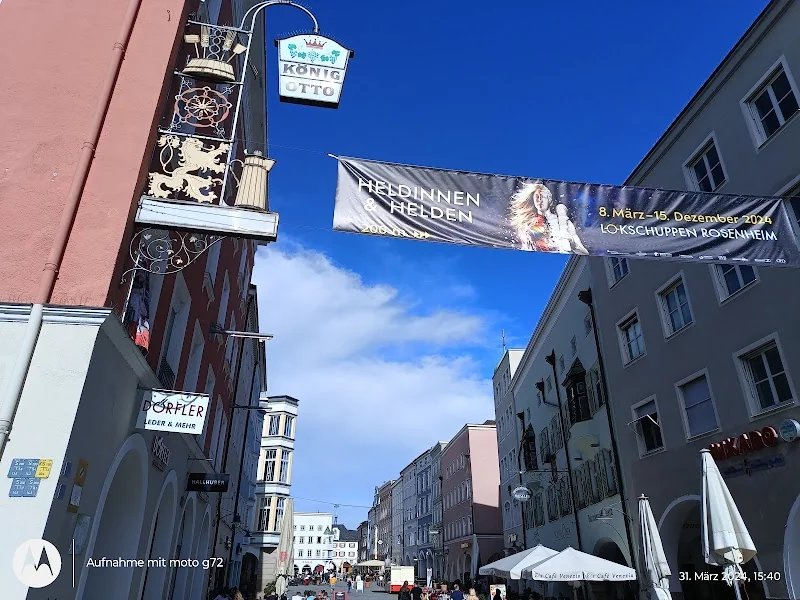
Max-Josefs-Platz 4, Rosenheim
Max-Josefs-Platz 4, 83022 Rosenheim, Germany
Wood Technology Museum Rosenheim | Opening Hours & Directions
The Wood Technology Museum Rosenheim is an unusually precise yet very accessible cultural address in the heart of the city. Those searching for Wood Technology Museum Rosenheim, Wood Technology Museum Rosenheim e.V., photos, or reviews are usually looking for more than just an address: they seek a place that brings together history, craftsmanship, technology, and regional identity. This museum, located in the listed Ellmaierhaus at Max-Josefs-Platz, fulfills exactly that. Since 1990, it has showcased what wood can do in everyday life, in craftsmanship, and in modern processing. In the city's educational offerings, the house is described as a place where wood becomes visible from felling to high-tech processing; there are also 12 exhibition rooms featuring models, original objects, and interactive stations. Current special exhibitions, workshops, and guided tours shape the profile of the house, making it attractive not only for specialists but also for families, school groups, and city visitors. ([rosenheim.de](https://www.rosenheim.de/kultur-bildung/))
Opening Hours, Admission, and Visit Planning
For successful planning, the most important information is quickly clarified: The Wood Technology Museum Rosenheim is open from Tuesday to Sunday from 12 to 5 PM. It is closed on Mondays and public holidays, but group visits outside regular hours are possible with prior arrangement. Therefore, if you are arriving with a school class, club, or family, you should reserve in advance and avoid planning a visit on a Monday. This arrangement is particularly convenient for groups, as it allows the museum visit to be integrated into the daily schedule of a city tour, excursion, or educational program. The museum's central location in Rosenheim also facilitates combining it with a stroll through Max-Josefs-Platz or a visit to the surrounding city center. The official museum website also lists current events and special tours, demonstrating that the place is not just a static collection but a vibrant cultural space. This creates a visit that is suitable for both short stays and longer city strolls with a cultural focus. ([htm.rosenheim.de](https://htm.rosenheim.de/))
If you want to find out about the current program in advance, the museum's homepage continuously provides information about events such as reading fun, workshops, or special tours. This is particularly advantageous for visitors who are specifically looking for programs, tickets, or a date in 2026: you can see not only the general opening hours but also what is currently happening in the house. The current special exhibition “Wood Connections – Examples from Europe and Japan” has been extended until July 26, 2026. This makes the timing of the visit particularly interesting, as a classic tour can be combined with a time-limited focus. For groups or children's programs, registration is recommended, as individual formats are specially coordinated. This positions the museum as a place that can be visited without major hurdles but offers significantly more depth and personal experiences with early planning. ([htm.rosenheim.de](https://htm.rosenheim.de/))
History of the Museum and the Ellmaierhaus
The history of the Wood Technology Museum does not begin with its opening but with a cultural-historical interest in wood as a material and the regional training tradition in Rosenheim. According to the association's website, the initiative began in 1979 with the founding of the Wood Technology Museum e.V. Representatives of leading training institutions for wood professions had the idea to collect, preserve, and publicly showcase knowledge about wood. Companies and private individuals supported the project with objects and donations. After suitable rooms were sought, the choice fell on the renovated Ellmaierhaus in the city center. From 1983, an exhibition area of about 400 square meters was available on the first floor. After several years of volunteer work and with professional support from the State Office for Non-State Museums in Bavaria, the museum was opened in 1990. This development illustrates a classic Bavarian museum model: civic engagement, professional advice, and municipal sponsorship intertwine. ([htmverein.de](https://www.htmverein.de/))
The building itself is as much a part of the narrative as the collection. The Ellmaierhaus dates back to the 16th century and is located in the pedestrian zone at Max-Josefs-Platz. It was exemplary restored and renovated from 1980 to 1984, thus forming not only the shell but also an atmospheric part of the museum visit. As you walk through the house, you encounter not only exhibition objects but also a historical backdrop that makes the connection between city history and material history visible. The museum is operated by the Zweckverband Wood Technology Museum of the District of Upper Bavaria and the City of Rosenheim; the office is currently managed by Andrea Krammer M.A. This organizational structure is not always immediately visible to visitors, but it explains why the house can present itself as both locally anchored and professionally specialized. Thus, the museum is not an isolated case but part of a developed cultural landscape in Rosenheim. ([htmverein.de](https://www.htmverein.de/das-museum/))
Exhibitions, Collection, and the Fascination of Wood Connections
Content-wise, the Wood Technology Museum Rosenheim is closely linked to its central message: wood is not only a natural raw material but also a material with enormous technical and aesthetic range. The city's educational site describes the house with the apt guiding principle “Wood Meets High Tech.” In 12 exhibition rooms, it is shown how wood is used from felling to high-tech processing. Models of mills, sawmills, and wooden buildings explain connections, while real tools, original objects, and interactive stations make the visit vivid even for younger guests. Historical working worlds, such as those of coopers and carpenters, are addressed as well as the development of modern wood professions. The result is not a purely technical display but a museum that connects craftsmanship, industrial history, and everyday culture. This makes it relevant for many search intentions: those looking for exhibitions, history, technology, or regional context will find a place where these topics converge. ([rosenheim.de](https://www.rosenheim.de/kultur-bildung/))
The current special exhibition “Wood Connections – Examples from Europe and Japan” particularly emphasizes this attitude. According to the museum and the city of Rosenheim, it spans the arc from early, simple techniques to highly modern solutions used today in architecture, furniture manufacturing, and industry. In the Middle Ages, mortise and tenon joints as well as dovetail joints were perfected; with industrialization, machines, standardized connections, and nail and screw joints were introduced. Later, panel materials, lamella connections, and CNC milling expanded the spectrum. The focus on Japan is a special appeal of the exhibition, as there, wood connections were developed without metal or glue, which can withstand high loads and even earthquakes. Such content explains why the museum is not only locally interesting but also remains relevant for regional inquiries about wood processing, wood technology, and craftsmanship precision. The extension of the exhibition until July 26, 2026, also ensures that the current reason for visiting is clearly and temporally identifiable. ([htm.rosenheim.de](https://htm.rosenheim.de/detail/holzverbindungen-beispiele-aus-europa-und-japan/))
The combination of scientific clarity and visual accessibility is particularly strong. The museum works with models, original objects, and interactive stations, making complex content tangible without prior knowledge. This is attractive not only for specialists but also for people who might casually drop by during a city visit and then realize that wood technology can be surprisingly exciting. Particularly in the context of photos and reviews, it often becomes clear that smaller museums with a clear thematic focus are perceived very positively: they are compact, concentrated, and offer a real density of content. This fits well with the Rosenheim Museum, which impresses not with size but with specialization in the center. Instead of a random collection of objects, there is a clear narrative about material, work, innovation, and regional identity. This makes the visit both educational and surprisingly modern. ([rosenheim.de](https://www.rosenheim.de/kultur-bildung/))
Directions, Parking, and Location in the Rosenheim City Center
The location of the Wood Technology Museum is one of its greatest practical advantages and also a reason why one should plan the journey well. The house is located at Max-Josefs-Platz 4 in the pedestrian zone of Rosenheim. The city of Rosenheim points out that Max-Josefs-Platz is part of the inner-city pedestrian zones and is generally kept free of traffic; access is mainly possible during delivery times. For visitors, this means: you do not drive directly to the entrance but best combine the museum visit with a short walk through the city center. This is not a disadvantage but part of the experience, as the path leads right through the historic center with its cafes, shops, and other cultural institutions. Those coming from the train station can easily incorporate the museum visit into a city stroll. ([rosenheim.de](https://www.rosenheim.de/en/entrepreneur-service/business-restaurants/pedestrian-zone/))
For those arriving by car, the inner-city parking options are the most sensible solution. The city of Rosenheim operates various parking garages, including the P1 Centre. Although the exact distance varies depending on the route, the city's parking infrastructure clearly shows that visitors can rely on a network of parking garages in the city center. Those arriving by city bus should orient themselves at the “Stadtmitte” stop and walk from there towards Max-Josefs-Platz. The museum's location in the historic core makes the visit particularly compact: arrival, city stroll, and museum visit can be well combined. This is particularly pleasant for groups, as bus, car, and walking routes can be flexibly combined in planning. Therefore, when searching for parking, directions, or public transport for the Wood Technology Museum, the practical answer is: city center, pedestrian zone, nearby parking garages, and a short walk to the entrance. This is uncomplicated but typical for an attractive old town location. ([rosenheim.de](https://www.rosenheim.de/en/citizen-service/mobility/parking/))
Workshops, Tours, and Offers for Families, Groups, and Events
The Wood Technology Museum Rosenheim sees itself not only as an exhibition space but also as a learning and experience space. The city's educational site emphasizes that the house offers workshops, tours, and a puzzle catalog for children. Such formats are important because they turn a classic museum tour into an active experience. Those coming with children benefit from the fact that content is not only conveyed textually but made tangible through models, objects, and participatory offerings. Current events such as reading fun in the museum or workshops around forest, tree, and wood also show that the house regularly offers programs for different age groups. This makes the theme of wood not abstract but experiential through stories, crafting, discovering, and learning together. This is particularly attractive for school classes and families, as the museum visit offers a good mix of knowledge, movement, and engaging activities. ([rosenheim.de](https://www.rosenheim.de/kultur-bildung/))
Furthermore, the museum also addresses groups looking for a clearly defined and regionally anchored program point. The museum's website explicitly states that school classes and groups can visit the house outside of opening hours by prior arrangement. The association's website also highlights current dates for workshops and tours. Even special occasions are possible: the association's website mentions civil weddings and children's birthdays in the museum, among other things. This shows how versatile the place is used without losing its museum character. From an SEO perspective, this multidimensionality is important: the house simultaneously serves inquiries about tours, workshops, family offerings, and special places in Rosenheim. Therefore, those looking for a museum with character, educational depth, and practical usability will find a profile that goes far beyond the mere exhibition. The Wood Technology Museum is thus both a destination for a spontaneous visit and a good choice for conscious planning with a group or family. ([htm.rosenheim.de](https://htm.rosenheim.de/))
Photos, Reviews, and the First Impression on Site
Although inquiries for photos and reviews often initially target visual impressions, it is especially worthwhile to look at what visitors actually describe at the Wood Technology Museum Rosenheim. The existing reviews speak of a “wonderful little museum,” a very good experience, and a place that is particularly interesting for children. This impression aligns well with what the official pages convey: a compact, professionally structured museum with a personal atmosphere that focuses not on size but on content precision. If you are looking for a museum that can be visited without haste during a city visit, you will find here a house that impresses with calmness, clarity, and thematic coherence. The combination of historic building, wood technology, special exhibitions, and interactive stations explains why many guests perceive the visit as pleasant and surprisingly diverse. ([rosenheim.de](https://www.rosenheim.de/kultur-bildung/))
The existing reviews and the 4.6 rating from 82 reviews further underscore this impression. Particularly for people who specifically search for photos and reviews before an outing, this is a valuable hint: the museum seems not only professionally solid but also emotionally accessible. Those looking for a place with a child-friendly approach, clear design, and a strong regional connection will find it here. From an SEO perspective, this is important because the search intent behind terms like photos, reviews, or museum in Rosenheim usually does not only target opening hours but the overall impression in advance. The Wood Technology Museum benefits from being centrally located, historically appealing, and simultaneously modern in its presentation. Therefore, the first impression on site is not only aesthetically strong but also content-wise: wood is not presented as a dry material but as a lively topic with history, present, and future. This is exactly what makes the visit memorable and recommendable. ([htm.rosenheim.de](https://www.rosenheim.de/))
Sources:
- Wood Technology Museum Rosenheim e.V. - Homepage
- Wood Technology Museum e.V. - Association and Museum
- City of Rosenheim - Cultural Education in the Municipal Collections of Rosenheim
- City of Rosenheim - Extension of the Special Exhibition “Wood Connections”
- Rosenheim.jetzt - Wood Technology Museum at Max-Josefs-Platz
Show moreShow less
Wood Technology Museum Rosenheim | Opening Hours & Directions
The Wood Technology Museum Rosenheim is an unusually precise yet very accessible cultural address in the heart of the city. Those searching for Wood Technology Museum Rosenheim, Wood Technology Museum Rosenheim e.V., photos, or reviews are usually looking for more than just an address: they seek a place that brings together history, craftsmanship, technology, and regional identity. This museum, located in the listed Ellmaierhaus at Max-Josefs-Platz, fulfills exactly that. Since 1990, it has showcased what wood can do in everyday life, in craftsmanship, and in modern processing. In the city's educational offerings, the house is described as a place where wood becomes visible from felling to high-tech processing; there are also 12 exhibition rooms featuring models, original objects, and interactive stations. Current special exhibitions, workshops, and guided tours shape the profile of the house, making it attractive not only for specialists but also for families, school groups, and city visitors. ([rosenheim.de](https://www.rosenheim.de/kultur-bildung/))
Opening Hours, Admission, and Visit Planning
For successful planning, the most important information is quickly clarified: The Wood Technology Museum Rosenheim is open from Tuesday to Sunday from 12 to 5 PM. It is closed on Mondays and public holidays, but group visits outside regular hours are possible with prior arrangement. Therefore, if you are arriving with a school class, club, or family, you should reserve in advance and avoid planning a visit on a Monday. This arrangement is particularly convenient for groups, as it allows the museum visit to be integrated into the daily schedule of a city tour, excursion, or educational program. The museum's central location in Rosenheim also facilitates combining it with a stroll through Max-Josefs-Platz or a visit to the surrounding city center. The official museum website also lists current events and special tours, demonstrating that the place is not just a static collection but a vibrant cultural space. This creates a visit that is suitable for both short stays and longer city strolls with a cultural focus. ([htm.rosenheim.de](https://htm.rosenheim.de/))
If you want to find out about the current program in advance, the museum's homepage continuously provides information about events such as reading fun, workshops, or special tours. This is particularly advantageous for visitors who are specifically looking for programs, tickets, or a date in 2026: you can see not only the general opening hours but also what is currently happening in the house. The current special exhibition “Wood Connections – Examples from Europe and Japan” has been extended until July 26, 2026. This makes the timing of the visit particularly interesting, as a classic tour can be combined with a time-limited focus. For groups or children's programs, registration is recommended, as individual formats are specially coordinated. This positions the museum as a place that can be visited without major hurdles but offers significantly more depth and personal experiences with early planning. ([htm.rosenheim.de](https://htm.rosenheim.de/))
History of the Museum and the Ellmaierhaus
The history of the Wood Technology Museum does not begin with its opening but with a cultural-historical interest in wood as a material and the regional training tradition in Rosenheim. According to the association's website, the initiative began in 1979 with the founding of the Wood Technology Museum e.V. Representatives of leading training institutions for wood professions had the idea to collect, preserve, and publicly showcase knowledge about wood. Companies and private individuals supported the project with objects and donations. After suitable rooms were sought, the choice fell on the renovated Ellmaierhaus in the city center. From 1983, an exhibition area of about 400 square meters was available on the first floor. After several years of volunteer work and with professional support from the State Office for Non-State Museums in Bavaria, the museum was opened in 1990. This development illustrates a classic Bavarian museum model: civic engagement, professional advice, and municipal sponsorship intertwine. ([htmverein.de](https://www.htmverein.de/))
The building itself is as much a part of the narrative as the collection. The Ellmaierhaus dates back to the 16th century and is located in the pedestrian zone at Max-Josefs-Platz. It was exemplary restored and renovated from 1980 to 1984, thus forming not only the shell but also an atmospheric part of the museum visit. As you walk through the house, you encounter not only exhibition objects but also a historical backdrop that makes the connection between city history and material history visible. The museum is operated by the Zweckverband Wood Technology Museum of the District of Upper Bavaria and the City of Rosenheim; the office is currently managed by Andrea Krammer M.A. This organizational structure is not always immediately visible to visitors, but it explains why the house can present itself as both locally anchored and professionally specialized. Thus, the museum is not an isolated case but part of a developed cultural landscape in Rosenheim. ([htmverein.de](https://www.htmverein.de/das-museum/))
Exhibitions, Collection, and the Fascination of Wood Connections
Content-wise, the Wood Technology Museum Rosenheim is closely linked to its central message: wood is not only a natural raw material but also a material with enormous technical and aesthetic range. The city's educational site describes the house with the apt guiding principle “Wood Meets High Tech.” In 12 exhibition rooms, it is shown how wood is used from felling to high-tech processing. Models of mills, sawmills, and wooden buildings explain connections, while real tools, original objects, and interactive stations make the visit vivid even for younger guests. Historical working worlds, such as those of coopers and carpenters, are addressed as well as the development of modern wood professions. The result is not a purely technical display but a museum that connects craftsmanship, industrial history, and everyday culture. This makes it relevant for many search intentions: those looking for exhibitions, history, technology, or regional context will find a place where these topics converge. ([rosenheim.de](https://www.rosenheim.de/kultur-bildung/))
The current special exhibition “Wood Connections – Examples from Europe and Japan” particularly emphasizes this attitude. According to the museum and the city of Rosenheim, it spans the arc from early, simple techniques to highly modern solutions used today in architecture, furniture manufacturing, and industry. In the Middle Ages, mortise and tenon joints as well as dovetail joints were perfected; with industrialization, machines, standardized connections, and nail and screw joints were introduced. Later, panel materials, lamella connections, and CNC milling expanded the spectrum. The focus on Japan is a special appeal of the exhibition, as there, wood connections were developed without metal or glue, which can withstand high loads and even earthquakes. Such content explains why the museum is not only locally interesting but also remains relevant for regional inquiries about wood processing, wood technology, and craftsmanship precision. The extension of the exhibition until July 26, 2026, also ensures that the current reason for visiting is clearly and temporally identifiable. ([htm.rosenheim.de](https://htm.rosenheim.de/detail/holzverbindungen-beispiele-aus-europa-und-japan/))
The combination of scientific clarity and visual accessibility is particularly strong. The museum works with models, original objects, and interactive stations, making complex content tangible without prior knowledge. This is attractive not only for specialists but also for people who might casually drop by during a city visit and then realize that wood technology can be surprisingly exciting. Particularly in the context of photos and reviews, it often becomes clear that smaller museums with a clear thematic focus are perceived very positively: they are compact, concentrated, and offer a real density of content. This fits well with the Rosenheim Museum, which impresses not with size but with specialization in the center. Instead of a random collection of objects, there is a clear narrative about material, work, innovation, and regional identity. This makes the visit both educational and surprisingly modern. ([rosenheim.de](https://www.rosenheim.de/kultur-bildung/))
Directions, Parking, and Location in the Rosenheim City Center
The location of the Wood Technology Museum is one of its greatest practical advantages and also a reason why one should plan the journey well. The house is located at Max-Josefs-Platz 4 in the pedestrian zone of Rosenheim. The city of Rosenheim points out that Max-Josefs-Platz is part of the inner-city pedestrian zones and is generally kept free of traffic; access is mainly possible during delivery times. For visitors, this means: you do not drive directly to the entrance but best combine the museum visit with a short walk through the city center. This is not a disadvantage but part of the experience, as the path leads right through the historic center with its cafes, shops, and other cultural institutions. Those coming from the train station can easily incorporate the museum visit into a city stroll. ([rosenheim.de](https://www.rosenheim.de/en/entrepreneur-service/business-restaurants/pedestrian-zone/))
For those arriving by car, the inner-city parking options are the most sensible solution. The city of Rosenheim operates various parking garages, including the P1 Centre. Although the exact distance varies depending on the route, the city's parking infrastructure clearly shows that visitors can rely on a network of parking garages in the city center. Those arriving by city bus should orient themselves at the “Stadtmitte” stop and walk from there towards Max-Josefs-Platz. The museum's location in the historic core makes the visit particularly compact: arrival, city stroll, and museum visit can be well combined. This is particularly pleasant for groups, as bus, car, and walking routes can be flexibly combined in planning. Therefore, when searching for parking, directions, or public transport for the Wood Technology Museum, the practical answer is: city center, pedestrian zone, nearby parking garages, and a short walk to the entrance. This is uncomplicated but typical for an attractive old town location. ([rosenheim.de](https://www.rosenheim.de/en/citizen-service/mobility/parking/))
Workshops, Tours, and Offers for Families, Groups, and Events
The Wood Technology Museum Rosenheim sees itself not only as an exhibition space but also as a learning and experience space. The city's educational site emphasizes that the house offers workshops, tours, and a puzzle catalog for children. Such formats are important because they turn a classic museum tour into an active experience. Those coming with children benefit from the fact that content is not only conveyed textually but made tangible through models, objects, and participatory offerings. Current events such as reading fun in the museum or workshops around forest, tree, and wood also show that the house regularly offers programs for different age groups. This makes the theme of wood not abstract but experiential through stories, crafting, discovering, and learning together. This is particularly attractive for school classes and families, as the museum visit offers a good mix of knowledge, movement, and engaging activities. ([rosenheim.de](https://www.rosenheim.de/kultur-bildung/))
Furthermore, the museum also addresses groups looking for a clearly defined and regionally anchored program point. The museum's website explicitly states that school classes and groups can visit the house outside of opening hours by prior arrangement. The association's website also highlights current dates for workshops and tours. Even special occasions are possible: the association's website mentions civil weddings and children's birthdays in the museum, among other things. This shows how versatile the place is used without losing its museum character. From an SEO perspective, this multidimensionality is important: the house simultaneously serves inquiries about tours, workshops, family offerings, and special places in Rosenheim. Therefore, those looking for a museum with character, educational depth, and practical usability will find a profile that goes far beyond the mere exhibition. The Wood Technology Museum is thus both a destination for a spontaneous visit and a good choice for conscious planning with a group or family. ([htm.rosenheim.de](https://htm.rosenheim.de/))
Photos, Reviews, and the First Impression on Site
Although inquiries for photos and reviews often initially target visual impressions, it is especially worthwhile to look at what visitors actually describe at the Wood Technology Museum Rosenheim. The existing reviews speak of a “wonderful little museum,” a very good experience, and a place that is particularly interesting for children. This impression aligns well with what the official pages convey: a compact, professionally structured museum with a personal atmosphere that focuses not on size but on content precision. If you are looking for a museum that can be visited without haste during a city visit, you will find here a house that impresses with calmness, clarity, and thematic coherence. The combination of historic building, wood technology, special exhibitions, and interactive stations explains why many guests perceive the visit as pleasant and surprisingly diverse. ([rosenheim.de](https://www.rosenheim.de/kultur-bildung/))
The existing reviews and the 4.6 rating from 82 reviews further underscore this impression. Particularly for people who specifically search for photos and reviews before an outing, this is a valuable hint: the museum seems not only professionally solid but also emotionally accessible. Those looking for a place with a child-friendly approach, clear design, and a strong regional connection will find it here. From an SEO perspective, this is important because the search intent behind terms like photos, reviews, or museum in Rosenheim usually does not only target opening hours but the overall impression in advance. The Wood Technology Museum benefits from being centrally located, historically appealing, and simultaneously modern in its presentation. Therefore, the first impression on site is not only aesthetically strong but also content-wise: wood is not presented as a dry material but as a lively topic with history, present, and future. This is exactly what makes the visit memorable and recommendable. ([htm.rosenheim.de](https://www.rosenheim.de/))
Sources:
- Wood Technology Museum Rosenheim e.V. - Homepage
- Wood Technology Museum e.V. - Association and Museum
- City of Rosenheim - Cultural Education in the Municipal Collections of Rosenheim
- City of Rosenheim - Extension of the Special Exhibition “Wood Connections”
- Rosenheim.jetzt - Wood Technology Museum at Max-Josefs-Platz
Wood Technology Museum Rosenheim | Opening Hours & Directions
The Wood Technology Museum Rosenheim is an unusually precise yet very accessible cultural address in the heart of the city. Those searching for Wood Technology Museum Rosenheim, Wood Technology Museum Rosenheim e.V., photos, or reviews are usually looking for more than just an address: they seek a place that brings together history, craftsmanship, technology, and regional identity. This museum, located in the listed Ellmaierhaus at Max-Josefs-Platz, fulfills exactly that. Since 1990, it has showcased what wood can do in everyday life, in craftsmanship, and in modern processing. In the city's educational offerings, the house is described as a place where wood becomes visible from felling to high-tech processing; there are also 12 exhibition rooms featuring models, original objects, and interactive stations. Current special exhibitions, workshops, and guided tours shape the profile of the house, making it attractive not only for specialists but also for families, school groups, and city visitors. ([rosenheim.de](https://www.rosenheim.de/kultur-bildung/))
Opening Hours, Admission, and Visit Planning
For successful planning, the most important information is quickly clarified: The Wood Technology Museum Rosenheim is open from Tuesday to Sunday from 12 to 5 PM. It is closed on Mondays and public holidays, but group visits outside regular hours are possible with prior arrangement. Therefore, if you are arriving with a school class, club, or family, you should reserve in advance and avoid planning a visit on a Monday. This arrangement is particularly convenient for groups, as it allows the museum visit to be integrated into the daily schedule of a city tour, excursion, or educational program. The museum's central location in Rosenheim also facilitates combining it with a stroll through Max-Josefs-Platz or a visit to the surrounding city center. The official museum website also lists current events and special tours, demonstrating that the place is not just a static collection but a vibrant cultural space. This creates a visit that is suitable for both short stays and longer city strolls with a cultural focus. ([htm.rosenheim.de](https://htm.rosenheim.de/))
If you want to find out about the current program in advance, the museum's homepage continuously provides information about events such as reading fun, workshops, or special tours. This is particularly advantageous for visitors who are specifically looking for programs, tickets, or a date in 2026: you can see not only the general opening hours but also what is currently happening in the house. The current special exhibition “Wood Connections – Examples from Europe and Japan” has been extended until July 26, 2026. This makes the timing of the visit particularly interesting, as a classic tour can be combined with a time-limited focus. For groups or children's programs, registration is recommended, as individual formats are specially coordinated. This positions the museum as a place that can be visited without major hurdles but offers significantly more depth and personal experiences with early planning. ([htm.rosenheim.de](https://htm.rosenheim.de/))
History of the Museum and the Ellmaierhaus
The history of the Wood Technology Museum does not begin with its opening but with a cultural-historical interest in wood as a material and the regional training tradition in Rosenheim. According to the association's website, the initiative began in 1979 with the founding of the Wood Technology Museum e.V. Representatives of leading training institutions for wood professions had the idea to collect, preserve, and publicly showcase knowledge about wood. Companies and private individuals supported the project with objects and donations. After suitable rooms were sought, the choice fell on the renovated Ellmaierhaus in the city center. From 1983, an exhibition area of about 400 square meters was available on the first floor. After several years of volunteer work and with professional support from the State Office for Non-State Museums in Bavaria, the museum was opened in 1990. This development illustrates a classic Bavarian museum model: civic engagement, professional advice, and municipal sponsorship intertwine. ([htmverein.de](https://www.htmverein.de/))
The building itself is as much a part of the narrative as the collection. The Ellmaierhaus dates back to the 16th century and is located in the pedestrian zone at Max-Josefs-Platz. It was exemplary restored and renovated from 1980 to 1984, thus forming not only the shell but also an atmospheric part of the museum visit. As you walk through the house, you encounter not only exhibition objects but also a historical backdrop that makes the connection between city history and material history visible. The museum is operated by the Zweckverband Wood Technology Museum of the District of Upper Bavaria and the City of Rosenheim; the office is currently managed by Andrea Krammer M.A. This organizational structure is not always immediately visible to visitors, but it explains why the house can present itself as both locally anchored and professionally specialized. Thus, the museum is not an isolated case but part of a developed cultural landscape in Rosenheim. ([htmverein.de](https://www.htmverein.de/das-museum/))
Exhibitions, Collection, and the Fascination of Wood Connections
Content-wise, the Wood Technology Museum Rosenheim is closely linked to its central message: wood is not only a natural raw material but also a material with enormous technical and aesthetic range. The city's educational site describes the house with the apt guiding principle “Wood Meets High Tech.” In 12 exhibition rooms, it is shown how wood is used from felling to high-tech processing. Models of mills, sawmills, and wooden buildings explain connections, while real tools, original objects, and interactive stations make the visit vivid even for younger guests. Historical working worlds, such as those of coopers and carpenters, are addressed as well as the development of modern wood professions. The result is not a purely technical display but a museum that connects craftsmanship, industrial history, and everyday culture. This makes it relevant for many search intentions: those looking for exhibitions, history, technology, or regional context will find a place where these topics converge. ([rosenheim.de](https://www.rosenheim.de/kultur-bildung/))
The current special exhibition “Wood Connections – Examples from Europe and Japan” particularly emphasizes this attitude. According to the museum and the city of Rosenheim, it spans the arc from early, simple techniques to highly modern solutions used today in architecture, furniture manufacturing, and industry. In the Middle Ages, mortise and tenon joints as well as dovetail joints were perfected; with industrialization, machines, standardized connections, and nail and screw joints were introduced. Later, panel materials, lamella connections, and CNC milling expanded the spectrum. The focus on Japan is a special appeal of the exhibition, as there, wood connections were developed without metal or glue, which can withstand high loads and even earthquakes. Such content explains why the museum is not only locally interesting but also remains relevant for regional inquiries about wood processing, wood technology, and craftsmanship precision. The extension of the exhibition until July 26, 2026, also ensures that the current reason for visiting is clearly and temporally identifiable. ([htm.rosenheim.de](https://htm.rosenheim.de/detail/holzverbindungen-beispiele-aus-europa-und-japan/))
The combination of scientific clarity and visual accessibility is particularly strong. The museum works with models, original objects, and interactive stations, making complex content tangible without prior knowledge. This is attractive not only for specialists but also for people who might casually drop by during a city visit and then realize that wood technology can be surprisingly exciting. Particularly in the context of photos and reviews, it often becomes clear that smaller museums with a clear thematic focus are perceived very positively: they are compact, concentrated, and offer a real density of content. This fits well with the Rosenheim Museum, which impresses not with size but with specialization in the center. Instead of a random collection of objects, there is a clear narrative about material, work, innovation, and regional identity. This makes the visit both educational and surprisingly modern. ([rosenheim.de](https://www.rosenheim.de/kultur-bildung/))
Directions, Parking, and Location in the Rosenheim City Center
The location of the Wood Technology Museum is one of its greatest practical advantages and also a reason why one should plan the journey well. The house is located at Max-Josefs-Platz 4 in the pedestrian zone of Rosenheim. The city of Rosenheim points out that Max-Josefs-Platz is part of the inner-city pedestrian zones and is generally kept free of traffic; access is mainly possible during delivery times. For visitors, this means: you do not drive directly to the entrance but best combine the museum visit with a short walk through the city center. This is not a disadvantage but part of the experience, as the path leads right through the historic center with its cafes, shops, and other cultural institutions. Those coming from the train station can easily incorporate the museum visit into a city stroll. ([rosenheim.de](https://www.rosenheim.de/en/entrepreneur-service/business-restaurants/pedestrian-zone/))
For those arriving by car, the inner-city parking options are the most sensible solution. The city of Rosenheim operates various parking garages, including the P1 Centre. Although the exact distance varies depending on the route, the city's parking infrastructure clearly shows that visitors can rely on a network of parking garages in the city center. Those arriving by city bus should orient themselves at the “Stadtmitte” stop and walk from there towards Max-Josefs-Platz. The museum's location in the historic core makes the visit particularly compact: arrival, city stroll, and museum visit can be well combined. This is particularly pleasant for groups, as bus, car, and walking routes can be flexibly combined in planning. Therefore, when searching for parking, directions, or public transport for the Wood Technology Museum, the practical answer is: city center, pedestrian zone, nearby parking garages, and a short walk to the entrance. This is uncomplicated but typical for an attractive old town location. ([rosenheim.de](https://www.rosenheim.de/en/citizen-service/mobility/parking/))
Workshops, Tours, and Offers for Families, Groups, and Events
The Wood Technology Museum Rosenheim sees itself not only as an exhibition space but also as a learning and experience space. The city's educational site emphasizes that the house offers workshops, tours, and a puzzle catalog for children. Such formats are important because they turn a classic museum tour into an active experience. Those coming with children benefit from the fact that content is not only conveyed textually but made tangible through models, objects, and participatory offerings. Current events such as reading fun in the museum or workshops around forest, tree, and wood also show that the house regularly offers programs for different age groups. This makes the theme of wood not abstract but experiential through stories, crafting, discovering, and learning together. This is particularly attractive for school classes and families, as the museum visit offers a good mix of knowledge, movement, and engaging activities. ([rosenheim.de](https://www.rosenheim.de/kultur-bildung/))
Furthermore, the museum also addresses groups looking for a clearly defined and regionally anchored program point. The museum's website explicitly states that school classes and groups can visit the house outside of opening hours by prior arrangement. The association's website also highlights current dates for workshops and tours. Even special occasions are possible: the association's website mentions civil weddings and children's birthdays in the museum, among other things. This shows how versatile the place is used without losing its museum character. From an SEO perspective, this multidimensionality is important: the house simultaneously serves inquiries about tours, workshops, family offerings, and special places in Rosenheim. Therefore, those looking for a museum with character, educational depth, and practical usability will find a profile that goes far beyond the mere exhibition. The Wood Technology Museum is thus both a destination for a spontaneous visit and a good choice for conscious planning with a group or family. ([htm.rosenheim.de](https://htm.rosenheim.de/))
Photos, Reviews, and the First Impression on Site
Although inquiries for photos and reviews often initially target visual impressions, it is especially worthwhile to look at what visitors actually describe at the Wood Technology Museum Rosenheim. The existing reviews speak of a “wonderful little museum,” a very good experience, and a place that is particularly interesting for children. This impression aligns well with what the official pages convey: a compact, professionally structured museum with a personal atmosphere that focuses not on size but on content precision. If you are looking for a museum that can be visited without haste during a city visit, you will find here a house that impresses with calmness, clarity, and thematic coherence. The combination of historic building, wood technology, special exhibitions, and interactive stations explains why many guests perceive the visit as pleasant and surprisingly diverse. ([rosenheim.de](https://www.rosenheim.de/kultur-bildung/))
The existing reviews and the 4.6 rating from 82 reviews further underscore this impression. Particularly for people who specifically search for photos and reviews before an outing, this is a valuable hint: the museum seems not only professionally solid but also emotionally accessible. Those looking for a place with a child-friendly approach, clear design, and a strong regional connection will find it here. From an SEO perspective, this is important because the search intent behind terms like photos, reviews, or museum in Rosenheim usually does not only target opening hours but the overall impression in advance. The Wood Technology Museum benefits from being centrally located, historically appealing, and simultaneously modern in its presentation. Therefore, the first impression on site is not only aesthetically strong but also content-wise: wood is not presented as a dry material but as a lively topic with history, present, and future. This is exactly what makes the visit memorable and recommendable. ([htm.rosenheim.de](https://www.rosenheim.de/))
Sources:
- Wood Technology Museum Rosenheim e.V. - Homepage
- Wood Technology Museum e.V. - Association and Museum
- City of Rosenheim - Cultural Education in the Municipal Collections of Rosenheim
- City of Rosenheim - Extension of the Special Exhibition “Wood Connections”
- Rosenheim.jetzt - Wood Technology Museum at Max-Josefs-Platz
Upcoming Events
No events found
Frequently Asked Questions
Reviews
Jonas Koblin
8. July 2025
Wonderful little museum.
Tommy
9. August 2024
1 A
Marcia Dos Santos
28. July 2020
Interesting for children!
Walter Sehnert
24. October 2025
A small but very fine museum, unique in its kind, located in Rosenheim because it has a woodworking college. It exhibits works from the woodworking school, documenting major projects in the wood industry. The atmosphere is very pleasant and peaceful, and the staff is friendly. Overall, a worthwhile visit!
Manuela M.
3. February 2024
A lovely little museum with a diverse program and the opportunity to get hands-on and familiarize yourself with wood as a material. Allow approximately 1 hour for your visit ;-)