
Mühldorfer Hart
Maxlinie, 84453 Mühldorfer Hart, Deutschland
Memorial Sites Mühldorfer Hart | Mass Grave & Memorial
The memorial sites Mühldorfer Hart are a historical place of remembrance in the forest area between Waldkraiburg and Mühldorf am Inn. Visitors to the site do not encounter a classic tourist attraction, but rather a largely quiet area that recalls forced labor, camp life, death, and later commemoration. The association 'For Remembrance' and the involved partners keep the history of the former concentration camp subcamp complex visible, so that the remaining structures are not only perceived as ruins but as testimonies of a system that deprived, exploited, and murdered people. The current ensemble includes several memorial sites, including the forest camp, the memorial site mass grave, and the bunker arch; additionally, the information pages refer to other concentration camp cemeteries and children's graves in the district. ([kz-muehldorfer-hart.de](https://kz-muehldorfer-hart.de/?utm_source=openai))
The site is historically significant because a bomb-proof manufacturing facility for combat aircraft was to be established here at the end of World War II. For this project, which was conducted under the code name Weingut I, concentration camp prisoners from the Dachau subcamp system were brought to Mühldorfer Hart. The memory of this is still closely linked to the former mass grave, the reforested camp area, and the visible remains of the bunker ruins. These three sites make the memorial so impressive: they not only show the crime but also the transformation from a crime scene to a place of learning. Visitors do not experience a loud presentation here, but a path through the forest that forces them to engage with history, responsibility, and the value of human dignity. ([kz-muehldorfer-hart.de](https://kz-muehldorfer-hart.de/bunkerbogen/))
Mass Grave at Kronprinzenstein: How a Crime Scene Became a Memorial Site
The mass grave in Mühldorfer Hart concentrates a significant part of the memory of the camp. According to the memorial site, over 2,200 concentration camp prisoners were buried in mass graves in the area. When American troops arrived after the war, the graves were discovered, and the dead were exhumed by former NSDAP members. Subsequently, the Americans ordered a dignified burial in honor cemeteries. Particularly striking is the fact that the local population, including children, had to participate in the funerals and were to walk past the open coffins. This form of public confrontation made the extent of the crimes immediately visible and laid the foundation for later memorial sites in the district. In the following years, four concentration camp honor cemeteries were established in Mühldorf am Inn, Kraiburg am Inn, Burghausen, and Neumarkt-St. Veit. ([kz-muehldorfer-hart.de](https://kz-muehldorfer-hart.de/en/mass-grave/))
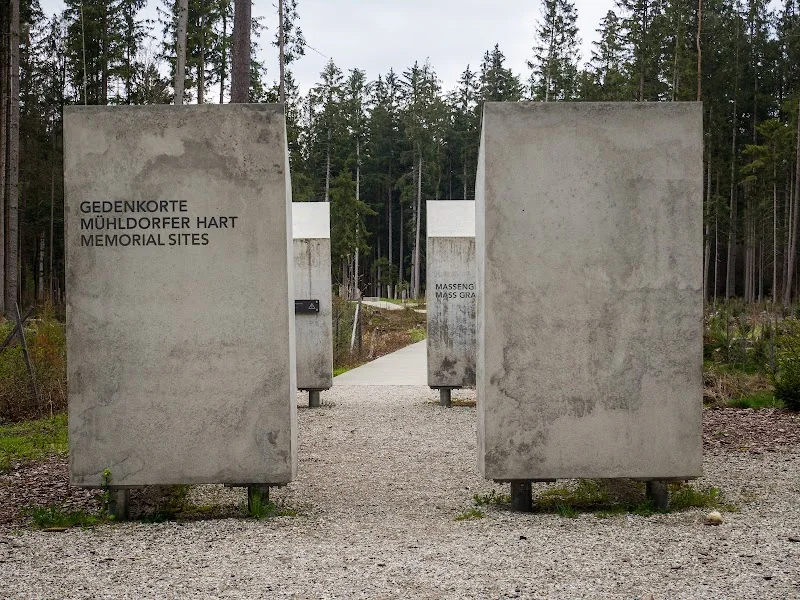
Today, the memorial site mass grave is located near the Kronprinzenstein, where the former depression in the ground and the memory of the grave converge. In April 2018, a three-part concentration camp memorial was opened there to commemorate the suffering of the prisoners and the dead who were buried in the surrounding concentration camp cemeteries. The site is thus not only a historical marker but also a consciously designed symbol against forgetting. The connection between the archaeologically and topographically preserved site and the current didactic preparation is particularly important: the memory is not told abstractly but conveyed directly at the place where the remains were found after the war. This proximity of ground, history, and remembrance gives the mass grave its power. ([kz-muehldorfer-hart.de](https://kz-muehldorfer-hart.de/en/mass-grave/))
Forest Camp and Bunker Arch: Forced Labor, Weingut I, and Camp Life
The forest camp makes visible the conditions under which the prisoners had to live in Mühldorfer Hart. According to the information pages, the prisoners were crammed into wooden barracks, tent-like plywood structures, and earth huts. The earth huts were built starting in the autumn of 1944, extended up to a meter into the ground, and were intended as winter accommodations for about 20 people. In reality, they were constantly overcrowded, damp, and cold; a small brick stove could only provide warmth temporarily. Even today, the depressions of the earth huts, concrete foundations of functional buildings, and further traces of camp operations can be seen in the forest. These remains are not a romantic forest find but a direct testimony of a place where people were exploited under extreme conditions. ([kz-muehldorfer-hart.de](https://kz-muehldorfer-hart.de/waldlager/?utm_source=openai))
The bunker arch complements this perspective as it marks the central place of forced labor. The armaments project Weingut I was to create a production facility for the jet aircraft Me 262 in Mühldorfer Hart. For this, building elements were organized, land was prepared, and a huge armaments bunker was planned. The choice of location was not coincidental: the gravel and rubble plain provided a stable foundation, the groundwater level was low enough, the forest surroundings concealed the project, and the railway junction Mühldorf facilitated the transport of materials and later the logistical connection. At the same time, the numbers reveal the extent of the crime. Between August 1944 and May 1945, more than 8,300 prisoners were in the complex; over 4,000 people did not survive the work at the bunker and in the commands. A large part of the prisoners came from Hungary, along with people from Poland, Lithuania, Italy, France, and Greece. The planned third memorial site at the bunker arch is currently being developed and is expected to be completed in autumn 2027. ([kz-muehldorfer-hart.de](https://kz-muehldorfer-hart.de/bunkerbogen/))
Access, Parking, and Circular Path Through Mühldorfer Hart
For visitors, the access is clearly described and intentionally kept simple. The Bavarian State Forests refer to the route from the A94 via the B12 towards Waldkraiburg and Mühldorf am Inn. Those coming from the west turn right towards Waldkraiburg in Ampfing; those coming from the east also leave the A94 via the B12 and turn left in Ampfing. After about 2 kilometers, the parking lot is on the left side. From there, follow the signs into the area. This information is important because the memorial sites are located in the forest, and the actual path of remembrance does not begin directly on a major road. For this reason, one should take some time before the visit and read not only the address but also the directions. ([baysf.de](https://www.baysf.de/die-kz-gedenkstaette-muehldorfer-hart/))
The formal visiting data also help with planning: The BaySF states that the circular path requires about 3 hours, is 11 kilometers long, has a low level of difficulty, and that it is not a circular path in the classical sense. Furthermore, the route is not wheelchair accessible, while access by public transport is possible. This means for visitors: the site is well connected, but it is a forest and memorial path and not a barrier-free museum area. Those who come should bring enough time, wear comfortable and sturdy shoes, and understand the visit as a quiet walk through a historically burdened area. This combination of nature, path network, and visible remains shapes the character of the memorial site. The location in the reforested forest district makes the site both accessible and thought-provoking, as nature does not obscure history but transforms it into a quiet form. ([baysf.de](https://www.baysf.de/die-kz-gedenkstaette-muehldorfer-hart/))
Guided Tours, Memorial Services, and Educational Work for Remembrance
The commemorative work at Mühldorfer Hart is not limited to signs but thrives on regular educational and remembrance work. The association 'For Remembrance' reports that it organizes a memorial service at the former bunker site every year on April 28, the anniversary of the evacuation of the camp in 1945. In addition, the association informs the public with guided tours about the area and history. The work is aimed not only at historical enthusiasts but also at school classes and groups visiting the site as part of educational trips. This transforms a former crime scene into a place of learning, where history does not appear as a distant past but as a task for the present and future. The memory of the victims of the Nazi regime and the dead of the subcamp complex is at the center of this work. ([kz-muehldorfer-hart.de](https://kz-muehldorfer-hart.de/verein/?utm_source=openai))
The international dimension of remembrance is also clearly felt. The association maintains contacts with survivors, including from Hungary and Italy, and keeps eyewitness reports and research results alive. This is particularly relevant in Mühldorfer Hart because the majority of the prisoners were Hungarian Jews, and the region is still connected to their history today. A current example is the visit of Hungarian President Tamás Sulyok in January 2026 at the mass grave memorial site, where a commemorative act with a wreath-laying took place. The Bavarian Memorial Foundation emphasized that such sites have great significance for public remembrance. The student project 'No longer silent' also shows how much the site encourages young people to take responsibility and stance. Thus, the memorial site does not stand still but continues to develop as a place of admonition, research, and dialogue. ([stiftung-bayerische-gedenkstaetten.de](https://www.stiftung-bayerische-gedenkstaetten.de/presse/staatspraesident-ungarns-besucht-kz-gedenkstaette-muehldorfer-hart))
Concentration Camp Cemeteries and Other Memorial Sites in the Mühldorf District
Those who want to understand the memorial sites Mühldorfer Hart should not view them in isolation. The official overview refers to a network of memorial sites throughout the district. Particularly important is the concentration camp cemetery Mühldorf am Inn: it is a memorial cemetery for 480 victims of Nazi tyranny, most of whom died in 1944/45 due to inhumane working conditions in the Dachau concentration camp subcamps. The site is located opposite the Christian cemetery, is surrounded by a hedge, and bears the inscription 'To the victims of violence 1933-1945'. Symbolic gravestones with David stars and crosses make the cemetery visible as a place of remembrance. This detail shows that the region developed not only individual graves but a whole network of memorial sites after the war. ([kz-muehldorfer-hart.de](https://kz-muehldorfer-hart.de/kz-friedhof-muehldorf-am-inn/))
The concentration camp cemetery Burghausen is also part of this memory space. According to the association, it is a memorial for 253 victims of the concentration camp subcamp Mettenheimer-Hart; the inscription of the memorial stone commemorates the resting place dedicated by the American military government and the city of Burghausen in 1945. In addition, the cemeteries in Kraiburg and Neumarkt-St. Veit, as well as the children's graves in Burgkirchen and Pürten, belong to the extended network of remembrance. This diversity is significant because it shows that the camp and death events in the Mühldorf area did not end at a single point. The victims were distributed to various cemeteries after the war, and later commemorative work created a coherent historical picture from these sites. Thus, those who visit Mühldorfer Hart not only understand the mass grave itself but also the subsequent history of burial, remembrance, and local responsibility. ([kz-muehldorfer-hart.de](https://kz-muehldorfer-hart.de/kz-friedhof-burghausen/))
Why the Site is So Impressive Today
The special impression of the memorial sites arises from the interplay of nature and the visible traces that remain. In the forest, there are still holes from the earth huts, foundations of functional buildings, and the remnants of the bunker ruins. At the same time, the site is not museum-like but allows the geography of suffering to be recognizable. This makes the visit challenging but also credible. Visitors do not stand before an abstract panel but on a site where forced labor was organized, lives were destroyed, and remembrance was reordered after the war. This immediate historical layering is one of the reasons why Mühldorfer Hart is still considered a central place of Nazi remembrance in Upper Bavaria today. ([kz-muehldorfer-hart.de](https://kz-muehldorfer-hart.de/waldlager/?utm_source=openai))
At the same time, the site shows how remembrance translates responsibility into the present. The association works with guided tours, memorial services, research, eyewitnesses, and cooperation with schools and institutions. The planned completion of the bunker arch memorial site in 2027, the maintenance of existing memorial sites, and the inclusion of the concentration camp cemeteries make it clear that remembrance is not complete here. It remains work. Therefore, those who visit the memorial sites Mühldorfer Hart experience a quiet but clear appeal: history must be named, substantiated, and passed on so that a place of horror can become a place of stance. This is precisely where the sustainable significance of this memorial space lies. ([kz-muehldorfer-hart.de](https://kz-muehldorfer-hart.de/bunkerbogen/?utm_source=openai))
Sources:
- For Remembrance – KZ Memorial in Mühldorfer Hart e. V. - Official Website
- MASS GRAVE - KZ Memorial in Mühldorfer Hart e. V.
- MEMORIAL SITES - KZ Memorial in Mühldorfer Hart e. V.
- FOREST CAMP - KZ Memorial in Mühldorfer Hart e. V.
- BUNKER ARCH - KZ Memorial in Mühldorfer Hart e. V.
- The KZ Memorial Mühldorfer Hart - Bavarian State Forests
- Bavarian Memorial Foundation - Press Release on the Commemorative Act 2026
Show moreShow less
Memorial Sites Mühldorfer Hart | Mass Grave & Memorial
The memorial sites Mühldorfer Hart are a historical place of remembrance in the forest area between Waldkraiburg and Mühldorf am Inn. Visitors to the site do not encounter a classic tourist attraction, but rather a largely quiet area that recalls forced labor, camp life, death, and later commemoration. The association 'For Remembrance' and the involved partners keep the history of the former concentration camp subcamp complex visible, so that the remaining structures are not only perceived as ruins but as testimonies of a system that deprived, exploited, and murdered people. The current ensemble includes several memorial sites, including the forest camp, the memorial site mass grave, and the bunker arch; additionally, the information pages refer to other concentration camp cemeteries and children's graves in the district. ([kz-muehldorfer-hart.de](https://kz-muehldorfer-hart.de/?utm_source=openai))
The site is historically significant because a bomb-proof manufacturing facility for combat aircraft was to be established here at the end of World War II. For this project, which was conducted under the code name Weingut I, concentration camp prisoners from the Dachau subcamp system were brought to Mühldorfer Hart. The memory of this is still closely linked to the former mass grave, the reforested camp area, and the visible remains of the bunker ruins. These three sites make the memorial so impressive: they not only show the crime but also the transformation from a crime scene to a place of learning. Visitors do not experience a loud presentation here, but a path through the forest that forces them to engage with history, responsibility, and the value of human dignity. ([kz-muehldorfer-hart.de](https://kz-muehldorfer-hart.de/bunkerbogen/))
Mass Grave at Kronprinzenstein: How a Crime Scene Became a Memorial Site
The mass grave in Mühldorfer Hart concentrates a significant part of the memory of the camp. According to the memorial site, over 2,200 concentration camp prisoners were buried in mass graves in the area. When American troops arrived after the war, the graves were discovered, and the dead were exhumed by former NSDAP members. Subsequently, the Americans ordered a dignified burial in honor cemeteries. Particularly striking is the fact that the local population, including children, had to participate in the funerals and were to walk past the open coffins. This form of public confrontation made the extent of the crimes immediately visible and laid the foundation for later memorial sites in the district. In the following years, four concentration camp honor cemeteries were established in Mühldorf am Inn, Kraiburg am Inn, Burghausen, and Neumarkt-St. Veit. ([kz-muehldorfer-hart.de](https://kz-muehldorfer-hart.de/en/mass-grave/))
Today, the memorial site mass grave is located near the Kronprinzenstein, where the former depression in the ground and the memory of the grave converge. In April 2018, a three-part concentration camp memorial was opened there to commemorate the suffering of the prisoners and the dead who were buried in the surrounding concentration camp cemeteries. The site is thus not only a historical marker but also a consciously designed symbol against forgetting. The connection between the archaeologically and topographically preserved site and the current didactic preparation is particularly important: the memory is not told abstractly but conveyed directly at the place where the remains were found after the war. This proximity of ground, history, and remembrance gives the mass grave its power. ([kz-muehldorfer-hart.de](https://kz-muehldorfer-hart.de/en/mass-grave/))
Forest Camp and Bunker Arch: Forced Labor, Weingut I, and Camp Life
The forest camp makes visible the conditions under which the prisoners had to live in Mühldorfer Hart. According to the information pages, the prisoners were crammed into wooden barracks, tent-like plywood structures, and earth huts. The earth huts were built starting in the autumn of 1944, extended up to a meter into the ground, and were intended as winter accommodations for about 20 people. In reality, they were constantly overcrowded, damp, and cold; a small brick stove could only provide warmth temporarily. Even today, the depressions of the earth huts, concrete foundations of functional buildings, and further traces of camp operations can be seen in the forest. These remains are not a romantic forest find but a direct testimony of a place where people were exploited under extreme conditions. ([kz-muehldorfer-hart.de](https://kz-muehldorfer-hart.de/waldlager/?utm_source=openai))
The bunker arch complements this perspective as it marks the central place of forced labor. The armaments project Weingut I was to create a production facility for the jet aircraft Me 262 in Mühldorfer Hart. For this, building elements were organized, land was prepared, and a huge armaments bunker was planned. The choice of location was not coincidental: the gravel and rubble plain provided a stable foundation, the groundwater level was low enough, the forest surroundings concealed the project, and the railway junction Mühldorf facilitated the transport of materials and later the logistical connection. At the same time, the numbers reveal the extent of the crime. Between August 1944 and May 1945, more than 8,300 prisoners were in the complex; over 4,000 people did not survive the work at the bunker and in the commands. A large part of the prisoners came from Hungary, along with people from Poland, Lithuania, Italy, France, and Greece. The planned third memorial site at the bunker arch is currently being developed and is expected to be completed in autumn 2027. ([kz-muehldorfer-hart.de](https://kz-muehldorfer-hart.de/bunkerbogen/))
Access, Parking, and Circular Path Through Mühldorfer Hart
For visitors, the access is clearly described and intentionally kept simple. The Bavarian State Forests refer to the route from the A94 via the B12 towards Waldkraiburg and Mühldorf am Inn. Those coming from the west turn right towards Waldkraiburg in Ampfing; those coming from the east also leave the A94 via the B12 and turn left in Ampfing. After about 2 kilometers, the parking lot is on the left side. From there, follow the signs into the area. This information is important because the memorial sites are located in the forest, and the actual path of remembrance does not begin directly on a major road. For this reason, one should take some time before the visit and read not only the address but also the directions. ([baysf.de](https://www.baysf.de/die-kz-gedenkstaette-muehldorfer-hart/))
The formal visiting data also help with planning: The BaySF states that the circular path requires about 3 hours, is 11 kilometers long, has a low level of difficulty, and that it is not a circular path in the classical sense. Furthermore, the route is not wheelchair accessible, while access by public transport is possible. This means for visitors: the site is well connected, but it is a forest and memorial path and not a barrier-free museum area. Those who come should bring enough time, wear comfortable and sturdy shoes, and understand the visit as a quiet walk through a historically burdened area. This combination of nature, path network, and visible remains shapes the character of the memorial site. The location in the reforested forest district makes the site both accessible and thought-provoking, as nature does not obscure history but transforms it into a quiet form. ([baysf.de](https://www.baysf.de/die-kz-gedenkstaette-muehldorfer-hart/))
Guided Tours, Memorial Services, and Educational Work for Remembrance
The commemorative work at Mühldorfer Hart is not limited to signs but thrives on regular educational and remembrance work. The association 'For Remembrance' reports that it organizes a memorial service at the former bunker site every year on April 28, the anniversary of the evacuation of the camp in 1945. In addition, the association informs the public with guided tours about the area and history. The work is aimed not only at historical enthusiasts but also at school classes and groups visiting the site as part of educational trips. This transforms a former crime scene into a place of learning, where history does not appear as a distant past but as a task for the present and future. The memory of the victims of the Nazi regime and the dead of the subcamp complex is at the center of this work. ([kz-muehldorfer-hart.de](https://kz-muehldorfer-hart.de/verein/?utm_source=openai))
The international dimension of remembrance is also clearly felt. The association maintains contacts with survivors, including from Hungary and Italy, and keeps eyewitness reports and research results alive. This is particularly relevant in Mühldorfer Hart because the majority of the prisoners were Hungarian Jews, and the region is still connected to their history today. A current example is the visit of Hungarian President Tamás Sulyok in January 2026 at the mass grave memorial site, where a commemorative act with a wreath-laying took place. The Bavarian Memorial Foundation emphasized that such sites have great significance for public remembrance. The student project 'No longer silent' also shows how much the site encourages young people to take responsibility and stance. Thus, the memorial site does not stand still but continues to develop as a place of admonition, research, and dialogue. ([stiftung-bayerische-gedenkstaetten.de](https://www.stiftung-bayerische-gedenkstaetten.de/presse/staatspraesident-ungarns-besucht-kz-gedenkstaette-muehldorfer-hart))
Concentration Camp Cemeteries and Other Memorial Sites in the Mühldorf District
Those who want to understand the memorial sites Mühldorfer Hart should not view them in isolation. The official overview refers to a network of memorial sites throughout the district. Particularly important is the concentration camp cemetery Mühldorf am Inn: it is a memorial cemetery for 480 victims of Nazi tyranny, most of whom died in 1944/45 due to inhumane working conditions in the Dachau concentration camp subcamps. The site is located opposite the Christian cemetery, is surrounded by a hedge, and bears the inscription 'To the victims of violence 1933-1945'. Symbolic gravestones with David stars and crosses make the cemetery visible as a place of remembrance. This detail shows that the region developed not only individual graves but a whole network of memorial sites after the war. ([kz-muehldorfer-hart.de](https://kz-muehldorfer-hart.de/kz-friedhof-muehldorf-am-inn/))
The concentration camp cemetery Burghausen is also part of this memory space. According to the association, it is a memorial for 253 victims of the concentration camp subcamp Mettenheimer-Hart; the inscription of the memorial stone commemorates the resting place dedicated by the American military government and the city of Burghausen in 1945. In addition, the cemeteries in Kraiburg and Neumarkt-St. Veit, as well as the children's graves in Burgkirchen and Pürten, belong to the extended network of remembrance. This diversity is significant because it shows that the camp and death events in the Mühldorf area did not end at a single point. The victims were distributed to various cemeteries after the war, and later commemorative work created a coherent historical picture from these sites. Thus, those who visit Mühldorfer Hart not only understand the mass grave itself but also the subsequent history of burial, remembrance, and local responsibility. ([kz-muehldorfer-hart.de](https://kz-muehldorfer-hart.de/kz-friedhof-burghausen/))
Why the Site is So Impressive Today
The special impression of the memorial sites arises from the interplay of nature and the visible traces that remain. In the forest, there are still holes from the earth huts, foundations of functional buildings, and the remnants of the bunker ruins. At the same time, the site is not museum-like but allows the geography of suffering to be recognizable. This makes the visit challenging but also credible. Visitors do not stand before an abstract panel but on a site where forced labor was organized, lives were destroyed, and remembrance was reordered after the war. This immediate historical layering is one of the reasons why Mühldorfer Hart is still considered a central place of Nazi remembrance in Upper Bavaria today. ([kz-muehldorfer-hart.de](https://kz-muehldorfer-hart.de/waldlager/?utm_source=openai))
At the same time, the site shows how remembrance translates responsibility into the present. The association works with guided tours, memorial services, research, eyewitnesses, and cooperation with schools and institutions. The planned completion of the bunker arch memorial site in 2027, the maintenance of existing memorial sites, and the inclusion of the concentration camp cemeteries make it clear that remembrance is not complete here. It remains work. Therefore, those who visit the memorial sites Mühldorfer Hart experience a quiet but clear appeal: history must be named, substantiated, and passed on so that a place of horror can become a place of stance. This is precisely where the sustainable significance of this memorial space lies. ([kz-muehldorfer-hart.de](https://kz-muehldorfer-hart.de/bunkerbogen/?utm_source=openai))
Sources:
- For Remembrance – KZ Memorial in Mühldorfer Hart e. V. - Official Website
- MASS GRAVE - KZ Memorial in Mühldorfer Hart e. V.
- MEMORIAL SITES - KZ Memorial in Mühldorfer Hart e. V.
- FOREST CAMP - KZ Memorial in Mühldorfer Hart e. V.
- BUNKER ARCH - KZ Memorial in Mühldorfer Hart e. V.
- The KZ Memorial Mühldorfer Hart - Bavarian State Forests
- Bavarian Memorial Foundation - Press Release on the Commemorative Act 2026
Memorial Sites Mühldorfer Hart | Mass Grave & Memorial
The memorial sites Mühldorfer Hart are a historical place of remembrance in the forest area between Waldkraiburg and Mühldorf am Inn. Visitors to the site do not encounter a classic tourist attraction, but rather a largely quiet area that recalls forced labor, camp life, death, and later commemoration. The association 'For Remembrance' and the involved partners keep the history of the former concentration camp subcamp complex visible, so that the remaining structures are not only perceived as ruins but as testimonies of a system that deprived, exploited, and murdered people. The current ensemble includes several memorial sites, including the forest camp, the memorial site mass grave, and the bunker arch; additionally, the information pages refer to other concentration camp cemeteries and children's graves in the district. ([kz-muehldorfer-hart.de](https://kz-muehldorfer-hart.de/?utm_source=openai))
The site is historically significant because a bomb-proof manufacturing facility for combat aircraft was to be established here at the end of World War II. For this project, which was conducted under the code name Weingut I, concentration camp prisoners from the Dachau subcamp system were brought to Mühldorfer Hart. The memory of this is still closely linked to the former mass grave, the reforested camp area, and the visible remains of the bunker ruins. These three sites make the memorial so impressive: they not only show the crime but also the transformation from a crime scene to a place of learning. Visitors do not experience a loud presentation here, but a path through the forest that forces them to engage with history, responsibility, and the value of human dignity. ([kz-muehldorfer-hart.de](https://kz-muehldorfer-hart.de/bunkerbogen/))
Mass Grave at Kronprinzenstein: How a Crime Scene Became a Memorial Site
The mass grave in Mühldorfer Hart concentrates a significant part of the memory of the camp. According to the memorial site, over 2,200 concentration camp prisoners were buried in mass graves in the area. When American troops arrived after the war, the graves were discovered, and the dead were exhumed by former NSDAP members. Subsequently, the Americans ordered a dignified burial in honor cemeteries. Particularly striking is the fact that the local population, including children, had to participate in the funerals and were to walk past the open coffins. This form of public confrontation made the extent of the crimes immediately visible and laid the foundation for later memorial sites in the district. In the following years, four concentration camp honor cemeteries were established in Mühldorf am Inn, Kraiburg am Inn, Burghausen, and Neumarkt-St. Veit. ([kz-muehldorfer-hart.de](https://kz-muehldorfer-hart.de/en/mass-grave/))
Today, the memorial site mass grave is located near the Kronprinzenstein, where the former depression in the ground and the memory of the grave converge. In April 2018, a three-part concentration camp memorial was opened there to commemorate the suffering of the prisoners and the dead who were buried in the surrounding concentration camp cemeteries. The site is thus not only a historical marker but also a consciously designed symbol against forgetting. The connection between the archaeologically and topographically preserved site and the current didactic preparation is particularly important: the memory is not told abstractly but conveyed directly at the place where the remains were found after the war. This proximity of ground, history, and remembrance gives the mass grave its power. ([kz-muehldorfer-hart.de](https://kz-muehldorfer-hart.de/en/mass-grave/))
Forest Camp and Bunker Arch: Forced Labor, Weingut I, and Camp Life
The forest camp makes visible the conditions under which the prisoners had to live in Mühldorfer Hart. According to the information pages, the prisoners were crammed into wooden barracks, tent-like plywood structures, and earth huts. The earth huts were built starting in the autumn of 1944, extended up to a meter into the ground, and were intended as winter accommodations for about 20 people. In reality, they were constantly overcrowded, damp, and cold; a small brick stove could only provide warmth temporarily. Even today, the depressions of the earth huts, concrete foundations of functional buildings, and further traces of camp operations can be seen in the forest. These remains are not a romantic forest find but a direct testimony of a place where people were exploited under extreme conditions. ([kz-muehldorfer-hart.de](https://kz-muehldorfer-hart.de/waldlager/?utm_source=openai))
The bunker arch complements this perspective as it marks the central place of forced labor. The armaments project Weingut I was to create a production facility for the jet aircraft Me 262 in Mühldorfer Hart. For this, building elements were organized, land was prepared, and a huge armaments bunker was planned. The choice of location was not coincidental: the gravel and rubble plain provided a stable foundation, the groundwater level was low enough, the forest surroundings concealed the project, and the railway junction Mühldorf facilitated the transport of materials and later the logistical connection. At the same time, the numbers reveal the extent of the crime. Between August 1944 and May 1945, more than 8,300 prisoners were in the complex; over 4,000 people did not survive the work at the bunker and in the commands. A large part of the prisoners came from Hungary, along with people from Poland, Lithuania, Italy, France, and Greece. The planned third memorial site at the bunker arch is currently being developed and is expected to be completed in autumn 2027. ([kz-muehldorfer-hart.de](https://kz-muehldorfer-hart.de/bunkerbogen/))
Access, Parking, and Circular Path Through Mühldorfer Hart
For visitors, the access is clearly described and intentionally kept simple. The Bavarian State Forests refer to the route from the A94 via the B12 towards Waldkraiburg and Mühldorf am Inn. Those coming from the west turn right towards Waldkraiburg in Ampfing; those coming from the east also leave the A94 via the B12 and turn left in Ampfing. After about 2 kilometers, the parking lot is on the left side. From there, follow the signs into the area. This information is important because the memorial sites are located in the forest, and the actual path of remembrance does not begin directly on a major road. For this reason, one should take some time before the visit and read not only the address but also the directions. ([baysf.de](https://www.baysf.de/die-kz-gedenkstaette-muehldorfer-hart/))
The formal visiting data also help with planning: The BaySF states that the circular path requires about 3 hours, is 11 kilometers long, has a low level of difficulty, and that it is not a circular path in the classical sense. Furthermore, the route is not wheelchair accessible, while access by public transport is possible. This means for visitors: the site is well connected, but it is a forest and memorial path and not a barrier-free museum area. Those who come should bring enough time, wear comfortable and sturdy shoes, and understand the visit as a quiet walk through a historically burdened area. This combination of nature, path network, and visible remains shapes the character of the memorial site. The location in the reforested forest district makes the site both accessible and thought-provoking, as nature does not obscure history but transforms it into a quiet form. ([baysf.de](https://www.baysf.de/die-kz-gedenkstaette-muehldorfer-hart/))
Guided Tours, Memorial Services, and Educational Work for Remembrance
The commemorative work at Mühldorfer Hart is not limited to signs but thrives on regular educational and remembrance work. The association 'For Remembrance' reports that it organizes a memorial service at the former bunker site every year on April 28, the anniversary of the evacuation of the camp in 1945. In addition, the association informs the public with guided tours about the area and history. The work is aimed not only at historical enthusiasts but also at school classes and groups visiting the site as part of educational trips. This transforms a former crime scene into a place of learning, where history does not appear as a distant past but as a task for the present and future. The memory of the victims of the Nazi regime and the dead of the subcamp complex is at the center of this work. ([kz-muehldorfer-hart.de](https://kz-muehldorfer-hart.de/verein/?utm_source=openai))
The international dimension of remembrance is also clearly felt. The association maintains contacts with survivors, including from Hungary and Italy, and keeps eyewitness reports and research results alive. This is particularly relevant in Mühldorfer Hart because the majority of the prisoners were Hungarian Jews, and the region is still connected to their history today. A current example is the visit of Hungarian President Tamás Sulyok in January 2026 at the mass grave memorial site, where a commemorative act with a wreath-laying took place. The Bavarian Memorial Foundation emphasized that such sites have great significance for public remembrance. The student project 'No longer silent' also shows how much the site encourages young people to take responsibility and stance. Thus, the memorial site does not stand still but continues to develop as a place of admonition, research, and dialogue. ([stiftung-bayerische-gedenkstaetten.de](https://www.stiftung-bayerische-gedenkstaetten.de/presse/staatspraesident-ungarns-besucht-kz-gedenkstaette-muehldorfer-hart))
Concentration Camp Cemeteries and Other Memorial Sites in the Mühldorf District
Those who want to understand the memorial sites Mühldorfer Hart should not view them in isolation. The official overview refers to a network of memorial sites throughout the district. Particularly important is the concentration camp cemetery Mühldorf am Inn: it is a memorial cemetery for 480 victims of Nazi tyranny, most of whom died in 1944/45 due to inhumane working conditions in the Dachau concentration camp subcamps. The site is located opposite the Christian cemetery, is surrounded by a hedge, and bears the inscription 'To the victims of violence 1933-1945'. Symbolic gravestones with David stars and crosses make the cemetery visible as a place of remembrance. This detail shows that the region developed not only individual graves but a whole network of memorial sites after the war. ([kz-muehldorfer-hart.de](https://kz-muehldorfer-hart.de/kz-friedhof-muehldorf-am-inn/))
The concentration camp cemetery Burghausen is also part of this memory space. According to the association, it is a memorial for 253 victims of the concentration camp subcamp Mettenheimer-Hart; the inscription of the memorial stone commemorates the resting place dedicated by the American military government and the city of Burghausen in 1945. In addition, the cemeteries in Kraiburg and Neumarkt-St. Veit, as well as the children's graves in Burgkirchen and Pürten, belong to the extended network of remembrance. This diversity is significant because it shows that the camp and death events in the Mühldorf area did not end at a single point. The victims were distributed to various cemeteries after the war, and later commemorative work created a coherent historical picture from these sites. Thus, those who visit Mühldorfer Hart not only understand the mass grave itself but also the subsequent history of burial, remembrance, and local responsibility. ([kz-muehldorfer-hart.de](https://kz-muehldorfer-hart.de/kz-friedhof-burghausen/))
Why the Site is So Impressive Today
The special impression of the memorial sites arises from the interplay of nature and the visible traces that remain. In the forest, there are still holes from the earth huts, foundations of functional buildings, and the remnants of the bunker ruins. At the same time, the site is not museum-like but allows the geography of suffering to be recognizable. This makes the visit challenging but also credible. Visitors do not stand before an abstract panel but on a site where forced labor was organized, lives were destroyed, and remembrance was reordered after the war. This immediate historical layering is one of the reasons why Mühldorfer Hart is still considered a central place of Nazi remembrance in Upper Bavaria today. ([kz-muehldorfer-hart.de](https://kz-muehldorfer-hart.de/waldlager/?utm_source=openai))
At the same time, the site shows how remembrance translates responsibility into the present. The association works with guided tours, memorial services, research, eyewitnesses, and cooperation with schools and institutions. The planned completion of the bunker arch memorial site in 2027, the maintenance of existing memorial sites, and the inclusion of the concentration camp cemeteries make it clear that remembrance is not complete here. It remains work. Therefore, those who visit the memorial sites Mühldorfer Hart experience a quiet but clear appeal: history must be named, substantiated, and passed on so that a place of horror can become a place of stance. This is precisely where the sustainable significance of this memorial space lies. ([kz-muehldorfer-hart.de](https://kz-muehldorfer-hart.de/bunkerbogen/?utm_source=openai))
Sources:
- For Remembrance – KZ Memorial in Mühldorfer Hart e. V. - Official Website
- MASS GRAVE - KZ Memorial in Mühldorfer Hart e. V.
- MEMORIAL SITES - KZ Memorial in Mühldorfer Hart e. V.
- FOREST CAMP - KZ Memorial in Mühldorfer Hart e. V.
- BUNKER ARCH - KZ Memorial in Mühldorfer Hart e. V.
- The KZ Memorial Mühldorfer Hart - Bavarian State Forests
- Bavarian Memorial Foundation - Press Release on the Commemorative Act 2026
Upcoming Events
No events found
Frequently Asked Questions
Reviews
Amr Abd Elmagid
9. May 2026
Nice place and sad history
Sebastian
4. August 2025
Very interesting.... We are always looking for such historical places, as we must not forget them and should see this madness while there is still something left... Nature is reclaiming its territory despite all the concrete.... just crazy... Highly recommended....
Michael Haider
23. February 2025
This sad place urgently needs regular maintenance and more attention! It's also a pity that the information boards at the mass grave and forest camp are identical -> there is plenty of additional information in the archive about these terrible places that could and should be shown and explained more.
Rainer Schmidkonz
25. July 2018
I have been interested in the U-Relocations of the Third Reich for a while now. While researching, I came across this mass grave. The memorial provides very good information about the forest camps and their history. Especially impressive are the many stones placed on the cut trees. A sign of Jewish remembrance.
Felix Pichlmair
11. August 2019
Well, I have no idea what to review about that?! It's just a former mass grave in the middle of the forest.