
Brannenburg
Rosenheimer Str. 5, 83098 Brannenburg, Deutschland
The Beavers | Stations of the Cross & Hiking
The Beavers in Brannenburg is a place where landscape, faith, craftsmanship, and movement come together in a small space. Those who arrive here do not experience a classic event location with halls and ticket counters, but a cultivated cultural landscape made up of conglomerate rock, a pilgrimage church, Stations of the Cross, historical quarry traces, and a manageable circular path. This mix makes the Beavers special: the site is quiet, historically significant, and practical for a short walk, a family outing, or a conscious cultural path. Tourist and municipal sources describe the Beavers as a natural monument and as a destination that connects geology and history in an unusually dense way. This is attractive for visitors because the place offers not just a viewpoint, but several levels: nature, views, spirituality, industrial culture, and hiking experience. Those who want to not only pass through Brannenburg but understand it will find one of the most exciting places in the district of Degerndorf and on the slopes of the Beavers Heights. ([chiemsee-alpenland.de](https://www.chiemsee-alpenland.de/entdecken/alle-sehenswuerdigkeiten/die-biber-437767a6b8))
Natural Monument The Beavers: Geology, Shape, and Formation
Geologically, the Beavers are much more than a pretty hill. The geotope profile of the Bavarian State Office for the Environment describes the Beavers as an inselberg made of crack-glacial delta gravels that were steeply dumped into a lake. This resulted in a rock sequence 50 to 60 meters thick with conglomerates and sandstones, in which crystal pebbles occur with diameters of over ten centimeters. The tourist short description refers to a conglomerate rock height, and a Brannenburg cultural guide calls it a hard rock that has remained since the Ice Ages. These different descriptions do not contradict each other but show the same place from different perspectives: as a landscape-shaping rock formation, as a geologically significant exposure area, and as a prominent point in the Inn Valley. The geotope site is located in the municipality of Brannenburg, is about 365,400 square meters in size, and is classified by the environmental atlas as geoscientifically very significant as well as a valuable excursion, research, and teaching object. This makes the Beavers interesting for visitors who want not only to hike but also to understand how landscapes become visible in the Alpine foothills. ([umweltatlas.bayern.de](https://www.umweltatlas.bayern.de/standortauskunft/rest/reporting/sb_geotope/generate/Geotope.pdf?additionallayerfieldvalue=187A009))
The shape of the hill is closely linked to ice ages, sedimentation, and later use. In a Brannenburg brochure, the Beavers are described as a hard rock about 30 meters high made of conglomerate rock, while the tourist information classifies it as a Nagelfluh rock height about 40 meters high from the last Ice Age. What matters less is the exact number than the fact that a resilient rock body has remained here while the surroundings have been shaped differently. This also explains the steep western and southern walls, which are explicitly described in the geotope profile as relics of old mining. At the same time, it becomes clear that the Beavers were not only a natural form but also a workspace: even today, conglomerate and building stone are extracted in three quarries, and the active quarries may not be entered without permission. Therefore, visitors to the Beavers see a landscape that is not museum-like frozen but is still economically and culturally utilized today. This mixture of natural monument, raw material deposit, and viewpoint makes the place so extraordinary for visitors. ([brannenburg.de](https://www.brannenburg.de/download/4723/?tmstv=1684832367))
Pilgrimage Church St. Magdalena and the Extraordinary Stations of the Cross
On the Beavers stands the Pilgrimage Church St. Magdalena, a building that shapes the place in a special way. The municipality of Brannenburg dates the early Baroque church to 1628/29, when the hermit Johannes Schelle had a small church built, which was consecrated in 1636. Below the church are naturally formed rock caves that were previously used by hermits as additional places of devotion. The settlement of the Beavers Heights has been documented as far back as the early 19th century, and the last hermit died in 1813. This is remarkable for visitors because here stands not only a church but an entire spiritual landscape has been preserved. The location of the church on a meadow above a rocky landscape gives the place a quiet, almost secluded atmosphere, even though it is easily accessible from the town of Brannenburg. At the same time, the history of the hermits points to a use that goes far back into the past and has shaped the hill not only religiously but also socially and culturally. ([brannenburg.de](https://www.brannenburg.de/orte/kirchen/wallfahrtskirche-st-magdalena/))
The Stations of the Cross are the second major feature of this place and for many visitors even the most impressive part. According to the municipality, the Stations of the Cross were added between 1733 and 1736; it has 15 stations, is mostly still preserved in its original state, and is considered one of the first Stations of the Cross installations in Bavaria. The installation is horseshoe-shaped, the individual stations are designed as chapels, and it is unusual that the resurrection of Christ has been included in the Stations of the Cross. This peculiarity makes the Beavers so exciting for culturally interested guests because here lies not just an ordinary path of devotion, but a document of art and piety history. This is complemented by the effect of the place in everyday life: in summer, sport climbers occasionally meet at the rocky landscape, and from the festival area below the church, there is a view of Riesenkopf and Maiwand, in winter of the opposite Peterskircherl. This makes the Beavers a place where quiet spirituality, enjoyment of nature, and regional tradition meet in rare density. ([brannenburg.de](https://www.brannenburg.de/orte/kirchen/wallfahrtskirche-st-magdalena/))
Beaver Circular Path: Hiking, Length, Difficulty, and Family Tip
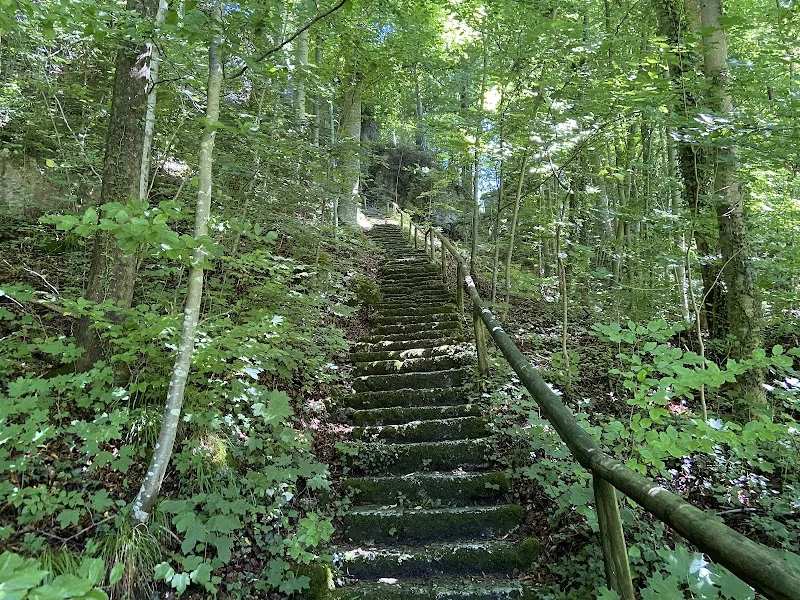
Those who want to experience the Beavers actively will find a manageable and very well-planned circular path in the official tour portal. The Beaver Circular Path is classified as an easy hike, is 2.1 kilometers long, and can be walked in about one hour. The elevation difference is 54 meters in ascent and descent, the highest point is at 532 meters, and the lowest at 478 meters. This makes the tour excellent for people who are not looking for a long mountain tour but a compact round with clear highlights. The tour portal describes the tour as a circular and family hike to the Nagelfluh rock height with an extraordinary Stations of the Cross. Additionally, geological highlights, cultural and historical references, as well as family-friendliness are explicitly mentioned. The best season is even marked throughout the year. For a location like the Beavers, this is ideal because visitors are not tied to a specific major event or season but can integrate the landscape very flexibly into their daily schedule. This combination of short length and high experience value is a real advantage, especially for guests who are traveling in Brannenburg or the Inn Valley. ([chiemsee-alpenland.de](https://www.chiemsee-alpenland.de/entdecken/tourenportal/wandern-von-brannenburg-aus-biber-rundweg-3bc1a9da00))
The starting point of the hike is also practically arranged. The tour portal names the district of Degerndorf as the starting point and recommends starting on the north side at the Buchberger farm or at the Kürmeier butcher shop. From there, the path leads around the natural monument Beavers and makes the most important points experienceable in a short time. It is important to have the right equipment: sturdy hiking shoes, weather-appropriate clothing, sufficient fluids, sun protection, and a mobile phone for emergencies are explicitly recommended. These tips are not dramatic for a short walk but sensible because the path can be steep and rocky in parts. For this reason, the Beavers are not marketed as an arbitrary city stroll but as a small but demanding nature and culture round. Those who walk attentively will experience not only the Stations of the Cross and the church but also the geological structure of the Nagelfluh, historical traces of stone mining, and the characteristic location between valley, slope, and forest. Thus, an hour of walking time becomes a short but content-rich excursion. ([chiemsee-alpenland.de](https://www.chiemsee-alpenland.de/entdecken/tourenportal/wandern-von-brannenburg-aus-biber-rundweg-3bc1a9da00))
Access, Parking, and Starting Points in Degerndorf and Milbing
For arriving by car, the tour portal provides a clear route: From the A93, take the Brannenburg exit and continue towards Brannenburg, then go straight along Nußdorfer Straße, turn left at the traffic light onto Kufsteiner Straße, and then right onto Biber Straße until you reach the Beavers. For parking, the district of Degerndorf is mentioned. Additionally, a Brannenburg cultural guide provides specific parking tips for cultural walks: parking options for the millstone stations are located on Biberstraße near the former Gasthof Marini. This is helpful for visitors because the Beavers do not function as a closed parking area but as a landscape space with several access points. Therefore, those who want to visit the circular path, the church, or the quarry traces should not only aim for a single destination but should determine the chosen starting point in advance. This saves time, prevents unnecessary searching, and makes the visit more relaxed. This orientation is particularly important for families or older visitors because it makes the start of the tour clear and realistically planable. ([chiemsee-alpenland.de](https://www.chiemsee-alpenland.de/entdecken/tourenportal/wandern-von-brannenburg-aus-biber-rundweg-3bc1a9da00))
Traveling by train is also quite possible and for many guests the more pleasant option. The official tour portal recommends the BRB Chiemgau-Inntal to Brannenburg and describes the footpath from the train station very specifically: along the Kirchbach, past the Christkönigkirche, further to Grießenbach. This connection shows that the Beavers are not isolated at the edge but embedded in a grown local structure. Those who come from the train first experience the town of Brannenburg itself and then approach the natural monument. This is touristically clever because the perception does not occur abruptly but gradually. Furthermore, Brannenburg's official cultural page points to the natural monument character of the Beaver quarry and that the landscape has attracted artists early on. Thus, the journey itself becomes part of the experience: not just a destination on the map but a transition from the town center to cultural landscape. For visitors who prefer to travel without a car or want to avoid parking searches, this option is particularly valuable. ([chiemsee-alpenland.de](https://www.chiemsee-alpenland.de/entdecken/tourenportal/wandern-von-brannenburg-aus-biber-rundweg-3bc1a9da00))
Quarries, Millstones, and the History of Conglomerate Mining
The history of the Beavers is closely linked to stone mining. The geotope profile of the Bavarian State Office for the Environment notes that the Beavers conglomerate is still mined as building stone in three quarries. At the same time, it is pointed out that the western and southern walls of the Beavers are relics of old mining and that traces of millstone extraction have been preserved below the church on a large conglomerate block. A Brannenburg cultural guide adds this perspective: from the 10th century until the 19th century, the rock was processed in caves on the steep eastern edge into millstones; the oldest written evidence of a millstone quarry in Bavaria refers to Degerndorf. It was not until the large orders for the regulation of the Inn in the mid-19th century that the three large quarries were created, which today reach up to the Beavers Heights. This is exciting for visitors because the visible rock walls are not random breaks but the result of centuries of work. The landscape thus tells not only of natural forces but also of economic history, transport routes, and artisanal knowledge. ([umweltatlas.bayern.de](https://www.umweltatlas.bayern.de/standortauskunft/rest/reporting/sb_geotope/generate/Geotope.pdf?additionallayerfieldvalue=187A009))
This artisanal tradition continues in Brannenburg to this day. The municipality presents the Feicht, Huber, and Grad quarries with their addresses on Biberstraße. According to the municipality, Feicht has been mining conglomerate at the Beavers since 1868, Huber refers to stories about mining rights since 1597, and the Grad conglomerate works have been in family ownership since 1773. It is no longer just about raw material extraction: the material is processed into natural stone slabs, rubble stones, and design elements for indoor and outdoor areas. This keeps the Beavers a lively production site, not a pure open-air museum. This continuity between historical millstone mining and modern natural stone processing makes the region distinctive. For visitors, this is also aesthetically interesting because the tradition and craftsmanship history is not told abstractly but remains visible directly on the slope, at the quarries, and at the information points on site. Thus, those who visit the Beavers see not only a beautiful hill but a landscape whose rock has been used, shaped, and passed down for centuries. ([brannenburg.de](https://www.brannenburg.de/orte/steinbrueche/steinbruch-feicht/))
Magdalene Festival, Views, and Cultural Experiences at the Beavers
The Beavers are not only geologically and historically interesting but also culturally vibrant. The official cultural page of the municipality of Brannenburg emphasizes that the landscape has attracted artists early on and that the natural monument Beaver quarry is among the motifs of the local stroll. This fits with the cultural walk around and on the Beavers, which reveals the traces of stonecutters from past times and the present. The Beavers is thus a place where nature experience and cultural history do not merely complement each other but explain each other. Those who walk here receive not only beautiful views but also a reading key for the region. This is precisely why the Beavers are interesting for guests looking for an excursion with substance: a short path but many layers of interpretation. The seasons also come into play as a factor. The church offers views of Riesenkopf and Maiwand in summer, and of the Peterskircherl in winter, and the tour portal marks the route as suitable for the entire year. The Beavers are thus not tied to a single moment but unfold their effect differently in every season. ([brannenburg.de](https://www.brannenburg.de/erleben-entdecken/kunst-kultur/))
A particularly beautiful example of this connection between tradition and place is the Magdalene Festival at the Beavers. The event is described by the tourism association with an outdoor service, entertainment by the Brannenburg music band, performances by the Degerndorf traditional costume association, and a culinary program; it takes place in good and bad weather, and the date for 2026 is announced for July 26. Together with the festival area below the church, this shows that the Beavers are not just a quiet cultural space but also a place for lived community. For visitors, this means: those who visit the Beavers can combine a very short walk with a genuine regional experience. One sees conglomerate rock, a historical Stations of the Cross, a pilgrimage church, active quarries, and a lively tradition in a single local image. This combination sets The Beavers apart from many other excursion destinations in the Chiemsee-Alpenland. It is neither a spectacle nor a backdrop but a place with depth, where the identity of Brannenburg can be read in a particularly vivid way. ([veranstaltungen.chiemsee-alpenland.de](https://veranstaltungen.chiemsee-alpenland.de/brannenburg/magdalenenfest-auf-der-biber-i310.10854330.html?utm_source=openai))
Sources:
Mehr anzeigenWeniger anzeigen
The Beavers | Stations of the Cross & Hiking
The Beavers in Brannenburg is a place where landscape, faith, craftsmanship, and movement come together in a small space. Those who arrive here do not experience a classic event location with halls and ticket counters, but a cultivated cultural landscape made up of conglomerate rock, a pilgrimage church, Stations of the Cross, historical quarry traces, and a manageable circular path. This mix makes the Beavers special: the site is quiet, historically significant, and practical for a short walk, a family outing, or a conscious cultural path. Tourist and municipal sources describe the Beavers as a natural monument and as a destination that connects geology and history in an unusually dense way. This is attractive for visitors because the place offers not just a viewpoint, but several levels: nature, views, spirituality, industrial culture, and hiking experience. Those who want to not only pass through Brannenburg but understand it will find one of the most exciting places in the district of Degerndorf and on the slopes of the Beavers Heights. ([chiemsee-alpenland.de](https://www.chiemsee-alpenland.de/entdecken/alle-sehenswuerdigkeiten/die-biber-437767a6b8))
Natural Monument The Beavers: Geology, Shape, and Formation
Geologically, the Beavers are much more than a pretty hill. The geotope profile of the Bavarian State Office for the Environment describes the Beavers as an inselberg made of crack-glacial delta gravels that were steeply dumped into a lake. This resulted in a rock sequence 50 to 60 meters thick with conglomerates and sandstones, in which crystal pebbles occur with diameters of over ten centimeters. The tourist short description refers to a conglomerate rock height, and a Brannenburg cultural guide calls it a hard rock that has remained since the Ice Ages. These different descriptions do not contradict each other but show the same place from different perspectives: as a landscape-shaping rock formation, as a geologically significant exposure area, and as a prominent point in the Inn Valley. The geotope site is located in the municipality of Brannenburg, is about 365,400 square meters in size, and is classified by the environmental atlas as geoscientifically very significant as well as a valuable excursion, research, and teaching object. This makes the Beavers interesting for visitors who want not only to hike but also to understand how landscapes become visible in the Alpine foothills. ([umweltatlas.bayern.de](https://www.umweltatlas.bayern.de/standortauskunft/rest/reporting/sb_geotope/generate/Geotope.pdf?additionallayerfieldvalue=187A009))
The shape of the hill is closely linked to ice ages, sedimentation, and later use. In a Brannenburg brochure, the Beavers are described as a hard rock about 30 meters high made of conglomerate rock, while the tourist information classifies it as a Nagelfluh rock height about 40 meters high from the last Ice Age. What matters less is the exact number than the fact that a resilient rock body has remained here while the surroundings have been shaped differently. This also explains the steep western and southern walls, which are explicitly described in the geotope profile as relics of old mining. At the same time, it becomes clear that the Beavers were not only a natural form but also a workspace: even today, conglomerate and building stone are extracted in three quarries, and the active quarries may not be entered without permission. Therefore, visitors to the Beavers see a landscape that is not museum-like frozen but is still economically and culturally utilized today. This mixture of natural monument, raw material deposit, and viewpoint makes the place so extraordinary for visitors. ([brannenburg.de](https://www.brannenburg.de/download/4723/?tmstv=1684832367))
Pilgrimage Church St. Magdalena and the Extraordinary Stations of the Cross
On the Beavers stands the Pilgrimage Church St. Magdalena, a building that shapes the place in a special way. The municipality of Brannenburg dates the early Baroque church to 1628/29, when the hermit Johannes Schelle had a small church built, which was consecrated in 1636. Below the church are naturally formed rock caves that were previously used by hermits as additional places of devotion. The settlement of the Beavers Heights has been documented as far back as the early 19th century, and the last hermit died in 1813. This is remarkable for visitors because here stands not only a church but an entire spiritual landscape has been preserved. The location of the church on a meadow above a rocky landscape gives the place a quiet, almost secluded atmosphere, even though it is easily accessible from the town of Brannenburg. At the same time, the history of the hermits points to a use that goes far back into the past and has shaped the hill not only religiously but also socially and culturally. ([brannenburg.de](https://www.brannenburg.de/orte/kirchen/wallfahrtskirche-st-magdalena/))
The Stations of the Cross are the second major feature of this place and for many visitors even the most impressive part. According to the municipality, the Stations of the Cross were added between 1733 and 1736; it has 15 stations, is mostly still preserved in its original state, and is considered one of the first Stations of the Cross installations in Bavaria. The installation is horseshoe-shaped, the individual stations are designed as chapels, and it is unusual that the resurrection of Christ has been included in the Stations of the Cross. This peculiarity makes the Beavers so exciting for culturally interested guests because here lies not just an ordinary path of devotion, but a document of art and piety history. This is complemented by the effect of the place in everyday life: in summer, sport climbers occasionally meet at the rocky landscape, and from the festival area below the church, there is a view of Riesenkopf and Maiwand, in winter of the opposite Peterskircherl. This makes the Beavers a place where quiet spirituality, enjoyment of nature, and regional tradition meet in rare density. ([brannenburg.de](https://www.brannenburg.de/orte/kirchen/wallfahrtskirche-st-magdalena/))
Beaver Circular Path: Hiking, Length, Difficulty, and Family Tip
Those who want to experience the Beavers actively will find a manageable and very well-planned circular path in the official tour portal. The Beaver Circular Path is classified as an easy hike, is 2.1 kilometers long, and can be walked in about one hour. The elevation difference is 54 meters in ascent and descent, the highest point is at 532 meters, and the lowest at 478 meters. This makes the tour excellent for people who are not looking for a long mountain tour but a compact round with clear highlights. The tour portal describes the tour as a circular and family hike to the Nagelfluh rock height with an extraordinary Stations of the Cross. Additionally, geological highlights, cultural and historical references, as well as family-friendliness are explicitly mentioned. The best season is even marked throughout the year. For a location like the Beavers, this is ideal because visitors are not tied to a specific major event or season but can integrate the landscape very flexibly into their daily schedule. This combination of short length and high experience value is a real advantage, especially for guests who are traveling in Brannenburg or the Inn Valley. ([chiemsee-alpenland.de](https://www.chiemsee-alpenland.de/entdecken/tourenportal/wandern-von-brannenburg-aus-biber-rundweg-3bc1a9da00))
The starting point of the hike is also practically arranged. The tour portal names the district of Degerndorf as the starting point and recommends starting on the north side at the Buchberger farm or at the Kürmeier butcher shop. From there, the path leads around the natural monument Beavers and makes the most important points experienceable in a short time. It is important to have the right equipment: sturdy hiking shoes, weather-appropriate clothing, sufficient fluids, sun protection, and a mobile phone for emergencies are explicitly recommended. These tips are not dramatic for a short walk but sensible because the path can be steep and rocky in parts. For this reason, the Beavers are not marketed as an arbitrary city stroll but as a small but demanding nature and culture round. Those who walk attentively will experience not only the Stations of the Cross and the church but also the geological structure of the Nagelfluh, historical traces of stone mining, and the characteristic location between valley, slope, and forest. Thus, an hour of walking time becomes a short but content-rich excursion. ([chiemsee-alpenland.de](https://www.chiemsee-alpenland.de/entdecken/tourenportal/wandern-von-brannenburg-aus-biber-rundweg-3bc1a9da00))
Access, Parking, and Starting Points in Degerndorf and Milbing
For arriving by car, the tour portal provides a clear route: From the A93, take the Brannenburg exit and continue towards Brannenburg, then go straight along Nußdorfer Straße, turn left at the traffic light onto Kufsteiner Straße, and then right onto Biber Straße until you reach the Beavers. For parking, the district of Degerndorf is mentioned. Additionally, a Brannenburg cultural guide provides specific parking tips for cultural walks: parking options for the millstone stations are located on Biberstraße near the former Gasthof Marini. This is helpful for visitors because the Beavers do not function as a closed parking area but as a landscape space with several access points. Therefore, those who want to visit the circular path, the church, or the quarry traces should not only aim for a single destination but should determine the chosen starting point in advance. This saves time, prevents unnecessary searching, and makes the visit more relaxed. This orientation is particularly important for families or older visitors because it makes the start of the tour clear and realistically planable. ([chiemsee-alpenland.de](https://www.chiemsee-alpenland.de/entdecken/tourenportal/wandern-von-brannenburg-aus-biber-rundweg-3bc1a9da00))
Traveling by train is also quite possible and for many guests the more pleasant option. The official tour portal recommends the BRB Chiemgau-Inntal to Brannenburg and describes the footpath from the train station very specifically: along the Kirchbach, past the Christkönigkirche, further to Grießenbach. This connection shows that the Beavers are not isolated at the edge but embedded in a grown local structure. Those who come from the train first experience the town of Brannenburg itself and then approach the natural monument. This is touristically clever because the perception does not occur abruptly but gradually. Furthermore, Brannenburg's official cultural page points to the natural monument character of the Beaver quarry and that the landscape has attracted artists early on. Thus, the journey itself becomes part of the experience: not just a destination on the map but a transition from the town center to cultural landscape. For visitors who prefer to travel without a car or want to avoid parking searches, this option is particularly valuable. ([chiemsee-alpenland.de](https://www.chiemsee-alpenland.de/entdecken/tourenportal/wandern-von-brannenburg-aus-biber-rundweg-3bc1a9da00))
Quarries, Millstones, and the History of Conglomerate Mining
The history of the Beavers is closely linked to stone mining. The geotope profile of the Bavarian State Office for the Environment notes that the Beavers conglomerate is still mined as building stone in three quarries. At the same time, it is pointed out that the western and southern walls of the Beavers are relics of old mining and that traces of millstone extraction have been preserved below the church on a large conglomerate block. A Brannenburg cultural guide adds this perspective: from the 10th century until the 19th century, the rock was processed in caves on the steep eastern edge into millstones; the oldest written evidence of a millstone quarry in Bavaria refers to Degerndorf. It was not until the large orders for the regulation of the Inn in the mid-19th century that the three large quarries were created, which today reach up to the Beavers Heights. This is exciting for visitors because the visible rock walls are not random breaks but the result of centuries of work. The landscape thus tells not only of natural forces but also of economic history, transport routes, and artisanal knowledge. ([umweltatlas.bayern.de](https://www.umweltatlas.bayern.de/standortauskunft/rest/reporting/sb_geotope/generate/Geotope.pdf?additionallayerfieldvalue=187A009))
This artisanal tradition continues in Brannenburg to this day. The municipality presents the Feicht, Huber, and Grad quarries with their addresses on Biberstraße. According to the municipality, Feicht has been mining conglomerate at the Beavers since 1868, Huber refers to stories about mining rights since 1597, and the Grad conglomerate works have been in family ownership since 1773. It is no longer just about raw material extraction: the material is processed into natural stone slabs, rubble stones, and design elements for indoor and outdoor areas. This keeps the Beavers a lively production site, not a pure open-air museum. This continuity between historical millstone mining and modern natural stone processing makes the region distinctive. For visitors, this is also aesthetically interesting because the tradition and craftsmanship history is not told abstractly but remains visible directly on the slope, at the quarries, and at the information points on site. Thus, those who visit the Beavers see not only a beautiful hill but a landscape whose rock has been used, shaped, and passed down for centuries. ([brannenburg.de](https://www.brannenburg.de/orte/steinbrueche/steinbruch-feicht/))
Magdalene Festival, Views, and Cultural Experiences at the Beavers
The Beavers are not only geologically and historically interesting but also culturally vibrant. The official cultural page of the municipality of Brannenburg emphasizes that the landscape has attracted artists early on and that the natural monument Beaver quarry is among the motifs of the local stroll. This fits with the cultural walk around and on the Beavers, which reveals the traces of stonecutters from past times and the present. The Beavers is thus a place where nature experience and cultural history do not merely complement each other but explain each other. Those who walk here receive not only beautiful views but also a reading key for the region. This is precisely why the Beavers are interesting for guests looking for an excursion with substance: a short path but many layers of interpretation. The seasons also come into play as a factor. The church offers views of Riesenkopf and Maiwand in summer, and of the Peterskircherl in winter, and the tour portal marks the route as suitable for the entire year. The Beavers are thus not tied to a single moment but unfold their effect differently in every season. ([brannenburg.de](https://www.brannenburg.de/erleben-entdecken/kunst-kultur/))
A particularly beautiful example of this connection between tradition and place is the Magdalene Festival at the Beavers. The event is described by the tourism association with an outdoor service, entertainment by the Brannenburg music band, performances by the Degerndorf traditional costume association, and a culinary program; it takes place in good and bad weather, and the date for 2026 is announced for July 26. Together with the festival area below the church, this shows that the Beavers are not just a quiet cultural space but also a place for lived community. For visitors, this means: those who visit the Beavers can combine a very short walk with a genuine regional experience. One sees conglomerate rock, a historical Stations of the Cross, a pilgrimage church, active quarries, and a lively tradition in a single local image. This combination sets The Beavers apart from many other excursion destinations in the Chiemsee-Alpenland. It is neither a spectacle nor a backdrop but a place with depth, where the identity of Brannenburg can be read in a particularly vivid way. ([veranstaltungen.chiemsee-alpenland.de](https://veranstaltungen.chiemsee-alpenland.de/brannenburg/magdalenenfest-auf-der-biber-i310.10854330.html?utm_source=openai))
Sources:
The Beavers | Stations of the Cross & Hiking
The Beavers in Brannenburg is a place where landscape, faith, craftsmanship, and movement come together in a small space. Those who arrive here do not experience a classic event location with halls and ticket counters, but a cultivated cultural landscape made up of conglomerate rock, a pilgrimage church, Stations of the Cross, historical quarry traces, and a manageable circular path. This mix makes the Beavers special: the site is quiet, historically significant, and practical for a short walk, a family outing, or a conscious cultural path. Tourist and municipal sources describe the Beavers as a natural monument and as a destination that connects geology and history in an unusually dense way. This is attractive for visitors because the place offers not just a viewpoint, but several levels: nature, views, spirituality, industrial culture, and hiking experience. Those who want to not only pass through Brannenburg but understand it will find one of the most exciting places in the district of Degerndorf and on the slopes of the Beavers Heights. ([chiemsee-alpenland.de](https://www.chiemsee-alpenland.de/entdecken/alle-sehenswuerdigkeiten/die-biber-437767a6b8))
Natural Monument The Beavers: Geology, Shape, and Formation
Geologically, the Beavers are much more than a pretty hill. The geotope profile of the Bavarian State Office for the Environment describes the Beavers as an inselberg made of crack-glacial delta gravels that were steeply dumped into a lake. This resulted in a rock sequence 50 to 60 meters thick with conglomerates and sandstones, in which crystal pebbles occur with diameters of over ten centimeters. The tourist short description refers to a conglomerate rock height, and a Brannenburg cultural guide calls it a hard rock that has remained since the Ice Ages. These different descriptions do not contradict each other but show the same place from different perspectives: as a landscape-shaping rock formation, as a geologically significant exposure area, and as a prominent point in the Inn Valley. The geotope site is located in the municipality of Brannenburg, is about 365,400 square meters in size, and is classified by the environmental atlas as geoscientifically very significant as well as a valuable excursion, research, and teaching object. This makes the Beavers interesting for visitors who want not only to hike but also to understand how landscapes become visible in the Alpine foothills. ([umweltatlas.bayern.de](https://www.umweltatlas.bayern.de/standortauskunft/rest/reporting/sb_geotope/generate/Geotope.pdf?additionallayerfieldvalue=187A009))
The shape of the hill is closely linked to ice ages, sedimentation, and later use. In a Brannenburg brochure, the Beavers are described as a hard rock about 30 meters high made of conglomerate rock, while the tourist information classifies it as a Nagelfluh rock height about 40 meters high from the last Ice Age. What matters less is the exact number than the fact that a resilient rock body has remained here while the surroundings have been shaped differently. This also explains the steep western and southern walls, which are explicitly described in the geotope profile as relics of old mining. At the same time, it becomes clear that the Beavers were not only a natural form but also a workspace: even today, conglomerate and building stone are extracted in three quarries, and the active quarries may not be entered without permission. Therefore, visitors to the Beavers see a landscape that is not museum-like frozen but is still economically and culturally utilized today. This mixture of natural monument, raw material deposit, and viewpoint makes the place so extraordinary for visitors. ([brannenburg.de](https://www.brannenburg.de/download/4723/?tmstv=1684832367))
Pilgrimage Church St. Magdalena and the Extraordinary Stations of the Cross
On the Beavers stands the Pilgrimage Church St. Magdalena, a building that shapes the place in a special way. The municipality of Brannenburg dates the early Baroque church to 1628/29, when the hermit Johannes Schelle had a small church built, which was consecrated in 1636. Below the church are naturally formed rock caves that were previously used by hermits as additional places of devotion. The settlement of the Beavers Heights has been documented as far back as the early 19th century, and the last hermit died in 1813. This is remarkable for visitors because here stands not only a church but an entire spiritual landscape has been preserved. The location of the church on a meadow above a rocky landscape gives the place a quiet, almost secluded atmosphere, even though it is easily accessible from the town of Brannenburg. At the same time, the history of the hermits points to a use that goes far back into the past and has shaped the hill not only religiously but also socially and culturally. ([brannenburg.de](https://www.brannenburg.de/orte/kirchen/wallfahrtskirche-st-magdalena/))
The Stations of the Cross are the second major feature of this place and for many visitors even the most impressive part. According to the municipality, the Stations of the Cross were added between 1733 and 1736; it has 15 stations, is mostly still preserved in its original state, and is considered one of the first Stations of the Cross installations in Bavaria. The installation is horseshoe-shaped, the individual stations are designed as chapels, and it is unusual that the resurrection of Christ has been included in the Stations of the Cross. This peculiarity makes the Beavers so exciting for culturally interested guests because here lies not just an ordinary path of devotion, but a document of art and piety history. This is complemented by the effect of the place in everyday life: in summer, sport climbers occasionally meet at the rocky landscape, and from the festival area below the church, there is a view of Riesenkopf and Maiwand, in winter of the opposite Peterskircherl. This makes the Beavers a place where quiet spirituality, enjoyment of nature, and regional tradition meet in rare density. ([brannenburg.de](https://www.brannenburg.de/orte/kirchen/wallfahrtskirche-st-magdalena/))
Beaver Circular Path: Hiking, Length, Difficulty, and Family Tip
Those who want to experience the Beavers actively will find a manageable and very well-planned circular path in the official tour portal. The Beaver Circular Path is classified as an easy hike, is 2.1 kilometers long, and can be walked in about one hour. The elevation difference is 54 meters in ascent and descent, the highest point is at 532 meters, and the lowest at 478 meters. This makes the tour excellent for people who are not looking for a long mountain tour but a compact round with clear highlights. The tour portal describes the tour as a circular and family hike to the Nagelfluh rock height with an extraordinary Stations of the Cross. Additionally, geological highlights, cultural and historical references, as well as family-friendliness are explicitly mentioned. The best season is even marked throughout the year. For a location like the Beavers, this is ideal because visitors are not tied to a specific major event or season but can integrate the landscape very flexibly into their daily schedule. This combination of short length and high experience value is a real advantage, especially for guests who are traveling in Brannenburg or the Inn Valley. ([chiemsee-alpenland.de](https://www.chiemsee-alpenland.de/entdecken/tourenportal/wandern-von-brannenburg-aus-biber-rundweg-3bc1a9da00))
The starting point of the hike is also practically arranged. The tour portal names the district of Degerndorf as the starting point and recommends starting on the north side at the Buchberger farm or at the Kürmeier butcher shop. From there, the path leads around the natural monument Beavers and makes the most important points experienceable in a short time. It is important to have the right equipment: sturdy hiking shoes, weather-appropriate clothing, sufficient fluids, sun protection, and a mobile phone for emergencies are explicitly recommended. These tips are not dramatic for a short walk but sensible because the path can be steep and rocky in parts. For this reason, the Beavers are not marketed as an arbitrary city stroll but as a small but demanding nature and culture round. Those who walk attentively will experience not only the Stations of the Cross and the church but also the geological structure of the Nagelfluh, historical traces of stone mining, and the characteristic location between valley, slope, and forest. Thus, an hour of walking time becomes a short but content-rich excursion. ([chiemsee-alpenland.de](https://www.chiemsee-alpenland.de/entdecken/tourenportal/wandern-von-brannenburg-aus-biber-rundweg-3bc1a9da00))
Access, Parking, and Starting Points in Degerndorf and Milbing
For arriving by car, the tour portal provides a clear route: From the A93, take the Brannenburg exit and continue towards Brannenburg, then go straight along Nußdorfer Straße, turn left at the traffic light onto Kufsteiner Straße, and then right onto Biber Straße until you reach the Beavers. For parking, the district of Degerndorf is mentioned. Additionally, a Brannenburg cultural guide provides specific parking tips for cultural walks: parking options for the millstone stations are located on Biberstraße near the former Gasthof Marini. This is helpful for visitors because the Beavers do not function as a closed parking area but as a landscape space with several access points. Therefore, those who want to visit the circular path, the church, or the quarry traces should not only aim for a single destination but should determine the chosen starting point in advance. This saves time, prevents unnecessary searching, and makes the visit more relaxed. This orientation is particularly important for families or older visitors because it makes the start of the tour clear and realistically planable. ([chiemsee-alpenland.de](https://www.chiemsee-alpenland.de/entdecken/tourenportal/wandern-von-brannenburg-aus-biber-rundweg-3bc1a9da00))
Traveling by train is also quite possible and for many guests the more pleasant option. The official tour portal recommends the BRB Chiemgau-Inntal to Brannenburg and describes the footpath from the train station very specifically: along the Kirchbach, past the Christkönigkirche, further to Grießenbach. This connection shows that the Beavers are not isolated at the edge but embedded in a grown local structure. Those who come from the train first experience the town of Brannenburg itself and then approach the natural monument. This is touristically clever because the perception does not occur abruptly but gradually. Furthermore, Brannenburg's official cultural page points to the natural monument character of the Beaver quarry and that the landscape has attracted artists early on. Thus, the journey itself becomes part of the experience: not just a destination on the map but a transition from the town center to cultural landscape. For visitors who prefer to travel without a car or want to avoid parking searches, this option is particularly valuable. ([chiemsee-alpenland.de](https://www.chiemsee-alpenland.de/entdecken/tourenportal/wandern-von-brannenburg-aus-biber-rundweg-3bc1a9da00))
Quarries, Millstones, and the History of Conglomerate Mining
The history of the Beavers is closely linked to stone mining. The geotope profile of the Bavarian State Office for the Environment notes that the Beavers conglomerate is still mined as building stone in three quarries. At the same time, it is pointed out that the western and southern walls of the Beavers are relics of old mining and that traces of millstone extraction have been preserved below the church on a large conglomerate block. A Brannenburg cultural guide adds this perspective: from the 10th century until the 19th century, the rock was processed in caves on the steep eastern edge into millstones; the oldest written evidence of a millstone quarry in Bavaria refers to Degerndorf. It was not until the large orders for the regulation of the Inn in the mid-19th century that the three large quarries were created, which today reach up to the Beavers Heights. This is exciting for visitors because the visible rock walls are not random breaks but the result of centuries of work. The landscape thus tells not only of natural forces but also of economic history, transport routes, and artisanal knowledge. ([umweltatlas.bayern.de](https://www.umweltatlas.bayern.de/standortauskunft/rest/reporting/sb_geotope/generate/Geotope.pdf?additionallayerfieldvalue=187A009))
This artisanal tradition continues in Brannenburg to this day. The municipality presents the Feicht, Huber, and Grad quarries with their addresses on Biberstraße. According to the municipality, Feicht has been mining conglomerate at the Beavers since 1868, Huber refers to stories about mining rights since 1597, and the Grad conglomerate works have been in family ownership since 1773. It is no longer just about raw material extraction: the material is processed into natural stone slabs, rubble stones, and design elements for indoor and outdoor areas. This keeps the Beavers a lively production site, not a pure open-air museum. This continuity between historical millstone mining and modern natural stone processing makes the region distinctive. For visitors, this is also aesthetically interesting because the tradition and craftsmanship history is not told abstractly but remains visible directly on the slope, at the quarries, and at the information points on site. Thus, those who visit the Beavers see not only a beautiful hill but a landscape whose rock has been used, shaped, and passed down for centuries. ([brannenburg.de](https://www.brannenburg.de/orte/steinbrueche/steinbruch-feicht/))
Magdalene Festival, Views, and Cultural Experiences at the Beavers
The Beavers are not only geologically and historically interesting but also culturally vibrant. The official cultural page of the municipality of Brannenburg emphasizes that the landscape has attracted artists early on and that the natural monument Beaver quarry is among the motifs of the local stroll. This fits with the cultural walk around and on the Beavers, which reveals the traces of stonecutters from past times and the present. The Beavers is thus a place where nature experience and cultural history do not merely complement each other but explain each other. Those who walk here receive not only beautiful views but also a reading key for the region. This is precisely why the Beavers are interesting for guests looking for an excursion with substance: a short path but many layers of interpretation. The seasons also come into play as a factor. The church offers views of Riesenkopf and Maiwand in summer, and of the Peterskircherl in winter, and the tour portal marks the route as suitable for the entire year. The Beavers are thus not tied to a single moment but unfold their effect differently in every season. ([brannenburg.de](https://www.brannenburg.de/erleben-entdecken/kunst-kultur/))
A particularly beautiful example of this connection between tradition and place is the Magdalene Festival at the Beavers. The event is described by the tourism association with an outdoor service, entertainment by the Brannenburg music band, performances by the Degerndorf traditional costume association, and a culinary program; it takes place in good and bad weather, and the date for 2026 is announced for July 26. Together with the festival area below the church, this shows that the Beavers are not just a quiet cultural space but also a place for lived community. For visitors, this means: those who visit the Beavers can combine a very short walk with a genuine regional experience. One sees conglomerate rock, a historical Stations of the Cross, a pilgrimage church, active quarries, and a lively tradition in a single local image. This combination sets The Beavers apart from many other excursion destinations in the Chiemsee-Alpenland. It is neither a spectacle nor a backdrop but a place with depth, where the identity of Brannenburg can be read in a particularly vivid way. ([veranstaltungen.chiemsee-alpenland.de](https://veranstaltungen.chiemsee-alpenland.de/brannenburg/magdalenenfest-auf-der-biber-i310.10854330.html?utm_source=openai))
Sources:
Upcoming Events
No events found
Frequently Asked Questions
Reviews
No reviews found