
Ruhpolding
Biathlonzentrum 1, 83324 Ruhpolding, Deutschland
Chiemgau Arena Ruhpolding | Biathlon & Tickets
The Chiemgau Arena in Ruhpolding is much more than a classic stadium for winter sports: it is a training center, World Cup stage, excursion destination, and event location at the same time. Visitors to the arena experience biathlon sports where international top performances, alpine landscapes, and an exceptionally compact stadium architecture have been combined for decades. The official arena describes itself as a training and event center for biathlon and Nordic skiing; at the same time, it is a DSV federal base and has been equipped with the IBU-A license and the requirements of FIS and the World Cup circuit since 2006. For visitors, this means: Here, sports history meets modern infrastructure, guided tours, shooting range experiences, event opportunities, and an offer that can be used throughout the year. Particularly attractive is the proximity between the spectator stands, shooting range, and race track, which makes the arena one of the most emotional biathlon locations in Germany. ([chiemgau-arena.de](https://www.chiemgau-arena.de/fuer-sportler/?utm_source=openai))
Today in the Stadium: Training, Calendar, and World Cup Atmosphere
Those looking for Chiemgau Arena Ruhpolding today will quickly land on the official section "Today in the Stadium". There, the arena shows in real-time when training sessions take place and which arena tours are offered on that particular day. This is particularly helpful for visitors, as the facility is lively not only during World Cup times but also during normal training operations. Depending on the season, different units of biathlon, cross-country skiing, or ski jumping groups can be seen there in the morning and afternoon, and the calendar links this information with bookable tours. This is a real added value for guests who spontaneously travel to Ruhpolding: instead of just seeing a sports facility from the outside, they can at least partially follow the training routine of top athletes live. ([chiemgau-arena.de](https://www.chiemgau-arena.de/heute-im-stadion/?utm_source=openai))
Interest peaks every year in January when the BMW IBU Biathlon World Cup makes a stop in Ruhpolding. The official website speaks of tens of thousands of spectators and a special exceptional atmosphere in the otherwise rather quiet town. This fits the staging of the arena: the main stands are close to the action, the shooting ranges are easily visible, and the mix of racing tension, stadium acoustics, and alpine backdrop creates an atmosphere that many fans describe as unique. Those planning a visit should keep an eye on the ticket page and the World Cup announcements, as dates, ticket shop, and travel information are combined there. ([chiemgau-arena.de](https://www.chiemgau-arena.de/biathlon-weltcup/?utm_source=openai))
Tickets for the Chiemgau Arena Ruhpolding
At the Chiemgau Arena, the topic of tickets is closely linked to two types of visits: the large biathlon World Cup and the guided arena experiences. For the World Cup, the website refers to the ticket shop; there, tickets for the competition days are provided. At the same time, there are tour offers that are deliberately designed to be smaller and experience-oriented. The classic arena tour takes visitors behind the scenes and conveys interesting facts about the operation of the facility, while the combination with biathlon shooting adds a practical experiential component. Both offers require registration and are scheduled differently seasonally, allowing the arena to flexibly adjust to training, event, and tour operations. ([chiemgau-arena.de](https://www.chiemgau-arena.de/veranstaltungen/arena-tour-16/))
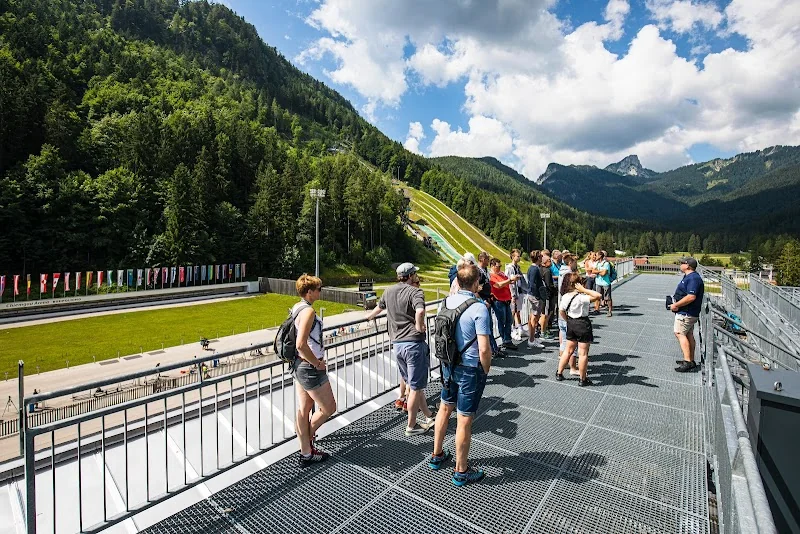
Particularly interesting is that the tours not only consist of a short guided tour but are clearly structured experiences with meeting points, duration, and price information. The arena tour lasts about two hours, while the variant with biathlon shooting takes about 2.5 hours; in both formats, weatherproof clothing is advisable, and registration is mandatory. Additionally, the arena offers vouchers that can be redeemed for tours, as well as group offers for club outings, company outings, or conferences. This makes it clear that tickets in Ruhpolding do not just mean admission but access to an experiential space that connects sports history, know-how, and immediate proximity to biathlon. ([chiemgau-arena.de](https://www.chiemgau-arena.de/veranstaltungen/arena-tour-16/))
Access, Parking, and Public Transport
The address of the Chiemgau Arena is clear and practical: Biathlonzentrum 1, 83324 Ruhpolding. The contact and service times are also clearly indicated on the official website, as well as the connection via bus line 9533. According to the arena's information, this bus runs daily between 8:00 AM and 8:00 PM; on Sundays and public holidays, the times may vary. For visitors, this means that travel is generally well-planned, provided they inform themselves in advance about the respective daily and seasonal notes. Especially for larger events, it is worthwhile to keep an eye on the pages for access, calendar, and World Cup. ([chiemgau-arena.de](https://www.chiemgau-arena.de/veranstaltungen/arena-tour-16/))
When it comes to parking, the distinction between normal operation and World Cup is crucial. The house rules of the Chiemgau Arena mention designated, paid visitor parking spaces on the stadium grounds; at the same time, access to the training area requires permission. However, stricter rules apply for the BMW IBU Biathlon World Cup: there are no access and parking options for normal individual traffic directly at the Chiemgau Arena. Instead, shuttle buses are used, including from Ruhpolding train station and Speedway stadium as well as from Inzell and Siegsdorf, partly according to a parking guidance system. This ensures that visits are safely and orderly managed even with high spectator numbers. ([chiemgau-arena.de](https://www.chiemgau-arena.de/wp-content/uploads/2020-07-01-benutzungsordnung-chiemgau-arena-final-1.pdf?utm_source=openai))
Track Plan, Roller Track, and Shooting Range
Sportingly, the Chiemgau Arena is particularly remarkable for its infrastructure. In the biathlon area, it is designated as a training and competition venue with an A-license from the International Biathlon Union and is also a DSV federal base. The roller track ranges from 1.1 kilometers to 5.2 kilometers and includes 12 different routes; the winter track has a total length of 6.8 kilometers with three routes. The shooting range is equipped with 30 stands for small caliber and a student shooting range with eight stands for air rifles. This combination makes the arena so strong: athletes can train here under realistic conditions while visitors can directly understand the sporting complexity of biathlon. ([chiemgau-arena.de](https://www.chiemgau-arena.de/sport/biathlon/?utm_source=openai))
Those looking for a track plan will find additional maps and PDFs with overview routes for the stadium grounds on the official website. There, stadium laps of various lengths are documented, such as 2.0 kilometers, 2.5 kilometers, and 3.4 kilometers, which clearly illustrate the spatial diversity of the facility. Additionally, the arena is designed for year-round use: from November onwards, the training and competition tracks can be prepared using a modern snowmaking system, and the grounds are designed so that skating, running, and shooting areas sensibly interconnect. For visitors, this is not only sportingly fascinating but also helpful, as the arena visit offers completely different impressions depending on the season. ([chiemgau-arena.de](https://www.chiemgau-arena.de/wp-content/uploads/strecke-neu-streckenubersicht-stadion-2019.pdf?utm_source=openai))
History of the Chiemgau Arena: from 1977/78 to 2012
The history of the Chiemgau Arena is closely linked to the development of biathlon in Germany. The construction of the biathlon center in 1977/78 was a central decision of the municipality of Ruhpolding. Even then, attention was paid to a landscape-integrated planning, where running tracks, shooting range, and technical buildings should form a functional unit. The arena was not simply built but deliberately designed as a future-proof performance location. In 1979, the first biathlon world championships took place in Ruhpolding, making the region an early international reference point. The official history also emphasizes that Ruhpolding took on a pioneering role in German biathlon and quickly established itself as a fixed location for major competitions. ([chiemgau-arena.de](https://www.chiemgau-arena.de/infowalk/))
Another important milestone was the renovation in the mid-1990s. In 1996, the core area of the stadium was modernized, including the main building, spectator stands, start and finish area, and shooting range. During this, the shooting range was expanded from 14 to 30 lanes and equipped with electronic target systems. Later, the large new building was added: with the Chiemgau Arena and the biathlon world championships in 2012, Ruhpolding set another sign for modern sports infrastructure. Today, the arena refers to over 40 biathlon World Cups and four world championships, which clearly illustrates the historical density of the location. For visitors, this is not just a number but the reason why Ruhpolding has almost a legendary sound in international biathlon. ([chiemgau-arena.de](https://www.chiemgau-arena.de/infowalk/))
Café Biathlon, Tours, and Event Rooms
The Chiemgau Arena is not only a sports venue but also a remarkable event location. In the press center, described as the largest event room in the grandstand building, the official press conferences of the IBU take place during the World Cup. Outside of top sports, the room is suitable for lectures, workshops, or business meetings. Particularly attractive is the Café Biathlon, which offers gastronomy year-round in the stylish premises of the WM press center and has a large sun terrace with a direct view of the shooting range. This transforms a functional sports building into a place where stay and view belong together. ([chiemgau-arena.de](https://www.chiemgau-arena.de/raeumlichkeit/pressezentrum/))
The arena tours also fit this concept. The website highlights that the tour offerings vary seasonally and continuously provide new experiences. In addition to classic guided tours, there is the popular biathlon shooting on the original shooting range, as well as offers for groups, clubs, and companies. Those preparing for the visit will also find a webcam point in the service area on the official page, as well as a weather note for the arena. This is particularly useful because conditions in the Chiemgau Alps can change quickly, and a look before the visit is worthwhile. This mix of service, sports proximity, and experience makes the Chiemgau Arena so versatile and attractive. ([chiemgau-arena.de](https://www.chiemgau-arena.de/arenatouren/arena-touren/))
Sources:
Mehr anzeigenWeniger anzeigen
Chiemgau Arena Ruhpolding | Biathlon & Tickets
The Chiemgau Arena in Ruhpolding is much more than a classic stadium for winter sports: it is a training center, World Cup stage, excursion destination, and event location at the same time. Visitors to the arena experience biathlon sports where international top performances, alpine landscapes, and an exceptionally compact stadium architecture have been combined for decades. The official arena describes itself as a training and event center for biathlon and Nordic skiing; at the same time, it is a DSV federal base and has been equipped with the IBU-A license and the requirements of FIS and the World Cup circuit since 2006. For visitors, this means: Here, sports history meets modern infrastructure, guided tours, shooting range experiences, event opportunities, and an offer that can be used throughout the year. Particularly attractive is the proximity between the spectator stands, shooting range, and race track, which makes the arena one of the most emotional biathlon locations in Germany. ([chiemgau-arena.de](https://www.chiemgau-arena.de/fuer-sportler/?utm_source=openai))
Today in the Stadium: Training, Calendar, and World Cup Atmosphere
Those looking for Chiemgau Arena Ruhpolding today will quickly land on the official section "Today in the Stadium". There, the arena shows in real-time when training sessions take place and which arena tours are offered on that particular day. This is particularly helpful for visitors, as the facility is lively not only during World Cup times but also during normal training operations. Depending on the season, different units of biathlon, cross-country skiing, or ski jumping groups can be seen there in the morning and afternoon, and the calendar links this information with bookable tours. This is a real added value for guests who spontaneously travel to Ruhpolding: instead of just seeing a sports facility from the outside, they can at least partially follow the training routine of top athletes live. ([chiemgau-arena.de](https://www.chiemgau-arena.de/heute-im-stadion/?utm_source=openai))
Interest peaks every year in January when the BMW IBU Biathlon World Cup makes a stop in Ruhpolding. The official website speaks of tens of thousands of spectators and a special exceptional atmosphere in the otherwise rather quiet town. This fits the staging of the arena: the main stands are close to the action, the shooting ranges are easily visible, and the mix of racing tension, stadium acoustics, and alpine backdrop creates an atmosphere that many fans describe as unique. Those planning a visit should keep an eye on the ticket page and the World Cup announcements, as dates, ticket shop, and travel information are combined there. ([chiemgau-arena.de](https://www.chiemgau-arena.de/biathlon-weltcup/?utm_source=openai))
Tickets for the Chiemgau Arena Ruhpolding
At the Chiemgau Arena, the topic of tickets is closely linked to two types of visits: the large biathlon World Cup and the guided arena experiences. For the World Cup, the website refers to the ticket shop; there, tickets for the competition days are provided. At the same time, there are tour offers that are deliberately designed to be smaller and experience-oriented. The classic arena tour takes visitors behind the scenes and conveys interesting facts about the operation of the facility, while the combination with biathlon shooting adds a practical experiential component. Both offers require registration and are scheduled differently seasonally, allowing the arena to flexibly adjust to training, event, and tour operations. ([chiemgau-arena.de](https://www.chiemgau-arena.de/veranstaltungen/arena-tour-16/))
Particularly interesting is that the tours not only consist of a short guided tour but are clearly structured experiences with meeting points, duration, and price information. The arena tour lasts about two hours, while the variant with biathlon shooting takes about 2.5 hours; in both formats, weatherproof clothing is advisable, and registration is mandatory. Additionally, the arena offers vouchers that can be redeemed for tours, as well as group offers for club outings, company outings, or conferences. This makes it clear that tickets in Ruhpolding do not just mean admission but access to an experiential space that connects sports history, know-how, and immediate proximity to biathlon. ([chiemgau-arena.de](https://www.chiemgau-arena.de/veranstaltungen/arena-tour-16/))
Access, Parking, and Public Transport
The address of the Chiemgau Arena is clear and practical: Biathlonzentrum 1, 83324 Ruhpolding. The contact and service times are also clearly indicated on the official website, as well as the connection via bus line 9533. According to the arena's information, this bus runs daily between 8:00 AM and 8:00 PM; on Sundays and public holidays, the times may vary. For visitors, this means that travel is generally well-planned, provided they inform themselves in advance about the respective daily and seasonal notes. Especially for larger events, it is worthwhile to keep an eye on the pages for access, calendar, and World Cup. ([chiemgau-arena.de](https://www.chiemgau-arena.de/veranstaltungen/arena-tour-16/))
When it comes to parking, the distinction between normal operation and World Cup is crucial. The house rules of the Chiemgau Arena mention designated, paid visitor parking spaces on the stadium grounds; at the same time, access to the training area requires permission. However, stricter rules apply for the BMW IBU Biathlon World Cup: there are no access and parking options for normal individual traffic directly at the Chiemgau Arena. Instead, shuttle buses are used, including from Ruhpolding train station and Speedway stadium as well as from Inzell and Siegsdorf, partly according to a parking guidance system. This ensures that visits are safely and orderly managed even with high spectator numbers. ([chiemgau-arena.de](https://www.chiemgau-arena.de/wp-content/uploads/2020-07-01-benutzungsordnung-chiemgau-arena-final-1.pdf?utm_source=openai))
Track Plan, Roller Track, and Shooting Range
Sportingly, the Chiemgau Arena is particularly remarkable for its infrastructure. In the biathlon area, it is designated as a training and competition venue with an A-license from the International Biathlon Union and is also a DSV federal base. The roller track ranges from 1.1 kilometers to 5.2 kilometers and includes 12 different routes; the winter track has a total length of 6.8 kilometers with three routes. The shooting range is equipped with 30 stands for small caliber and a student shooting range with eight stands for air rifles. This combination makes the arena so strong: athletes can train here under realistic conditions while visitors can directly understand the sporting complexity of biathlon. ([chiemgau-arena.de](https://www.chiemgau-arena.de/sport/biathlon/?utm_source=openai))
Those looking for a track plan will find additional maps and PDFs with overview routes for the stadium grounds on the official website. There, stadium laps of various lengths are documented, such as 2.0 kilometers, 2.5 kilometers, and 3.4 kilometers, which clearly illustrate the spatial diversity of the facility. Additionally, the arena is designed for year-round use: from November onwards, the training and competition tracks can be prepared using a modern snowmaking system, and the grounds are designed so that skating, running, and shooting areas sensibly interconnect. For visitors, this is not only sportingly fascinating but also helpful, as the arena visit offers completely different impressions depending on the season. ([chiemgau-arena.de](https://www.chiemgau-arena.de/wp-content/uploads/strecke-neu-streckenubersicht-stadion-2019.pdf?utm_source=openai))
History of the Chiemgau Arena: from 1977/78 to 2012
The history of the Chiemgau Arena is closely linked to the development of biathlon in Germany. The construction of the biathlon center in 1977/78 was a central decision of the municipality of Ruhpolding. Even then, attention was paid to a landscape-integrated planning, where running tracks, shooting range, and technical buildings should form a functional unit. The arena was not simply built but deliberately designed as a future-proof performance location. In 1979, the first biathlon world championships took place in Ruhpolding, making the region an early international reference point. The official history also emphasizes that Ruhpolding took on a pioneering role in German biathlon and quickly established itself as a fixed location for major competitions. ([chiemgau-arena.de](https://www.chiemgau-arena.de/infowalk/))
Another important milestone was the renovation in the mid-1990s. In 1996, the core area of the stadium was modernized, including the main building, spectator stands, start and finish area, and shooting range. During this, the shooting range was expanded from 14 to 30 lanes and equipped with electronic target systems. Later, the large new building was added: with the Chiemgau Arena and the biathlon world championships in 2012, Ruhpolding set another sign for modern sports infrastructure. Today, the arena refers to over 40 biathlon World Cups and four world championships, which clearly illustrates the historical density of the location. For visitors, this is not just a number but the reason why Ruhpolding has almost a legendary sound in international biathlon. ([chiemgau-arena.de](https://www.chiemgau-arena.de/infowalk/))
Café Biathlon, Tours, and Event Rooms
The Chiemgau Arena is not only a sports venue but also a remarkable event location. In the press center, described as the largest event room in the grandstand building, the official press conferences of the IBU take place during the World Cup. Outside of top sports, the room is suitable for lectures, workshops, or business meetings. Particularly attractive is the Café Biathlon, which offers gastronomy year-round in the stylish premises of the WM press center and has a large sun terrace with a direct view of the shooting range. This transforms a functional sports building into a place where stay and view belong together. ([chiemgau-arena.de](https://www.chiemgau-arena.de/raeumlichkeit/pressezentrum/))
The arena tours also fit this concept. The website highlights that the tour offerings vary seasonally and continuously provide new experiences. In addition to classic guided tours, there is the popular biathlon shooting on the original shooting range, as well as offers for groups, clubs, and companies. Those preparing for the visit will also find a webcam point in the service area on the official page, as well as a weather note for the arena. This is particularly useful because conditions in the Chiemgau Alps can change quickly, and a look before the visit is worthwhile. This mix of service, sports proximity, and experience makes the Chiemgau Arena so versatile and attractive. ([chiemgau-arena.de](https://www.chiemgau-arena.de/arenatouren/arena-touren/))
Sources:
Chiemgau Arena Ruhpolding | Biathlon & Tickets
The Chiemgau Arena in Ruhpolding is much more than a classic stadium for winter sports: it is a training center, World Cup stage, excursion destination, and event location at the same time. Visitors to the arena experience biathlon sports where international top performances, alpine landscapes, and an exceptionally compact stadium architecture have been combined for decades. The official arena describes itself as a training and event center for biathlon and Nordic skiing; at the same time, it is a DSV federal base and has been equipped with the IBU-A license and the requirements of FIS and the World Cup circuit since 2006. For visitors, this means: Here, sports history meets modern infrastructure, guided tours, shooting range experiences, event opportunities, and an offer that can be used throughout the year. Particularly attractive is the proximity between the spectator stands, shooting range, and race track, which makes the arena one of the most emotional biathlon locations in Germany. ([chiemgau-arena.de](https://www.chiemgau-arena.de/fuer-sportler/?utm_source=openai))
Today in the Stadium: Training, Calendar, and World Cup Atmosphere
Those looking for Chiemgau Arena Ruhpolding today will quickly land on the official section "Today in the Stadium". There, the arena shows in real-time when training sessions take place and which arena tours are offered on that particular day. This is particularly helpful for visitors, as the facility is lively not only during World Cup times but also during normal training operations. Depending on the season, different units of biathlon, cross-country skiing, or ski jumping groups can be seen there in the morning and afternoon, and the calendar links this information with bookable tours. This is a real added value for guests who spontaneously travel to Ruhpolding: instead of just seeing a sports facility from the outside, they can at least partially follow the training routine of top athletes live. ([chiemgau-arena.de](https://www.chiemgau-arena.de/heute-im-stadion/?utm_source=openai))
Interest peaks every year in January when the BMW IBU Biathlon World Cup makes a stop in Ruhpolding. The official website speaks of tens of thousands of spectators and a special exceptional atmosphere in the otherwise rather quiet town. This fits the staging of the arena: the main stands are close to the action, the shooting ranges are easily visible, and the mix of racing tension, stadium acoustics, and alpine backdrop creates an atmosphere that many fans describe as unique. Those planning a visit should keep an eye on the ticket page and the World Cup announcements, as dates, ticket shop, and travel information are combined there. ([chiemgau-arena.de](https://www.chiemgau-arena.de/biathlon-weltcup/?utm_source=openai))
Tickets for the Chiemgau Arena Ruhpolding
At the Chiemgau Arena, the topic of tickets is closely linked to two types of visits: the large biathlon World Cup and the guided arena experiences. For the World Cup, the website refers to the ticket shop; there, tickets for the competition days are provided. At the same time, there are tour offers that are deliberately designed to be smaller and experience-oriented. The classic arena tour takes visitors behind the scenes and conveys interesting facts about the operation of the facility, while the combination with biathlon shooting adds a practical experiential component. Both offers require registration and are scheduled differently seasonally, allowing the arena to flexibly adjust to training, event, and tour operations. ([chiemgau-arena.de](https://www.chiemgau-arena.de/veranstaltungen/arena-tour-16/))
Particularly interesting is that the tours not only consist of a short guided tour but are clearly structured experiences with meeting points, duration, and price information. The arena tour lasts about two hours, while the variant with biathlon shooting takes about 2.5 hours; in both formats, weatherproof clothing is advisable, and registration is mandatory. Additionally, the arena offers vouchers that can be redeemed for tours, as well as group offers for club outings, company outings, or conferences. This makes it clear that tickets in Ruhpolding do not just mean admission but access to an experiential space that connects sports history, know-how, and immediate proximity to biathlon. ([chiemgau-arena.de](https://www.chiemgau-arena.de/veranstaltungen/arena-tour-16/))
Access, Parking, and Public Transport
The address of the Chiemgau Arena is clear and practical: Biathlonzentrum 1, 83324 Ruhpolding. The contact and service times are also clearly indicated on the official website, as well as the connection via bus line 9533. According to the arena's information, this bus runs daily between 8:00 AM and 8:00 PM; on Sundays and public holidays, the times may vary. For visitors, this means that travel is generally well-planned, provided they inform themselves in advance about the respective daily and seasonal notes. Especially for larger events, it is worthwhile to keep an eye on the pages for access, calendar, and World Cup. ([chiemgau-arena.de](https://www.chiemgau-arena.de/veranstaltungen/arena-tour-16/))
When it comes to parking, the distinction between normal operation and World Cup is crucial. The house rules of the Chiemgau Arena mention designated, paid visitor parking spaces on the stadium grounds; at the same time, access to the training area requires permission. However, stricter rules apply for the BMW IBU Biathlon World Cup: there are no access and parking options for normal individual traffic directly at the Chiemgau Arena. Instead, shuttle buses are used, including from Ruhpolding train station and Speedway stadium as well as from Inzell and Siegsdorf, partly according to a parking guidance system. This ensures that visits are safely and orderly managed even with high spectator numbers. ([chiemgau-arena.de](https://www.chiemgau-arena.de/wp-content/uploads/2020-07-01-benutzungsordnung-chiemgau-arena-final-1.pdf?utm_source=openai))
Track Plan, Roller Track, and Shooting Range
Sportingly, the Chiemgau Arena is particularly remarkable for its infrastructure. In the biathlon area, it is designated as a training and competition venue with an A-license from the International Biathlon Union and is also a DSV federal base. The roller track ranges from 1.1 kilometers to 5.2 kilometers and includes 12 different routes; the winter track has a total length of 6.8 kilometers with three routes. The shooting range is equipped with 30 stands for small caliber and a student shooting range with eight stands for air rifles. This combination makes the arena so strong: athletes can train here under realistic conditions while visitors can directly understand the sporting complexity of biathlon. ([chiemgau-arena.de](https://www.chiemgau-arena.de/sport/biathlon/?utm_source=openai))
Those looking for a track plan will find additional maps and PDFs with overview routes for the stadium grounds on the official website. There, stadium laps of various lengths are documented, such as 2.0 kilometers, 2.5 kilometers, and 3.4 kilometers, which clearly illustrate the spatial diversity of the facility. Additionally, the arena is designed for year-round use: from November onwards, the training and competition tracks can be prepared using a modern snowmaking system, and the grounds are designed so that skating, running, and shooting areas sensibly interconnect. For visitors, this is not only sportingly fascinating but also helpful, as the arena visit offers completely different impressions depending on the season. ([chiemgau-arena.de](https://www.chiemgau-arena.de/wp-content/uploads/strecke-neu-streckenubersicht-stadion-2019.pdf?utm_source=openai))
History of the Chiemgau Arena: from 1977/78 to 2012
The history of the Chiemgau Arena is closely linked to the development of biathlon in Germany. The construction of the biathlon center in 1977/78 was a central decision of the municipality of Ruhpolding. Even then, attention was paid to a landscape-integrated planning, where running tracks, shooting range, and technical buildings should form a functional unit. The arena was not simply built but deliberately designed as a future-proof performance location. In 1979, the first biathlon world championships took place in Ruhpolding, making the region an early international reference point. The official history also emphasizes that Ruhpolding took on a pioneering role in German biathlon and quickly established itself as a fixed location for major competitions. ([chiemgau-arena.de](https://www.chiemgau-arena.de/infowalk/))
Another important milestone was the renovation in the mid-1990s. In 1996, the core area of the stadium was modernized, including the main building, spectator stands, start and finish area, and shooting range. During this, the shooting range was expanded from 14 to 30 lanes and equipped with electronic target systems. Later, the large new building was added: with the Chiemgau Arena and the biathlon world championships in 2012, Ruhpolding set another sign for modern sports infrastructure. Today, the arena refers to over 40 biathlon World Cups and four world championships, which clearly illustrates the historical density of the location. For visitors, this is not just a number but the reason why Ruhpolding has almost a legendary sound in international biathlon. ([chiemgau-arena.de](https://www.chiemgau-arena.de/infowalk/))
Café Biathlon, Tours, and Event Rooms
The Chiemgau Arena is not only a sports venue but also a remarkable event location. In the press center, described as the largest event room in the grandstand building, the official press conferences of the IBU take place during the World Cup. Outside of top sports, the room is suitable for lectures, workshops, or business meetings. Particularly attractive is the Café Biathlon, which offers gastronomy year-round in the stylish premises of the WM press center and has a large sun terrace with a direct view of the shooting range. This transforms a functional sports building into a place where stay and view belong together. ([chiemgau-arena.de](https://www.chiemgau-arena.de/raeumlichkeit/pressezentrum/))
The arena tours also fit this concept. The website highlights that the tour offerings vary seasonally and continuously provide new experiences. In addition to classic guided tours, there is the popular biathlon shooting on the original shooting range, as well as offers for groups, clubs, and companies. Those preparing for the visit will also find a webcam point in the service area on the official page, as well as a weather note for the arena. This is particularly useful because conditions in the Chiemgau Alps can change quickly, and a look before the visit is worthwhile. This mix of service, sports proximity, and experience makes the Chiemgau Arena so versatile and attractive. ([chiemgau-arena.de](https://www.chiemgau-arena.de/arenatouren/arena-touren/))
Sources:
Upcoming Events
No events found
Frequently Asked Questions
Reviews
Ana. Ko.
5. November 2024
Was staying in Rupholding in October and went on a tour which was super interesting! Hoping to come back to watch one of the biathlon world cups.
sahana d n
14. March 2025
The world Masters ski-OL '25 was organised here. Has a restaurant and had good parking spaces for us. They have a guided tour of the Biathlon area but need to be reserved in advance as it is only on certain days of the month.
Daniel Thomsen
22. January 2023
My favorite biathlon arena! ❤️
Jacques Jefferies
13. February 2018
Such a crazy biathlon arena!! That's all I can say, the pistes are great and the shooting range is amazing. Toilets are always clean and there's lots of them scattered around as well. The restaurant is small but nice and cheap and the staff are friendly.
Dennis Serban
24. January 2019
Amazing place, with best tracks and best people.