
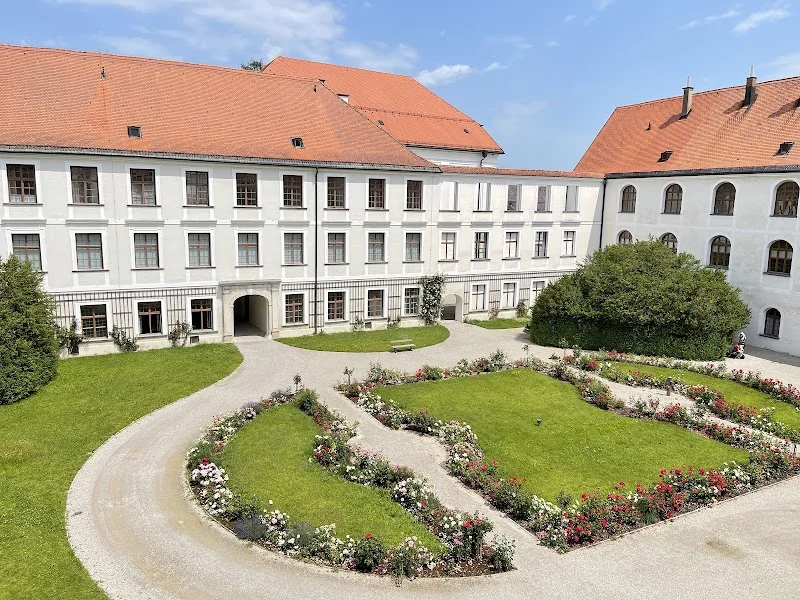
Herrenchiemsee
Altes Schloss 3, 83209 Herrenchiemsee, Deutschland
Augustinian Canons' Monastery | Constitution Museum & Opening Hours
The Augustinian Canons' Monastery on Herrenchiemsee is much more than a beautiful photo opportunity on the island of Herrenchiemsee. The complex combines medieval monastic history, baroque architecture, the memory of King Ludwig II, and several museums ranging from art to constitutional history. Therefore, visitors to the Old Castle experience not only a tranquil place by the water but also a multifaceted cultural ensemble with a strong historical core. The grounds are open daily, the museum in the monastery is accessible without a guided tour, and the island cathedral is one of the highlights that can only be experienced as part of a guided tour. This combination of freely accessible exhibition areas, guided sacred spaces, and the special island path makes the visit attractive for day guests, cultural travelers, and groups. The official castle administration classifies the Augustinian Canons' Monastery as a central part of the Herrenchiemsee ensemble, alongside the New Castle, the park, and the visitor offerings on the island. ([herrenchiemsee.de](https://www.herrenchiemsee.de/deutsch/a_schloss/index.htm))
From the Early Monastic Foundation to the Old Castle
The history of the Augustinian Canons' Monastery begins long before the current building stock. Archaeological excavations on Herreninsel indicate that a first monastic complex existed at this location as early as the early 7th century, that is, before 629. Later, the abbey dedicated to the divine Redeemer was replaced by an Augustinian Canons' Monastery. Its church was consecrated in 1131 and also served as the cathedral of the Chiemsee bishops since 1215. Thus, the site is significant not only religiously but also in terms of church and regional history. In the late Middle Ages, renovations of the Romanesque church took place, and between 1676 and 1678, the cathedral church was largely rebuilt by Lorenzo Sciasca. The stucco work was done by Francesco Brenno and Giulio Zuccalli, while the ceiling paintings were executed by Joseph Eder and Jacob Carnutsch. This baroque phase decisively shaped the appearance of the complex and anchored the monastery in the grand history of South German art and architecture. ([herrenchiemsee.de](https://www.herrenchiemsee.de/deutsch/a_schloss/sakral.htm))
However, today's view of the Augustinian Canons' Monastery is also shaped by loss, repurposing, and memory. Today, only the nave of the former monastery church remains; the choir and towers were demolished in 1819/1820, and a brewery was installed in the church nave. After the secularization in 1803, the monastery was dissolved, but about 70 years later, King Ludwig II bought the entire Herreninsel, including the former monastery complex. In the monastery building, he had living quarters set up, which he used when inspecting the construction work at the New Castle. It is from this phase that the term Old Castle for the former monastery originates. The former bedroom of Ludwig II and the court kitchen can be visited today, giving the place a personal, almost private dimension alongside its significant historical role. Thus, a rare mix of medieval origins, baroque flourishing, royal use, and museum presence emerges. ([herrenchiemsee.de](https://www.herrenchiemsee.de/deutsch/a_schloss/index.htm))
Constitution Museum and Democracy History at the Authentic Location
A special focus of the Augustinian Canons' Monastery is the Constitution Museum in the convent and princely wing. The exhibition is set up at the authentic location and deals with various perspectives from the time until 1948 and, in a significant leap, up to the present day. Central questions that shaped the discussions after World War II are at the forefront, such as who should determine the constitution, how a divided country and a divided Europe can be organized, and what lessons can be learned from the devastations of the recent past. These questions make the place particularly compelling for politically interested visitors, as it not only informs but also encourages personal engagement. The exhibition works with participation opportunities, allowing content to be not just viewed but deepened and reflected upon. This makes the Augustinian Canons' Monastery a space of remembrance where democracy is not abstract but spatially and historically tangible. ([herrenchiemsee.de](https://www.herrenchiemsee.de/deutsch/a_schloss/verfassungsmuseum.htm))
Additionally, the museum is easily accessible in everyday life and is complemented by educational offerings. The castle administration points out that there are special guided tours on the topic of democracy in the summer at the Augustinian Canons' Monastery. For visitors looking for more than a quiet tour, this is an important plus, as the exhibition remains lively and is regularly placed in the context of current educational work. The barrier-free access is also relevant for many guests: The path from the visitor information center to the monastery is signposted without steps and leads over asphalt and paved gravel paths. On-site, there is also a separate step-free entrance via the Rosengarten courtyard, and the main areas are accessible via elevators. Therefore, those who want to combine constitutional history, political education, and a well-organized visitor tour will find one of the most interesting places on Herreninsel here. ([herrenchiemsee.de](https://www.herrenchiemsee.de/deutsch/a_schloss/verfassungsmuseum.htm))
Gallery Julius Exter and Gallery Painters at Chiemsee
For art enthusiasts, the Augustinian Canons' Monastery is especially worthwhile due to its two galleries. The Gallery Julius Exter is located in the prelature wing, that is, in the north wing of the monastery complex, which was built between 1727 and 1730. In the baroque rooms, the work of the artist from all periods of creation is presented in overview. Around 1900, Julius Exter was considered an important pioneer of modern painting in Munich, was a member of the Secession founded in 1892, and was referred to by colleagues as the prince of colors. His paintings found a market throughout Germany and especially in Switzerland. Artistically, he developed from historicism to a vital colorfulness that approaches expressionism and also brings him close to the Blue Rider. The presentation in the monastery makes this journey not dry but spatially tangible: The baroque architecture forms the framework for the development of a painter who stands for departure, brightness, and artistic independence. ([herrenchiemsee.de](https://www.herrenchiemsee.de/deutsch/a_schloss/exter.htm))
This is complemented by the Gallery Painters at Chiemsee, which shows a selection of masterpieces by artists active at Chiemsee in six rooms. These include Karl Millner, Friedrich August Kessler, Friedrich Wilhelm Pfeiffer, Karl Raupp, Joseph Wopfner, Wilhelm Trübner, Julius Exter, Leo Putz, Walther Püttner, Paul Roloff, and Erich Glette. The collection is set up as a permanent exhibition of the Bavarian Palace Administration in collaboration with the Bavarian State Painting Collections in Munich and documents the development of painting at Chiemsee from 1790 to World War II. Thus, those who walk through these rooms see not only individual paintings but a whole region as an artistic resonance space. Landscape, water, islands, fishermen, village life, and light moods come together here to create a visual memory of Chiemgau. For visitors, this is particularly appealing because the paintings do not appear detached but hang in a genuine historical monastery architecture that deepens the view of the region itself. ([herrenchiemsee.de](https://www.herrenchiemsee.de/deutsch/a_schloss/maler.htm?utm_source=openai))
Island Cathedral, Monastery Church, and Sacred Buildings on Herrenchiemsee
Among the most impressive areas of the Augustinian Canons' Monastery are the sacred buildings, including the so-called Island Cathedral. The former monastery church, that is, the cathedral church, was a significant building of early baroque and was largely rebuilt between 1676 and 1678. Today, however, only the nave remains because the choir and towers were demolished in 1819/1820, and the nave was later used for a brewery. The Island Cathedral can now only be visited as part of guided tours, which gives it a special aura. Those who experience this space stand in a place where ecclesiastical history, architectural change, and later secularization directly overlap. It is precisely these layers that make the visit so exciting because one does not only see a beautiful interior but can read the traces of many centuries. The official presentation of the castle administration also refers to the art-historical quality of the baroque renewal and thus to the role of the monastery in the tradition of the Graubünden baroque masters. ([herrenchiemsee.de](https://www.herrenchiemsee.de/deutsch/a_schloss/sakral.htm))
The sacred ensemble also includes the former parish church of St. Mary, which was built for the laypeople of the monastery parish. The late Gothic building was consecrated in 1469, remodeled and newly furnished from 1630 to 1632. From this phase comes the early baroque high altar from 1632 and the coffered ceiling with panel paintings from the life of Mary. Additionally, the church houses a valuable baroque organ from 1668. The exterior facade features coat of arms stones of provosts of the Augustinian Canons' Monastery. This makes it clear that Herreninsel was not only a place of representation but also, for a long time, a religious center. Thus, those searching for the term Island Cathedral will find not just a single space but a whole sacred structure with church, parish church, cathedral, renovation phases, and later uses. For visitors, this constitutes the historical charm of the monastery: The history is not reconstructed but can be read in the walls themselves. ([herrenchiemsee.de](https://www.herrenchiemsee.de/deutsch/a_schloss/sakral.htm))
Access, Parking, and Barrier-Free Visit to Herreninsel
The journey to the Augustinian Canons' Monastery is clearly organized and well-planned for an outing. Those arriving by car drive via the A8 Salzburg-Munich, take the exit Bernau, and then follow the signs to Prien am Chiemsee to the paid parking lot. Regular boats to Herreninsel operate from Prien/Stock, and the schedules of the Chiemsee Railway and Chiemsee Shipping are officially available through visitor information. Those arriving by train travel to Prien am Chiemsee; from Munich, the journey takes about an hour. In the summer season, the Chiemsee Railway additionally operates from Prien station to the boat landing stage at Prien/Stock, and the landing stage can be reached on foot in about 30 minutes. For guests, this means: The visit is indeed insular but logical and well-connected. The interplay of train, short walk, boat, and island makes the journey to the monastery part of the experience. ([herrenchiemsee.de](https://www.herrenchiemsee.de/deutsch/tourist/anfahrt.htm?utm_source=openai))
The castle administration has also described concrete solutions for accessibility. For wheelchair users, the boat ride from Prien am Chiemsee is recommended, as there are accessible restrooms and parking spaces easily reachable there. An audio guide is available for the museum in the Augustinian Canons' Monastery. The path from the visitor information center to the monastery is signposted without steps and leads over asphalt and paved gravel paths, although there may be sections with more than six percent incline. At the building itself, there is a separate step-free entrance via the Rosengarten courtyard with a bell for wheelchair users. The main areas are accessible via elevators, doors and paths are designed for use, and mobile ramps assist with boarding and disembarking on the boat. This makes the visit feasible for many guests despite the island and historic building situation. Therefore, those who plan their stay in advance and consider the official guidelines can experience the complex at a leisurely pace and with good orientation. ([herrenchiemsee.de](https://www.herrenchiemsee.de/deutsch/tourist/mobilitaet.htm?utm_source=openai))
Opening Hours, Tours, and Event Rooms
For practical planning, the opening hours of the Augustinian Canons' Monastery are particularly helpful. The New Castle Herrenchiemsee and the Augustinian Canons' Monastery are open daily; they are only closed on a few days such as January 1, Shrove Tuesday, and December 24, 25, and 31. The museum in the Augustinian Canons' Monastery is seasonally open from April to October 24 from 9 a.m. to 6 p.m. and from October 25 to March from 10 a.m. to 4:45 p.m. The Island Cathedral, on the other hand, is only accessible with a guided tour; tours take place from April to the end of October on Saturdays, Sundays, and public holidays at 11 a.m. and 2 p.m. Therefore, those who want to see several areas should consciously time their tour and plan enough time. The castle administration also points out that the island is overall not a place for a quick stop but intended for a longer visit where paths, exhibitions, and viewpoints are experienced together. ([herrenchiemsee.de](https://www.herrenchiemsee.de/deutsch/tourist/oeffnung.htm))
The Augustinian Canons' Monastery also offers interesting possibilities for events. The library hall in the Old Castle is suitable for chamber concerts, small conferences, and civil weddings. In row seating, the maximum occupancy is 99 people, which keeps the room intentionally intimate and high-quality. This smaller dimension is an advantage for cultural formats because atmosphere and acoustics can have a stronger effect than in a large multipurpose hall. Those looking for a special backdrop for a musical evening, a festive wedding, or a focused professional event will find a room here that feels historical and is also clearly defined organizationally. Thus, the Augustinian Canons' Monastery shows a second side that goes beyond mere sightseeing: it is not only a museum and monument but also a place for selected encounters and cultural use. This mix of history, present, and event suitability makes the complex on Herreninsel so enduringly relevant. ([schloesser.bayern.de](https://www.schloesser.bayern.de/deutsch/raeume/objekte/hch_bibl.htm))
Sources:
- Bavarian Palace Administration - Overview of Augustinian Canons' Monastery
- Bavarian Palace Administration - Constitution Museum
- Bavarian Palace Administration - Gallery Julius Exter
- Bavarian Palace Administration - Gallery Painters at Chiemsee
- Bavarian Palace Administration - Sacred Buildings
- Bavarian Palace Administration - Access
- Bavarian Palace Administration - Opening Hours and Tours
- Bavarian Palace Administration - Accessibility
- Bavarian Palace Administration - Library Hall
Show moreShow less
Augustinian Canons' Monastery | Constitution Museum & Opening Hours
The Augustinian Canons' Monastery on Herrenchiemsee is much more than a beautiful photo opportunity on the island of Herrenchiemsee. The complex combines medieval monastic history, baroque architecture, the memory of King Ludwig II, and several museums ranging from art to constitutional history. Therefore, visitors to the Old Castle experience not only a tranquil place by the water but also a multifaceted cultural ensemble with a strong historical core. The grounds are open daily, the museum in the monastery is accessible without a guided tour, and the island cathedral is one of the highlights that can only be experienced as part of a guided tour. This combination of freely accessible exhibition areas, guided sacred spaces, and the special island path makes the visit attractive for day guests, cultural travelers, and groups. The official castle administration classifies the Augustinian Canons' Monastery as a central part of the Herrenchiemsee ensemble, alongside the New Castle, the park, and the visitor offerings on the island. ([herrenchiemsee.de](https://www.herrenchiemsee.de/deutsch/a_schloss/index.htm))
From the Early Monastic Foundation to the Old Castle
The history of the Augustinian Canons' Monastery begins long before the current building stock. Archaeological excavations on Herreninsel indicate that a first monastic complex existed at this location as early as the early 7th century, that is, before 629. Later, the abbey dedicated to the divine Redeemer was replaced by an Augustinian Canons' Monastery. Its church was consecrated in 1131 and also served as the cathedral of the Chiemsee bishops since 1215. Thus, the site is significant not only religiously but also in terms of church and regional history. In the late Middle Ages, renovations of the Romanesque church took place, and between 1676 and 1678, the cathedral church was largely rebuilt by Lorenzo Sciasca. The stucco work was done by Francesco Brenno and Giulio Zuccalli, while the ceiling paintings were executed by Joseph Eder and Jacob Carnutsch. This baroque phase decisively shaped the appearance of the complex and anchored the monastery in the grand history of South German art and architecture. ([herrenchiemsee.de](https://www.herrenchiemsee.de/deutsch/a_schloss/sakral.htm))
However, today's view of the Augustinian Canons' Monastery is also shaped by loss, repurposing, and memory. Today, only the nave of the former monastery church remains; the choir and towers were demolished in 1819/1820, and a brewery was installed in the church nave. After the secularization in 1803, the monastery was dissolved, but about 70 years later, King Ludwig II bought the entire Herreninsel, including the former monastery complex. In the monastery building, he had living quarters set up, which he used when inspecting the construction work at the New Castle. It is from this phase that the term Old Castle for the former monastery originates. The former bedroom of Ludwig II and the court kitchen can be visited today, giving the place a personal, almost private dimension alongside its significant historical role. Thus, a rare mix of medieval origins, baroque flourishing, royal use, and museum presence emerges. ([herrenchiemsee.de](https://www.herrenchiemsee.de/deutsch/a_schloss/index.htm))
Constitution Museum and Democracy History at the Authentic Location
A special focus of the Augustinian Canons' Monastery is the Constitution Museum in the convent and princely wing. The exhibition is set up at the authentic location and deals with various perspectives from the time until 1948 and, in a significant leap, up to the present day. Central questions that shaped the discussions after World War II are at the forefront, such as who should determine the constitution, how a divided country and a divided Europe can be organized, and what lessons can be learned from the devastations of the recent past. These questions make the place particularly compelling for politically interested visitors, as it not only informs but also encourages personal engagement. The exhibition works with participation opportunities, allowing content to be not just viewed but deepened and reflected upon. This makes the Augustinian Canons' Monastery a space of remembrance where democracy is not abstract but spatially and historically tangible. ([herrenchiemsee.de](https://www.herrenchiemsee.de/deutsch/a_schloss/verfassungsmuseum.htm))
Additionally, the museum is easily accessible in everyday life and is complemented by educational offerings. The castle administration points out that there are special guided tours on the topic of democracy in the summer at the Augustinian Canons' Monastery. For visitors looking for more than a quiet tour, this is an important plus, as the exhibition remains lively and is regularly placed in the context of current educational work. The barrier-free access is also relevant for many guests: The path from the visitor information center to the monastery is signposted without steps and leads over asphalt and paved gravel paths. On-site, there is also a separate step-free entrance via the Rosengarten courtyard, and the main areas are accessible via elevators. Therefore, those who want to combine constitutional history, political education, and a well-organized visitor tour will find one of the most interesting places on Herreninsel here. ([herrenchiemsee.de](https://www.herrenchiemsee.de/deutsch/a_schloss/verfassungsmuseum.htm))
Gallery Julius Exter and Gallery Painters at Chiemsee
For art enthusiasts, the Augustinian Canons' Monastery is especially worthwhile due to its two galleries. The Gallery Julius Exter is located in the prelature wing, that is, in the north wing of the monastery complex, which was built between 1727 and 1730. In the baroque rooms, the work of the artist from all periods of creation is presented in overview. Around 1900, Julius Exter was considered an important pioneer of modern painting in Munich, was a member of the Secession founded in 1892, and was referred to by colleagues as the prince of colors. His paintings found a market throughout Germany and especially in Switzerland. Artistically, he developed from historicism to a vital colorfulness that approaches expressionism and also brings him close to the Blue Rider. The presentation in the monastery makes this journey not dry but spatially tangible: The baroque architecture forms the framework for the development of a painter who stands for departure, brightness, and artistic independence. ([herrenchiemsee.de](https://www.herrenchiemsee.de/deutsch/a_schloss/exter.htm))
This is complemented by the Gallery Painters at Chiemsee, which shows a selection of masterpieces by artists active at Chiemsee in six rooms. These include Karl Millner, Friedrich August Kessler, Friedrich Wilhelm Pfeiffer, Karl Raupp, Joseph Wopfner, Wilhelm Trübner, Julius Exter, Leo Putz, Walther Püttner, Paul Roloff, and Erich Glette. The collection is set up as a permanent exhibition of the Bavarian Palace Administration in collaboration with the Bavarian State Painting Collections in Munich and documents the development of painting at Chiemsee from 1790 to World War II. Thus, those who walk through these rooms see not only individual paintings but a whole region as an artistic resonance space. Landscape, water, islands, fishermen, village life, and light moods come together here to create a visual memory of Chiemgau. For visitors, this is particularly appealing because the paintings do not appear detached but hang in a genuine historical monastery architecture that deepens the view of the region itself. ([herrenchiemsee.de](https://www.herrenchiemsee.de/deutsch/a_schloss/maler.htm?utm_source=openai))
Island Cathedral, Monastery Church, and Sacred Buildings on Herrenchiemsee
Among the most impressive areas of the Augustinian Canons' Monastery are the sacred buildings, including the so-called Island Cathedral. The former monastery church, that is, the cathedral church, was a significant building of early baroque and was largely rebuilt between 1676 and 1678. Today, however, only the nave remains because the choir and towers were demolished in 1819/1820, and the nave was later used for a brewery. The Island Cathedral can now only be visited as part of guided tours, which gives it a special aura. Those who experience this space stand in a place where ecclesiastical history, architectural change, and later secularization directly overlap. It is precisely these layers that make the visit so exciting because one does not only see a beautiful interior but can read the traces of many centuries. The official presentation of the castle administration also refers to the art-historical quality of the baroque renewal and thus to the role of the monastery in the tradition of the Graubünden baroque masters. ([herrenchiemsee.de](https://www.herrenchiemsee.de/deutsch/a_schloss/sakral.htm))
The sacred ensemble also includes the former parish church of St. Mary, which was built for the laypeople of the monastery parish. The late Gothic building was consecrated in 1469, remodeled and newly furnished from 1630 to 1632. From this phase comes the early baroque high altar from 1632 and the coffered ceiling with panel paintings from the life of Mary. Additionally, the church houses a valuable baroque organ from 1668. The exterior facade features coat of arms stones of provosts of the Augustinian Canons' Monastery. This makes it clear that Herreninsel was not only a place of representation but also, for a long time, a religious center. Thus, those searching for the term Island Cathedral will find not just a single space but a whole sacred structure with church, parish church, cathedral, renovation phases, and later uses. For visitors, this constitutes the historical charm of the monastery: The history is not reconstructed but can be read in the walls themselves. ([herrenchiemsee.de](https://www.herrenchiemsee.de/deutsch/a_schloss/sakral.htm))
Access, Parking, and Barrier-Free Visit to Herreninsel
The journey to the Augustinian Canons' Monastery is clearly organized and well-planned for an outing. Those arriving by car drive via the A8 Salzburg-Munich, take the exit Bernau, and then follow the signs to Prien am Chiemsee to the paid parking lot. Regular boats to Herreninsel operate from Prien/Stock, and the schedules of the Chiemsee Railway and Chiemsee Shipping are officially available through visitor information. Those arriving by train travel to Prien am Chiemsee; from Munich, the journey takes about an hour. In the summer season, the Chiemsee Railway additionally operates from Prien station to the boat landing stage at Prien/Stock, and the landing stage can be reached on foot in about 30 minutes. For guests, this means: The visit is indeed insular but logical and well-connected. The interplay of train, short walk, boat, and island makes the journey to the monastery part of the experience. ([herrenchiemsee.de](https://www.herrenchiemsee.de/deutsch/tourist/anfahrt.htm?utm_source=openai))
The castle administration has also described concrete solutions for accessibility. For wheelchair users, the boat ride from Prien am Chiemsee is recommended, as there are accessible restrooms and parking spaces easily reachable there. An audio guide is available for the museum in the Augustinian Canons' Monastery. The path from the visitor information center to the monastery is signposted without steps and leads over asphalt and paved gravel paths, although there may be sections with more than six percent incline. At the building itself, there is a separate step-free entrance via the Rosengarten courtyard with a bell for wheelchair users. The main areas are accessible via elevators, doors and paths are designed for use, and mobile ramps assist with boarding and disembarking on the boat. This makes the visit feasible for many guests despite the island and historic building situation. Therefore, those who plan their stay in advance and consider the official guidelines can experience the complex at a leisurely pace and with good orientation. ([herrenchiemsee.de](https://www.herrenchiemsee.de/deutsch/tourist/mobilitaet.htm?utm_source=openai))
Opening Hours, Tours, and Event Rooms
For practical planning, the opening hours of the Augustinian Canons' Monastery are particularly helpful. The New Castle Herrenchiemsee and the Augustinian Canons' Monastery are open daily; they are only closed on a few days such as January 1, Shrove Tuesday, and December 24, 25, and 31. The museum in the Augustinian Canons' Monastery is seasonally open from April to October 24 from 9 a.m. to 6 p.m. and from October 25 to March from 10 a.m. to 4:45 p.m. The Island Cathedral, on the other hand, is only accessible with a guided tour; tours take place from April to the end of October on Saturdays, Sundays, and public holidays at 11 a.m. and 2 p.m. Therefore, those who want to see several areas should consciously time their tour and plan enough time. The castle administration also points out that the island is overall not a place for a quick stop but intended for a longer visit where paths, exhibitions, and viewpoints are experienced together. ([herrenchiemsee.de](https://www.herrenchiemsee.de/deutsch/tourist/oeffnung.htm))
The Augustinian Canons' Monastery also offers interesting possibilities for events. The library hall in the Old Castle is suitable for chamber concerts, small conferences, and civil weddings. In row seating, the maximum occupancy is 99 people, which keeps the room intentionally intimate and high-quality. This smaller dimension is an advantage for cultural formats because atmosphere and acoustics can have a stronger effect than in a large multipurpose hall. Those looking for a special backdrop for a musical evening, a festive wedding, or a focused professional event will find a room here that feels historical and is also clearly defined organizationally. Thus, the Augustinian Canons' Monastery shows a second side that goes beyond mere sightseeing: it is not only a museum and monument but also a place for selected encounters and cultural use. This mix of history, present, and event suitability makes the complex on Herreninsel so enduringly relevant. ([schloesser.bayern.de](https://www.schloesser.bayern.de/deutsch/raeume/objekte/hch_bibl.htm))
Sources:
- Bavarian Palace Administration - Overview of Augustinian Canons' Monastery
- Bavarian Palace Administration - Constitution Museum
- Bavarian Palace Administration - Gallery Julius Exter
- Bavarian Palace Administration - Gallery Painters at Chiemsee
- Bavarian Palace Administration - Sacred Buildings
- Bavarian Palace Administration - Access
- Bavarian Palace Administration - Opening Hours and Tours
- Bavarian Palace Administration - Accessibility
- Bavarian Palace Administration - Library Hall
Augustinian Canons' Monastery | Constitution Museum & Opening Hours
The Augustinian Canons' Monastery on Herrenchiemsee is much more than a beautiful photo opportunity on the island of Herrenchiemsee. The complex combines medieval monastic history, baroque architecture, the memory of King Ludwig II, and several museums ranging from art to constitutional history. Therefore, visitors to the Old Castle experience not only a tranquil place by the water but also a multifaceted cultural ensemble with a strong historical core. The grounds are open daily, the museum in the monastery is accessible without a guided tour, and the island cathedral is one of the highlights that can only be experienced as part of a guided tour. This combination of freely accessible exhibition areas, guided sacred spaces, and the special island path makes the visit attractive for day guests, cultural travelers, and groups. The official castle administration classifies the Augustinian Canons' Monastery as a central part of the Herrenchiemsee ensemble, alongside the New Castle, the park, and the visitor offerings on the island. ([herrenchiemsee.de](https://www.herrenchiemsee.de/deutsch/a_schloss/index.htm))
From the Early Monastic Foundation to the Old Castle
The history of the Augustinian Canons' Monastery begins long before the current building stock. Archaeological excavations on Herreninsel indicate that a first monastic complex existed at this location as early as the early 7th century, that is, before 629. Later, the abbey dedicated to the divine Redeemer was replaced by an Augustinian Canons' Monastery. Its church was consecrated in 1131 and also served as the cathedral of the Chiemsee bishops since 1215. Thus, the site is significant not only religiously but also in terms of church and regional history. In the late Middle Ages, renovations of the Romanesque church took place, and between 1676 and 1678, the cathedral church was largely rebuilt by Lorenzo Sciasca. The stucco work was done by Francesco Brenno and Giulio Zuccalli, while the ceiling paintings were executed by Joseph Eder and Jacob Carnutsch. This baroque phase decisively shaped the appearance of the complex and anchored the monastery in the grand history of South German art and architecture. ([herrenchiemsee.de](https://www.herrenchiemsee.de/deutsch/a_schloss/sakral.htm))
However, today's view of the Augustinian Canons' Monastery is also shaped by loss, repurposing, and memory. Today, only the nave of the former monastery church remains; the choir and towers were demolished in 1819/1820, and a brewery was installed in the church nave. After the secularization in 1803, the monastery was dissolved, but about 70 years later, King Ludwig II bought the entire Herreninsel, including the former monastery complex. In the monastery building, he had living quarters set up, which he used when inspecting the construction work at the New Castle. It is from this phase that the term Old Castle for the former monastery originates. The former bedroom of Ludwig II and the court kitchen can be visited today, giving the place a personal, almost private dimension alongside its significant historical role. Thus, a rare mix of medieval origins, baroque flourishing, royal use, and museum presence emerges. ([herrenchiemsee.de](https://www.herrenchiemsee.de/deutsch/a_schloss/index.htm))
Constitution Museum and Democracy History at the Authentic Location
A special focus of the Augustinian Canons' Monastery is the Constitution Museum in the convent and princely wing. The exhibition is set up at the authentic location and deals with various perspectives from the time until 1948 and, in a significant leap, up to the present day. Central questions that shaped the discussions after World War II are at the forefront, such as who should determine the constitution, how a divided country and a divided Europe can be organized, and what lessons can be learned from the devastations of the recent past. These questions make the place particularly compelling for politically interested visitors, as it not only informs but also encourages personal engagement. The exhibition works with participation opportunities, allowing content to be not just viewed but deepened and reflected upon. This makes the Augustinian Canons' Monastery a space of remembrance where democracy is not abstract but spatially and historically tangible. ([herrenchiemsee.de](https://www.herrenchiemsee.de/deutsch/a_schloss/verfassungsmuseum.htm))
Additionally, the museum is easily accessible in everyday life and is complemented by educational offerings. The castle administration points out that there are special guided tours on the topic of democracy in the summer at the Augustinian Canons' Monastery. For visitors looking for more than a quiet tour, this is an important plus, as the exhibition remains lively and is regularly placed in the context of current educational work. The barrier-free access is also relevant for many guests: The path from the visitor information center to the monastery is signposted without steps and leads over asphalt and paved gravel paths. On-site, there is also a separate step-free entrance via the Rosengarten courtyard, and the main areas are accessible via elevators. Therefore, those who want to combine constitutional history, political education, and a well-organized visitor tour will find one of the most interesting places on Herreninsel here. ([herrenchiemsee.de](https://www.herrenchiemsee.de/deutsch/a_schloss/verfassungsmuseum.htm))
Gallery Julius Exter and Gallery Painters at Chiemsee
For art enthusiasts, the Augustinian Canons' Monastery is especially worthwhile due to its two galleries. The Gallery Julius Exter is located in the prelature wing, that is, in the north wing of the monastery complex, which was built between 1727 and 1730. In the baroque rooms, the work of the artist from all periods of creation is presented in overview. Around 1900, Julius Exter was considered an important pioneer of modern painting in Munich, was a member of the Secession founded in 1892, and was referred to by colleagues as the prince of colors. His paintings found a market throughout Germany and especially in Switzerland. Artistically, he developed from historicism to a vital colorfulness that approaches expressionism and also brings him close to the Blue Rider. The presentation in the monastery makes this journey not dry but spatially tangible: The baroque architecture forms the framework for the development of a painter who stands for departure, brightness, and artistic independence. ([herrenchiemsee.de](https://www.herrenchiemsee.de/deutsch/a_schloss/exter.htm))
This is complemented by the Gallery Painters at Chiemsee, which shows a selection of masterpieces by artists active at Chiemsee in six rooms. These include Karl Millner, Friedrich August Kessler, Friedrich Wilhelm Pfeiffer, Karl Raupp, Joseph Wopfner, Wilhelm Trübner, Julius Exter, Leo Putz, Walther Püttner, Paul Roloff, and Erich Glette. The collection is set up as a permanent exhibition of the Bavarian Palace Administration in collaboration with the Bavarian State Painting Collections in Munich and documents the development of painting at Chiemsee from 1790 to World War II. Thus, those who walk through these rooms see not only individual paintings but a whole region as an artistic resonance space. Landscape, water, islands, fishermen, village life, and light moods come together here to create a visual memory of Chiemgau. For visitors, this is particularly appealing because the paintings do not appear detached but hang in a genuine historical monastery architecture that deepens the view of the region itself. ([herrenchiemsee.de](https://www.herrenchiemsee.de/deutsch/a_schloss/maler.htm?utm_source=openai))
Island Cathedral, Monastery Church, and Sacred Buildings on Herrenchiemsee
Among the most impressive areas of the Augustinian Canons' Monastery are the sacred buildings, including the so-called Island Cathedral. The former monastery church, that is, the cathedral church, was a significant building of early baroque and was largely rebuilt between 1676 and 1678. Today, however, only the nave remains because the choir and towers were demolished in 1819/1820, and the nave was later used for a brewery. The Island Cathedral can now only be visited as part of guided tours, which gives it a special aura. Those who experience this space stand in a place where ecclesiastical history, architectural change, and later secularization directly overlap. It is precisely these layers that make the visit so exciting because one does not only see a beautiful interior but can read the traces of many centuries. The official presentation of the castle administration also refers to the art-historical quality of the baroque renewal and thus to the role of the monastery in the tradition of the Graubünden baroque masters. ([herrenchiemsee.de](https://www.herrenchiemsee.de/deutsch/a_schloss/sakral.htm))
The sacred ensemble also includes the former parish church of St. Mary, which was built for the laypeople of the monastery parish. The late Gothic building was consecrated in 1469, remodeled and newly furnished from 1630 to 1632. From this phase comes the early baroque high altar from 1632 and the coffered ceiling with panel paintings from the life of Mary. Additionally, the church houses a valuable baroque organ from 1668. The exterior facade features coat of arms stones of provosts of the Augustinian Canons' Monastery. This makes it clear that Herreninsel was not only a place of representation but also, for a long time, a religious center. Thus, those searching for the term Island Cathedral will find not just a single space but a whole sacred structure with church, parish church, cathedral, renovation phases, and later uses. For visitors, this constitutes the historical charm of the monastery: The history is not reconstructed but can be read in the walls themselves. ([herrenchiemsee.de](https://www.herrenchiemsee.de/deutsch/a_schloss/sakral.htm))
Access, Parking, and Barrier-Free Visit to Herreninsel
The journey to the Augustinian Canons' Monastery is clearly organized and well-planned for an outing. Those arriving by car drive via the A8 Salzburg-Munich, take the exit Bernau, and then follow the signs to Prien am Chiemsee to the paid parking lot. Regular boats to Herreninsel operate from Prien/Stock, and the schedules of the Chiemsee Railway and Chiemsee Shipping are officially available through visitor information. Those arriving by train travel to Prien am Chiemsee; from Munich, the journey takes about an hour. In the summer season, the Chiemsee Railway additionally operates from Prien station to the boat landing stage at Prien/Stock, and the landing stage can be reached on foot in about 30 minutes. For guests, this means: The visit is indeed insular but logical and well-connected. The interplay of train, short walk, boat, and island makes the journey to the monastery part of the experience. ([herrenchiemsee.de](https://www.herrenchiemsee.de/deutsch/tourist/anfahrt.htm?utm_source=openai))
The castle administration has also described concrete solutions for accessibility. For wheelchair users, the boat ride from Prien am Chiemsee is recommended, as there are accessible restrooms and parking spaces easily reachable there. An audio guide is available for the museum in the Augustinian Canons' Monastery. The path from the visitor information center to the monastery is signposted without steps and leads over asphalt and paved gravel paths, although there may be sections with more than six percent incline. At the building itself, there is a separate step-free entrance via the Rosengarten courtyard with a bell for wheelchair users. The main areas are accessible via elevators, doors and paths are designed for use, and mobile ramps assist with boarding and disembarking on the boat. This makes the visit feasible for many guests despite the island and historic building situation. Therefore, those who plan their stay in advance and consider the official guidelines can experience the complex at a leisurely pace and with good orientation. ([herrenchiemsee.de](https://www.herrenchiemsee.de/deutsch/tourist/mobilitaet.htm?utm_source=openai))
Opening Hours, Tours, and Event Rooms
For practical planning, the opening hours of the Augustinian Canons' Monastery are particularly helpful. The New Castle Herrenchiemsee and the Augustinian Canons' Monastery are open daily; they are only closed on a few days such as January 1, Shrove Tuesday, and December 24, 25, and 31. The museum in the Augustinian Canons' Monastery is seasonally open from April to October 24 from 9 a.m. to 6 p.m. and from October 25 to March from 10 a.m. to 4:45 p.m. The Island Cathedral, on the other hand, is only accessible with a guided tour; tours take place from April to the end of October on Saturdays, Sundays, and public holidays at 11 a.m. and 2 p.m. Therefore, those who want to see several areas should consciously time their tour and plan enough time. The castle administration also points out that the island is overall not a place for a quick stop but intended for a longer visit where paths, exhibitions, and viewpoints are experienced together. ([herrenchiemsee.de](https://www.herrenchiemsee.de/deutsch/tourist/oeffnung.htm))
The Augustinian Canons' Monastery also offers interesting possibilities for events. The library hall in the Old Castle is suitable for chamber concerts, small conferences, and civil weddings. In row seating, the maximum occupancy is 99 people, which keeps the room intentionally intimate and high-quality. This smaller dimension is an advantage for cultural formats because atmosphere and acoustics can have a stronger effect than in a large multipurpose hall. Those looking for a special backdrop for a musical evening, a festive wedding, or a focused professional event will find a room here that feels historical and is also clearly defined organizationally. Thus, the Augustinian Canons' Monastery shows a second side that goes beyond mere sightseeing: it is not only a museum and monument but also a place for selected encounters and cultural use. This mix of history, present, and event suitability makes the complex on Herreninsel so enduringly relevant. ([schloesser.bayern.de](https://www.schloesser.bayern.de/deutsch/raeume/objekte/hch_bibl.htm))
Sources:
- Bavarian Palace Administration - Overview of Augustinian Canons' Monastery
- Bavarian Palace Administration - Constitution Museum
- Bavarian Palace Administration - Gallery Julius Exter
- Bavarian Palace Administration - Gallery Painters at Chiemsee
- Bavarian Palace Administration - Sacred Buildings
- Bavarian Palace Administration - Access
- Bavarian Palace Administration - Opening Hours and Tours
- Bavarian Palace Administration - Accessibility
- Bavarian Palace Administration - Library Hall
Upcoming Events
No events found
Frequently Asked Questions
Reviews
Maryam Klidsar
23. August 2023
The monetary is now turned into a museum presenting The Will to Freedom and Democracy - the constitutional convention of Herrenchiemsee 1948. Permanent Exhibition. The reason why this museum is held there is that in August 1948, 30 officials from 11 countries gathered there to decide the future of Germany and its constitution. On one floor you can also see the original rooms of the monastery where King Ludwig the Second used to reside when he was visiting the island to follow up on the castle constitution. Another interesting fact about this monastery is that the food for the king when he was staying in his palace was cooked there and brought to him by carriage. The entrance is included in the ticker for the palace.
MDH
27. June 2024
This is ok, but if I had to prioritize, I’d say King Ludwig II’s palace was much more interesting than the church.
Harrison C. Davies
6. May 2019
There might be some truth to the Augustiner Chorherrenstift museum not being quite as overwhelming as the parlance but that is more or less what is to be expected. It is enjoyable to see the monastery and be in the spiritual presence of the fortress. The staff is a little less welcoming than the palace but not going to ruin your day or anything.
david antoun
14. August 2023
its your 3rd station to visit of the combi ticket 10€. a museum including painting exhibitons from different artists, old remains of the cathedral, a ceasar 1800 Hall and a political exhibition for democracy.
Jan
14. July 2021
It's about €10 to the Island. They only accept cash at the kiosk. (A cash machine is adjacent to the office and pay attention, it will take your cash and card if you're not quick enough to pull out your money, with no alarms or warnings!!!!!..and the emergency holiness is disconnected so you card will be shipped back to your bank eventually), and about €8 when you are at the island if you want to see the castle museum as well. You can walk to it or a short horse and cart ride for €3.50 will also get you there. Unusually, as well as the art gallery, there's a lot of WWII political party history in many rooms which I thought was ugly and misplaced in such a religiously historical building.