
Wasserburg am Inn
Schmidzeile 8, 83512 Wasserburg am Inn, Deutschland
AK68 Gallery in Ganserhaus | Art Exhibition & Photos
The AK68 Gallery in Ganserhaus is one of those places where Wasserburg am Inn shows its strongest cultural side: historical, independent, and at the same time open to contemporary art. The house at Schmidzeile 8 has been closely associated with the Working Group 68 for decades, which not only exhibits here but also makes art visible, conveys it, and extends it into public space. Those looking for photos, images, or information about the gallery quickly come across a building with a distinctive facade, a long history of use, and an unusual interplay of medieval roots, bourgeois architectural history, and contemporary art practice. Today, the gallery is temporarily located in the former police station at Kaspar-Aiblinger-Platz 5 due to the renovation of the Ganserhaus, but it remains the same art center of AK68 in terms of content and institution. It is precisely this mixture of place, history, and present that makes it appealing. ([wasserburg.de](https://www.wasserburg.de/ganserhaus?utm_source=openai))
AK68 and the Great Art Exhibition
To understand the AK68 Gallery in Ganserhaus, one must also consider the Great Art Exhibition. Since the founding of the Working Group 68, it has been the most visible format of the association and continues to shape the cultural profile of Wasserburg today. AK68 describes the exhibition as an annual, juried organized exhibition that traditionally takes place in the town hall and in the Ganserhaus; in the current phase, the Old Police Station is also included. This makes the GKA a format that is not only known locally but also charges the old town spatially and atmospherically with art. The great strength lies in the fact that not only finished hangings are presented here, but a lively art process that connects submissions, jury, setup, and exhibition concept. ([ak68.org](https://www.ak68.org/grosse-kunstausstellung))
AK68 itself sees itself as an association of artists who want to show, make visible, and convey art. This attitude runs through all program work: from member and solo exhibitions to the large annual exhibition, which, according to the association's history, began even before the official founding and soon became a fixed institution. Particularly interesting is that the house in Schmidzeile does not function as a static exhibition space but as part of a larger cultural-historical ensemble. The Ganserhaus and the town hall complex enter into a dialogue during the GKA that is immediately palpable for visitors. Precisely for this reason, the house is well suited as an SEO topic for search queries like ak68 art exhibition or ak68 great art exhibition: it is not just about a building, but about an institutionally grown art culture. ([ak68.org](https://www.ak68.org/verein))
In 2025 and 2026, the Great Art Exhibition will remain a central focal point. The AK68 pages mention the period from July 25 to August 23, 2026, for 2026 and describe the submission as a juried process with clear deadlines and rules. This is important because it shows that the gallery is not just an exhibition space but an active production site for art in Wasserburg. In the association's communication, it is also repeatedly implied that the Great Art Exhibition is more than a classic group show: it is an event with a festival character that extends across various spaces and thus involves the city as a whole. Therefore, those looking for programs, exhibitions, or photos ultimately land at a network of art, public, and urban architecture. ([ak68.org](https://www.ak68.org/grosse-kunstausstellung))
Photos and Images of the Gallery in Ganserhaus
The search for photos and images related to the AK68 Gallery in Ganserhaus is no coincidence, as the house is extremely photogenic. Its facade with two bay windows, the newly uncovered painting, and its location in the old town make it a striking motif that clearly differs from many other gallery buildings. The city of Wasserburg describes the building as a restored bourgeois house with several artist studios, and this mixture of historical surface and vibrant use creates strong visual stimuli. For image searches, this is important: it is not just about an interior photo, but about a house that itself acts like an exhibition object. When one sees the gallery, one also sees architectural history, urban history, and art history in one image. ([wasserburg.de](https://www.wasserburg.de/de/tourismus-freizeit/wasserburg-erleben/sehenswuerdigkeiten/sehenswuerdigkeiten-altstadt/))
On the official pages of the city and AK68, image motifs and image fields are integrated that emphasize the character of the house. This ranges from the iconic exterior view to the gallery view to event and exhibition pages, each of which uses image-related content. For the search intent ak68 gallery in ganserhaus images, this is particularly relevant because the images do not stand alone but are always placed in the context of an active art scene. The gallery is not a museum with a static collection but a place of changing presentations where images, objects, installations, and spatial arrangements compete or complement each other. This creates motifs that are interesting for both visitors and the press. ([wasserburg.de](https://www.wasserburg.de/ganserhaus?utm_source=openai))
Those wondering where the best motifs are usually find them at exactly the spots that make the building special: at the bay windows, at the historically reminiscent wall surfaces, at the finely structured facade, and in the exhibition rooms that force a dialogue between art and space. AK68 itself points out that the characteristics of the house prompt exhibiting artists to relate their works to the spatial conditions. This is also crucial for photos, as this spatial tension is visually immediately palpable. Thus, a simple search term like photos quickly becomes a complex image of place, architecture, and art practice. ([ak68.org](https://www.ak68.org/ganserhaus))
History of the Ganserhaus at Schmidzeile 8
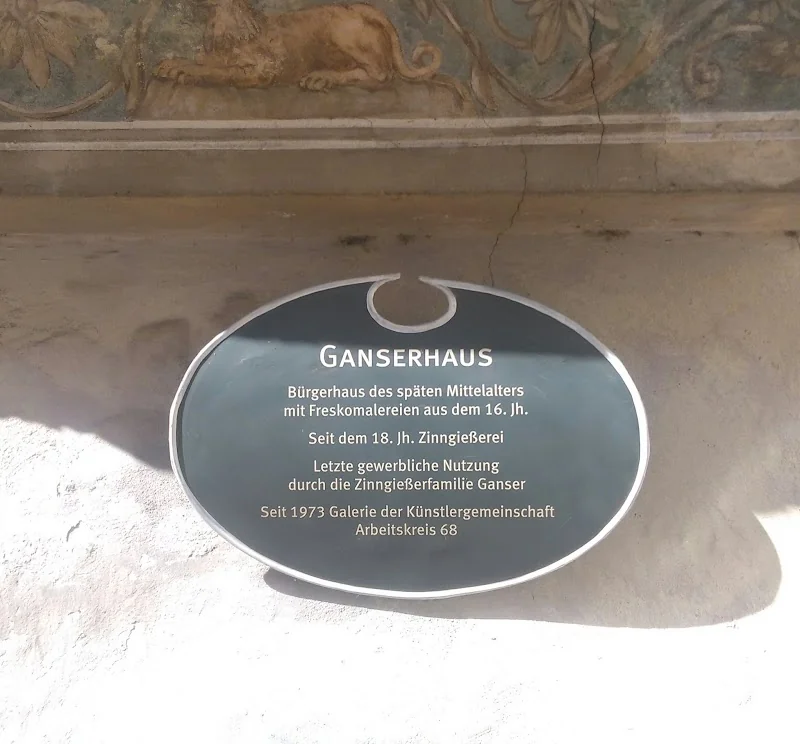
The history of the Ganserhaus goes far back before its current use as a gallery. AK68 describes the building as a house with a historical core dating back to the 14th century and also refers to the important year 1555 for the facade, which likely marks a renovation or reconstruction. The city of Wasserburg adds that the bourgeois house, named after its last private owners, was restored by AK68 between 1970 and 1977 and has since served as a gallery with several artist studios. Thus, the house connects several layers of time: medieval substance, early modern facade design, bourgeois usage history, and contemporary cultural work. It is precisely these depth layers that make the location so exciting for visitors. ([ak68.org](https://www.ak68.org/ganserhaus))
The ownership history is also remarkable. According to AK68, the building served as a pewter foundry for over 250 years until 1970. Later owners such as Franz Seift, Adam Seiff, Franz Ganser, Anna Ganser, and Annie Ganser represent a long line of craftsmanship before the art association acquired the house in 1970. The restoration of the south facade took place from 1971 to 1973; the interior restoration largely remained in the original room layout until early 1977. For visitors, this is more than a historical addition: it explains why the rooms still have a special character today and why art does not hang neutrally here but interacts with walls, vaults, and wooden ceilings. ([ak68.org](https://www.ak68.org/ganserhaus))
The location in Schmidzeile is also historically charged. The street rises towards the castle and is one of the historically early documented street names after the city's reconstruction following the fire of 1339. This urban embedding makes the Ganserhaus so strong: it is not somewhere in an anonymous cultural quarter but part of a grown old town with clear topography and visible history. The facade with its two bay windows and the uncovered painting from the 16th century tells this story from the outside. Therefore, the Ganserhaus is not only relevant for search queries about AK68, gallery, and art exhibition but is actually the key to understanding the entire association profile. ([ak68.org](https://www.ak68.org/ganserhaus))
Exhibitions, Studios, and Contemporary Art
The core content of the AK68 Gallery in Ganserhaus is contemporary art. The city of Wasserburg explicitly describes the gallery as the domicile of the artist community Working Group 68, whose task is to promote, exhibit, and stimulate a continuous dialogue about art. Regularly, special exhibitions of renowned artists are shown there. This is important for SEO logic because it positions the space not as a mere event venue but as a genuine art place. The gallery thus aligns with art associations that bring together regional, national, and international positions and aim not only to entertain the audience but also to introduce them to contemporary art. ([wasserburg.de](https://www.wasserburg.de/ganserhaus?utm_source=openai))
AK68 emphasizes on its program pages that the house offers artists a special challenge: the artworks should enter into a dialogue with the different spatial conditions. This is often the appeal for visitors. Unlike in standardized white cube spaces, every exhibition here is shaped by the architecture. This interaction is not just an aesthetic detail but part of the curatorial concept. Exhibitions in Ganserhaus often function particularly intensely because they are thought of as site-specific. In addition, there are member exhibitions, solo exhibitions, and special formats that show that AK68 does not only offer a one-time annual highlight but a continuous program. ([ak68.org](https://www.ak68.org/ganserhaus))
The connection between local and regional positions is also clearly visible. The association states in its history that exhibitions of regionally and nationally active artists are regularly on display in the gallery in Ganserhaus. This is crucial for the perception of the place because AK68 thus does not appear as a purely local hobby association but as a serious art actor with professional aspirations. For those searching for art exhibition wasserburg or contemporary art wasserburg, this combination is particularly interesting. The gallery in Ganserhaus is therefore not just a house for images but a place where art becomes visible, debatable, and publicly experienceable. ([ak68.org](https://www.ak68.org/verein))
Directions, Parking, and Current Visitor Information
The address of the Ganserhaus is Schmidzeile 8 in Wasserburg am Inn. Schmidzeile is a street that rises westward towards the castle and is one of the historically early documented street names of the city. For visitors, this location is ideal because it is located in the middle of the old town, and many paths are reachable on foot from there. At the same time, the current situation is important: due to the renovation of the Ganserhaus, the gallery is currently located in the former police station at Kaspar-Aiblinger-Platz 5. Therefore, anyone wanting to visit the AK68 Gallery today should not only know the historical address but also consider the temporary exhibition location. ([ak68.org](https://www.ak68.org/ganserhaus))
When it comes to parking, the city of Wasserburg points to two parking garages directly at the edge of the old town. There, visitors can park for up to four hours for free; beyond that, a daily flat rate of 1.50 euros applies. For an old town location, this is practical and attractive, especially if one wants to visit not only the gallery but also other sights, cafes, or the entire historic city center. Additionally, the city points out that the city center can also be easily reached by train and bus. For search queries like parking old town wasserburg or directions wasserburg old town, these are the central practical information because they make the visit actually planable. ([wasserburg.de](https://www.wasserburg.de/einkaufen))
The surroundings of the gallery are part of the special old town experience. The Wasserburg old town is under ensemble protection and is described by the city as a first-rate sight. This means: even the way to the gallery is a cultural walk through a historically dense urban landscape. Whether coming to the current alternative address or later back to the renovated Ganserhaus, one always moves in an environment shaped by urban history, trade, art, and civic architecture. For this reason, it is worthwhile to think of the gallery in connection with the old town and not just as an isolated destination. ([wasserburg.de](https://www.wasserburg.de/de/tourismus-freizeit/wasserburg-erleben/sehenswuerdigkeiten/sehenswuerdigkeiten-altstadt/))
Sculpture Path, Youth, and Cultural Significance
AK68 is more than just the gallery in Ganserhaus. The association is also the sponsor of the sculpture path along the Inndamm around the Wasserburg Inn loop, and this significantly expands its profile. According to the AK68 context, the sculpture path was created in 1988 for the 20th anniversary of the association and is now an important part of the city's public art offerings. This connection between indoor gallery and art in public space is culturally strategic because it addresses different audience groups: people who specifically go to an exhibition and those who come across art in everyday life. For those searching for sculpture path wasserburg, this is a direct indication of the breadth of the AK68 offering. ([ak68.org](https://www.ak68.org/skulpturenweg?utm_source=openai))
Additionally, the association has a strong focus on youth. AK68 explicitly names the promotion of young art as an important goal and awards a prize for young art at the Great Art Exhibition. Member exhibitions and the inclusion of students and pupils show that the association is not a closed tradition island but actively oriented towards the future. This is crucial for the perception of the gallery in Ganserhaus because it transforms a historical house into a place where new artistic positions receive a stage. The gallery thus connects preservation and development, creating a strong profile in today's cultural landscape. ([ak68.org](https://www.ak68.org/vision?utm_source=openai))
For this reason, the AK68 Gallery in Ganserhaus is so important for Wasserburg. It represents a local art community that has grown since 1968, continuously evolves, and makes the city visible far beyond the region with its program. Art is not only shown here in rooms but is placed in an urban context that links historical architecture, public spaces, and changing exhibitions. Therefore, those searching for ak68, gallery in ganserhaus, or images will encounter a place with substance: a bourgeois house with a long history, an art association with a clear vision, and a gallery that draws its significance precisely from the interplay between tradition and present. ([ak68.org](https://www.ak68.org/verein))
Sources:
Show moreShow less
AK68 Gallery in Ganserhaus | Art Exhibition & Photos
The AK68 Gallery in Ganserhaus is one of those places where Wasserburg am Inn shows its strongest cultural side: historical, independent, and at the same time open to contemporary art. The house at Schmidzeile 8 has been closely associated with the Working Group 68 for decades, which not only exhibits here but also makes art visible, conveys it, and extends it into public space. Those looking for photos, images, or information about the gallery quickly come across a building with a distinctive facade, a long history of use, and an unusual interplay of medieval roots, bourgeois architectural history, and contemporary art practice. Today, the gallery is temporarily located in the former police station at Kaspar-Aiblinger-Platz 5 due to the renovation of the Ganserhaus, but it remains the same art center of AK68 in terms of content and institution. It is precisely this mixture of place, history, and present that makes it appealing. ([wasserburg.de](https://www.wasserburg.de/ganserhaus?utm_source=openai))
AK68 and the Great Art Exhibition
To understand the AK68 Gallery in Ganserhaus, one must also consider the Great Art Exhibition. Since the founding of the Working Group 68, it has been the most visible format of the association and continues to shape the cultural profile of Wasserburg today. AK68 describes the exhibition as an annual, juried organized exhibition that traditionally takes place in the town hall and in the Ganserhaus; in the current phase, the Old Police Station is also included. This makes the GKA a format that is not only known locally but also charges the old town spatially and atmospherically with art. The great strength lies in the fact that not only finished hangings are presented here, but a lively art process that connects submissions, jury, setup, and exhibition concept. ([ak68.org](https://www.ak68.org/grosse-kunstausstellung))
AK68 itself sees itself as an association of artists who want to show, make visible, and convey art. This attitude runs through all program work: from member and solo exhibitions to the large annual exhibition, which, according to the association's history, began even before the official founding and soon became a fixed institution. Particularly interesting is that the house in Schmidzeile does not function as a static exhibition space but as part of a larger cultural-historical ensemble. The Ganserhaus and the town hall complex enter into a dialogue during the GKA that is immediately palpable for visitors. Precisely for this reason, the house is well suited as an SEO topic for search queries like ak68 art exhibition or ak68 great art exhibition: it is not just about a building, but about an institutionally grown art culture. ([ak68.org](https://www.ak68.org/verein))
In 2025 and 2026, the Great Art Exhibition will remain a central focal point. The AK68 pages mention the period from July 25 to August 23, 2026, for 2026 and describe the submission as a juried process with clear deadlines and rules. This is important because it shows that the gallery is not just an exhibition space but an active production site for art in Wasserburg. In the association's communication, it is also repeatedly implied that the Great Art Exhibition is more than a classic group show: it is an event with a festival character that extends across various spaces and thus involves the city as a whole. Therefore, those looking for programs, exhibitions, or photos ultimately land at a network of art, public, and urban architecture. ([ak68.org](https://www.ak68.org/grosse-kunstausstellung))
Photos and Images of the Gallery in Ganserhaus
The search for photos and images related to the AK68 Gallery in Ganserhaus is no coincidence, as the house is extremely photogenic. Its facade with two bay windows, the newly uncovered painting, and its location in the old town make it a striking motif that clearly differs from many other gallery buildings. The city of Wasserburg describes the building as a restored bourgeois house with several artist studios, and this mixture of historical surface and vibrant use creates strong visual stimuli. For image searches, this is important: it is not just about an interior photo, but about a house that itself acts like an exhibition object. When one sees the gallery, one also sees architectural history, urban history, and art history in one image. ([wasserburg.de](https://www.wasserburg.de/de/tourismus-freizeit/wasserburg-erleben/sehenswuerdigkeiten/sehenswuerdigkeiten-altstadt/))
On the official pages of the city and AK68, image motifs and image fields are integrated that emphasize the character of the house. This ranges from the iconic exterior view to the gallery view to event and exhibition pages, each of which uses image-related content. For the search intent ak68 gallery in ganserhaus images, this is particularly relevant because the images do not stand alone but are always placed in the context of an active art scene. The gallery is not a museum with a static collection but a place of changing presentations where images, objects, installations, and spatial arrangements compete or complement each other. This creates motifs that are interesting for both visitors and the press. ([wasserburg.de](https://www.wasserburg.de/ganserhaus?utm_source=openai))
Those wondering where the best motifs are usually find them at exactly the spots that make the building special: at the bay windows, at the historically reminiscent wall surfaces, at the finely structured facade, and in the exhibition rooms that force a dialogue between art and space. AK68 itself points out that the characteristics of the house prompt exhibiting artists to relate their works to the spatial conditions. This is also crucial for photos, as this spatial tension is visually immediately palpable. Thus, a simple search term like photos quickly becomes a complex image of place, architecture, and art practice. ([ak68.org](https://www.ak68.org/ganserhaus))
History of the Ganserhaus at Schmidzeile 8
The history of the Ganserhaus goes far back before its current use as a gallery. AK68 describes the building as a house with a historical core dating back to the 14th century and also refers to the important year 1555 for the facade, which likely marks a renovation or reconstruction. The city of Wasserburg adds that the bourgeois house, named after its last private owners, was restored by AK68 between 1970 and 1977 and has since served as a gallery with several artist studios. Thus, the house connects several layers of time: medieval substance, early modern facade design, bourgeois usage history, and contemporary cultural work. It is precisely these depth layers that make the location so exciting for visitors. ([ak68.org](https://www.ak68.org/ganserhaus))
The ownership history is also remarkable. According to AK68, the building served as a pewter foundry for over 250 years until 1970. Later owners such as Franz Seift, Adam Seiff, Franz Ganser, Anna Ganser, and Annie Ganser represent a long line of craftsmanship before the art association acquired the house in 1970. The restoration of the south facade took place from 1971 to 1973; the interior restoration largely remained in the original room layout until early 1977. For visitors, this is more than a historical addition: it explains why the rooms still have a special character today and why art does not hang neutrally here but interacts with walls, vaults, and wooden ceilings. ([ak68.org](https://www.ak68.org/ganserhaus))
The location in Schmidzeile is also historically charged. The street rises towards the castle and is one of the historically early documented street names after the city's reconstruction following the fire of 1339. This urban embedding makes the Ganserhaus so strong: it is not somewhere in an anonymous cultural quarter but part of a grown old town with clear topography and visible history. The facade with its two bay windows and the uncovered painting from the 16th century tells this story from the outside. Therefore, the Ganserhaus is not only relevant for search queries about AK68, gallery, and art exhibition but is actually the key to understanding the entire association profile. ([ak68.org](https://www.ak68.org/ganserhaus))
Exhibitions, Studios, and Contemporary Art
The core content of the AK68 Gallery in Ganserhaus is contemporary art. The city of Wasserburg explicitly describes the gallery as the domicile of the artist community Working Group 68, whose task is to promote, exhibit, and stimulate a continuous dialogue about art. Regularly, special exhibitions of renowned artists are shown there. This is important for SEO logic because it positions the space not as a mere event venue but as a genuine art place. The gallery thus aligns with art associations that bring together regional, national, and international positions and aim not only to entertain the audience but also to introduce them to contemporary art. ([wasserburg.de](https://www.wasserburg.de/ganserhaus?utm_source=openai))
AK68 emphasizes on its program pages that the house offers artists a special challenge: the artworks should enter into a dialogue with the different spatial conditions. This is often the appeal for visitors. Unlike in standardized white cube spaces, every exhibition here is shaped by the architecture. This interaction is not just an aesthetic detail but part of the curatorial concept. Exhibitions in Ganserhaus often function particularly intensely because they are thought of as site-specific. In addition, there are member exhibitions, solo exhibitions, and special formats that show that AK68 does not only offer a one-time annual highlight but a continuous program. ([ak68.org](https://www.ak68.org/ganserhaus))
The connection between local and regional positions is also clearly visible. The association states in its history that exhibitions of regionally and nationally active artists are regularly on display in the gallery in Ganserhaus. This is crucial for the perception of the place because AK68 thus does not appear as a purely local hobby association but as a serious art actor with professional aspirations. For those searching for art exhibition wasserburg or contemporary art wasserburg, this combination is particularly interesting. The gallery in Ganserhaus is therefore not just a house for images but a place where art becomes visible, debatable, and publicly experienceable. ([ak68.org](https://www.ak68.org/verein))
Directions, Parking, and Current Visitor Information
The address of the Ganserhaus is Schmidzeile 8 in Wasserburg am Inn. Schmidzeile is a street that rises westward towards the castle and is one of the historically early documented street names of the city. For visitors, this location is ideal because it is located in the middle of the old town, and many paths are reachable on foot from there. At the same time, the current situation is important: due to the renovation of the Ganserhaus, the gallery is currently located in the former police station at Kaspar-Aiblinger-Platz 5. Therefore, anyone wanting to visit the AK68 Gallery today should not only know the historical address but also consider the temporary exhibition location. ([ak68.org](https://www.ak68.org/ganserhaus))
When it comes to parking, the city of Wasserburg points to two parking garages directly at the edge of the old town. There, visitors can park for up to four hours for free; beyond that, a daily flat rate of 1.50 euros applies. For an old town location, this is practical and attractive, especially if one wants to visit not only the gallery but also other sights, cafes, or the entire historic city center. Additionally, the city points out that the city center can also be easily reached by train and bus. For search queries like parking old town wasserburg or directions wasserburg old town, these are the central practical information because they make the visit actually planable. ([wasserburg.de](https://www.wasserburg.de/einkaufen))
The surroundings of the gallery are part of the special old town experience. The Wasserburg old town is under ensemble protection and is described by the city as a first-rate sight. This means: even the way to the gallery is a cultural walk through a historically dense urban landscape. Whether coming to the current alternative address or later back to the renovated Ganserhaus, one always moves in an environment shaped by urban history, trade, art, and civic architecture. For this reason, it is worthwhile to think of the gallery in connection with the old town and not just as an isolated destination. ([wasserburg.de](https://www.wasserburg.de/de/tourismus-freizeit/wasserburg-erleben/sehenswuerdigkeiten/sehenswuerdigkeiten-altstadt/))
Sculpture Path, Youth, and Cultural Significance
AK68 is more than just the gallery in Ganserhaus. The association is also the sponsor of the sculpture path along the Inndamm around the Wasserburg Inn loop, and this significantly expands its profile. According to the AK68 context, the sculpture path was created in 1988 for the 20th anniversary of the association and is now an important part of the city's public art offerings. This connection between indoor gallery and art in public space is culturally strategic because it addresses different audience groups: people who specifically go to an exhibition and those who come across art in everyday life. For those searching for sculpture path wasserburg, this is a direct indication of the breadth of the AK68 offering. ([ak68.org](https://www.ak68.org/skulpturenweg?utm_source=openai))
Additionally, the association has a strong focus on youth. AK68 explicitly names the promotion of young art as an important goal and awards a prize for young art at the Great Art Exhibition. Member exhibitions and the inclusion of students and pupils show that the association is not a closed tradition island but actively oriented towards the future. This is crucial for the perception of the gallery in Ganserhaus because it transforms a historical house into a place where new artistic positions receive a stage. The gallery thus connects preservation and development, creating a strong profile in today's cultural landscape. ([ak68.org](https://www.ak68.org/vision?utm_source=openai))
For this reason, the AK68 Gallery in Ganserhaus is so important for Wasserburg. It represents a local art community that has grown since 1968, continuously evolves, and makes the city visible far beyond the region with its program. Art is not only shown here in rooms but is placed in an urban context that links historical architecture, public spaces, and changing exhibitions. Therefore, those searching for ak68, gallery in ganserhaus, or images will encounter a place with substance: a bourgeois house with a long history, an art association with a clear vision, and a gallery that draws its significance precisely from the interplay between tradition and present. ([ak68.org](https://www.ak68.org/verein))
Sources:
AK68 Gallery in Ganserhaus | Art Exhibition & Photos
The AK68 Gallery in Ganserhaus is one of those places where Wasserburg am Inn shows its strongest cultural side: historical, independent, and at the same time open to contemporary art. The house at Schmidzeile 8 has been closely associated with the Working Group 68 for decades, which not only exhibits here but also makes art visible, conveys it, and extends it into public space. Those looking for photos, images, or information about the gallery quickly come across a building with a distinctive facade, a long history of use, and an unusual interplay of medieval roots, bourgeois architectural history, and contemporary art practice. Today, the gallery is temporarily located in the former police station at Kaspar-Aiblinger-Platz 5 due to the renovation of the Ganserhaus, but it remains the same art center of AK68 in terms of content and institution. It is precisely this mixture of place, history, and present that makes it appealing. ([wasserburg.de](https://www.wasserburg.de/ganserhaus?utm_source=openai))
AK68 and the Great Art Exhibition
To understand the AK68 Gallery in Ganserhaus, one must also consider the Great Art Exhibition. Since the founding of the Working Group 68, it has been the most visible format of the association and continues to shape the cultural profile of Wasserburg today. AK68 describes the exhibition as an annual, juried organized exhibition that traditionally takes place in the town hall and in the Ganserhaus; in the current phase, the Old Police Station is also included. This makes the GKA a format that is not only known locally but also charges the old town spatially and atmospherically with art. The great strength lies in the fact that not only finished hangings are presented here, but a lively art process that connects submissions, jury, setup, and exhibition concept. ([ak68.org](https://www.ak68.org/grosse-kunstausstellung))
AK68 itself sees itself as an association of artists who want to show, make visible, and convey art. This attitude runs through all program work: from member and solo exhibitions to the large annual exhibition, which, according to the association's history, began even before the official founding and soon became a fixed institution. Particularly interesting is that the house in Schmidzeile does not function as a static exhibition space but as part of a larger cultural-historical ensemble. The Ganserhaus and the town hall complex enter into a dialogue during the GKA that is immediately palpable for visitors. Precisely for this reason, the house is well suited as an SEO topic for search queries like ak68 art exhibition or ak68 great art exhibition: it is not just about a building, but about an institutionally grown art culture. ([ak68.org](https://www.ak68.org/verein))
In 2025 and 2026, the Great Art Exhibition will remain a central focal point. The AK68 pages mention the period from July 25 to August 23, 2026, for 2026 and describe the submission as a juried process with clear deadlines and rules. This is important because it shows that the gallery is not just an exhibition space but an active production site for art in Wasserburg. In the association's communication, it is also repeatedly implied that the Great Art Exhibition is more than a classic group show: it is an event with a festival character that extends across various spaces and thus involves the city as a whole. Therefore, those looking for programs, exhibitions, or photos ultimately land at a network of art, public, and urban architecture. ([ak68.org](https://www.ak68.org/grosse-kunstausstellung))
Photos and Images of the Gallery in Ganserhaus
The search for photos and images related to the AK68 Gallery in Ganserhaus is no coincidence, as the house is extremely photogenic. Its facade with two bay windows, the newly uncovered painting, and its location in the old town make it a striking motif that clearly differs from many other gallery buildings. The city of Wasserburg describes the building as a restored bourgeois house with several artist studios, and this mixture of historical surface and vibrant use creates strong visual stimuli. For image searches, this is important: it is not just about an interior photo, but about a house that itself acts like an exhibition object. When one sees the gallery, one also sees architectural history, urban history, and art history in one image. ([wasserburg.de](https://www.wasserburg.de/de/tourismus-freizeit/wasserburg-erleben/sehenswuerdigkeiten/sehenswuerdigkeiten-altstadt/))
On the official pages of the city and AK68, image motifs and image fields are integrated that emphasize the character of the house. This ranges from the iconic exterior view to the gallery view to event and exhibition pages, each of which uses image-related content. For the search intent ak68 gallery in ganserhaus images, this is particularly relevant because the images do not stand alone but are always placed in the context of an active art scene. The gallery is not a museum with a static collection but a place of changing presentations where images, objects, installations, and spatial arrangements compete or complement each other. This creates motifs that are interesting for both visitors and the press. ([wasserburg.de](https://www.wasserburg.de/ganserhaus?utm_source=openai))
Those wondering where the best motifs are usually find them at exactly the spots that make the building special: at the bay windows, at the historically reminiscent wall surfaces, at the finely structured facade, and in the exhibition rooms that force a dialogue between art and space. AK68 itself points out that the characteristics of the house prompt exhibiting artists to relate their works to the spatial conditions. This is also crucial for photos, as this spatial tension is visually immediately palpable. Thus, a simple search term like photos quickly becomes a complex image of place, architecture, and art practice. ([ak68.org](https://www.ak68.org/ganserhaus))
History of the Ganserhaus at Schmidzeile 8
The history of the Ganserhaus goes far back before its current use as a gallery. AK68 describes the building as a house with a historical core dating back to the 14th century and also refers to the important year 1555 for the facade, which likely marks a renovation or reconstruction. The city of Wasserburg adds that the bourgeois house, named after its last private owners, was restored by AK68 between 1970 and 1977 and has since served as a gallery with several artist studios. Thus, the house connects several layers of time: medieval substance, early modern facade design, bourgeois usage history, and contemporary cultural work. It is precisely these depth layers that make the location so exciting for visitors. ([ak68.org](https://www.ak68.org/ganserhaus))
The ownership history is also remarkable. According to AK68, the building served as a pewter foundry for over 250 years until 1970. Later owners such as Franz Seift, Adam Seiff, Franz Ganser, Anna Ganser, and Annie Ganser represent a long line of craftsmanship before the art association acquired the house in 1970. The restoration of the south facade took place from 1971 to 1973; the interior restoration largely remained in the original room layout until early 1977. For visitors, this is more than a historical addition: it explains why the rooms still have a special character today and why art does not hang neutrally here but interacts with walls, vaults, and wooden ceilings. ([ak68.org](https://www.ak68.org/ganserhaus))
The location in Schmidzeile is also historically charged. The street rises towards the castle and is one of the historically early documented street names after the city's reconstruction following the fire of 1339. This urban embedding makes the Ganserhaus so strong: it is not somewhere in an anonymous cultural quarter but part of a grown old town with clear topography and visible history. The facade with its two bay windows and the uncovered painting from the 16th century tells this story from the outside. Therefore, the Ganserhaus is not only relevant for search queries about AK68, gallery, and art exhibition but is actually the key to understanding the entire association profile. ([ak68.org](https://www.ak68.org/ganserhaus))
Exhibitions, Studios, and Contemporary Art
The core content of the AK68 Gallery in Ganserhaus is contemporary art. The city of Wasserburg explicitly describes the gallery as the domicile of the artist community Working Group 68, whose task is to promote, exhibit, and stimulate a continuous dialogue about art. Regularly, special exhibitions of renowned artists are shown there. This is important for SEO logic because it positions the space not as a mere event venue but as a genuine art place. The gallery thus aligns with art associations that bring together regional, national, and international positions and aim not only to entertain the audience but also to introduce them to contemporary art. ([wasserburg.de](https://www.wasserburg.de/ganserhaus?utm_source=openai))
AK68 emphasizes on its program pages that the house offers artists a special challenge: the artworks should enter into a dialogue with the different spatial conditions. This is often the appeal for visitors. Unlike in standardized white cube spaces, every exhibition here is shaped by the architecture. This interaction is not just an aesthetic detail but part of the curatorial concept. Exhibitions in Ganserhaus often function particularly intensely because they are thought of as site-specific. In addition, there are member exhibitions, solo exhibitions, and special formats that show that AK68 does not only offer a one-time annual highlight but a continuous program. ([ak68.org](https://www.ak68.org/ganserhaus))
The connection between local and regional positions is also clearly visible. The association states in its history that exhibitions of regionally and nationally active artists are regularly on display in the gallery in Ganserhaus. This is crucial for the perception of the place because AK68 thus does not appear as a purely local hobby association but as a serious art actor with professional aspirations. For those searching for art exhibition wasserburg or contemporary art wasserburg, this combination is particularly interesting. The gallery in Ganserhaus is therefore not just a house for images but a place where art becomes visible, debatable, and publicly experienceable. ([ak68.org](https://www.ak68.org/verein))
Directions, Parking, and Current Visitor Information
The address of the Ganserhaus is Schmidzeile 8 in Wasserburg am Inn. Schmidzeile is a street that rises westward towards the castle and is one of the historically early documented street names of the city. For visitors, this location is ideal because it is located in the middle of the old town, and many paths are reachable on foot from there. At the same time, the current situation is important: due to the renovation of the Ganserhaus, the gallery is currently located in the former police station at Kaspar-Aiblinger-Platz 5. Therefore, anyone wanting to visit the AK68 Gallery today should not only know the historical address but also consider the temporary exhibition location. ([ak68.org](https://www.ak68.org/ganserhaus))
When it comes to parking, the city of Wasserburg points to two parking garages directly at the edge of the old town. There, visitors can park for up to four hours for free; beyond that, a daily flat rate of 1.50 euros applies. For an old town location, this is practical and attractive, especially if one wants to visit not only the gallery but also other sights, cafes, or the entire historic city center. Additionally, the city points out that the city center can also be easily reached by train and bus. For search queries like parking old town wasserburg or directions wasserburg old town, these are the central practical information because they make the visit actually planable. ([wasserburg.de](https://www.wasserburg.de/einkaufen))
The surroundings of the gallery are part of the special old town experience. The Wasserburg old town is under ensemble protection and is described by the city as a first-rate sight. This means: even the way to the gallery is a cultural walk through a historically dense urban landscape. Whether coming to the current alternative address or later back to the renovated Ganserhaus, one always moves in an environment shaped by urban history, trade, art, and civic architecture. For this reason, it is worthwhile to think of the gallery in connection with the old town and not just as an isolated destination. ([wasserburg.de](https://www.wasserburg.de/de/tourismus-freizeit/wasserburg-erleben/sehenswuerdigkeiten/sehenswuerdigkeiten-altstadt/))
Sculpture Path, Youth, and Cultural Significance
AK68 is more than just the gallery in Ganserhaus. The association is also the sponsor of the sculpture path along the Inndamm around the Wasserburg Inn loop, and this significantly expands its profile. According to the AK68 context, the sculpture path was created in 1988 for the 20th anniversary of the association and is now an important part of the city's public art offerings. This connection between indoor gallery and art in public space is culturally strategic because it addresses different audience groups: people who specifically go to an exhibition and those who come across art in everyday life. For those searching for sculpture path wasserburg, this is a direct indication of the breadth of the AK68 offering. ([ak68.org](https://www.ak68.org/skulpturenweg?utm_source=openai))
Additionally, the association has a strong focus on youth. AK68 explicitly names the promotion of young art as an important goal and awards a prize for young art at the Great Art Exhibition. Member exhibitions and the inclusion of students and pupils show that the association is not a closed tradition island but actively oriented towards the future. This is crucial for the perception of the gallery in Ganserhaus because it transforms a historical house into a place where new artistic positions receive a stage. The gallery thus connects preservation and development, creating a strong profile in today's cultural landscape. ([ak68.org](https://www.ak68.org/vision?utm_source=openai))
For this reason, the AK68 Gallery in Ganserhaus is so important for Wasserburg. It represents a local art community that has grown since 1968, continuously evolves, and makes the city visible far beyond the region with its program. Art is not only shown here in rooms but is placed in an urban context that links historical architecture, public spaces, and changing exhibitions. Therefore, those searching for ak68, gallery in ganserhaus, or images will encounter a place with substance: a bourgeois house with a long history, an art association with a clear vision, and a gallery that draws its significance precisely from the interplay between tradition and present. ([ak68.org](https://www.ak68.org/verein))
Sources:
Upcoming Events
No events found
Frequently Asked Questions
Reviews
h3px1a
5. January 2026
Currently (Jan 2026 😀) still at the old police station at Kaspar-Aiblinger-Platz 5, but always worth a visit.
Mindful Change
24. August 2023
The venerable Ganserhaus is worth a visit on its own, but the annual GKA, the Great Art Exhibition, the member exhibition, and all the other varied, high-quality, diverse, and exciting projects throughout the year bring art in a very unpretentious, straightforward, and casual way. There’s something for everyone all year round. The gallery in Ganserhaus has a well-deserved, regionally recognized good reputation!
Ernst Michael Albertz
1. February 2020
Always good supplies, next to it: "Antiquariat Dr. Feurer! Also 5 stars. If you love books, check it out on Saturday.
Sylvia Hampel
7. March 2020
Great exhibitions. They don’t all have to appeal to me.
R. Wein
16. June 2022
Great exhibitions, diverse, cool, laid-back location