
Timm Ulrichs
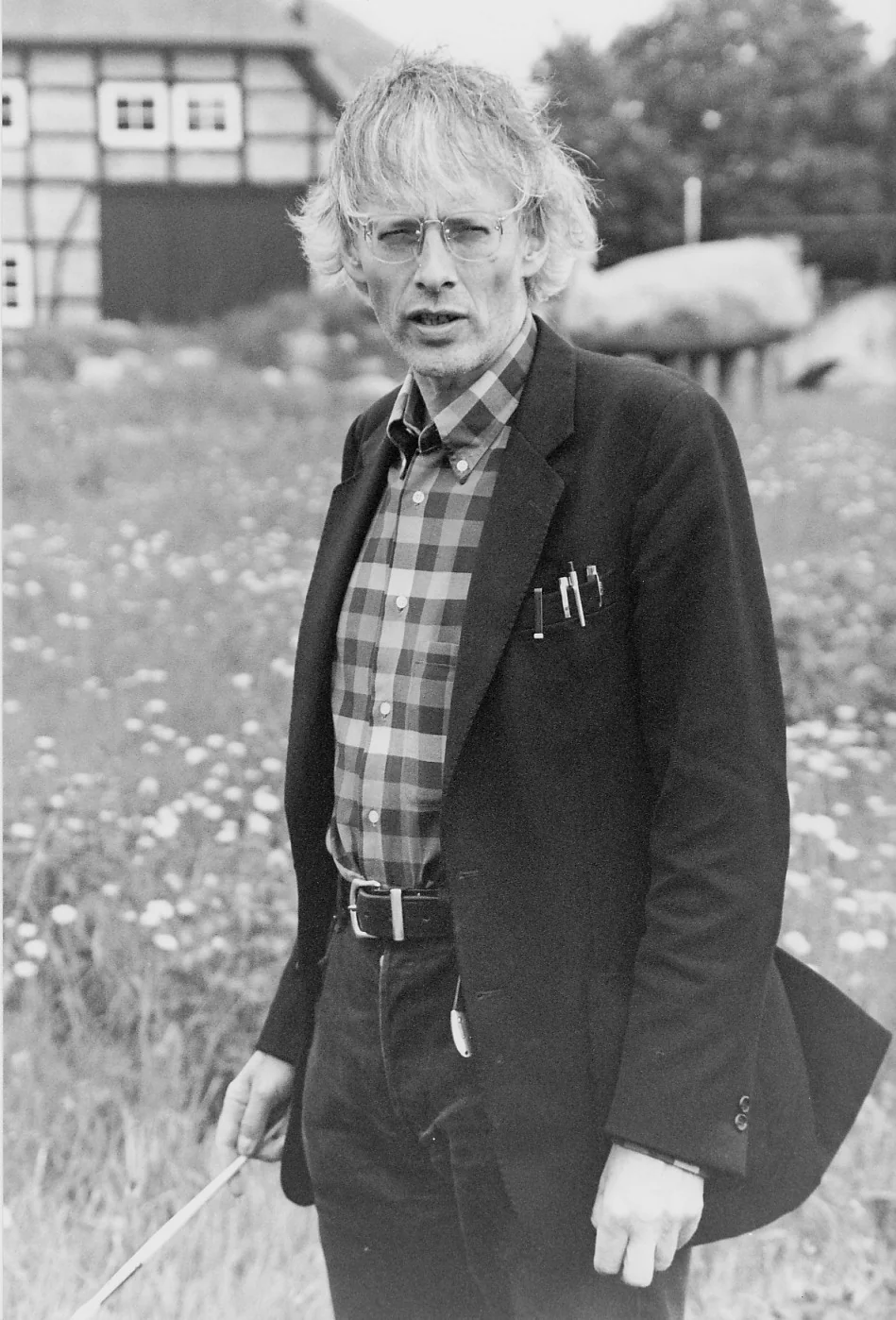
Image from Wikipedia
Image from Wikipedia
Timm Ulrichs: The Total Artist Who Redefined Art as a Way of Life
An Artist Between Concept, Provocation, and Radical Self-Presentation
Timm Ulrichs was one of the most idiosyncratic and influential figures in post-war German art. Born in 1940 in Berlin and dying in 2026 in Berlin, he developed an artistic practice that connected conceptual art, action, object art, language, and self-representation in extraordinary ways. His work revolves around the question of what art can be when the artist themselves becomes the material. ([de.wikipedia.org](https://de.wikipedia.org/wiki/Timm_Ulrichs))
Ulrichs saw himself early on as a "total artist" and shaped an attitude that extended far beyond individual works. His famous idea of inextricably intertwining art and life marked his entire career: he made himself the subject of art, worked with irony, contradiction, and linguistic precision, while simultaneously attacking the institutions of the art world. It is exactly this mixture of intellectual sharpness and performative radicality that still makes him so fascinating today. ([museum-joanneum.at](https://www.museum-joanneum.at/en/austrian-sculpture-park/discover/artists/ulrichs-timm))
Early Years, Education, and the Decision for Art
Ulrichs was born on March 31, 1940, in Berlin and initially grew up in Bremen. After finishing high school, he studied architecture at the Technical University of Hanover from 1959 to 1966 but dropped out after completing the preliminary diploma. Even during these years, he already worked as a freelance artist, making ends meet with side jobs and building his artistic practice with great persistence. ([munzinger.de](https://www.munzinger.de/register/portrait/biographien/Timm%20Ulrichs/00/18214))
This early phase already shows the fundamental pattern of his later work: Ulrichs did not wait for recognition but created the stage for himself. He founded the "Advertising Center for Total Art, Banalism, and Extemporization" in Hanover and spread his ideas through posters, postcards, leaflets, and print materials. In doing so, he developed not only an independent artistic language but also an early form of media self-marketing long before such strategies became commonplace in the art field. ([museum-joanneum.at](https://www.museum-joanneum.at/en/austrian-sculpture-park/discover/artists/ulrichs-timm))
The Breakthrough: The "First Living Artwork"
His internationally noted concept of art crystallized in the early 1960s. In 1961, Ulrichs declared himself the "first living artwork" and derived an art form in which his own body, biography, and presence became the artistic medium. In 1966, he exhibited for the first time in a gallery in Frankfurt after previously being denied participation in a jury-free exhibition in Berlin. ([museum-joanneum.at](https://www.museum-joanneum.at/en/austrian-sculpture-park/discover/artists/ulrichs-timm))
With this step, Ulrichs created one of the most consistent positions of conceptual art in the German-speaking world. His art was never just an illustration of a thought but the practical processing of an artistic principle. Whether as "Ego-Art," as action, or as text-based intervention: Ulrichs turned his own existence into a permanent art experiment and thereby shifted the boundaries between work, author, and performance. ([museum-joanneum.at](https://www.museum-joanneum.at/en/austrian-sculpture-park/discover/artists/ulrichs-timm))
Language, Paradox, and Total Art as an Artistic System
A central feature of his work is the playful yet highly reflective engagement with language. Ulrichs artistically employed tautologies, paradoxes, word games, anagrams, and palindromes, transforming language into plastic, installation, and form of thought. In his work, concepts and matter, semantics and objects, theory and gesture intersect. ([de.wikipedia.org](https://de.wikipedia.org/wiki/Timm_Ulrichs))
This formal openness was intertwined with his concept of "total art." For Ulrichs, this meant not merely versatility but an artistic mode of existence in which art, daily life, body, and public space intermingle. His historical significance lies precisely in this: he was among those artists who understood conceptual art not just as a style but as an attitude, enriching the art of the 20th century with radical self-questioning. ([museum-joanneum.at](https://www.museum-joanneum.at/en/austrian-sculpture-park/discover/artists/ulrichs-timm))
Body, Action, and the Staging of the Self
Ulrichs' work thrives on the tension between control and surrender. He integrated his own body into the art, allowing himself to be observed, measured, documented, and symbolically represented. The idea of the "living artwork" did not become a mere provocation for him but a permanent artistic method that intertwined self-image, perception, and public life. ([museum-joanneum.at](https://www.museum-joanneum.at/en/austrian-sculpture-park/discover/artists/ulrichs-timm))
Especially striking are those actions in which he demonstratively crossed the boundaries between art and reality. These include interventions where he staged himself as a blind museum visitor or commented ironically and sharply on the art world. The Ludwiggalerie aptly describes him as an artist who has incisively, biting, and humorously satirized norms, rules, and museum logics. ([ludwiggalerie.de](https://www.ludwiggalerie.de/en/siebzehn-kilo-kunst-timm-ulrichs-ein-nachruf/))
Public Space, Work Complexes, and Plastic Presence
Ulrichs was not restricted to exhibition spaces. He continuously worked in public spaces, with site-specific sculptures and installations visible in Magdeburg, Munich-Frottmaning, Antwerp, Recklinghausen, Bergkamen, Mülheim an der Ruhr, Sinsheim, Nordhorn, Essen, Waldenbuch, or Einbeck. These works show how consistently he understood urban space as a stage for thought. ([de.wikipedia.org](https://de.wikipedia.org/wiki/Timm_Ulrichs))
The works interconnect architectural placements, conceptual points, and spatial perception. Titles like "Earth Axis," "Sunken Village," "The Whole and the Parts," or "The Quadrature of the Circle" illustrate how deeply Ulrichs worked with language, topography, and metaphor. His sculptures are not just objects but signs of thought in space. ([de.wikipedia.org](https://de.wikipedia.org/wiki/Timm_Ulrichs))
Teaching, Recognition, and Art Historical Authority
Ulrichs was also influential as a teacher. From 1972 to 2005, he served as a professor at the Art Academy in Münster, having previously been a guest professor in Braunschweig. His academic work bolstered his authority as an artist who not only created but also sensitized an entire generation to conceptual thinking. ([museum-joanneum.at](https://www.museum-joanneum.at/en/austrian-sculpture-park/discover/artists/ulrichs-timm))
His work was recognized early on and repeatedly awarded. Honors include the promotion award for literature from the Lower Saxony Art Prize, the German Critics' Prize for Visual Arts, the Art Prize of the City of Nordhorn, the Karl Ernst Osthaus Prize, the Will-Grohmann Prize, and several other accolades. He was also represented at documenta 6 and was entered into the Golden Book of the City of Hanover in 2010. ([museum-joanneum.at](https://www.museum-joanneum.at/en/austrian-sculpture-park/discover/artists/ulrichs-timm))
Critical Reception and Cultural Influence
Art critics and major institutions have hailed Ulrichs as a pioneer of conceptual art. The Museum Joanneum describes him as a central representative of an art nourished by Neo-Dada, Schwitters, and Duchamp, while Artsy categorizes him as a radical extender of the concept of art. These attributions are no coincidence: Ulrichs combined intellectual rigor with humor and developed a visual language that brought together institutional critique and self-reflection in a rare way. ([museum-joanneum.at](https://www.museum-joanneum.at/en/austrian-sculpture-park/discover/artists/ulrichs-timm))
His impact extends far beyond individual works. The idea of making one's own life an artistic form resonates even in current performative, installative, and conceptual practices. Ulrichs stands in line with those artists who have broadened the meaning of art without diluting it. Precisely because he intertwined the seemingly banal, the ironic, and the philosophical so closely, his work remains a reference point for contemporary art. ([museum-joanneum.at](https://www.museum-joanneum.at/en/austrian-sculpture-park/discover/artists/ulrichs-timm))
Late Honors and the Legacy of an Uncomfortable Artist
Even in his later years, Ulrichs remained present. In 2024, the Bietigheim-Bissingen City Gallery dedicated the exhibition "Nothing but Theater" to him, and in 2026, the Ludwiggalerie published an obituary highlighting his lifelong critique of the art world and his performative energy. Such exhibitions and texts show that his work has not fossilized in museums but continues to be read as a living provocation. ([galerie.bietigheim-bissingen.de](https://galerie.bietigheim-bissingen.de/fileadmin/user_upload_galerie/events/ausstellungen/Timm_Ulrichs/Lehrerbriefulrichs.pdf?utm_source=openai))
Ulrichs died on April 29, 2026, in Berlin. His legacy lies in an art that does not decorate but thinks; does not console but questions; does not merely show but demands a stance. Precisely in this lies his lasting significance for German art history. ([de.wikipedia.org](https://de.wikipedia.org/wiki/Timm_Ulrichs?utm_source=openai))
Conclusion: Why Timm Ulrichs Remains Compelling Today
Timm Ulrichs is compelling because he understood art not as an object but as a principle of life. He connected conceptual art, action, language, body, and public intervention into a recognizable whole that intellectually challenges and sensually surprises. Those interested in radical art history, media criticism, and the great tradition of total art will find Ulrichs among the most consistent artistic thinkers of the 20th and early 21st centuries. ([museum-joanneum.at](https://www.museum-joanneum.at/en/austrian-sculpture-park/discover/artists/ulrichs-timm))
Anyone experiencing his works in a museum or in public space encounters not just a work but an attitude: art as existence, as contradiction, as play, and as a serious matter all at once. For this reason, it is worth continuing to discover Timm Ulrichs in exhibitions, documentaries, and contexts of his work. His oeuvre remains a pressing appeal to not passively view art but to take it seriously as a mental and societal force. ([museum-joanneum.at](https://www.museum-joanneum.at/en/austrian-sculpture-park/discover/artists/ulrichs-timm))
Official Channels of Timm Ulrichs:
- Instagram: No official profile found
- Facebook: No official profile found
- YouTube: No official profile found
- Spotify: No official profile found
- TikTok: No official profile found
Sources:
- Timm Ulrichs – Wikipedia: Image and text source. ([de.wikipedia.org](https://de.wikipedia.org/wiki/Timm_Ulrichs))
- Museum Joanneum – Timm Ulrichs. ([museum-joanneum.at](https://www.museum-joanneum.at/en/austrian-sculpture-park/discover/artists/ulrichs-timm))
- LUDWIGGALERIE Oberhausen – Seventeen Kilos of Art: Timm Ulrichs – An Obituary. ([ludwiggalerie.de](https://www.ludwiggalerie.de/en/siebzehn-kilo-kunst-timm-ulrichs-ein-nachruf/))
- Munzinger – Timm Ulrichs Biography. ([munzinger.de](https://www.munzinger.de/register/portrait/biographien/Timm%20Ulrichs/00/18214))
- Artsy – Timm Ulrichs About. ([artsy.net](https://www.artsy.net/artist/timm-ulrichs/about))
- Bietigheim-Bissingen City Gallery – Timm Ulrichs: Nothing but Theater. ([galerie.bietigheim-bissingen.de](https://galerie.bietigheim-bissingen.de/fileadmin/user_upload_galerie/events/ausstellungen/Timm_Ulrichs/Lehrerbriefulrichs.pdf?utm_source=openai))