
Michael Haydn
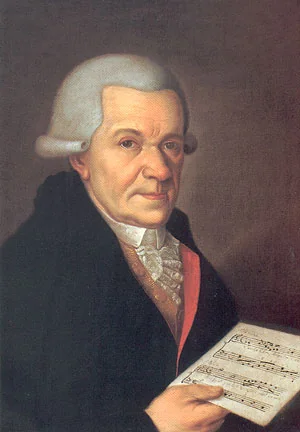
Image from Wikipedia
Image from Wikipedia
Michael Haydn – The Great Salzburg Master Between Church Music, Classicism, and Proximity to Mozart
An Underrated Classic Who Shaped Salzburg's Sound History
Johann Michael Haydn is one of those composers of the Viennese Classicism whose significance unfolds fully only upon closer listening. Born on September 14, 1737, in Rohrau and died on August 10, 1806, in Salzburg, he long stood in the shadow of his older brother Joseph Haydn, yet as a Salzburg church composer, organist, teacher, and instrumental composer, he shaped an entire era. His music combines liturgical austerity with melodic invention, formal clarity, and a distinctiveness that becomes ever more apparent in music history. (michaelhaydn.com)
Early Years: Education, Choral Art, and the Path to Vienna
Michael Haydn was born as the sixth child in a musically and artisanally inclined family. Like his brother Joseph, he received early musical impulses and arrived in Vienna at a young age, where he received his training as a choirboy at St. Stephen's. His exceptionally wide voice – described in sources as spanning three octaves – made him a striking figure in Vienna's music scene. At the same time, he independently studied counterpoint and composition, orienting himself to Johann Joseph Fux's Gradus ad Parnassum, a foundation of baroque compositional art that significantly shaped his later musical language. (encyclopedia.com)
Beginning of His Career in Hungary and Salzburg: Rising to Court Musician
In 1757, Haydn received his first significant position as music director for the Bishop of Großwardein. A few years later, he took a decisive career leap: in 1762, he became court musician and concertmaster for the Archbishop of Salzburg, Sigismund Schrattenbach. In Salzburg, he found the environment that would define his entire subsequent music career. There, he married Maria Magdalena Lipp in 1768, a singer in the archiepiscopal service, and became part of a cultural center where church music, court music, and bourgeois music culture were closely intertwined. (allmusic.com)
The Salzburg Years: Mozart, Official Duties, and Artistic Maturity
Michael Haydn worked in Salzburg for a total of 43 years and remained closely linked to the city throughout his life. Following the death of Anton Cajetan Adlgasser, he took over the position of principal organist at the Church of the Holy Trinity in 1777, and in 1781 he succeeded Mozart as cathedral organist. These positions made him a central figure in Salzburg's musical life. His proximity to Mozart was significant not only biographically but also musically: The Michael Haydn website emphasizes his influence on Mozart's work, and AllMusic also refers to the lasting impact of his music on Mozart, Schubert, and Weber. (michaelhaydn.com)
Compositional Profile: Sacred Depth and Secular Elegance
Haydn's work encompasses a remarkable span. Sources mention symphonies, concertos, chamber music, serenades, operas, scores for the university theater, male quartets, and a large amount of church music. Particularly noteworthy is his ability to connect the stile antico with more modern expressions. In his masses, he often concludes Gloria and Credo with fugues, while the instrumentation often remains purposefully reduced – an echo of the liturgical reforms of the time. Especially in sacred music, his mastery is evident in counterpoint technique, proportion, and liturgical appropriateness. (allmusic.com)
Church Music as a Major Achievement: Requiem, Masses, and Graduals
Michael Haydn had the greatest historical impact in the field of church music. His Requiem in C minor for Archbishop Schrattenbach from 1771 is considered one of his most famous works; sources even note that it may have served as a model for Mozart's similarly titled composition. In addition, there are masses, graduals, and the frequently sung German High Mass "Hier liegt vor Deiner Majestät," which holds a special place in German-speaking church music. Reception indicates that Haydn was not only a productive composer but also a pioneer of sacred classicism. (encyclopedia.com)
Instrumental and Chamber Music: An Underrated Wealth
Beyond his liturgical repertoire, Michael Haydn left behind substantial works. The sources mention around 40 symphonies, several violin concertos, flute concertos, a trumpet concerto, a horn concerto, chamber music, and numerous divertimenti, serenades, and dances. AllMusic and Encyclopedia.com highlight his stylistic versatility and note him as a composer who worked confidently with both older contrapuntal models and the modern idioms of the 18th century. The discography shows that his music is currently being rediscovered primarily in recordings of string quartets, sacred works, and concertante pieces. (encyclopedia.com)
Teacher, Mentor, Influential Figure: Mozart’s Silent Collaborator
Michael Haydn's cultural influence extends far beyond Salzburg. Sources cite him as a teacher of Carl Maria von Weber, Anton Diabelli, and Sigismund Neukomm. At the same time, several references emphasize his impact on Mozart and Schubert. This is precisely where part of his posthumous fame lies: Haydn was not a compositional lone wolf but a nexus of tradition and transmission. His music continued to have an effect in schools, churches, and monasteries and in the education of future generations, often without great public acclaim but with lasting historical resonance. (allmusic.com)
Critical Reception and Current Rediscovery
The critical reception describes Michael Haydn as a highly esteemed but long-underappreciated master. AllMusic speaks of a respected Salzburg composer whose music influenced Mozart, Schubert, and Weber, while the German Biography ranks him as one of the most significant musical personalities of Salzburg. One reason for his long marginalization was that many works did not appear in print during his lifetime and circulated only in handwritten copies. All the more remarkable is the current rediscovery: In 2024 and 2025, new recordings of his quartets, his requiem, and other works will be released. (allmusic.com)
Current Projects and Releases in 2024/2025
As Michael Haydn is a historical figure, there are no current projects in the contemporary sense. However, the relevance of his work is evident in the ongoing performance and recording of his music. AllMusic lists a recording of the Six String Quartets in 2024 and recordings of the Requiem Pro defuncto Archiepiscopo Sigismundo and the Missa Sancti Hieronymi in 2025; additionally, Naxos lists an album of Michael Haydn's sacred works in the Easter catalog for 2026. Thus, the presence of the composer lives on in concert programs, editions, and new recordings. (allmusic.com)
Conclusion: Why Michael Haydn Remains Fascinating to This Day
Michael Haydn is a composer of quiet greatness: not a mythological eccentric but a master of form, liturgy, and musical substance. His works open up a view of Salzburg as a musical laboratory of Classicism and show how closely intertwined church music, court culture, and compositional innovation were. Those who experience Michael Haydn live or in high-quality recordings discover a sound cosmos between discipline and expression, between tradition and invention. This is where his lasting fascination lies: in the art of transforming perceived restraint into enduring musical brilliance. (michaelhaydn.com)
Official Channels of Michael Haydn:
- Instagram: No official profile found
- Facebook: No official profile found
- YouTube: No official profile found
- Spotify: No official profile found
- TikTok: No official profile found