
Oberaudorf
Am Schloßberg, 83080 Oberaudorf, Deutschland
Auerburg Castle Ruin | History & View
The Auerburg Castle Ruin is one of the most prominent historical sites in Oberaudorf. Located high above the town on the Schlossberg, it combines medieval history, short hiking trails, and an extraordinary view of the Inn Valley and the Kaiser Mountains. Visitors to the Auerburg experience not a closed museum space, but an open monument site where wall remnants, rock, pathways, and landscape directly interact. This mixture makes the ruin interesting for history enthusiasts, walkers, families, and photography fans. The Auerburg was first explicitly mentioned in 1329, but the rock plateau was already settled in the Bronze Age; later, a castle with a caretaker's seat and district court developed here. After destruction and the blowing up of the facility, an impressive ruin remained, which is now accessible via a short ascent from the town. ([hdbg.eu](https://hdbg.eu/burgen/detail/burgruine-auerburg/61))
History of the Auerburg Castle Ruin in Oberaudorf
The historical depth of the Auerburg begins well before the actual castle period. The rock plateau was already settled in the Bronze Age, long before a stone castle complex was built in the High Middle Ages. This is a particularly exciting thought for many visitors: The current viewpoint is not only a medieval ruin but a place where people have utilized protection, overview, and strategic location for millennia. According to the House of Bavarian History, a first stone castle developed in the mid-12th century. The location on the rock was ideal, as it controlled the path through the Inn Valley and combined safety with visibility. At the latest in this phase, an exposed site became a politically and militarily important stronghold. The Auerburg exemplifies those Bavarian heights and rock castles that were built not only for representation but for very practical reasons. ([hdbg.eu](https://hdbg.eu/burgen/detail/burgruine-auerburg/61))
The written history of the Auerburg becomes more concrete in the 13th and 14th centuries. In 1247, the Bavarian dukes acquired the castle, and in 1329 it was first explicitly mentioned. Shortly before, it had been elevated to a caretaker's seat or the center of its own district court. Thus, the Auerburg was not only a fortress but also an administrative center. This dual function still gives it historical charm today: Castles were often centers of power in the Middle Ages, where rule, law, and military control overlapped. In 1388, the castle was restored after the conflicts of that time; later, a cloister, additional fortifications like a barbican, and new outbuildings were built below the castle. The facility thus became increasingly complex and defensible. At the same time, the construction history shows how castles changed over the centuries, adapted to new threats, and transformed their shape multiple times. ([hdbg.eu](https://hdbg.eu/burgen/detail/burgruine-auerburg/61))
In the late Middle Ages and early modern times, the Auerburg repeatedly fell into the whirlpool of regional conflicts. The House of Bavarian History mentions a siege in 1505 during the War of Succession of the Wittelsbachs, as well as a state of disrepair around 1620. In 1704, the castle was burned down by Austrian troops, in 1743 it was heavily damaged again by pandur mercenaries, and two years later it was blown up. This chain of destruction explains why no closed castle complex stands today, but rather an impressive landscape of ruins. For today's visitors, however, this is an advantage: The remaining wall sections, the lines of the rock, and the open topography allow one to sense the former grandeur rather than fully define it. From 1992 to 1998, restoration work was carried out that opened the facility to visitors and significantly improved access. Additionally, there is an exhibition room in the castle gate museum that further makes the history of the site visible. ([hdbg.eu](https://hdbg.eu/burgen/detail/burgruine-auerburg/61))
Access, Parking, and the Short Ascent to Schlossberg
The Auerburg Castle Ruin is not a remote high mountain ruin that can only be reached after a long tour. On the contrary: One of the major advantages is the short and easily understandable access from the town center of Oberaudorf. The regional tour description begins at the tourist information or the town hall square and initially passes by the church and the castle gate. The path then follows the marked route towards Schlossberg, crosses the main road, and ascends via a historic road. Thus, those visiting the Auerburg experience a small piece of local history on the way there, as the route connects the urban space with the historical castle hill. Along the way, there are a gate, a fork in the path, steps, and finally the bridge to the ruin. This sequence makes the ascent varied but not overwhelming. The region explicitly describes it as a short hike, family-friendly and culturally-historically shaped. ([chiemsee-alpenland.de](https://www.chiemsee-alpenland.de/entdecken/tourenportal/zur-ruine-auerburg-18dc78adc4))
For practical planning, parking is an important topic, as many visitors want to combine the ruin with a short walk or a small hike. The official website of the municipality mentions the Florianiberg parking lot on Florianibergstraße as a starting point. The tour notes from Chiemsee-Alpenland add that there are several parking spaces in the town and alternatively parking can also be done at Luegsteinsee. Those arriving by train can reach Oberaudorf via the route from Munich, Rosenheim, or Kufstein and continue on foot from there. Particularly pleasant is that the ascent is not only short but also well marked. The route description mentions green signposts labeled Schlossberg, and the region refers to a solid, clear route through the urban landscape. Therefore, a realistic time buffer of half a morning or afternoon is usually sufficient for the visit. Those who combine their stay with a museum, a meal, or a walk at Luegsteinsee can quickly have a whole day trip. ([tourismus-oberaudorf.de](https://www.tourismus-oberaudorf.de/ruine-auerburg/))
Photos and View: Why the Auerburg Ruin is So Photogenic
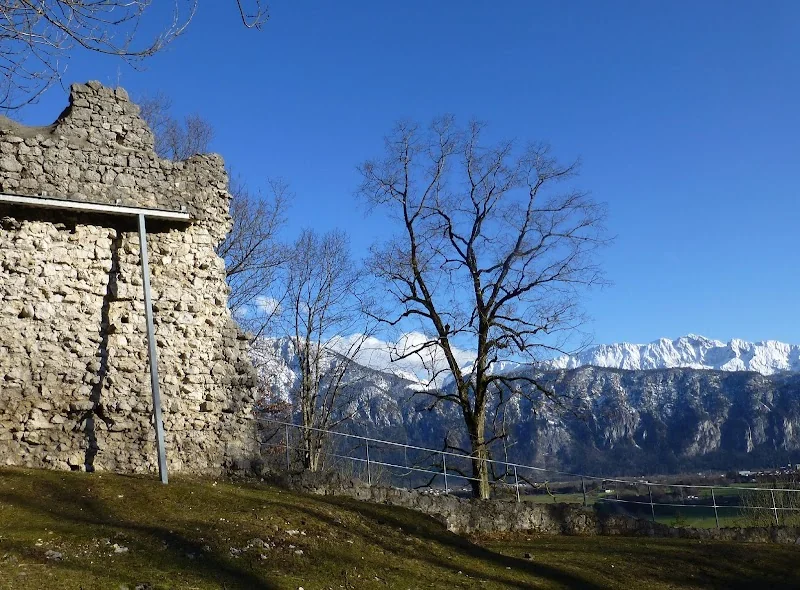
Those searching for photos of Auerburg Castle Ruin are actually looking for a very clear image motif: historical walls on a rock, with the town of Oberaudorf below and the mountain world of the Inn Valley behind. This constellation makes the Auerburg so photogenic. The ruin is located on the Schlossberg above the town, and the ascent is rewarded with a wide view over Oberaudorf and the Inn Valley. The tour description additionally emphasizes the view of the Kaiser Mountains and the Tyrolean neighboring mountains. This means: The Auerburg is not only a place for history enthusiasts but also a classic panorama and photo point. Depending on the time of day, the light on the stones, on the meadows on the slope, and on the distant mountains changes, resulting in very different photographic moods. Clear days with good visibility are particularly appealing because the contours of the landscape become clearly visible, and the ruin's exposed location is particularly pronounced. ([chiemsee-alpenland.de](https://www.chiemsee-alpenland.de/entdecken/tourenportal/zur-ruine-auerburg-18dc78adc4))
The view from above is also an important part of the historical experience. The Auerburg was once significant precisely because it provided control over paths and valley space. Today, visitors experience the same topography as a landscape image. This makes the site so strong: history and perspective coincide here. The House of Bavarian History describes the building stock as an isolated rock block surrounded by a multi-angled ring wall. From the northern front side, a powerful moat secured access, and a gatework with barbican protruded far in front. On the castle rock once stood a keep, kitchen, palas, and other building components. Even if much of this is only visible in remnants, this form of facility helps to read the ruin as a three-dimensional space. This is particularly interesting for photography fans because not only a single motif emerges but many sight axes: from the valley up to the castle, from the castle rock into the sky, and from the wall remnants into the open mountain landscape. Therefore, those visiting the Auerburg should not only capture the main motif but also the details of the stones, the lines of the rock, and the perspective beyond the edge. ([hdbg.eu](https://hdbg.eu/burgen/detail/burgruine-auerburg/61))
Castle Gate Museum and the Historical Circular Path Around the Auerburg
A special advantage of the Auerburg Castle Ruin is the Castle Gate Museum, which places the ruin in a larger local and historical context. The Audorf Museum in the castle gate is located in a historical late medieval castle gate that once controlled access to the Auerburg located above. Today, it is a local history museum of the municipality of Oberaudorf and conveys knowledge about geology, settlement of the Inn Valley, the Auerburg, the Inn shipping, the mountain shooters, and tourism in Oberaudorf. This thematic mix makes the visit valuable because the castle is not viewed in isolation but as part of a vibrant cultural landscape. Those interested in the Auerburg understand better through the museum why this place has been important for centuries: not only as a military point but also as part of transport, settlement, and regional identity. Thus, the museum does not merely complement the ruin; it deepens it. ([chiemsee-alpenland.de](https://www.chiemsee-alpenland.de/entdecken/alle-sehenswuerdigkeiten/audorfer-museum-im-burgtor-593665382b))
The museum visit can be particularly well combined with a circular path. The regional hiking route to the Auerburg leads from the town center up to the Schlossberg and back, while the Oberaudorf History Trail connects the Auerburg, Florianiberg, Luegsteinsee, and the Grafenloch cave. This creates an excursion that combines nature, history, and small local discoveries. Along the way, according to the tour description, there are information boards about the Auerburg and its history, and a look over the castle hill and the surrounding landscape is worthwhile at the top. The history trail is thus not only a sporty connection of points but a curated historical experience in the open air. Those who have more time can end the path at the Castle Gate Museum or start there before the ascent. This results in a visit that not only processes a single motif but connects multiple layers of the site: the medieval wall image, the local museum, the hiking route, and the geological and landscape embedding of Oberaudorf. ([chiemsee-alpenland.de](https://www.chiemsee-alpenland.de/entdecken/tourenportal/oberaudorfer-geschichtsweg-02548395cc))
Visiting Tips for the Auerburg Castle Ruin
No complicated preparations are necessary for visiting the Auerburg Castle Ruin, but a few simple practical considerations are needed. The region describes the path as a short hike with some steps, and the House of Bavarian History points out that the ruin is accessible via a comfortably climbable castle tower. At the same time, the tour description recommends sturdy footwear, which is sensible given the slope, the steps, and the historical path layout. Those traveling with children or who only have half a day will find here an ideal excursion point, as the ascent remains manageable and still provides a genuine sense of destination. The Auerburg is thus a beautiful example of a sight that is neither too large nor too small: it offers enough history for an intense visit without requiring a long mountain day. When the weather is clear, the view is particularly impressive, and on sunny days, the ruin quickly becomes a favorite spot for photos, short breaks, and views into the valley. ([hdbg.eu](https://hdbg.eu/burgen/detail/burgruine-auerburg/61))
Particularly interesting is the connection between accessibility and historical weight. The Auerburg is not a spectacularly restored grand building but a ruin that makes its history visible. This is precisely where its strength lies. Walking through the remnants of the walls, one sees not only stones but a condensed image of history: Bronze Age settlement, High Medieval castle, late medieval expansions, modern destructions, and finally the tourist development of the present. Additionally, the proximity to the town center of Oberaudorf makes it easy to integrate the visit into a larger walk, a museum stop, or a circular path. For many travelers, the combination of a short hike, history, and view is the actual reason why the Auerburg remains memorable. It is not a place for quick surface glances but for quiet, careful observation. Those who experience the ruin in the right light quickly understand why it counts among the defining landmarks of Oberaudorf and why it is repeatedly associated with photos, access, parking, and history in search queries. ([tourismus-oberaudorf.de](https://www.tourismus-oberaudorf.de/ruine-auerburg/))
Sources:
Mehr anzeigenWeniger anzeigen
Auerburg Castle Ruin | History & View
The Auerburg Castle Ruin is one of the most prominent historical sites in Oberaudorf. Located high above the town on the Schlossberg, it combines medieval history, short hiking trails, and an extraordinary view of the Inn Valley and the Kaiser Mountains. Visitors to the Auerburg experience not a closed museum space, but an open monument site where wall remnants, rock, pathways, and landscape directly interact. This mixture makes the ruin interesting for history enthusiasts, walkers, families, and photography fans. The Auerburg was first explicitly mentioned in 1329, but the rock plateau was already settled in the Bronze Age; later, a castle with a caretaker's seat and district court developed here. After destruction and the blowing up of the facility, an impressive ruin remained, which is now accessible via a short ascent from the town. ([hdbg.eu](https://hdbg.eu/burgen/detail/burgruine-auerburg/61))
History of the Auerburg Castle Ruin in Oberaudorf
The historical depth of the Auerburg begins well before the actual castle period. The rock plateau was already settled in the Bronze Age, long before a stone castle complex was built in the High Middle Ages. This is a particularly exciting thought for many visitors: The current viewpoint is not only a medieval ruin but a place where people have utilized protection, overview, and strategic location for millennia. According to the House of Bavarian History, a first stone castle developed in the mid-12th century. The location on the rock was ideal, as it controlled the path through the Inn Valley and combined safety with visibility. At the latest in this phase, an exposed site became a politically and militarily important stronghold. The Auerburg exemplifies those Bavarian heights and rock castles that were built not only for representation but for very practical reasons. ([hdbg.eu](https://hdbg.eu/burgen/detail/burgruine-auerburg/61))
The written history of the Auerburg becomes more concrete in the 13th and 14th centuries. In 1247, the Bavarian dukes acquired the castle, and in 1329 it was first explicitly mentioned. Shortly before, it had been elevated to a caretaker's seat or the center of its own district court. Thus, the Auerburg was not only a fortress but also an administrative center. This dual function still gives it historical charm today: Castles were often centers of power in the Middle Ages, where rule, law, and military control overlapped. In 1388, the castle was restored after the conflicts of that time; later, a cloister, additional fortifications like a barbican, and new outbuildings were built below the castle. The facility thus became increasingly complex and defensible. At the same time, the construction history shows how castles changed over the centuries, adapted to new threats, and transformed their shape multiple times. ([hdbg.eu](https://hdbg.eu/burgen/detail/burgruine-auerburg/61))
In the late Middle Ages and early modern times, the Auerburg repeatedly fell into the whirlpool of regional conflicts. The House of Bavarian History mentions a siege in 1505 during the War of Succession of the Wittelsbachs, as well as a state of disrepair around 1620. In 1704, the castle was burned down by Austrian troops, in 1743 it was heavily damaged again by pandur mercenaries, and two years later it was blown up. This chain of destruction explains why no closed castle complex stands today, but rather an impressive landscape of ruins. For today's visitors, however, this is an advantage: The remaining wall sections, the lines of the rock, and the open topography allow one to sense the former grandeur rather than fully define it. From 1992 to 1998, restoration work was carried out that opened the facility to visitors and significantly improved access. Additionally, there is an exhibition room in the castle gate museum that further makes the history of the site visible. ([hdbg.eu](https://hdbg.eu/burgen/detail/burgruine-auerburg/61))
Access, Parking, and the Short Ascent to Schlossberg
The Auerburg Castle Ruin is not a remote high mountain ruin that can only be reached after a long tour. On the contrary: One of the major advantages is the short and easily understandable access from the town center of Oberaudorf. The regional tour description begins at the tourist information or the town hall square and initially passes by the church and the castle gate. The path then follows the marked route towards Schlossberg, crosses the main road, and ascends via a historic road. Thus, those visiting the Auerburg experience a small piece of local history on the way there, as the route connects the urban space with the historical castle hill. Along the way, there are a gate, a fork in the path, steps, and finally the bridge to the ruin. This sequence makes the ascent varied but not overwhelming. The region explicitly describes it as a short hike, family-friendly and culturally-historically shaped. ([chiemsee-alpenland.de](https://www.chiemsee-alpenland.de/entdecken/tourenportal/zur-ruine-auerburg-18dc78adc4))
For practical planning, parking is an important topic, as many visitors want to combine the ruin with a short walk or a small hike. The official website of the municipality mentions the Florianiberg parking lot on Florianibergstraße as a starting point. The tour notes from Chiemsee-Alpenland add that there are several parking spaces in the town and alternatively parking can also be done at Luegsteinsee. Those arriving by train can reach Oberaudorf via the route from Munich, Rosenheim, or Kufstein and continue on foot from there. Particularly pleasant is that the ascent is not only short but also well marked. The route description mentions green signposts labeled Schlossberg, and the region refers to a solid, clear route through the urban landscape. Therefore, a realistic time buffer of half a morning or afternoon is usually sufficient for the visit. Those who combine their stay with a museum, a meal, or a walk at Luegsteinsee can quickly have a whole day trip. ([tourismus-oberaudorf.de](https://www.tourismus-oberaudorf.de/ruine-auerburg/))
Photos and View: Why the Auerburg Ruin is So Photogenic
Those searching for photos of Auerburg Castle Ruin are actually looking for a very clear image motif: historical walls on a rock, with the town of Oberaudorf below and the mountain world of the Inn Valley behind. This constellation makes the Auerburg so photogenic. The ruin is located on the Schlossberg above the town, and the ascent is rewarded with a wide view over Oberaudorf and the Inn Valley. The tour description additionally emphasizes the view of the Kaiser Mountains and the Tyrolean neighboring mountains. This means: The Auerburg is not only a place for history enthusiasts but also a classic panorama and photo point. Depending on the time of day, the light on the stones, on the meadows on the slope, and on the distant mountains changes, resulting in very different photographic moods. Clear days with good visibility are particularly appealing because the contours of the landscape become clearly visible, and the ruin's exposed location is particularly pronounced. ([chiemsee-alpenland.de](https://www.chiemsee-alpenland.de/entdecken/tourenportal/zur-ruine-auerburg-18dc78adc4))
The view from above is also an important part of the historical experience. The Auerburg was once significant precisely because it provided control over paths and valley space. Today, visitors experience the same topography as a landscape image. This makes the site so strong: history and perspective coincide here. The House of Bavarian History describes the building stock as an isolated rock block surrounded by a multi-angled ring wall. From the northern front side, a powerful moat secured access, and a gatework with barbican protruded far in front. On the castle rock once stood a keep, kitchen, palas, and other building components. Even if much of this is only visible in remnants, this form of facility helps to read the ruin as a three-dimensional space. This is particularly interesting for photography fans because not only a single motif emerges but many sight axes: from the valley up to the castle, from the castle rock into the sky, and from the wall remnants into the open mountain landscape. Therefore, those visiting the Auerburg should not only capture the main motif but also the details of the stones, the lines of the rock, and the perspective beyond the edge. ([hdbg.eu](https://hdbg.eu/burgen/detail/burgruine-auerburg/61))
Castle Gate Museum and the Historical Circular Path Around the Auerburg
A special advantage of the Auerburg Castle Ruin is the Castle Gate Museum, which places the ruin in a larger local and historical context. The Audorf Museum in the castle gate is located in a historical late medieval castle gate that once controlled access to the Auerburg located above. Today, it is a local history museum of the municipality of Oberaudorf and conveys knowledge about geology, settlement of the Inn Valley, the Auerburg, the Inn shipping, the mountain shooters, and tourism in Oberaudorf. This thematic mix makes the visit valuable because the castle is not viewed in isolation but as part of a vibrant cultural landscape. Those interested in the Auerburg understand better through the museum why this place has been important for centuries: not only as a military point but also as part of transport, settlement, and regional identity. Thus, the museum does not merely complement the ruin; it deepens it. ([chiemsee-alpenland.de](https://www.chiemsee-alpenland.de/entdecken/alle-sehenswuerdigkeiten/audorfer-museum-im-burgtor-593665382b))
The museum visit can be particularly well combined with a circular path. The regional hiking route to the Auerburg leads from the town center up to the Schlossberg and back, while the Oberaudorf History Trail connects the Auerburg, Florianiberg, Luegsteinsee, and the Grafenloch cave. This creates an excursion that combines nature, history, and small local discoveries. Along the way, according to the tour description, there are information boards about the Auerburg and its history, and a look over the castle hill and the surrounding landscape is worthwhile at the top. The history trail is thus not only a sporty connection of points but a curated historical experience in the open air. Those who have more time can end the path at the Castle Gate Museum or start there before the ascent. This results in a visit that not only processes a single motif but connects multiple layers of the site: the medieval wall image, the local museum, the hiking route, and the geological and landscape embedding of Oberaudorf. ([chiemsee-alpenland.de](https://www.chiemsee-alpenland.de/entdecken/tourenportal/oberaudorfer-geschichtsweg-02548395cc))
Visiting Tips for the Auerburg Castle Ruin
No complicated preparations are necessary for visiting the Auerburg Castle Ruin, but a few simple practical considerations are needed. The region describes the path as a short hike with some steps, and the House of Bavarian History points out that the ruin is accessible via a comfortably climbable castle tower. At the same time, the tour description recommends sturdy footwear, which is sensible given the slope, the steps, and the historical path layout. Those traveling with children or who only have half a day will find here an ideal excursion point, as the ascent remains manageable and still provides a genuine sense of destination. The Auerburg is thus a beautiful example of a sight that is neither too large nor too small: it offers enough history for an intense visit without requiring a long mountain day. When the weather is clear, the view is particularly impressive, and on sunny days, the ruin quickly becomes a favorite spot for photos, short breaks, and views into the valley. ([hdbg.eu](https://hdbg.eu/burgen/detail/burgruine-auerburg/61))
Particularly interesting is the connection between accessibility and historical weight. The Auerburg is not a spectacularly restored grand building but a ruin that makes its history visible. This is precisely where its strength lies. Walking through the remnants of the walls, one sees not only stones but a condensed image of history: Bronze Age settlement, High Medieval castle, late medieval expansions, modern destructions, and finally the tourist development of the present. Additionally, the proximity to the town center of Oberaudorf makes it easy to integrate the visit into a larger walk, a museum stop, or a circular path. For many travelers, the combination of a short hike, history, and view is the actual reason why the Auerburg remains memorable. It is not a place for quick surface glances but for quiet, careful observation. Those who experience the ruin in the right light quickly understand why it counts among the defining landmarks of Oberaudorf and why it is repeatedly associated with photos, access, parking, and history in search queries. ([tourismus-oberaudorf.de](https://www.tourismus-oberaudorf.de/ruine-auerburg/))
Sources:
Auerburg Castle Ruin | History & View
The Auerburg Castle Ruin is one of the most prominent historical sites in Oberaudorf. Located high above the town on the Schlossberg, it combines medieval history, short hiking trails, and an extraordinary view of the Inn Valley and the Kaiser Mountains. Visitors to the Auerburg experience not a closed museum space, but an open monument site where wall remnants, rock, pathways, and landscape directly interact. This mixture makes the ruin interesting for history enthusiasts, walkers, families, and photography fans. The Auerburg was first explicitly mentioned in 1329, but the rock plateau was already settled in the Bronze Age; later, a castle with a caretaker's seat and district court developed here. After destruction and the blowing up of the facility, an impressive ruin remained, which is now accessible via a short ascent from the town. ([hdbg.eu](https://hdbg.eu/burgen/detail/burgruine-auerburg/61))
History of the Auerburg Castle Ruin in Oberaudorf
The historical depth of the Auerburg begins well before the actual castle period. The rock plateau was already settled in the Bronze Age, long before a stone castle complex was built in the High Middle Ages. This is a particularly exciting thought for many visitors: The current viewpoint is not only a medieval ruin but a place where people have utilized protection, overview, and strategic location for millennia. According to the House of Bavarian History, a first stone castle developed in the mid-12th century. The location on the rock was ideal, as it controlled the path through the Inn Valley and combined safety with visibility. At the latest in this phase, an exposed site became a politically and militarily important stronghold. The Auerburg exemplifies those Bavarian heights and rock castles that were built not only for representation but for very practical reasons. ([hdbg.eu](https://hdbg.eu/burgen/detail/burgruine-auerburg/61))
The written history of the Auerburg becomes more concrete in the 13th and 14th centuries. In 1247, the Bavarian dukes acquired the castle, and in 1329 it was first explicitly mentioned. Shortly before, it had been elevated to a caretaker's seat or the center of its own district court. Thus, the Auerburg was not only a fortress but also an administrative center. This dual function still gives it historical charm today: Castles were often centers of power in the Middle Ages, where rule, law, and military control overlapped. In 1388, the castle was restored after the conflicts of that time; later, a cloister, additional fortifications like a barbican, and new outbuildings were built below the castle. The facility thus became increasingly complex and defensible. At the same time, the construction history shows how castles changed over the centuries, adapted to new threats, and transformed their shape multiple times. ([hdbg.eu](https://hdbg.eu/burgen/detail/burgruine-auerburg/61))
In the late Middle Ages and early modern times, the Auerburg repeatedly fell into the whirlpool of regional conflicts. The House of Bavarian History mentions a siege in 1505 during the War of Succession of the Wittelsbachs, as well as a state of disrepair around 1620. In 1704, the castle was burned down by Austrian troops, in 1743 it was heavily damaged again by pandur mercenaries, and two years later it was blown up. This chain of destruction explains why no closed castle complex stands today, but rather an impressive landscape of ruins. For today's visitors, however, this is an advantage: The remaining wall sections, the lines of the rock, and the open topography allow one to sense the former grandeur rather than fully define it. From 1992 to 1998, restoration work was carried out that opened the facility to visitors and significantly improved access. Additionally, there is an exhibition room in the castle gate museum that further makes the history of the site visible. ([hdbg.eu](https://hdbg.eu/burgen/detail/burgruine-auerburg/61))
Access, Parking, and the Short Ascent to Schlossberg
The Auerburg Castle Ruin is not a remote high mountain ruin that can only be reached after a long tour. On the contrary: One of the major advantages is the short and easily understandable access from the town center of Oberaudorf. The regional tour description begins at the tourist information or the town hall square and initially passes by the church and the castle gate. The path then follows the marked route towards Schlossberg, crosses the main road, and ascends via a historic road. Thus, those visiting the Auerburg experience a small piece of local history on the way there, as the route connects the urban space with the historical castle hill. Along the way, there are a gate, a fork in the path, steps, and finally the bridge to the ruin. This sequence makes the ascent varied but not overwhelming. The region explicitly describes it as a short hike, family-friendly and culturally-historically shaped. ([chiemsee-alpenland.de](https://www.chiemsee-alpenland.de/entdecken/tourenportal/zur-ruine-auerburg-18dc78adc4))
For practical planning, parking is an important topic, as many visitors want to combine the ruin with a short walk or a small hike. The official website of the municipality mentions the Florianiberg parking lot on Florianibergstraße as a starting point. The tour notes from Chiemsee-Alpenland add that there are several parking spaces in the town and alternatively parking can also be done at Luegsteinsee. Those arriving by train can reach Oberaudorf via the route from Munich, Rosenheim, or Kufstein and continue on foot from there. Particularly pleasant is that the ascent is not only short but also well marked. The route description mentions green signposts labeled Schlossberg, and the region refers to a solid, clear route through the urban landscape. Therefore, a realistic time buffer of half a morning or afternoon is usually sufficient for the visit. Those who combine their stay with a museum, a meal, or a walk at Luegsteinsee can quickly have a whole day trip. ([tourismus-oberaudorf.de](https://www.tourismus-oberaudorf.de/ruine-auerburg/))
Photos and View: Why the Auerburg Ruin is So Photogenic
Those searching for photos of Auerburg Castle Ruin are actually looking for a very clear image motif: historical walls on a rock, with the town of Oberaudorf below and the mountain world of the Inn Valley behind. This constellation makes the Auerburg so photogenic. The ruin is located on the Schlossberg above the town, and the ascent is rewarded with a wide view over Oberaudorf and the Inn Valley. The tour description additionally emphasizes the view of the Kaiser Mountains and the Tyrolean neighboring mountains. This means: The Auerburg is not only a place for history enthusiasts but also a classic panorama and photo point. Depending on the time of day, the light on the stones, on the meadows on the slope, and on the distant mountains changes, resulting in very different photographic moods. Clear days with good visibility are particularly appealing because the contours of the landscape become clearly visible, and the ruin's exposed location is particularly pronounced. ([chiemsee-alpenland.de](https://www.chiemsee-alpenland.de/entdecken/tourenportal/zur-ruine-auerburg-18dc78adc4))
The view from above is also an important part of the historical experience. The Auerburg was once significant precisely because it provided control over paths and valley space. Today, visitors experience the same topography as a landscape image. This makes the site so strong: history and perspective coincide here. The House of Bavarian History describes the building stock as an isolated rock block surrounded by a multi-angled ring wall. From the northern front side, a powerful moat secured access, and a gatework with barbican protruded far in front. On the castle rock once stood a keep, kitchen, palas, and other building components. Even if much of this is only visible in remnants, this form of facility helps to read the ruin as a three-dimensional space. This is particularly interesting for photography fans because not only a single motif emerges but many sight axes: from the valley up to the castle, from the castle rock into the sky, and from the wall remnants into the open mountain landscape. Therefore, those visiting the Auerburg should not only capture the main motif but also the details of the stones, the lines of the rock, and the perspective beyond the edge. ([hdbg.eu](https://hdbg.eu/burgen/detail/burgruine-auerburg/61))
Castle Gate Museum and the Historical Circular Path Around the Auerburg
A special advantage of the Auerburg Castle Ruin is the Castle Gate Museum, which places the ruin in a larger local and historical context. The Audorf Museum in the castle gate is located in a historical late medieval castle gate that once controlled access to the Auerburg located above. Today, it is a local history museum of the municipality of Oberaudorf and conveys knowledge about geology, settlement of the Inn Valley, the Auerburg, the Inn shipping, the mountain shooters, and tourism in Oberaudorf. This thematic mix makes the visit valuable because the castle is not viewed in isolation but as part of a vibrant cultural landscape. Those interested in the Auerburg understand better through the museum why this place has been important for centuries: not only as a military point but also as part of transport, settlement, and regional identity. Thus, the museum does not merely complement the ruin; it deepens it. ([chiemsee-alpenland.de](https://www.chiemsee-alpenland.de/entdecken/alle-sehenswuerdigkeiten/audorfer-museum-im-burgtor-593665382b))
The museum visit can be particularly well combined with a circular path. The regional hiking route to the Auerburg leads from the town center up to the Schlossberg and back, while the Oberaudorf History Trail connects the Auerburg, Florianiberg, Luegsteinsee, and the Grafenloch cave. This creates an excursion that combines nature, history, and small local discoveries. Along the way, according to the tour description, there are information boards about the Auerburg and its history, and a look over the castle hill and the surrounding landscape is worthwhile at the top. The history trail is thus not only a sporty connection of points but a curated historical experience in the open air. Those who have more time can end the path at the Castle Gate Museum or start there before the ascent. This results in a visit that not only processes a single motif but connects multiple layers of the site: the medieval wall image, the local museum, the hiking route, and the geological and landscape embedding of Oberaudorf. ([chiemsee-alpenland.de](https://www.chiemsee-alpenland.de/entdecken/tourenportal/oberaudorfer-geschichtsweg-02548395cc))
Visiting Tips for the Auerburg Castle Ruin
No complicated preparations are necessary for visiting the Auerburg Castle Ruin, but a few simple practical considerations are needed. The region describes the path as a short hike with some steps, and the House of Bavarian History points out that the ruin is accessible via a comfortably climbable castle tower. At the same time, the tour description recommends sturdy footwear, which is sensible given the slope, the steps, and the historical path layout. Those traveling with children or who only have half a day will find here an ideal excursion point, as the ascent remains manageable and still provides a genuine sense of destination. The Auerburg is thus a beautiful example of a sight that is neither too large nor too small: it offers enough history for an intense visit without requiring a long mountain day. When the weather is clear, the view is particularly impressive, and on sunny days, the ruin quickly becomes a favorite spot for photos, short breaks, and views into the valley. ([hdbg.eu](https://hdbg.eu/burgen/detail/burgruine-auerburg/61))
Particularly interesting is the connection between accessibility and historical weight. The Auerburg is not a spectacularly restored grand building but a ruin that makes its history visible. This is precisely where its strength lies. Walking through the remnants of the walls, one sees not only stones but a condensed image of history: Bronze Age settlement, High Medieval castle, late medieval expansions, modern destructions, and finally the tourist development of the present. Additionally, the proximity to the town center of Oberaudorf makes it easy to integrate the visit into a larger walk, a museum stop, or a circular path. For many travelers, the combination of a short hike, history, and view is the actual reason why the Auerburg remains memorable. It is not a place for quick surface glances but for quiet, careful observation. Those who experience the ruin in the right light quickly understand why it counts among the defining landmarks of Oberaudorf and why it is repeatedly associated with photos, access, parking, and history in search queries. ([tourismus-oberaudorf.de](https://www.tourismus-oberaudorf.de/ruine-auerburg/))
Sources:
Upcoming Events
No events found
Frequently Asked Questions
Reviews
Max Coter Lynn
14. November 2024
The scenery is awesome, great for camping and just chilling with friends! Ps: you can also see the Alpaca farm which is close from there.
Mikka Luster
18. February 2022
A beautiful short walk up a slight hill and a great view from above.
Aysegül Varisli Friesl
15. March 2023
Nice and quiet place.
Peter Theyrl
28. April 2022
HOME IS HOME
Schattenschimmer
22. November 2025
You can see Alpacas if you're lucky. You can reach the castle via different paths, and up there you have the chance to read about what was there. It's just a ruin now, but you have a very good view of the Inn Valley.