
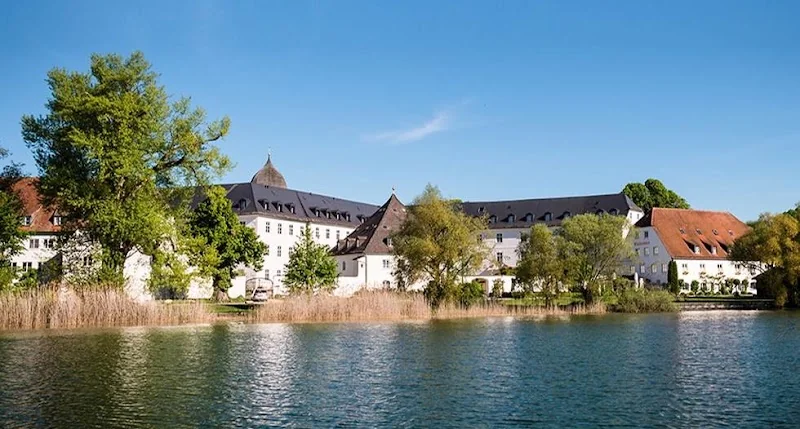
Chiemsee
Frauenchiemsee 50, 83256 Chiemsee-Frauenchiemsee (Insel), Deutschland
Abbey of Frauenwörth on Lake Chiemsee | Monastery Shop & History
The Abbey of Frauenwörth on Lake Chiemsee is much more than a historical point on the map: it is a spiritual center, a destination for excursions, a pilgrimage site, and a place where monastic history, island life, and guest offerings visibly connect to this day. On Fraueninsel, the car-free and only 15.5-hectare island in Lake Chiemsee, the abbey has shaped the landscape for centuries, while the pilgrimage to Blessed Irmengard and the Benedictine community give the place its special tranquility. The official website describes the abbey as a developed spiritual community in the Bavarian Alpine foothills, a place with a long and eventful history, and a destination with a special aura. Those looking for photos, directions, the monastery shop, history, or services will find content that is both practical, cultural, and spiritually relevant. For this reason, Frauenwörth is excellently suited for an SEO page that addresses genuine search intentions and quickly provides orientation to visitors. ([frauenwoerth.de](https://www.frauenwoerth.de/besucher))
Directions to the Abbey of Frauenwörth and Boat Ride to Fraueninsel
The journey to the Abbey of Frauenwörth is already part of the experience, as the route across Lake Chiemsee makes the special island location tangible. Officially, the abbey guides visitors depending on their origin via Munich Airport or Salzburg Airport, then by train to Prien am Chiemsee, and from there on foot, by bus, taxi, or Chiemsee train to the Prien-Stock harbor. The crossing takes about 25 to 35 minutes, so the boat connection is consciously experienced as a small transition into a different atmosphere. Those arriving by car follow the A8 Munich-Salzburg to the Bernau exit and drive through Prien towards Rimsting, Breitbrunn, and Gstadt; there are sufficient paid parking options available, and the boat ride from Gstadt takes about 10 minutes. The abbey thus recommends a journey that is well-planned for both day visitors and longer stays. At the same time, Fraueninsel itself remains car-free, which protects its quiet character and slows down every visit. This combination of clear accessibility and tangible distance from everyday life makes the abbey so attractive to visitors. Those looking for directions and parking will receive not only a logistical answer but also a taste of what characterizes the place: water, expansiveness, silence, and a historical ensemble that appears particularly impressive without traffic. For excursions, seminars, church visits, or a walk around the island, orientation is therefore simple and at the same time atmospheric. ([frauenwoerth.de](https://www.frauenwoerth.de/kontakte-anreise))
Monastery Shop, Marzipan, and Chiemsee Gingerbread
The monastery shop is one of the strongest search reasons related to the Abbey of Frauenwörth, as it combines tradition, enjoyment, and an unusually wide range of products. According to the official website, the shop covers 150 square meters with around 6000 items and is considered the largest selection of spiritual books in the entire Chiemgau. For almost 100 years, the monastery shop has been known in the surrounding area for its selected range and sees itself as a bookstore and art shop where one can browse, discover, and find special gifts. Particularly well-known are the homemade marzipan specialties, the spicy Chiemsee gingerbread, and the famous herbal liqueurs, which are considered popular souvenirs from Fraueninsel. The individual production areas are also presented in detail on the website: The Chiemsee Marzipan Manufactory refers to a decades-long monastic tradition and emphasizes the daily freshly prepared products according to traditional recipes; the gingerbread bakery explains that gingerbread was particularly popular in monasteries during the Middle Ages due to its long shelf life and is produced in the monastery bakery according to traditional recipes; the liqueur distillery traces the abbey's distillation tradition back to the 14th century and describes the production of herbal liqueurs, monastery spirits, bitters, and other specialties. For the search intention of the monastery shop, this is particularly strong because it describes not just a shop but a whole monastic product universe with history, craftsmanship, and recognizability. Those visiting the abbey can take home a very concrete experience: books, devotional items, fine sweets, and regional monastery products that shape the character of Frauenwörth and make the place unmistakable in culinary terms. ([frauenwoerth.de](https://www.frauenwoerth.de/klosterladen))
History of the Abbey of Frauenwörth from Tassilo to Today
The history of the Abbey of Frauenwörth is one of the strongest reasons for its enduring fascination, as it reflects almost the entire early history of Bavaria and the church. According to tradition, the abbey was founded around the year 772 by Duke Tassilo III of Bavaria; on September 1, 782, Bishop Virgil of Salzburg consecrated the church. Around 850, Blessed Irmengard stood as the first named abbess at the head of the community, and to this day her veneration shapes the place. In the 10th century, the time of the Hungarian storms interrupted the Carolingian order, and later the abbey lost its imperial immediacy due to the Investiture Controversy before Archbishop Anno of Cologne gifted it to the Archbishop of Salzburg in 1062. In 1254, the Bavarian dukes finally gained the sovereign rights over Frauenwörth, and as a remnant of the old imperial immediacy, the designation Royal Abbey remained until the secularization of 1803. The modern era also brought significant changes: in 1722/30, the monastery buildings were completely rebuilt and larger than before under Abbess Irmengard von Scharfsedt; in 1803, the abbey was dissolved during the secularization, but the nuns were allowed to remain, and five of them experienced the re-establishment in 1838 under King Ludwig I. In 1901, the monastery was once again elevated to an abbey and is thus considered, alongside Nonnberg in Salzburg, the oldest existing German-speaking women's monastery north of the Alps. This chronology explains why Frauenwörth has such a strong historical impact: here stands not only an old monastery but a place where continuity and renewal overlap over more than twelve centuries. Those looking for history will find an exceptionally dense and credible narrative of foundation, crisis, renewal, and today's vibrant community on the official website. ([frauenwoerth.de](https://www.frauenwoerth.de/gemeinschaft/geschichte))
Church, Irmengard, and Services on Frauenchiemsee
The church of the Abbey of Frauenwörth is a central attraction for visitors, pilgrims, and those interested in sacred architecture. According to the website, the Münster features Romanesque arcade arches in the baptismal chapel, which likely belonged to the westwork of the church around the year 1000; immediately in front lies the high tomb of Blessed Irmengard. Behind the high altar, in the Irmengard Chapel, is the altar with the remains of the Blessed in a crystal glass shrine, and numerous votive tablets and burning candles still testify to the lived veneration today. Blessed Irmengard was beatified in 1929, and her role as the patron saint of Chiemgau continues to shape the spiritual identity of the abbey to this day. Practically important for visitors is also that the church is under the administration of the parish association of Blessed Irmengard, and the service times are Sundays at 9:30 AM, although not regularly. For services, weddings, baptisms, and concerts, the abbey refers to the curacy of Frauenchiemsee, whose parish office is staffed on Tuesdays and Fridays from 9 to 11 AM. Those interested in guided tours can book a church tour with a monastery courtyard and abbess walk by appointment; an alternative tour as a round-table discussion provides an overview of Fraueninsel, the monastery church, the history of the abbey, and today's life according to the Rule of St. Benedict. Particularly appealing is also the note on the Baroque nativity scene: diary entries indicate that it was set up for Christmas 1627 in the present Irmengard Chapel and is cared for by the sisters as a precious spiritual heritage. Thus, the church of Frauenwörth connects historical depth, liturgical life, and a spirituality that is still experienced today, which goes far beyond a mere museum visit. ([frauenwoerth.de](https://www.frauenwoerth.de/besucher/kirche-gottesdienste))
Guesthouse Scholastika and Quiet Days of Reflection
The Guesthouse Scholastika complements the Abbey of Frauenwörth with a quiet, very characteristic form of hospitality. According to the official website, the house located directly on the shores of Lake Chiemsee was built in 1611 and conveys an atmosphere that invites contemplation with its simple, resting architecture. The abbey makes it clear that it does not want to be a hotel but welcomes guests for quiet days of reflection and retreat. Participation in the sisters' daily prayers is explicitly offered, and in a limited way, a conversation with a sister is also possible. The house is also open to women who wish to clarify their vocation for a life in community. This is exactly what makes Scholastika so relevant for inquiries about accommodation, monastery experience, or spiritual time out: it is not about tourist standard logic, but about a place of conscious slowing down. The fact that the guesthouse was recently completely renovated and reopened shows that the abbey actively carries its hospitable tradition into the present. Hospitality is not only organizationally but theologically grounded, as Benedict dedicates an entire chapter of his rule to the reception of guests. The guesthouse thus becomes a visible part of the Benedictine understanding of life, where silence, prayer, conversation, and seclusion belong together. So, for those looking for a place for reflection, retreat, or a quiet stay on the island, Scholastika offers not just an ordinary accommodation but a historically grown, spiritually shaped house with a clear stance and very own character. ([frauenwoerth.de](https://www.frauenwoerth.de/gemeinschaft/gast-im-kloster))
Photos, Fraueninsel, and the Special Atmosphere on Lake Chiemsee
The search for photos is particularly obvious at Frauenwörth because the official website works very visually and makes the monastery ensemble visible from many perspectives. On the abbey's pages, there are, among other things, aerial photographs of Fraueninsel, views of the passage of the gate hall, pictures from the monastery shop, the guesthouse, and interior areas of the community; the imagery thus conveys a realistic impression of architecture, location, and atmosphere even before the visit. At the same time, the website provides important contextual data about the island itself: Fraueninsel rises up to 8 meters above the lake surface, is the second largest island in Lake Chiemsee at 15.5 hectares, car-free, and can be circled in about 20 minutes on a comfortable lakeside path. With over 50 houses, it is now densely populated and forms the smallest political municipality in all of Bavaria, while about a third of the area is occupied by the monastery area. Since 1828, the Frauenchiemsee artist colony has also contributed to the island's fame, further shaping the place as a cultural landscape. For visitors, this means: Frauenwörth is not just an abbey but a whole experiential space where water, island character, monastery architecture, and living history come together. So, those specifically searching for photos, Frauenchiemsee, or Lake Chiemsee will not just find a single attraction here but an ensemble composed of the monastery, church, shop, guesthouse, cemetery, gate hall, and lakeside path. This mixture of documented history and very concrete images makes the abbey a place that has a strong online presence and is even more impressive offline. Fraueninsel remains the quiet heart of the whole: manageable, low in traffic, culturally rich, and closely intertwined with the abbey. ([frauenwoerth.de](https://www.frauenwoerth.de/besucher))
Sources:
- Abbey of Frauenwörth - Official Website
- Abbey of Frauenwörth - History
- Abbey of Frauenwörth - Contacts and Directions
- Abbey of Frauenwörth - Monastery Shop
- Abbey of Frauenwörth - Guesthouse Scholastika
- Abbey of Frauenwörth - Church and Services
- Abbey of Frauenwörth - Church Tours
- Abbey of Frauenwörth - Baroque Nativity Scene Today
Mehr anzeigenWeniger anzeigen
Abbey of Frauenwörth on Lake Chiemsee | Monastery Shop & History
The Abbey of Frauenwörth on Lake Chiemsee is much more than a historical point on the map: it is a spiritual center, a destination for excursions, a pilgrimage site, and a place where monastic history, island life, and guest offerings visibly connect to this day. On Fraueninsel, the car-free and only 15.5-hectare island in Lake Chiemsee, the abbey has shaped the landscape for centuries, while the pilgrimage to Blessed Irmengard and the Benedictine community give the place its special tranquility. The official website describes the abbey as a developed spiritual community in the Bavarian Alpine foothills, a place with a long and eventful history, and a destination with a special aura. Those looking for photos, directions, the monastery shop, history, or services will find content that is both practical, cultural, and spiritually relevant. For this reason, Frauenwörth is excellently suited for an SEO page that addresses genuine search intentions and quickly provides orientation to visitors. ([frauenwoerth.de](https://www.frauenwoerth.de/besucher))
Directions to the Abbey of Frauenwörth and Boat Ride to Fraueninsel
The journey to the Abbey of Frauenwörth is already part of the experience, as the route across Lake Chiemsee makes the special island location tangible. Officially, the abbey guides visitors depending on their origin via Munich Airport or Salzburg Airport, then by train to Prien am Chiemsee, and from there on foot, by bus, taxi, or Chiemsee train to the Prien-Stock harbor. The crossing takes about 25 to 35 minutes, so the boat connection is consciously experienced as a small transition into a different atmosphere. Those arriving by car follow the A8 Munich-Salzburg to the Bernau exit and drive through Prien towards Rimsting, Breitbrunn, and Gstadt; there are sufficient paid parking options available, and the boat ride from Gstadt takes about 10 minutes. The abbey thus recommends a journey that is well-planned for both day visitors and longer stays. At the same time, Fraueninsel itself remains car-free, which protects its quiet character and slows down every visit. This combination of clear accessibility and tangible distance from everyday life makes the abbey so attractive to visitors. Those looking for directions and parking will receive not only a logistical answer but also a taste of what characterizes the place: water, expansiveness, silence, and a historical ensemble that appears particularly impressive without traffic. For excursions, seminars, church visits, or a walk around the island, orientation is therefore simple and at the same time atmospheric. ([frauenwoerth.de](https://www.frauenwoerth.de/kontakte-anreise))
Monastery Shop, Marzipan, and Chiemsee Gingerbread
The monastery shop is one of the strongest search reasons related to the Abbey of Frauenwörth, as it combines tradition, enjoyment, and an unusually wide range of products. According to the official website, the shop covers 150 square meters with around 6000 items and is considered the largest selection of spiritual books in the entire Chiemgau. For almost 100 years, the monastery shop has been known in the surrounding area for its selected range and sees itself as a bookstore and art shop where one can browse, discover, and find special gifts. Particularly well-known are the homemade marzipan specialties, the spicy Chiemsee gingerbread, and the famous herbal liqueurs, which are considered popular souvenirs from Fraueninsel. The individual production areas are also presented in detail on the website: The Chiemsee Marzipan Manufactory refers to a decades-long monastic tradition and emphasizes the daily freshly prepared products according to traditional recipes; the gingerbread bakery explains that gingerbread was particularly popular in monasteries during the Middle Ages due to its long shelf life and is produced in the monastery bakery according to traditional recipes; the liqueur distillery traces the abbey's distillation tradition back to the 14th century and describes the production of herbal liqueurs, monastery spirits, bitters, and other specialties. For the search intention of the monastery shop, this is particularly strong because it describes not just a shop but a whole monastic product universe with history, craftsmanship, and recognizability. Those visiting the abbey can take home a very concrete experience: books, devotional items, fine sweets, and regional monastery products that shape the character of Frauenwörth and make the place unmistakable in culinary terms. ([frauenwoerth.de](https://www.frauenwoerth.de/klosterladen))
History of the Abbey of Frauenwörth from Tassilo to Today
The history of the Abbey of Frauenwörth is one of the strongest reasons for its enduring fascination, as it reflects almost the entire early history of Bavaria and the church. According to tradition, the abbey was founded around the year 772 by Duke Tassilo III of Bavaria; on September 1, 782, Bishop Virgil of Salzburg consecrated the church. Around 850, Blessed Irmengard stood as the first named abbess at the head of the community, and to this day her veneration shapes the place. In the 10th century, the time of the Hungarian storms interrupted the Carolingian order, and later the abbey lost its imperial immediacy due to the Investiture Controversy before Archbishop Anno of Cologne gifted it to the Archbishop of Salzburg in 1062. In 1254, the Bavarian dukes finally gained the sovereign rights over Frauenwörth, and as a remnant of the old imperial immediacy, the designation Royal Abbey remained until the secularization of 1803. The modern era also brought significant changes: in 1722/30, the monastery buildings were completely rebuilt and larger than before under Abbess Irmengard von Scharfsedt; in 1803, the abbey was dissolved during the secularization, but the nuns were allowed to remain, and five of them experienced the re-establishment in 1838 under King Ludwig I. In 1901, the monastery was once again elevated to an abbey and is thus considered, alongside Nonnberg in Salzburg, the oldest existing German-speaking women's monastery north of the Alps. This chronology explains why Frauenwörth has such a strong historical impact: here stands not only an old monastery but a place where continuity and renewal overlap over more than twelve centuries. Those looking for history will find an exceptionally dense and credible narrative of foundation, crisis, renewal, and today's vibrant community on the official website. ([frauenwoerth.de](https://www.frauenwoerth.de/gemeinschaft/geschichte))
Church, Irmengard, and Services on Frauenchiemsee
The church of the Abbey of Frauenwörth is a central attraction for visitors, pilgrims, and those interested in sacred architecture. According to the website, the Münster features Romanesque arcade arches in the baptismal chapel, which likely belonged to the westwork of the church around the year 1000; immediately in front lies the high tomb of Blessed Irmengard. Behind the high altar, in the Irmengard Chapel, is the altar with the remains of the Blessed in a crystal glass shrine, and numerous votive tablets and burning candles still testify to the lived veneration today. Blessed Irmengard was beatified in 1929, and her role as the patron saint of Chiemgau continues to shape the spiritual identity of the abbey to this day. Practically important for visitors is also that the church is under the administration of the parish association of Blessed Irmengard, and the service times are Sundays at 9:30 AM, although not regularly. For services, weddings, baptisms, and concerts, the abbey refers to the curacy of Frauenchiemsee, whose parish office is staffed on Tuesdays and Fridays from 9 to 11 AM. Those interested in guided tours can book a church tour with a monastery courtyard and abbess walk by appointment; an alternative tour as a round-table discussion provides an overview of Fraueninsel, the monastery church, the history of the abbey, and today's life according to the Rule of St. Benedict. Particularly appealing is also the note on the Baroque nativity scene: diary entries indicate that it was set up for Christmas 1627 in the present Irmengard Chapel and is cared for by the sisters as a precious spiritual heritage. Thus, the church of Frauenwörth connects historical depth, liturgical life, and a spirituality that is still experienced today, which goes far beyond a mere museum visit. ([frauenwoerth.de](https://www.frauenwoerth.de/besucher/kirche-gottesdienste))
Guesthouse Scholastika and Quiet Days of Reflection
The Guesthouse Scholastika complements the Abbey of Frauenwörth with a quiet, very characteristic form of hospitality. According to the official website, the house located directly on the shores of Lake Chiemsee was built in 1611 and conveys an atmosphere that invites contemplation with its simple, resting architecture. The abbey makes it clear that it does not want to be a hotel but welcomes guests for quiet days of reflection and retreat. Participation in the sisters' daily prayers is explicitly offered, and in a limited way, a conversation with a sister is also possible. The house is also open to women who wish to clarify their vocation for a life in community. This is exactly what makes Scholastika so relevant for inquiries about accommodation, monastery experience, or spiritual time out: it is not about tourist standard logic, but about a place of conscious slowing down. The fact that the guesthouse was recently completely renovated and reopened shows that the abbey actively carries its hospitable tradition into the present. Hospitality is not only organizationally but theologically grounded, as Benedict dedicates an entire chapter of his rule to the reception of guests. The guesthouse thus becomes a visible part of the Benedictine understanding of life, where silence, prayer, conversation, and seclusion belong together. So, for those looking for a place for reflection, retreat, or a quiet stay on the island, Scholastika offers not just an ordinary accommodation but a historically grown, spiritually shaped house with a clear stance and very own character. ([frauenwoerth.de](https://www.frauenwoerth.de/gemeinschaft/gast-im-kloster))
Photos, Fraueninsel, and the Special Atmosphere on Lake Chiemsee
The search for photos is particularly obvious at Frauenwörth because the official website works very visually and makes the monastery ensemble visible from many perspectives. On the abbey's pages, there are, among other things, aerial photographs of Fraueninsel, views of the passage of the gate hall, pictures from the monastery shop, the guesthouse, and interior areas of the community; the imagery thus conveys a realistic impression of architecture, location, and atmosphere even before the visit. At the same time, the website provides important contextual data about the island itself: Fraueninsel rises up to 8 meters above the lake surface, is the second largest island in Lake Chiemsee at 15.5 hectares, car-free, and can be circled in about 20 minutes on a comfortable lakeside path. With over 50 houses, it is now densely populated and forms the smallest political municipality in all of Bavaria, while about a third of the area is occupied by the monastery area. Since 1828, the Frauenchiemsee artist colony has also contributed to the island's fame, further shaping the place as a cultural landscape. For visitors, this means: Frauenwörth is not just an abbey but a whole experiential space where water, island character, monastery architecture, and living history come together. So, those specifically searching for photos, Frauenchiemsee, or Lake Chiemsee will not just find a single attraction here but an ensemble composed of the monastery, church, shop, guesthouse, cemetery, gate hall, and lakeside path. This mixture of documented history and very concrete images makes the abbey a place that has a strong online presence and is even more impressive offline. Fraueninsel remains the quiet heart of the whole: manageable, low in traffic, culturally rich, and closely intertwined with the abbey. ([frauenwoerth.de](https://www.frauenwoerth.de/besucher))
Sources:
- Abbey of Frauenwörth - Official Website
- Abbey of Frauenwörth - History
- Abbey of Frauenwörth - Contacts and Directions
- Abbey of Frauenwörth - Monastery Shop
- Abbey of Frauenwörth - Guesthouse Scholastika
- Abbey of Frauenwörth - Church and Services
- Abbey of Frauenwörth - Church Tours
- Abbey of Frauenwörth - Baroque Nativity Scene Today
Abbey of Frauenwörth on Lake Chiemsee | Monastery Shop & History
The Abbey of Frauenwörth on Lake Chiemsee is much more than a historical point on the map: it is a spiritual center, a destination for excursions, a pilgrimage site, and a place where monastic history, island life, and guest offerings visibly connect to this day. On Fraueninsel, the car-free and only 15.5-hectare island in Lake Chiemsee, the abbey has shaped the landscape for centuries, while the pilgrimage to Blessed Irmengard and the Benedictine community give the place its special tranquility. The official website describes the abbey as a developed spiritual community in the Bavarian Alpine foothills, a place with a long and eventful history, and a destination with a special aura. Those looking for photos, directions, the monastery shop, history, or services will find content that is both practical, cultural, and spiritually relevant. For this reason, Frauenwörth is excellently suited for an SEO page that addresses genuine search intentions and quickly provides orientation to visitors. ([frauenwoerth.de](https://www.frauenwoerth.de/besucher))
Directions to the Abbey of Frauenwörth and Boat Ride to Fraueninsel
The journey to the Abbey of Frauenwörth is already part of the experience, as the route across Lake Chiemsee makes the special island location tangible. Officially, the abbey guides visitors depending on their origin via Munich Airport or Salzburg Airport, then by train to Prien am Chiemsee, and from there on foot, by bus, taxi, or Chiemsee train to the Prien-Stock harbor. The crossing takes about 25 to 35 minutes, so the boat connection is consciously experienced as a small transition into a different atmosphere. Those arriving by car follow the A8 Munich-Salzburg to the Bernau exit and drive through Prien towards Rimsting, Breitbrunn, and Gstadt; there are sufficient paid parking options available, and the boat ride from Gstadt takes about 10 minutes. The abbey thus recommends a journey that is well-planned for both day visitors and longer stays. At the same time, Fraueninsel itself remains car-free, which protects its quiet character and slows down every visit. This combination of clear accessibility and tangible distance from everyday life makes the abbey so attractive to visitors. Those looking for directions and parking will receive not only a logistical answer but also a taste of what characterizes the place: water, expansiveness, silence, and a historical ensemble that appears particularly impressive without traffic. For excursions, seminars, church visits, or a walk around the island, orientation is therefore simple and at the same time atmospheric. ([frauenwoerth.de](https://www.frauenwoerth.de/kontakte-anreise))
Monastery Shop, Marzipan, and Chiemsee Gingerbread
The monastery shop is one of the strongest search reasons related to the Abbey of Frauenwörth, as it combines tradition, enjoyment, and an unusually wide range of products. According to the official website, the shop covers 150 square meters with around 6000 items and is considered the largest selection of spiritual books in the entire Chiemgau. For almost 100 years, the monastery shop has been known in the surrounding area for its selected range and sees itself as a bookstore and art shop where one can browse, discover, and find special gifts. Particularly well-known are the homemade marzipan specialties, the spicy Chiemsee gingerbread, and the famous herbal liqueurs, which are considered popular souvenirs from Fraueninsel. The individual production areas are also presented in detail on the website: The Chiemsee Marzipan Manufactory refers to a decades-long monastic tradition and emphasizes the daily freshly prepared products according to traditional recipes; the gingerbread bakery explains that gingerbread was particularly popular in monasteries during the Middle Ages due to its long shelf life and is produced in the monastery bakery according to traditional recipes; the liqueur distillery traces the abbey's distillation tradition back to the 14th century and describes the production of herbal liqueurs, monastery spirits, bitters, and other specialties. For the search intention of the monastery shop, this is particularly strong because it describes not just a shop but a whole monastic product universe with history, craftsmanship, and recognizability. Those visiting the abbey can take home a very concrete experience: books, devotional items, fine sweets, and regional monastery products that shape the character of Frauenwörth and make the place unmistakable in culinary terms. ([frauenwoerth.de](https://www.frauenwoerth.de/klosterladen))
History of the Abbey of Frauenwörth from Tassilo to Today
The history of the Abbey of Frauenwörth is one of the strongest reasons for its enduring fascination, as it reflects almost the entire early history of Bavaria and the church. According to tradition, the abbey was founded around the year 772 by Duke Tassilo III of Bavaria; on September 1, 782, Bishop Virgil of Salzburg consecrated the church. Around 850, Blessed Irmengard stood as the first named abbess at the head of the community, and to this day her veneration shapes the place. In the 10th century, the time of the Hungarian storms interrupted the Carolingian order, and later the abbey lost its imperial immediacy due to the Investiture Controversy before Archbishop Anno of Cologne gifted it to the Archbishop of Salzburg in 1062. In 1254, the Bavarian dukes finally gained the sovereign rights over Frauenwörth, and as a remnant of the old imperial immediacy, the designation Royal Abbey remained until the secularization of 1803. The modern era also brought significant changes: in 1722/30, the monastery buildings were completely rebuilt and larger than before under Abbess Irmengard von Scharfsedt; in 1803, the abbey was dissolved during the secularization, but the nuns were allowed to remain, and five of them experienced the re-establishment in 1838 under King Ludwig I. In 1901, the monastery was once again elevated to an abbey and is thus considered, alongside Nonnberg in Salzburg, the oldest existing German-speaking women's monastery north of the Alps. This chronology explains why Frauenwörth has such a strong historical impact: here stands not only an old monastery but a place where continuity and renewal overlap over more than twelve centuries. Those looking for history will find an exceptionally dense and credible narrative of foundation, crisis, renewal, and today's vibrant community on the official website. ([frauenwoerth.de](https://www.frauenwoerth.de/gemeinschaft/geschichte))
Church, Irmengard, and Services on Frauenchiemsee
The church of the Abbey of Frauenwörth is a central attraction for visitors, pilgrims, and those interested in sacred architecture. According to the website, the Münster features Romanesque arcade arches in the baptismal chapel, which likely belonged to the westwork of the church around the year 1000; immediately in front lies the high tomb of Blessed Irmengard. Behind the high altar, in the Irmengard Chapel, is the altar with the remains of the Blessed in a crystal glass shrine, and numerous votive tablets and burning candles still testify to the lived veneration today. Blessed Irmengard was beatified in 1929, and her role as the patron saint of Chiemgau continues to shape the spiritual identity of the abbey to this day. Practically important for visitors is also that the church is under the administration of the parish association of Blessed Irmengard, and the service times are Sundays at 9:30 AM, although not regularly. For services, weddings, baptisms, and concerts, the abbey refers to the curacy of Frauenchiemsee, whose parish office is staffed on Tuesdays and Fridays from 9 to 11 AM. Those interested in guided tours can book a church tour with a monastery courtyard and abbess walk by appointment; an alternative tour as a round-table discussion provides an overview of Fraueninsel, the monastery church, the history of the abbey, and today's life according to the Rule of St. Benedict. Particularly appealing is also the note on the Baroque nativity scene: diary entries indicate that it was set up for Christmas 1627 in the present Irmengard Chapel and is cared for by the sisters as a precious spiritual heritage. Thus, the church of Frauenwörth connects historical depth, liturgical life, and a spirituality that is still experienced today, which goes far beyond a mere museum visit. ([frauenwoerth.de](https://www.frauenwoerth.de/besucher/kirche-gottesdienste))
Guesthouse Scholastika and Quiet Days of Reflection
The Guesthouse Scholastika complements the Abbey of Frauenwörth with a quiet, very characteristic form of hospitality. According to the official website, the house located directly on the shores of Lake Chiemsee was built in 1611 and conveys an atmosphere that invites contemplation with its simple, resting architecture. The abbey makes it clear that it does not want to be a hotel but welcomes guests for quiet days of reflection and retreat. Participation in the sisters' daily prayers is explicitly offered, and in a limited way, a conversation with a sister is also possible. The house is also open to women who wish to clarify their vocation for a life in community. This is exactly what makes Scholastika so relevant for inquiries about accommodation, monastery experience, or spiritual time out: it is not about tourist standard logic, but about a place of conscious slowing down. The fact that the guesthouse was recently completely renovated and reopened shows that the abbey actively carries its hospitable tradition into the present. Hospitality is not only organizationally but theologically grounded, as Benedict dedicates an entire chapter of his rule to the reception of guests. The guesthouse thus becomes a visible part of the Benedictine understanding of life, where silence, prayer, conversation, and seclusion belong together. So, for those looking for a place for reflection, retreat, or a quiet stay on the island, Scholastika offers not just an ordinary accommodation but a historically grown, spiritually shaped house with a clear stance and very own character. ([frauenwoerth.de](https://www.frauenwoerth.de/gemeinschaft/gast-im-kloster))
Photos, Fraueninsel, and the Special Atmosphere on Lake Chiemsee
The search for photos is particularly obvious at Frauenwörth because the official website works very visually and makes the monastery ensemble visible from many perspectives. On the abbey's pages, there are, among other things, aerial photographs of Fraueninsel, views of the passage of the gate hall, pictures from the monastery shop, the guesthouse, and interior areas of the community; the imagery thus conveys a realistic impression of architecture, location, and atmosphere even before the visit. At the same time, the website provides important contextual data about the island itself: Fraueninsel rises up to 8 meters above the lake surface, is the second largest island in Lake Chiemsee at 15.5 hectares, car-free, and can be circled in about 20 minutes on a comfortable lakeside path. With over 50 houses, it is now densely populated and forms the smallest political municipality in all of Bavaria, while about a third of the area is occupied by the monastery area. Since 1828, the Frauenchiemsee artist colony has also contributed to the island's fame, further shaping the place as a cultural landscape. For visitors, this means: Frauenwörth is not just an abbey but a whole experiential space where water, island character, monastery architecture, and living history come together. So, those specifically searching for photos, Frauenchiemsee, or Lake Chiemsee will not just find a single attraction here but an ensemble composed of the monastery, church, shop, guesthouse, cemetery, gate hall, and lakeside path. This mixture of documented history and very concrete images makes the abbey a place that has a strong online presence and is even more impressive offline. Fraueninsel remains the quiet heart of the whole: manageable, low in traffic, culturally rich, and closely intertwined with the abbey. ([frauenwoerth.de](https://www.frauenwoerth.de/besucher))
Sources:
- Abbey of Frauenwörth - Official Website
- Abbey of Frauenwörth - History
- Abbey of Frauenwörth - Contacts and Directions
- Abbey of Frauenwörth - Monastery Shop
- Abbey of Frauenwörth - Guesthouse Scholastika
- Abbey of Frauenwörth - Church and Services
- Abbey of Frauenwörth - Church Tours
- Abbey of Frauenwörth - Baroque Nativity Scene Today
Frequently Asked Questions
Reviews
No reviews found