
Julius Exter
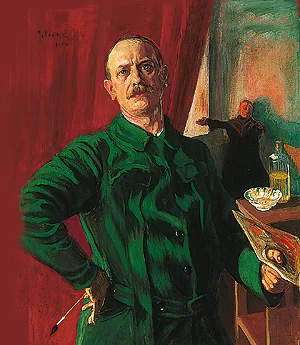
Image from Wikipedia
Image from Wikipedia
Julius Exter – the Color Magician of Munich Modernism and the Chiemsee Universe of His Art
An Artist Between Departure, Color, and Landscape
Julius Exter belonged to that generation of artists who, around 1900, led German painting from the confines of academic style into modernity. Born in 1863 in Ludwigshafen am Rhein and died in 1939 in Übersee am Chiemsee, he developed a body of work that embraced styles from symbolism and neo-impressionism to expressionism. Today, he is regarded as an important painter of modernity and a formative figure in the Munich art scene of his time. (schloesser.bayern.de)
Biography: From Ludwigshafen to Munich
Exter came from a milieu that provided him early access to education and artistic development. After a brief apprenticeship at the School of Applied Arts in Nuremberg, he moved to Munich, where he mingled in the vibrant scene of artists' associations and soon connected with reform-oriented circles. The years in Munich shaped his attitude towards modernity and laid the groundwork for his later role as an independent stylist. (chiemsee-alpenland.de)
Particularly significant was his proximity to the Munich Secession, an association of avant-garde painters of which he was a co-founder. His friendship with Franz von Stuck, based on a shared fondness for plein air painting, also highlights Exter's artistic position between decorative composition, nature observation, and modern color perception. Sources describe him as part of the reform movement that made Munich a center of modernity around 1900. (schloesser.bayern.de)
The Chiemsee as an Artistic Resonance Space
The decisive turning point in his career was marked by the acquisition of the historic "Stricker" estate in Übersee-Feldwies in 1902. Exter converted the farmhouse into an artist's residence and settled there permanently in 1917; the house became the base of his renowned painting school. His art gained a geographical and atmospheric focal point: the Chiemsee became not just a motif, but a whole realm of possibilities for image creation, teaching, and artistic self-presentation. (schloesser.bayern.de)
The present-day Julius Exter Artist House visibly preserves this history. The building features study rooms and studio as permanent exhibition spaces, while additional works are displayed in the Julius Exter Gallery at the Augustinian Monastery Herrenchiemsee. Thus, Exter’s art remains accessible not just in archives but in a vibrant museum context. (schloesser.bayern.de)
Career and Breakthrough: From Avant-Gardist to "Prince of Colors"
By around 1900, Exter had already established himself as an important proponent of modern painting in Munich. Sources describe him as an artist whose paintings found market success throughout Germany and particularly in Switzerland, and as a painter whose colleagues nicknamed him "Prince of Colors." This title fits an art where vibrant color splendor, intense landscapes, and a strong personal touch converge. (chiemsee-alpenland.de)
His imagery did not develop abruptly, but rather in a clearly traceable movement. The paintings dissolve from symbolism and neo-impressionism toward expressionism without abandoning the binding power of the landscape. It is this combination of formal discipline and color boldness that makes Exter a key figure of Bavarian modernity. (schloesser.bayern.de)
Works and Discography of Images: Motifs, Series, and Visual Language
Although Exter naturally left no musical discography, his works possess a comparable internal order of recurring motifs and variations. In collections and museum holdings, one encounters self-portraits, bathers, lake shores, beach and family scenes, as well as rural images and sun-drenched views of nature. This thematic consistency reveals an artist who developed a distinctive visual language through his perspectives on bodies, water, light, and landscape. (lenbachhaus.de)
The painting gallery in Herrenchiemsee showcases roughly 100 works in nine baroque rooms. The artist house in Übersee complements this perspective with an intimate look at the workspace, studio, and surroundings. It becomes clear that Exter's work operates not only in isolated masterpieces but in the sum of a long, concentrated artistic development. (chiemsee-alpenland.de)
Style: Color as Composition, Nature as Stage
Exter's style thrives on a controlled intensification of color. His compositions exhibit an intense luminosity, bringing together landscapes, figures, and bath or shore scenes with almost orchestral power. It is precisely in this that his connection to modernity lies: the mere reproduction of the visible world is not central, but the transformation of nature into pictorial energy. (schloesser.bayern.de)
Art historians and curators convincingly place him between symbolism, neo-impressionism, and expressionism. Exter works with surface effects, color contrasts, and an atmospheric density that makes his paintings appear timeless. Anyone who views his images quickly realizes that this is not governed by chance, but rather by a sovereign artistic production with a clear artistic handwriting. (schloesser.bayern.de)
Cultural Influence and Legacy
Exter's significance extends far beyond his personal oeuvre. As a co-founder of the Munich Secession, he stood at the center of a movement that renewed German art around 1900 and paved the way for new forms of expression. His role as a teacher, networker, and style-defining painter made him a formative figure in southern German artistic life. (schloesser.bayern.de)
To this day, he remains present in the museal memory. The Julius Exter Artist House is publicly accessible, the painting gallery at Herrenchiemsee showcases a large selection of his works, and regional cultural institutions firmly anchor his name in the memory of modernity at the Chiemsee. Thus, Exter’s legacy does not act merely as a historical footnote but as a living component of the German art landscape. (chiemsee-alpenland.de)
Current Projects and Publications
As a historical artist, Julius Exter has no current music releases, albums, singles, or tours. The presence of his art manifests itself rather in exhibitions, collections, and museal presentations, including the public accessibility of the Julius Exter Artist House and the permanent display of works in Herrenchiemsee. For contemporary culture, this represents his form of "relevance": the constant rediscovery of a modern pictorial thought. (schloesser.bayern.de)
Conclusion: Why Julius Exter Continues to Fascinate Today
Julius Exter connects the energy of the avant-garde with a deep bond to landscape, light, and color. His career tells of departure, independence, and the courage to shape modern visual language not as a theoretical program, but as a sensory experience. Those who see his works encounter an artist who does not explain modernity but makes it visible. (schloesser.bayern.de)
Exter remains intriguing because his art stands between personal handwriting and art-historical rupture. This makes a visit to the Julius Exter Artist House or the painting gallery at Herrenchiemsee an immediate encounter with modernity. Whoever wants to understand how color becomes attitude should not only read about Julius Exter but stand before his paintings. (schloesser.bayern.de)
Official Channels of Julius Exter:
- Instagram: No official profile found
- Facebook: No official profile found
- YouTube: No official profile found
- Spotify: No official profile found
- TikTok: No official profile found
Sources:
- Bavarian Palace Administration – Julius Exter Artist House (Übersee-Feldwies)
- Bavarian Palace Administration – Julius Exter Gallery
- Chiemsee-Alpenland Tourism – Julius Exter Gallery
- German Biography – Exter, Julius
- Lenbachhaus – Julius Exter (1863–1939)
- Museums in Bavaria – Julius Exter (1863–1939)
- Wikipedia – Julius Exter