
Johann Nestroy
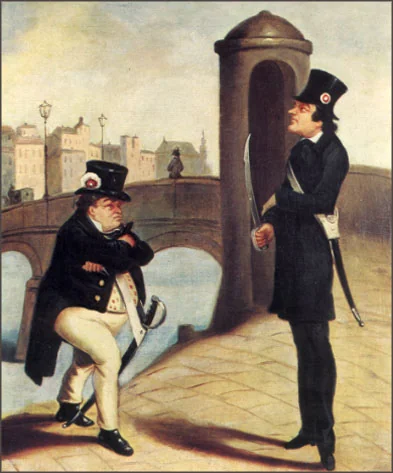
Image from Wikipedia
Image from Wikipedia
Johann Nestroy – the great word wizard of Old Viennese popular theater
A stage artist between opera, satire, and theater revolution
Johann Nepomuk Eduard Ambrosius Nestroy is considered one of the most colorful figures in Austrian theater history. Born on December 7, 1801, in Vienna and died on May 25, 1862, in Graz, he combined the experiences of an opera singer with the aggressiveness of a playwright and the precision of an actor. His work is regarded as the literary peak of Old Viennese popular theater and continues to shape the perception of Viennese theater culture to this day. ([de.wikipedia.org](https://de.wikipedia.org/wiki/Johann_Nestroy?utm_source=openai))
Nestroy was not an artist of a single register, but a master of transitions: a trained bass, a successful opera interpreter, a playwright, a comedian, and a sharp observer of social conditions. This versatility makes his musical career and theatrical path so remarkable, as they intertwine comedic energy, musical sensibility, and linguistic virtuosity into an unmistakable artistic figure. ([deutsche-biographie.de](https://www.deutsche-biographie.de/gnd118587080.html?utm_source=openai))
Biography: From Viennese education to opera stage debut
Nestroy attended the Akademisches Gymnasium and the Schottengymnasium in Vienna, initially began studying law, and dropped out in 1822 in favor of a career as a singer and pianist. In the same year, he achieved a breakthrough as Sarastro in Mozart's "The Magic Flute" at the Vienna Theater at Kärntnertor. This early phase already shows how profoundly his artistic development was shaped by musical discipline and stage presence. ([deutsche-biographie.de](https://www.deutsche-biographie.de/gnd118587080.html?utm_source=openai))
In the following years, his career took him to Amsterdam, Brno, and Graz, before he was engaged as a playwright and comedian in 1831 at the Theater an der Wien in Vienna. A cholera epidemic in Lemberg marked a decisive turning point as Nestroy increasingly shifted the focus of his work from singing to writing and acting. This began the phase in which he de facto shaped the Viennese suburban theater. ([de.wikipedia.org](https://de.wikipedia.org/wiki/Johann_Nestroy?utm_source=openai))
Career: The swift rise of a theater person with a sharp eye
Nestroy's dramatic breakthrough came in 1833 with the magic farce "Der böse Geist Lumpazivagabundus," which was regarded as a great success of its time and is still considered one of his most famous works. This was followed by plays such as "Liebesgeschichten und Heiratssachen," "Der Talisman," "Einen Jux will er sich machen," and "Der Zerrissene," in which social satire, linguistic wit, and precise observations of milieu converge. Britannica and Deutsche Biographie highlight these works as central pillars of his oeuvre. ([britannica.com](https://www.britannica.com/biography/Johann-Nestroy?utm_source=openai))
Particularly important for his artistic authority was his long-standing connection to the Viennese suburban stage. Since 1854, he directed the Carltheater, while the economic organization was in the hands of Marie Weiler, with whom he lived in partnership since 1827. This arrangement not only shaped his career, but also his productivity, independence, and approach to popular theater practice. ([deutsche-biographie.de](https://www.deutsche-biographie.de/gnd118587080.html?utm_source=openai))
Musical origins and spoken art: The singer in the playwright
Although Nestroy became famous primarily as a playwright, his musical origins are essential for understanding his works. He appeared as a bass, sang as Sarastro in 1822, and repeatedly included musical interludes, vaudeville elements, and parodies in his works. A scholarly investigation into Nestroy's songs points out that he drew significantly from the reservoir of French vaudevilles and creatively transformed musical sources. ([deutsche-biographie.de](https://www.deutsche-biographie.de/gnd118587080.html?utm_source=openai))
This connection of music, language, and scene created a special dynamic: Nestroy did not write mere comedies, but forms for the stage in which rhythm, dialogue, punchlines, and comic tension worked closely together. His linguistic style has been described as virtuosic by theater pedagogy, characterized by creative word formations and parodistic jargon. This is precisely where the core of his lasting fascination lies: Nestroy always thinks of theater acoustically as well. ([stadttheater-klagenfurt.at](https://www.stadttheater-klagenfurt.at/wp-content/uploads/2024/04/Begleitmaterial_FRUeHERE-VERHAeLTNISSE_HAeUPTLING-ABENDWIND_.pdf?utm_source=openai))
Discography? Nestroy as a playwright with musical resonance
Nestroy does not naturally possess a classical discography in the sense of a catalog of sound recordings. His work lives on in theater performances, adaptations, and musical reinterpretations. For example, "Der Talisman" was later transformed into the operetta "Titus macht Karriere," and "Einen Jux will er sich machen" inspired later adaptations up to international traditions. ([britannica.com](https://www.britannica.com/biography/Johann-Nestroy?utm_source=openai))
The cultural reach of his plays is particularly evident in this history of adaptations. Nestroy's comedies combine social relevance with a format that can be staged anew time and again. The fact that his works resonate with modern theater and musical forms underscores his authority as an author whose influence extends far beyond the historical Viennese stage. ([britannica.com](https://www.britannica.com/biography/Johann-Nestroy?utm_source=openai))
Language, satire, and social perspective
Nestroy's stature rests not only on wit but also on sharp observation. His characters are social types, masks, and milieu figures that he equips with biting humor and precise psychology. Die Presse describes him as both a sharp-witted societal analyst and a pub politician, capturing the spectrum of his tone very accurately. ([diepresse.com](https://www.diepresse.com/4673864/zwischen-zweifel-und-zensur?utm_source=openai))
This satirical energy also explains why his plays are still regarded as lively today. Nestroy attacks vanity, self-deception, social pretension, and bourgeois disguise without resorting to the smooth moral stance of entertainment theater. Instead, dense comedies emerge, where linguistic wit and social criticism constantly propel one another. ([britannica.com](https://www.britannica.com/biography/Johann-Nestroy?utm_source=openai))
Impact and cultural influence: A fixed point in Austrian theater history
Nestroy dominated the Viennese suburban stage for decades, as described by Deutsche Biographie, and accustomed the audience to his taste. This is more than just an indication of success: it describes an author who not only responded to the zeitgeist but actively shaped it. His plays became reference points for Austrian popular theater and continue to influence directorial texts, acting traditions, and theater debates today. ([deutsche-biographie.de](https://www.deutsche-biographie.de/sfz71168.html?utm_source=openai))
Even in contemporary performance practice, Nestroy remains a touchstone for ensemble art, timing, and linguistic precision. His comedies demand a fine balance of musical feeling, physical comedy, and analytical sharpness. That is precisely why he is repeatedly rediscovered in German-speaking theater: as a classic who is not dusty but challenges. ([diepresse.com](https://www.diepresse.com/693791/lumpazivagabundus-nestroys-kinderwagen-tragoedie?utm_source=openai))
Current projects and publications
As a historical figure, Johann Nestroy is naturally not the subject of new albums, singles, or tours in today's sense. His presence in the present emerges through new stagings, scholarly editions, theater awards, and cultural-historical discussions about Viennese theater. Thus, his work remains alive, even if there are no current music releases in modern market formats. ([de.wikipedia.org](https://de.wikipedia.org/wiki/Verleihung_des_Nestroy-Theaterpreises_2025?utm_source=openai))
Conclusion: Why Johann Nestroy continues to electrify
Johann Nestroy fascinates because he was far more than a significant playwright. He was a singer, actor, satirist, and word artist who made popular theater a stage with intellectual explosive power. His career speaks of artistic development, a willingness to experiment with form, sharp observation, and a stage presence that still serves as a benchmark today. ([deutsche-biographie.de](https://www.deutsche-biographie.de/gnd118587080.html?utm_source=openai))
Those who experience Nestroy live do not discover a museum piece but theater of immediate relevance. Particularly in the best productions, his rhythmic language, musical pulse, and undiminished comedy reveal themselves as vibrant forces. Nestroy remains an artist who should not only be read but experienced on stage. ([diepresse.com](https://www.diepresse.com/693791/lumpazivagabundus-nestroys-kinderwagen-tragoedie?utm_source=openai))
Official channels of Johann Nestroy:
- Instagram: no official profile found
- Facebook: no official profile found
- YouTube: no official profile found
- Spotify: no official profile found
- TikTok: no official profile found
Sources:
- Wikipedia: Johann Nestroy – Image and text source
- Britannica – Johann Nestroy
- Deutsche Biographie – Nestroy, Johann
- Deutsche Biographie – Nestroy, Johann (additional entry)
- Wiener Digitale Revue – Nestroy and the songs of his templates
- Die Presse – Between Doubt and Censorship
- Die Presse – Lumpazivagabundus: Nestroy's Kinderwagen Tragedy
- Stadttheater Klagenfurt – Theater pedagogical accompanying material
- LIMAM – Johann Nestroy
Upcoming Events
Theater premiere with "He Wants to Have a Fun" by Johann Nestroy