How Chiemgau Is Changing: Culture, Art, and Tradition
How Chiemgau Will Change – New Cultural Venues and Ideas
In the coming years, new cultural formats will emerge in Chiemgau, museums will collaborate more closely, and art in public spaces will become more visible. This outlook summarizes likely developments, explains backgrounds, and shows how locals and guests can experience culture, landscape, and regional identity together in the future.
Guiding Question: Preserve Character and Still Reinvent?
In the future, Chiemgau will be measured by a central challenge: How can a region with strong tradition remain open to new cultural forms without appearing arbitrary? Much suggests that the answer will not be found in a single “flagship project,” but in many small, well-networked building blocks: art in everyday life, new educational offerings, more professional museum work, and sustainable regional value creation as a cultural attitude.
Culture in Everyday Life: Art Will Take Place in the Landscape
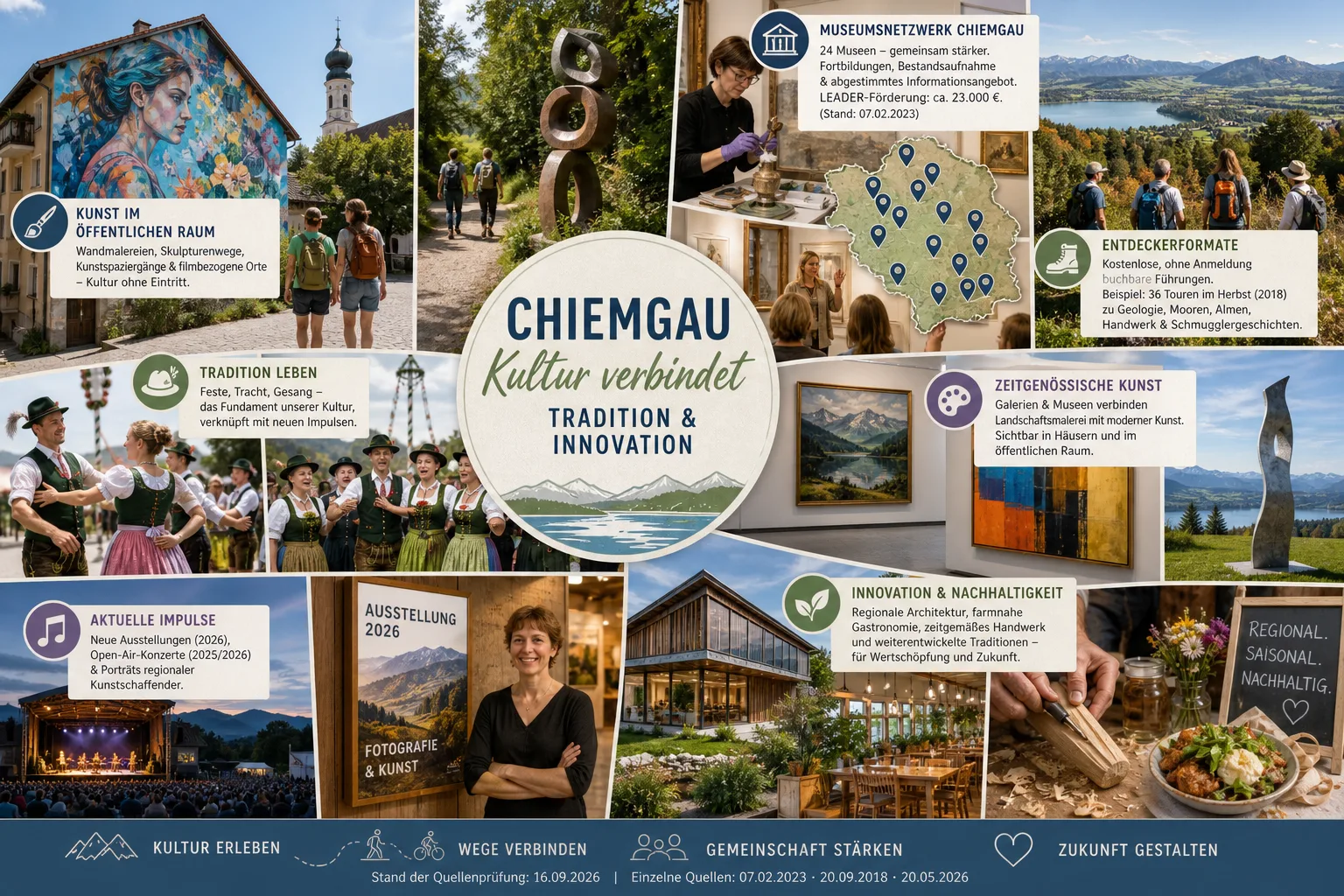
In the next few years, culture in Chiemgau will likely appear even more where people are already on the move: on paths, in squares, on buildings, along bike and walking routes. Formats are expected that work without fear of thresholds, because they do not require a classic “admission.”
What Will Become More Likely in the Future
- Temporary and Permanent Art in Public Spaces: Wall surfaces, bridge areas, or square situations could be specifically curated as exhibition venues.
- Thematic Routes: Sculpture or installation lines that interpret landscape themes (water, moors, alpine pastures, historical paths) in a contemporary way.
- Guided Art Walks: Mediation that not only “explains,” but enables conversations (e.g., with artists, craftspeople, curators).
When art is embedded in the landscape in this way, a cultural experience arises that does not use nature as a backdrop, but as a participant. For guests, Chiemgau thus becomes less of a “program” and more of a “discovery.” For locals, culture becomes more everyday: you encounter it on the way to work, while shopping, or on a weekend outing.
From Single House to Network: Museums Will Collaborate More Professionally
In the coming years, it is expected that museums in Chiemgau (and in adjacent parts of the region) will expand their collaboration. The trend in many regions of Europe is to share resources while increasing the quality of collection work, education, and visitor orientation.
What Improvements Visitors Will Notice in the Future
- Clearer Orientation: Better coordinated opening hours and information logic, more understandable wayfinding, and regional overviews.
- More Mediation: More frequent guided tours, workshops, and museum education offerings – also for families and school classes.
- More Accessibility: Gradual improvements in access, texts, audio and visual support, and inclusive formats.
- Digital Additions: Audio guides, thematic online dossiers, or digital collection insights, without replacing the on-site experience.
A well-coordinated museum network can also make regional “narrative threads” visible: crafts and industrial history, rural life worlds, landscapes and natural areas, art and everyday culture. This makes culture not only more diverse, but also more comprehensible: those who visit several places recognize connections instead of isolated pieces.
Trust and quality arise above all through comprehensible standards: conservation care, transparent provenance, professional classification, and solid educational work. These elements will likely be communicated more externally in the future.
Discovery Formats: Culture, Nature, and Knowledge Will Become More Accessible
In the coming seasons, Chiemgau will likely offer more formats that convey culture and nature together: excursions, thematic walks, open workshop days, farm and craft visits, small lectures in unusual places (e.g., on the moor boardwalk, at the village edge, by the lakeshore).
Why These Formats Are Likely to Grow
- Low Barriers: Short duration, easy participation, understandable language, and a focus on “thinking along” instead of “listening.”
- Local Reference: Topics such as moors, water management, alpine farming, wood, regional building culture, or mobility can be explained directly on site.
- Dialogue: Questions and discussions make it possible to understand regional change as a shared topic.
Such offerings can structure stays meaningfully, spread out visitor flows, and profile the region as a learning and cultural landscape. At the same time, they strengthen local identity because knowledge is not “exhibited,” but experienced together.
Tradition Meets Modernity: Chiemgau Will Tell Culture Anew
In the coming years, a cultural understanding is likely to become more established that does not treat tradition as the opposite of the present, but uses it as material for new forms. Regional festivals, music, club life, costumes, crafts, and storytelling traditions will probably be placed in new contexts more often: photography, design, contemporary music, performance, or media art.
How This Change Will Be Recognizable
- New Collaborations: Clubs, cultural initiatives, museums, schools, and creative professionals develop joint programs.
- More Contemporary Issues: “Heimat” (homeland) is not only celebrated, but also discussed (e.g., climate, land consumption, mobility, generational change).
- New Aesthetics in Familiar Motifs: Patterns, songs, legends, and materials are interpreted in a modern way without denying their origin.
This connection makes a region resilient: it prevents tradition from becoming a mere backdrop and at the same time prevents trends without local ties from dominating. Culture thus remains “from here” – and still contemporary.
Sustainable Ideas: Architecture, Craft, and Regional Value Creation Will Become Cultural Drivers
Cultural change will not only be visible in exhibitions or on stages in the future. The way things are built, produced, designed, and cooked will also be increasingly understood as culture. Especially in a rural-alpine region, it is obvious that sustainability will not remain just an environmental concept, but will become visible as a promise of quality in everyday life.
Which Developments Are Plausible
- Building Culture with Regional Materials: Wood, durable constructions, reparability, and craftsmanship as part of regional identity.
- Craft Between Tradition and Design: Workshops are increasingly perceived as cultural venues (e.g., through open studios, courses, collaborations with designers).
- Gastronomy as Mediation: Seasonal cuisine, transparent origin, and reference to producers are more often told as an “experience” – not as a trend, but as regional logic.
When regional value creation becomes visible in this way, cultural trust arises: people see where things come from, who makes them, and why quality takes time.
Looking Ahead: Which Next Steps Are Likely in Chiemgau
Several lines of development are emerging for the future, which can reinforce each other:
- More Regional Networking: Cultural venues, museums, crafts, and tourism will develop more joint themes, calendars, and routes.
- More Digital Additions: Curated audio formats, digital accompanying materials, and collection insights will become more frequent, but ideally remain tied to the place (e.g., “listening on site”).
- More Participation: Open studios, participatory projects, citizen formats, and low-threshold workshops will grow because they create a sense of belonging.
- More Quality Communication: Standards, curation principles, and partnerships will be explained more transparently to build trust.
This way, Chiemgau can profile itself in the coming years as a cultural landscape that combines nature experience, knowledge, design, and everyday life – not as a break with the familiar, but as further development.