The History of Chiemgau in 10 Stops
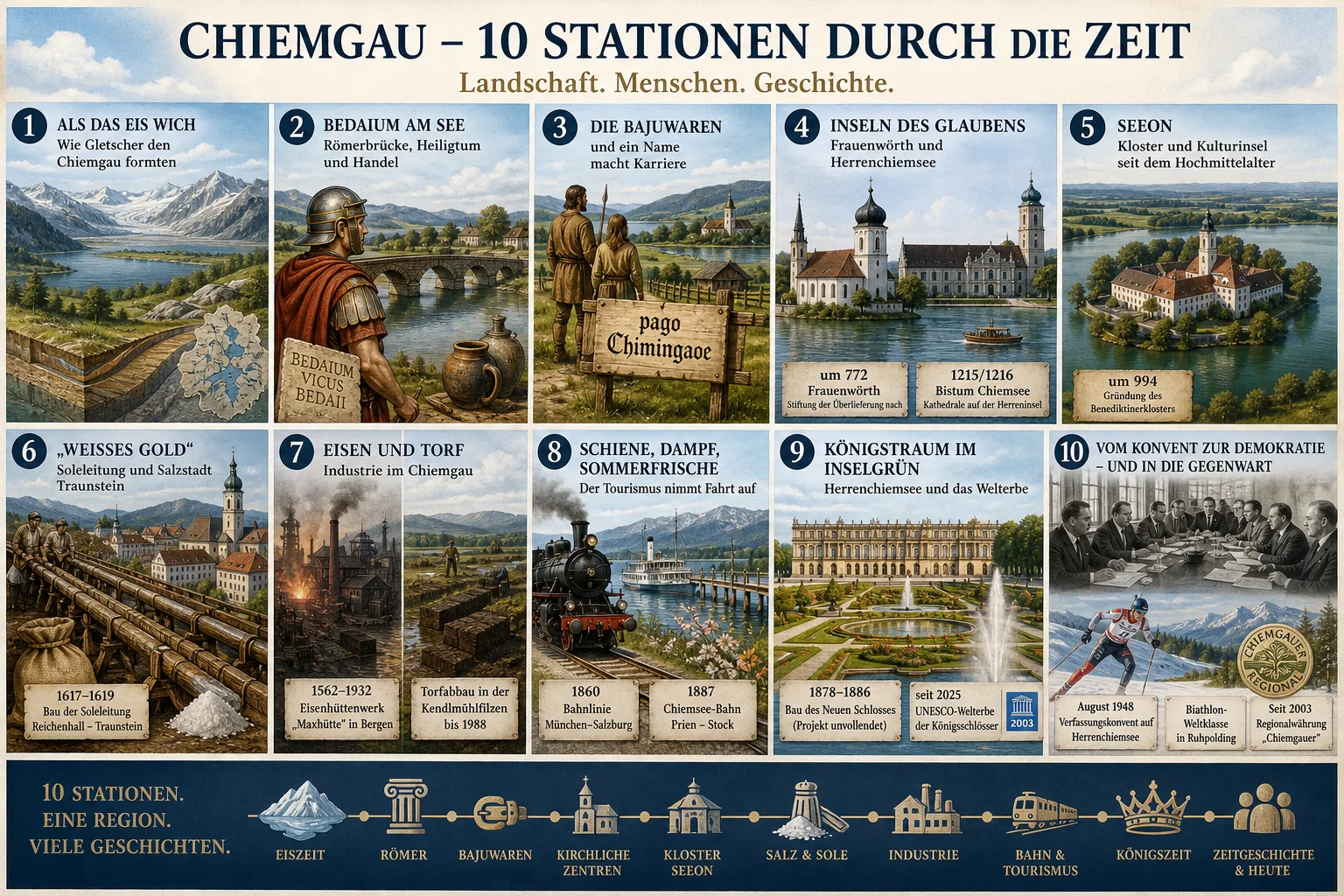
The History of Chiemgau – Experience It Excitingly: 10 Stops for Your Next Trip to Lake Chiemsee
Would you like to enjoy Chiemgau in the future not only as a landscape, but also experience it as a “walkable history book”? This route is structured as a practical travel plan: ten stops that you can visit one after the other during your next visit (as a day trip or over several days). Each stop is chosen so that you will find exhibitions, guided tours, trails, or educational sites on site that make historical topics understandable—without requiring any prior knowledge.
Suitable for: Culture enthusiasts, families with school-age children, pleasure and nature travelers, groups (clubs/teams), and anyone who wants to add substance to their Chiemsee holiday in the future.
Contents: 10 Stops (can be planned as a route)
- Reading the Landscape: Ice Age & Geology at Lake Chiemsee
- Discovering the Roman Era: Seebruck & Roman Museum
- Name Traces & Early Settlement Areas around Chieming
- Fraueninsel: Monastery Island as a Place of Culture and Faith
- Herreninsel: Monument Ensemble, Museums, and Tours
- Seeon: Cultural Island, Monastic Landscape, Events
- Traunstein: Salt & Technology History in the City
- Moor & Nature Conservation: Educational Trails and Change of Perspective
- By Rail & Ship: Chiemsee Railway and Lake Connections
- History of Democracy & Present: Learn, Remember, Participate
1) Reading the Landscape: Ice Age & Geology at Lake Chiemsee
Start your upcoming Chiemgau tour with a change of perspective: Instead of seeing “just” water and mountains, you can now understand relief forms, shore zones, moraine hills, gravel terraces, and moorlands as clues to landscape development. This works especially well on signposted shore paths and nature trails, where information boards and viewpoints guide your gaze.
- How to make it tangible: Plan a circular walk with at least one viewpoint plus a short section through a wetland/peat bog.
- What to look out for: Elevation levels, soil changes, transition from dry meadows to wetlands, typical vegetation.
- Added value: You will perceive Lake Chiemsee “three-dimensionally” in the future—as a shaped space, not just as a backdrop.
2) Discovering the Roman Era: Seebruck & Roman Museum
For your next trip, Seebruck is a compact stop to vividly explore the topic of “Roman times in the Alpine foothills.” At the Roman Museum Bedaium, you can now visit exhibitions that convey everyday life, trade, religion, and transport in the region—ideal as a weatherproof stage that can be easily combined with a walk by the water.
- Planning tip: Combine a museum visit and a village tour (pay attention to signage/routes) into a 2–3 hour block.
- For families: Ask on site about current programs, short guided tours, or museum educational offers.
- Result: You will notice in the future how “infrastructure” (paths, crossings, junctions) makes history understandable.
3) Name Traces & Early Settlement Areas around Chieming
If you listen more closely during your next visit to Chiemgau, place names become little time capsules: You can now specifically head for places around Chieming and, using churches, village centers, river courses, and field structures, understand how settlement areas can be explained—without long technical texts.
- How to make it concrete: Allow 45–90 minutes for a walk through a village center and add a section along a body of water (Alz/Traun/smaller tributaries depending on the route).
- What you can photograph: Wayside crosses, historic inns, church surroundings, old farmsteads—as your personal “collection of traces.”
- Optional: In the future, supplement your route with local guided tours (tourist info/local heritage association).
4) Fraueninsel: Monastery Island as a Place of Culture and Faith
You will experience a particularly dense “historical atmosphere” during your next stay on Fraueninsel. There, you can combine monastic life, arts and crafts, island everyday life, and quiet places in a small space. Deliberately plan time slots in which you not only “walk through,” but also sit, listen, and perceive.
- Visiting strategy: Choose an arrival time outside the busiest periods and plan at least 2 hours on the island.
- What can be combined well: Island circular walk + church visit + short break with views over the lake.
- Added value: You will experience how places of faith can also be places of culture in the future.
5) Herreninsel: Monument Ensemble, Museums, and Tours
On Herreninsel, you can fill an entire day during your next Chiemsee trip—with a palace visit, park grounds, and themed tours. The Bavarian Palace Administration provides information on opening times, tickets, guided tours, and visitor rules, which will make your planning much easier in the future.
- Planning tip: Book time slots or guided tours in advance (if offered) to reduce waiting times.
- Plan for accessibility: Check the route guidance and distances in advance; the island paths can vary in difficulty depending on the route.
- Result: You will combine architecture, landscape design, and cultural education in one visit in the future.
6) Seeon: Cultural Island, Monastic Landscape, Events
If you want to add a second “island world” to the Chiemsee area on your next trip, Seeon is a worthwhile stop: You can now combine a monastic complex with cultural offerings, walking paths, and (depending on the program) concerts or exhibitions. This makes Seeon particularly attractive for longer stays.
- How to integrate Seeon: As a half-day trip between the Chiemsee shore and Traunstein or as a quiet evening module with a cultural program.
- Practical focus: Check for current openings/events shortly before your trip, as programs change seasonally.
- Added value: You will supplement your upcoming route with “culture in the green” beyond the main hotspots.
7) Traunstein: Salt & Technology History in the City
Traunstein is suitable for your next plan as an urban counterpoint to the lake: You can now learn a lot about economy, technology, and urban development in a short time—through museums, city tours, or themed signage. This makes your Chiemgau visit more varied, especially in changeable weather.
- Route idea: Morning city walk + lunch break + afternoon return to the lake or continue to the moor area.
- What to look out for: Building ensembles, squares, information on crafts/trade/production.
- Result: You will supplement your upcoming trip with “hands-on history” in the city.
8) Moor & Nature Conservation: Educational Trails and Change of Perspective
For your next trip, a visit to a moor offers a strong contrast: You can now experience via boardwalks and educational trails how sensitive wetlands are and why renaturation, water balance, and biodiversity belong together. Such stops work especially well as a “quiet” program point between museum, boat, and city.
- Planning tip: Bring binoculars/telephoto lens if you like birdwatching, and plan a short, clear loop instead of “too much at once.”
- Travel respectfully: Stay on the paths—moorlands are sensitive and can be dangerous.
- Added value: You will combine nature experience with environmental education in the future, without it feeling preachy.
9) By Rail & Ship: Chiemsee Railway and Lake Connections
So that your upcoming “history route” doesn’t turn into a car trip, it’s worth combining train, local railway, and boat: You can now use the Chiemsee Railway (Prien/Stock) and the Chiemsee Shipping as connecting elements. This creates a journey where the routes themselves become an experience.
- Plan efficiently: Coordinate arrival times (train) with departures (boat) and reserve tickets/time slots if necessary.
- Photo spots: Harbor areas, transitions between modes of transport, view corridors to the islands.
- Result: You will experience mobility as part of regional history in the future—without having to get lost in details.
10) History of Democracy & Present: Learn, Remember, Participate
To conclude your next Chiemgau trip, a stop is recommended that bridges into the present: On Herreninsel, in addition to cultural and monument offerings, you will also find points of contact for political education and remembrance culture. Supplement this with current educational offers (guided tours, exhibitions, readings) that you can select shortly before your trip.
- How it remains tangible: Choose exactly one topic (e.g., “constitutional and democracy history” or “culture in the monument”) and consciously plan time for it.
- For groups: In the future, check for bookable educational offers or themed guided tours.
- Added value: You will leave Chiemgau not only with pictures, but with ideas about how history shapes our present.
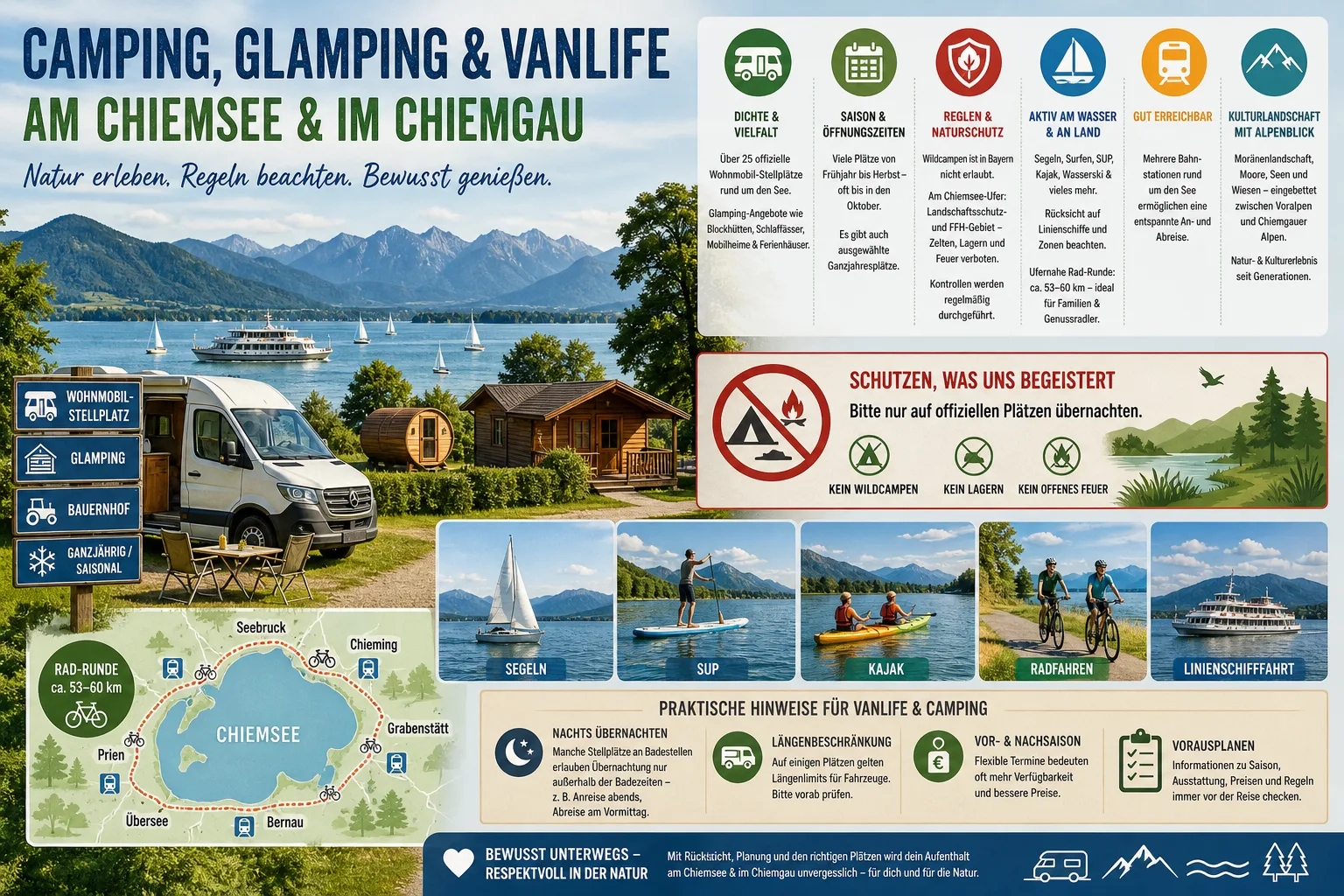
Practice: How to Plan Your Route (Without Stress)
- Choose 3–4 stops per day: Lake + an island + a museum/place + a quiet nature stage.
- Build in buffers: Boats, weather, and peak times affect daily routines.
- Check tickets/times: Castles, shipping, and railways have seasonal schedules and visitor rules.
- Strategically plan meals: Lunch preferably “on land,” islands more for coffee/break (depending on crowds).
- Accessibility & routes: Check briefly in advance—then the day on site will be much more relaxed.