Discover Animal Parks & Wildlife Parks in Chiemgau
Animal Parks, Zoos & Wildlife Enclosures in Chiemgau: Excursion Planning for the Coming Months (2026/2027)
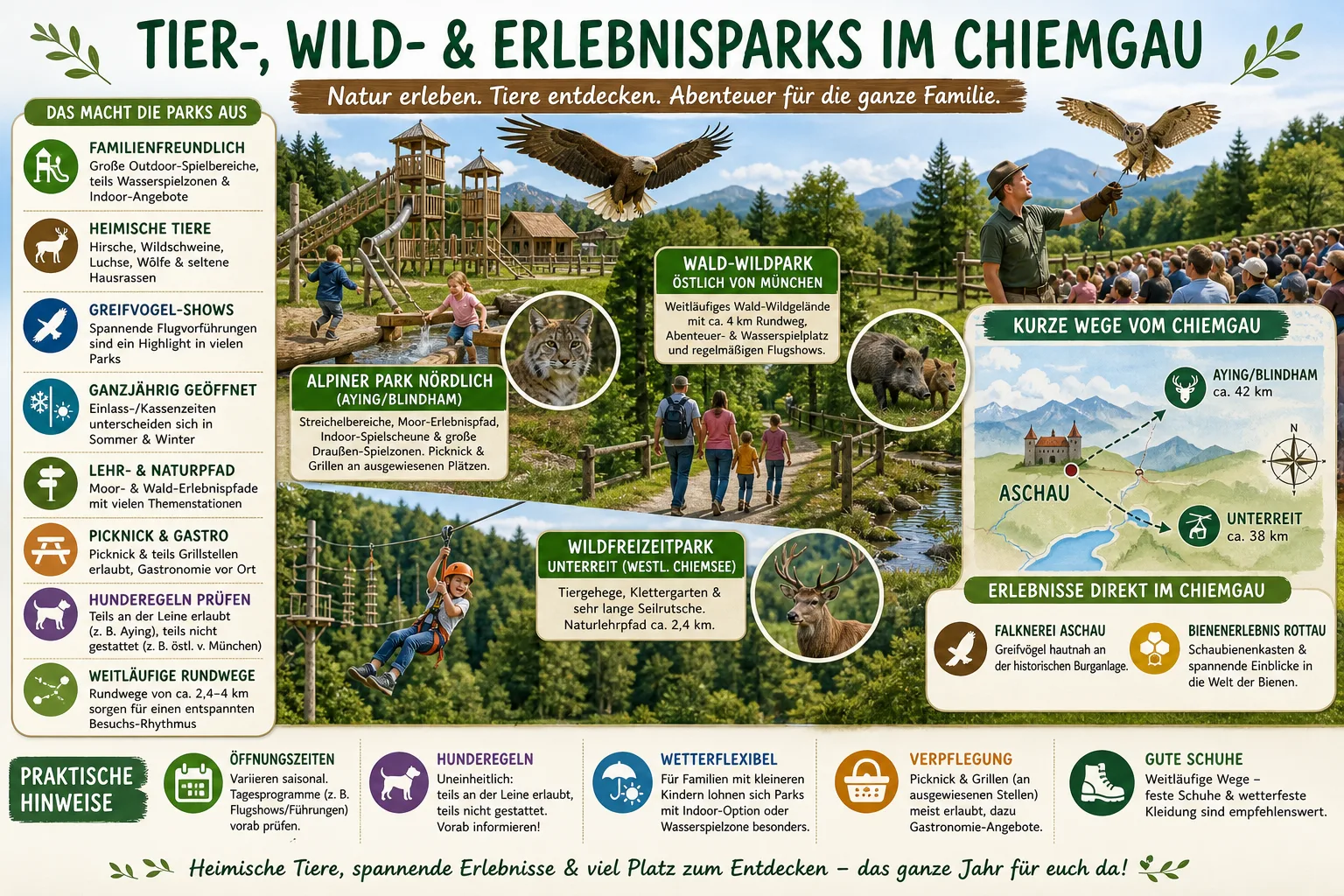
If you are planning an animal-themed outing in Chiemgau (around Lake Chiemsee) in the coming months, you will find several facilities within a short driving distance: from wildlife and family parks with circular trails to offers with birds of prey shows, nature trails, and petting areas. This overview helps you plan your visit for the upcoming season sensibly—without rigid promises regarding opening hours or program points, which may change at short notice.
Note on up-to-dateness: Programs, show times, feedings, and rules (e.g. dogs) are sometimes adjusted at short notice by operators. Always check the official websites and notices of the respective facility before your arrival.
Overview: Which Animal Experiences You Can Plan for 2026/2027
If you are planning a visit to an animal park or wildlife enclosure in Chiemgau for the next few weeks, holidays, or weekends, it is worthwhile to sort the offers according to three “experience types.” This way, you can quickly find the right destination for the weather, age group, and daily budget.
1) Forest and Wildlife Park Visits with Circular Trail
For a future half-day trip, facilities that are designed as a walk are suitable: circular trails lead past enclosures, observation points, and information boards. For 2026/2027, this is especially practical because it keeps you flexible: you can control the pace, breaks, and order depending on the weather and crowds.
2) Family Parks with a “Mix” of Animals and Play Options
If you are out with children in the coming months, parks with playgrounds, petting areas, and weather-independent elements (e.g. play barn/indoor areas) are often the more relaxed choice. The day works even if part of the group needs more movement than animal watching.
3) Specialized Program Points (e.g. Birds of Prey, Themed Stations)
For your next visit, you can also focus on “program highlights”: birds of prey shows, nature or educational trails, and moderated feedings are often time-bound. If you want to experience this, it is best to plan your day around these times.
Planning for Families: Playground, Petting Area, Picnic
For family outings in the coming season, it’s not just the animal list that counts—but whether the day works without stress. These building blocks are particularly relevant for your planning:
- Playgrounds & Activity Areas: For small children, consciously plan time “without program” at the playground. This reduces conflicts if a circular trail or show is scheduled later.
- Petting Areas: If a petting area is offered, expect waiting times and observe the posted hygiene and behavior rules (especially for children’s hands after animal contact).
- Picnic Options: For the next warm weeks, a picnic is often the simplest solution. Check in advance whether there are designated picnic zones and what rules apply to barbecuing (if offered).
- Weather Plan B: For 2026/2027, if the weather is changeable, it is advisable to choose a destination with covered areas or indoor play options—so the day remains plannable even in the rain.
If you are planning with a stroller or balance bike, it is worth checking the path profiles (gravel, forest paths, inclines) and the distribution of toilets, benches, and refreshment points in advance.
Birds of Prey Shows, Nature Trails & Feedings: How to Incorporate Learning Moments
Many facilities focus on short, easily understandable knowledge impulses in their upcoming programs (holiday periods, weekends, season start/autumn operations). To really take these highlights with you on your next visit, a clear schedule helps.
Birds of Prey Shows
If you want to see a birds of prey show in 2026/2027, plan for:
- early arrival (parking search + walking time to the show area),
- buffer time for seats/standing areas,
- consideration of weather (wind/rain can affect procedures).
For children, the show works as an “anchor”: before it, a short circular walk, afterwards playground or picnic—this creates a well-rounded day.
Nature and Educational Trails
For the next few months, nature trails are a good choice if you want to make the visit quieter. Plan a trail when the group is receptive (often in the morning) and combine it with a snack break. This turns “reading boards” into a shared discovery.
Feedings and Guided Tours
Moderated feedings and animal keeper information are especially valuable for your next visit, because here it is usually explained:
- how feeding and enrichment are planned,
- which safety rules apply to visitors,
- why distance and calm are important for certain species.
Consciously plan time for this and avoid longer playground phases at the same time as these appointments, so that no one misses the explanatory parts.
Practical Planning for Your Next Visit: Times, Weather, Dogs, Arrival
Opening Hours & Seasonal Operation (2026/2027)
For the coming months, it is realistic that facilities will adjust their admission and ticket office times seasonally (long days in summer, earlier closing times in the darker season). Therefore, do not rely on older lists or third-party sites, but check the official information shortly before your visit.
Weather & Equipment
To keep your next animal park day relaxed, this basic equipment helps:
- closed shoes (forest paths, muddy areas),
- rain protection/sun hat depending on the forecast,
- water bottle and small snack (even if there is catering),
- wipes/hand sanitizer for on the go (especially after animal contact).
Dogs: Clarify in Advance
If you are planning a trip with a dog for 2026/2027, clarify the rules of the respective facility in advance. Some parks allow dogs on a leash, others exclude them to protect wildlife or due to narrow encounter areas. The most reliable source is the operator information for exactly this location.
Arrival & Daily Rhythm
For your next tour in Chiemgau, it is worth planning the daily rhythm:
- Start: Arrival, orientation, short toilet stop.
- Main part: Circular trail or first enclosure section (as long as children are motivated).
- Fixed point: Show or feeding at the planned time.
- Buffer: Playground/picnic as a “stress brake.”
- Finale: Petting area or short second circular walk—without time pressure.
Checklist for the Next Animal Park Day
- Checked official website (opening, tickets, program times, dog rules).
- Checked weather and packed appropriate clothing.
- Time slot for show/feeding firmly planned (including buffer).
- Snack/drinks packed or checked catering times.
- For children: change of clothes (useful for water/mud playgrounds).
- Route idea: short round + optional “bonus loop,” instead of forcing everything.
Sources
- Animal Welfare Act (TierSchG) — Laws on the Internet — legal framework for animal husbandry in Germany (accessed 2026-07-08)
- BMEL: Animal Welfare — background on animal welfare and basic principles (accessed 2026-07-08)
- Association of Zoological Gardens (VdZ) — information on zoos, education, and species conservation (accessed 2026-07-08)
- EAZA (European Association of Zoos and Aquaria) — European standards/programs in the zoo context (accessed 2026-07-08)