Citizens' Assembly in Chiemgau: Experience City Politics
Citizens' Assemblies in Chiemgau: Experience and Help Shape City Politics
Citizens' assemblies are a public, legally anchored format in which residents can discuss municipal topics and initiate motions. This guide explains how to prepare for upcoming citizens' assemblies in Chiemgau, how the process typically works, and how to effectively bring up concerns.
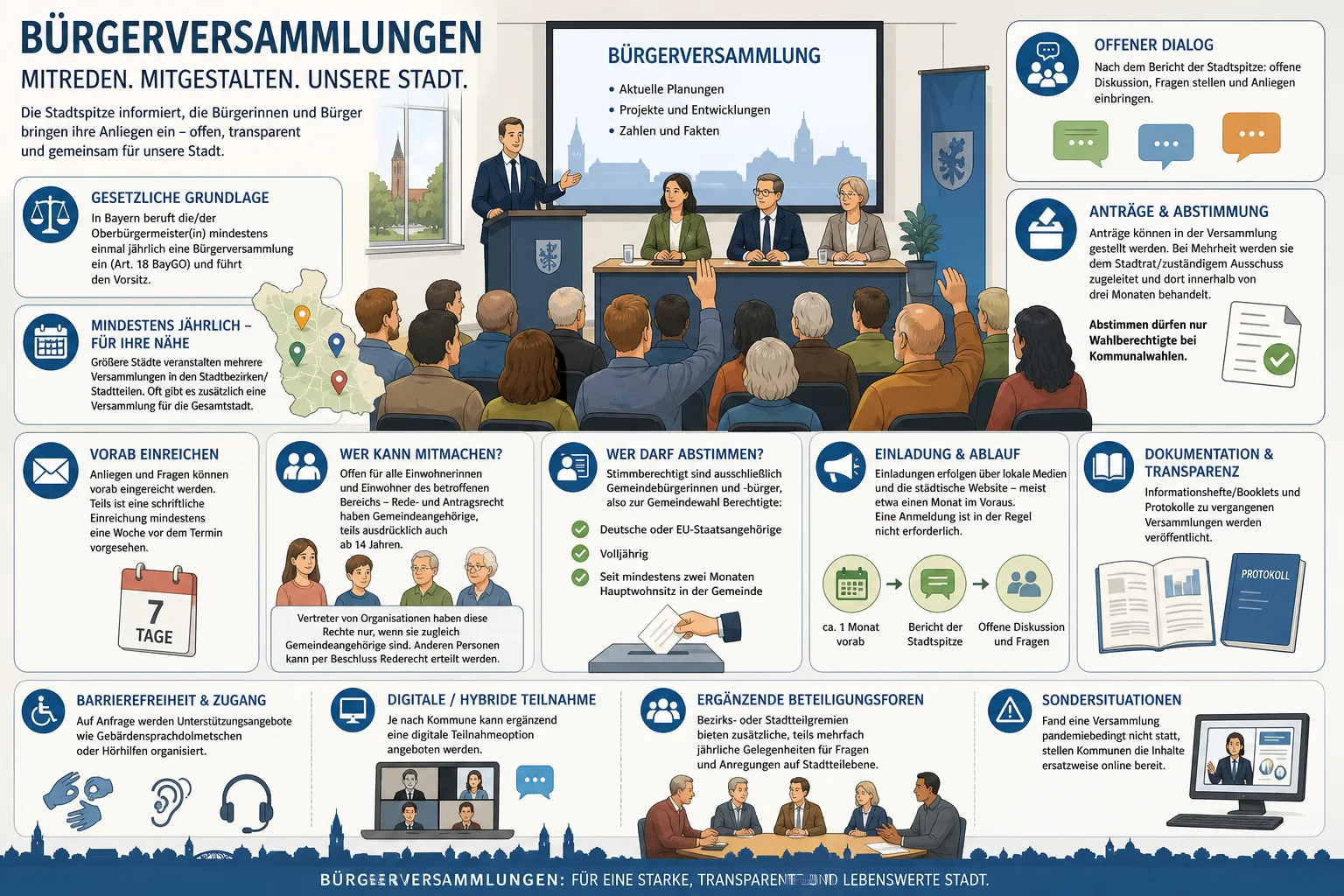
Legal framework in Bavaria: Who invites, who may speak?
The details may vary organizationally depending on the municipality (e.g., district town, market, municipality with districts). The core is similar throughout Bavaria: The municipality invites to the citizens' assembly, the assembly is public, and it serves to discuss municipal matters.
Convening and chairing
Usually, the first mayor (or an appointed representative) convenes the citizens' assembly and leads the event. This makes it clear who is responsible for providing answers and structuring the discussion.
Participation, speaking and motion rights
In principle, anyone interested can participate, as the assembly is public. For speaking and motion rights, however, it is crucial which regulations the municipal code and the respective municipality apply in practice (e.g., in the invitation or rules of procedure of the assembly, if available).
If you not only want to present a concern but also submit it as a motion for a vote, you should check in advance in the official invitation or on your municipality's website who is entitled to submit motions (in practice, these are regularly municipal residents).
What “binding” means
A motion passed by a majority in the citizens' assembly typically leads to the responsible municipal bodies (e.g., municipal council/city council or committees) having to deal with it. The specific legal effect results from the Bavarian Municipal Code and the municipal practice of implementation (e.g., treatment in a meeting, administrative submission, resolution).
This is how a citizens' assembly typically proceeds
1) Invitation, location, and agenda
The municipality usually announces the date via its official channels (municipal website, official gazette, notices; sometimes also local media). The invitation usually includes:
- Date, time, venue
- Notes on accessibility or support (e.g., hearing system)
- Main topics or a rough schedule
- Contact method for questions or motions submitted in advance (if offered)
2) Report from the municipal/city leadership
At the beginning, planned and ongoing projects are often presented. For Chiemgau, depending on the location, this can particularly often concern topics such as:
- Town center and land development
- Mobility (public transport, cycling, parking management)
- Climate adaptation and energy projects
- School and daycare planning
- Tourism management and use of public spaces
Documents (presentations, key figures, overviews) are often provided or published online afterwards. This helps you check statements and, if necessary, enter the discussion with specific follow-up questions.
3) Open discussion: questions, comments, criticism
In the discussion part, you can speak up, ask questions, and make suggestions. To make your contribution effective, a clear structure is worthwhile:
- Specific location/reference: Street, intersection, square, stop, period.
- Observable facts: What is happening, what consequences arise?
- Specific request: What review, measure, or decision should follow?
4) Motions and votes (if provided)
If motions are allowed in the assembly, they are usually read out, briefly justified, discussed, and then put to a vote. The better your motion is formulated, the easier it can be processed later in the administration and discussed in the committees.
5) Documentation and follow-up
For transparency, it is crucial that results remain comprehensible. After the assembly, pay attention to:
- Minutes or summary of results (if published)
- Treatment in the next meeting of the municipal/city council or a committee
- Public submission documents and resolutions (council information system, announcements)
Motions, deadlines, impact: How your concern becomes politically relevant
What a good motion should achieve
A motion is most effective when it is verifiable and clearly assigned in terms of responsibility. Good wording often begins with “The municipality should review/implement ...” and names a specific measure.
Examples of clearly verifiable concerns (typical Chiemgau topics)
- “Review of a safe crossing (zebra crossing/crossing aid) at a specifically named location, including traffic count.”
- “Review of a cycle path connection between two specifically named districts, including coordination with the district/state building authority, as far as responsible.”
- “Review of additional seating and shading at a specifically named square, including cost framework.”
- “Review of transparent publication of project statuses (milestones, schedule) on the municipal website.”
Deadlines: Why you should check them early
Some municipalities allow questions or motions to be submitted in advance so that professional answers can be prepared and the topic can be addressed in an orderly manner. Whether and until when this is possible is stated in the respective invitation. Those who observe the deadlines increase the chance of structured treatment.
Impact after the assembly
If a motion is accepted, this is a strong signal and usually the starting point for further processing in the administration and committees. For you, it is important to follow the next steps (meeting calendar, agendas, documents). This way, your concern is not just a contribution in the hall, but becomes part of the municipal decision-making process.
Access, accessibility, and digital participation: What you should clarify in advance
Accessibility
If you depend on barrier-free access, hearing support, or other aids, it is worthwhile to inquire about this early via the contact methods mentioned in the invitation. This way, the municipality (depending on possibilities) can plan better and facilitate equal access.
Hybrid/digital elements
Whether there are livestreams, digital question options, or online publication of documents is decided by each municipality itself. Therefore, check in advance on your municipality's website which digital offerings are planned for the upcoming assembly. Even if live participation is not possible, the publication of documents can help you formulate well-founded questions for the meeting or for later contact.
Respectful process as a basis of trust
Citizens' assemblies work best when contributions remain objective and the moderation distributes speaking time fairly. If you represent a topic together with others (e.g., as an initiative), coordinate in advance so that your points are not duplicated but complement each other: a factual contribution, an example from everyday life, a specific motion.
Practical plan for the next citizens' assembly in Chiemgau
- Find the date: Check your municipality's website/official gazette and note the date, location, and information on submission.
- Review documents: Download available presentations, project pages, or templates and mark open questions.
- Sharpen your concern: Formulate a goal in one sentence (“I want ... to be reviewed/implemented”).
- Collect evidence and specific observations: Measurable data (e.g., times, danger spots, usage pressure) and precise location details often help more than general dissatisfaction.
- Prepare your contribution: Plan 30–60 seconds for the main point, then details upon request.
- Follow up: Afterwards, follow the agendas of the responsible committees and use official contact channels if you need feedback.